
Introduction
Getting a payload into the mesosphere reliably is still one of the harder problems in aerospace. This atmospheric layer, roughly 50 to 85 kilometers up, sits too high for balloons and aircraft but too low for most satellites to sample directly.
That gap is exactly where Green Launch has focused its hydrogen light-gas propulsion work. Its documented history shows a slow, methodical build toward vertical flight.
This article reviews Green Launch's latest publicly supplied milestone: the company's 2022 first vertical light-gas launch for space access. It does not announce a new launch date, payload, altitude, or orbital result. Those claims aren't supported by the available record as of this writing.
Here's what we'll cover:
- Why the mesosphere is tough to access
- Green Launch's timeline from 2017 testing through the 2022 vertical launch
- What that milestone technically demonstrates
- Evidence to require before treating future updates as operational readiness
Key Takeaways
- Green Launch's latest reported milestone is a 2022 first vertical light-gas launch for space access, after a December 21, 2021 test.
- Development path includes a 2017 Yuma Proving Ground testing contract and 12 successful horizontal test firings in 2018.
- One vertical launch shows engineering progress, not orbital capability, launch cadence, or commercial readiness.
- Scrutinize future updates for repeatable testing, measured performance, payload survivability, and independent reporting.
What Is the Mesosphere and Why Does It Matter to Launch Programs?
The mesosphere sits above the stratosphere and below the thermosphere. NOAA places its boundaries at roughly 50 to 85 kilometers, while NASA uses a slightly different range of about 50 to 80 kilometers. Exact boundaries shift depending on the agency's convention.
The layer's general position doesn't change, though: it's the coldest region in Earth's atmosphere, with temperatures near the mesopause averaging around -85°C (-121°F).
A Layer Full of Activity, Hard to Reach
Despite the extreme cold, the mesosphere remains highly active:
- Most meteors burn up here, creating visible streaks
- Noctilucent clouds, ice-particle clouds around 50 to 86 km high, form at high latitudes in summer
- Winds, temperature swings, and atmospheric chemistry shift with solar activity and season
- Long-term data shows measurable cooling trends in parts of the mesosphere, tied partly to CO2 and ozone-related changes
None of this is easy to study directly. Balloons and aircraft can't climb high enough, and satellites orbit well above it. That leaves sounding rockets and short-duration vertical flights as some of the only tools capable of sampling the mesosphere directly.
Why This Matters for Launch Programs
Mesosphere research feeds directly into practical aerospace problems: atmospheric modeling, satellite drag calculations, communications planning, and re-entry analysis. A launch vehicle simply passing through the mesosphere on its way to higher altitudes is not a dedicated sampling mission. Transit is atmospheric passage. Sampling requires instrumentation and a payload built to collect data at that altitude. Green Launch has identified that sampling work as a target application, not a completed mission.
Green Launch's Program Milestones: From Testing to Vertical Launch
Green Launch's documented history moves through a handful of clear stages, each building on the last.
| Date | Event | What It Demonstrates | What Remains Unconfirmed |
|---|---|---|---|
| 2017 | Testing contract signed with Yuma Proving Ground | Formal access to a government test range | Specific test objectives beyond general propulsion validation |
| Dec 2017–Mar 2018 | 12 successful horizontal test firings | Repeatable horizontal propulsion firing | Structural-load and instrumentation-specific test goals |
| Nov 2020 | Horizontal shot reaches 2.03 km/sec | Continued velocity progress | Independent measurement verification |
| Dec 21, 2021 | Shot 28: first vertical launch, estimated 30 km altitude | Transition from horizontal to vertical flight | Radar didn't track the projectile; altitude is estimated, not measured |
| Jan 13, 2022 | Public announcement: first vertical light-gas launch for space access | Company confirms and frames the milestone | Described by Green Launch itself as a "proof of concept" |
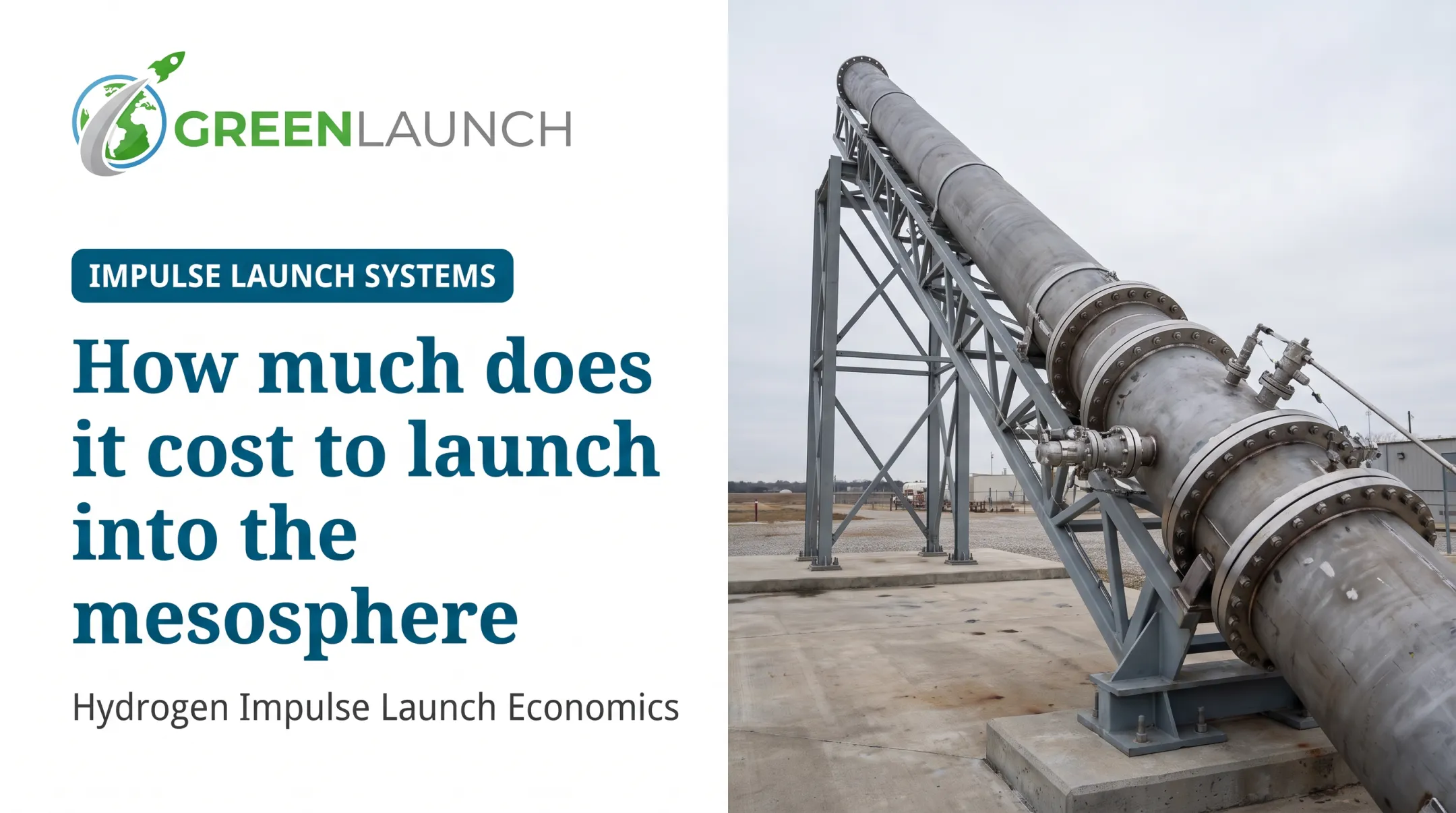
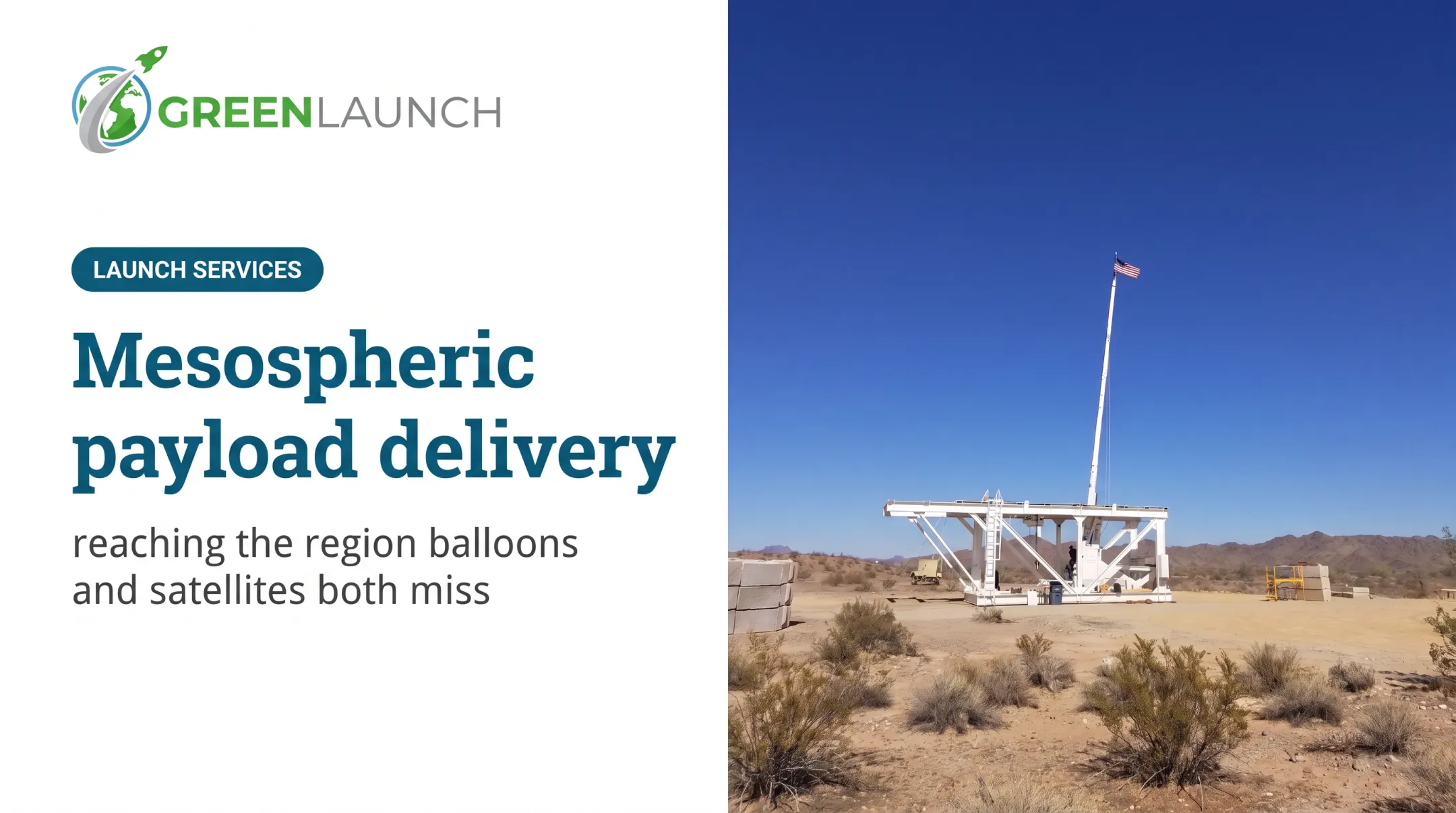
Shot 28 used a 54-foot launch tube at the KOFA test range at Yuma Proving Ground to send a 28-pound steel-and-tungsten projectile beyond Mach 3.
The U.S. Army's own reporting on the test confirms the event and describes it as the first vertical gas-gun firing at Yuma Proving Ground. CTO Dr. John Hunter estimated 30 to 40 kilometers at the time.
That figure is a contemporaneous estimate, not radar-confirmed. Green Launch's own account notes radar did not capture the projectile at all.

Why Horizontal Testing Mattered First
Horizontal firings typically help validate propulsion behavior, control response, structural loads, and instrumentation under repeatable conditions. Green Launch's 12-shot series in early 2018 varied gas-charge pressures, projectile weight, and resulting velocity, which the company says showed consistent light-gas propulsion performance under field conditions.
The Jump to Vertical
Moving from horizontal to vertical flight isn't a minor tweak. It changes:
- Trajectory and gravity loading - the vehicle now fights gravity through the entire flight path
- Guidance and tracking - a meteorological balloon measured winds aloft to keep the December 2021 projectile within range boundaries
- Range safety - the launch tube's 71-degree azimuth had to be checked against Yuma Proving Ground's Surface Danger Zone by ballistic experts
- Payload handling - a 79-degree elevation and tensioned support cables replaced the horizontal setup entirely
That is a different engineering problem. Completing the transition matters even when altitude is estimated rather than radar-confirmed.
The Propulsion Background Behind It
Green Launch's technical direction traces back to Dr. John W. Hunter's work on the Super High Altitude Research Project (SHARP) at Lawrence Livermore National Laboratory. SHARP built the world's largest hydrogen gas gun in 1992 and launched nine scramjets at velocities up to Mach 9.
That experience informs Green Launch's approach. It does not imply government endorsement; SHARP was a separate, publicly funded research program.
What the Light-Gas Launch Milestones Mean Technically
A light-gas launch system uses a low-molecular-weight gas, typically hydrogen, to push a projectile to speeds that conventional propellants struggle to reach. Green Launch's design uses a 54-foot launch tube and, per its own descriptions, a hydrogen-based mixture rather than a solid or liquid rocket propellant for this stage of testing.
Why Hydrogen and Oxygen
The company frames its hydrogen-oxygen approach around two goals: cost and sustainability. Green Launch estimates its fuel cost at roughly $200 per pound, compared with about $5,000 per pound for rocket fuel. That figure is the company's own estimate, not an independently audited cost analysis.
Its environmental comparison is also self-reported. It contrasts water-vapor byproducts with the CO2 output of RP-1 and methalox rocket fuels. These remain stated goals, not third-party-verified performance data.

Engineering Questions a Vertical Launch Raises
One successful vertical shot answers some questions and opens others:
- Propulsion consistency — whether the same velocity can be reproduced shot after shot
- Thermal and aerodynamic loads — how the vehicle handles heating and drag at higher speeds
- Telemetry — Shot 28's radar did not track the projectile, so altitude was estimated rather than measured
- Recovery and termination — no recovery operation or guidance-system change is documented for this test
None of these gaps are unusual for an early-stage vertical test. But they're exactly why one demonstration, however meaningful, doesn't equal operational readiness.
Before treating a light-gas system as commercially viable, look for:
- Repeated vertical launches with consistent, measured (not estimated) results
- Payload survivability data under actual launch loads
- Documented turnaround time between launches
- Independent test reporting beyond company-published updates
Suborbital Research vs. Conventional Rockets
Light-gas systems and conventional rockets solve overlapping but distinct problems. A light-gas launcher can deliver a burst of initial velocity cheaply and quickly, which suits small, acceleration-tolerant payloads well.
It is not built to replace rockets across every mission type. Orbital insertion still typically needs an onboard rocket stage for the remaining velocity, since a ground-based launcher alone cannot circularize an orbit.
Why Mesosphere-Related Launch Capability Could Matter
High-altitude and suborbital access has real, established use cases. NASA's sounding rocket program is a good reference point: the agency's FY2024 program recorded 17 launches with a 94% success rate across geospace science, solar physics, and astrophysics. That's the kind of track record that builds operational credibility over time.
Where This Fits Green Launch's Target Customers
Green Launch maps lower launch costs, sustainable propellant, and high-altitude payload delivery to specific customer needs:
- Aerospace and defense organizations evaluating hypersonic testing platforms
- Satellite manufacturers looking at small-payload, CubeSat-class delivery options
- Scientific research organizations interested in atmospheric sampling, including a stated near-term interest from the National Science Foundation for mesosphere data collection
These are the company's claimed advantages and stated customer interests, not independently confirmed contracts.
How Buyers Actually Evaluate This
Organizations comparing launch providers typically weigh:
- Mission profile and required altitude
- Payload mass and acceleration tolerance
- Schedule and launch cadence
- Safety case and regulatory status
- Total program cost versus conventional alternatives
Where Light-Gas Systems Have Trade-Offs
Compared to conventional sounding rockets, a ground-based light-gas system may offer lower per-launch cost and faster turnaround for small, rugged payloads. It still faces real limits:
- Payloads must tolerate very high acceleration at launch
- Atmospheric drag affects lower-altitude trajectories more
- Reaching orbit, not just suborbital altitude, still needs onboard propulsion

These aren't flaws unique to Green Launch. They're inherent trade-offs of the approach.
Current Program Status and What to Watch Next
Here's the honest state of the public record: Green Launch's documented history runs through the December 21, 2021 test and the January 13, 2022 announcement of the first vertical light-gas launch.
A more recent archive entry, dated October 2025, references continued exploration of velocity limits, reporting 2.97 km/sec, or roughly Mach 9, from a one-stage combustion system.
That's useful context, but it doesn't specify a new vertical launch, altitude achievement, customer mission, or regulatory milestone. Treat it as a sign of continued testing, not a confirmed new flight record.
What to Verify Through Primary Sources
Before assuming Green Launch has moved past its 2022 proof of concept, check for:
- Additional vertical test results with measured, not estimated, altitude
- Repeatability data across multiple launches
- Payload demonstrations, especially any active sensor packages
- Range or site approvals beyond the existing Yuma Proving Ground arrangement
- Named partnerships with defense, satellite, or research customers
Test Milestone vs. Operational Capability
Use precise terms when reading program updates:
- Test milestone: the system worked once, under specific conditions
- Technology demonstration: a capability functioning toward a defined goal
- Commercial service announcement: a paying customer has booked a mission
- Operational launch capability: predictable, repeatable schedule performance
Green Launch's 2022 update falls into the first category, and the company's own "proof of concept" language backs that up.
A Quick Checklist for Assessing Future Updates
When Green Launch or any similar company announces a new milestone, verify:
- What launched, and from where
- Payload type and mass
- Altitude or speed (measured vs. estimated)
- Regulatory authority covering the test
- Whether independent sources corroborate the claim
Aerospace, defense, satellite, and atmospheric research teams can reach out to Green Launch directly to discuss mission requirements and current testing status. That conversation does not imply specific availability, launch dates, or guaranteed performance.
Green Launch's next real test isn't another single launch. It's proving that vertical flight, measured performance, and mission-relevant payload delivery can happen repeatably, not just once.
Frequently Asked Questions
What is the mesosphere and what happens there?
The mesosphere sits above the stratosphere and below the thermosphere, roughly 50 to 85 kilometers up. Most meteors burn up here, and noctilucent clouds form here too, along with shifts in mesospheric winds and chemistry.
Is the mesosphere the coldest layer of Earth's atmosphere?
Yes, its upper boundary is generally the coldest region in Earth's atmosphere, averaging around -85°C. Exact temperatures vary by altitude, season, and latitude.
Do any planes fly in the mesosphere?
No. Conventional aircraft can't climb anywhere near mesospheric altitudes. Sounding rockets and some spacecraft can pass through the layer during ascent or re-entry.
Which atmospheric layer has no clouds?
The thermosphere, roughly 80 to 700 kilometers up, has no conventional weather clouds. It still shows other phenomena, such as auroras, so it isn't without visible activity.
What is Green Launch's latest documented mesosphere-related milestone?
Green Launch's latest documented milestone is its first vertical light-gas launch for space access in 2022, based on a December 2021 test. Check the company's official channels for any newer updates.
How does light-gas launch technology relate to mesosphere research and access?
Light-gas systems aim to generate high launch velocities that could support high-altitude or suborbital missions, including atmospheric sampling. Whether a specific mission reaches the mesosphere depends on verified altitude, payload design, and trajectory data.