
Introduction
The commercial space industry is experiencing explosive growth. In FY2024, the FAA licensed 148 operations—a 30% year-over-year increase—and 2025 saw 205 licensed operations, far exceeding agency forecasts. From satellite manufacturers to novel propulsion companies like Green Launch, every launch begins with a legal checklist that operators cannot afford to ignore.
Operators face real, compounding challenges before a single payload leaves the ground:
- Multi-agency oversight spanning the FAA, FCC, and Department of Commerce
- Licensing timelines averaging 151 days—sometimes exceeding the statutory 180-day limit
- Liability exposure requiring millions in financial responsibility coverage
- International treaty obligations that make federal authorization mandatory
Companies developing non-traditional launch technologies (such as Green Launch's hydrogen/oxygen light-gas combustion system) face additional uncertainty about which regulatory pathways apply to their innovations.
This guide covers the foundational legislation, FAA licensing process, insurance requirements, international treaties, and the 2025 regulatory reforms restructuring compliance requirements for commercial space operators.
Key Takeaways
- FAA's Office of Commercial Space Transportation licenses all U.S. commercial launches under Title 51 of the U.S. Code
- Every commercial launch requires either a launch license or an experimental permit — no exceptions
- Liability insurance is mandatory up to FAA-determined limits, with government indemnification above that threshold
- Under the 1967 Outer Space Treaty, federal authorization is a legal requirement for all U.S. operators
- A 2025 Executive Order is simplifying environmental reviews and opening licensing pathways for non-traditional systems like impulse launchers and in-space servicing vehicles
The Legal Foundation: Key U.S. Laws Governing Commercial Space Launch
All U.S. space launch law is compiled in Title 51 of the United States Code, establishing the statutory framework governing every commercial launch from American soil. This codified structure replaced scattered provisions across multiple titles, centralizing commercial space law into a single, coherent legal foundation.
The Commercial Space Launch Act of 1984
President Reagan signed this foundational law (codified at 51 U.S.C. § 50901 et seq.) to create the modern commercial space industry framework. The Act assigned the Department of Transportation regulatory oversight, established the licensing regime, and formally recognized the private sector's role in developing launch vehicles and operating launch sites, shifting regulatory authority away from NASA and DoD to a civilian licensing body for the first time.
Key statutory provisions operators must understand:
- § 50904: Restrictions on launches, operations, and reentries
- § 50905: License applications and requirements
- § 50906: Experimental permits for developmental vehicles
- § 50914: Liability insurance requirements
- § 50915: Government indemnification for claims exceeding insurance
These sections form the backbone of every licensing determination and define the legal boundaries within which commercial operators must function.
Key Amendments and Subsequent Legislation
As the industry evolved, Congress updated this foundation several times. The Commercial Space Launch Competitiveness Act of 2015 (CSLCA) made three significant changes:
- Postponed new regulatory oversight for emerging technologies to allow innovation room to develop
- Extended government indemnification through 2028
- Granted private operators rights to own resources extracted in space under 51 U.S.C. § 51303, a provision critical for asteroid mining and lunar resource ventures
Other relevant laws operators should track:
- Communications Act of 1934 (as amended): Governs satellite spectrum and FCC licensing requirements
- National Defense Authorization Act of 2020: Established the U.S. Space Force, altering federal range coordination dynamics
- NASA Authorization Act of 2017: Provides policy direction and funding for NASA partnerships with commercial operators
FAA Launch Licensing: How to Get Approved
The FAA's Office of Commercial Space Transportation (FAA/AST) administers two primary authorization pathways. A launch license allows repeatable commercial operations and payload delivery for compensation. An experimental permit covers reusable suborbital vehicles in research and development phases, offering a faster review process designed for companies testing novel technologies.
Operators must complete four core reviews for a launch license: policy review (national security, foreign policy, and treaty obligations), safety review and approval, payload review, and financial responsibility determination. Average processing times hit 151 days in 2024, with some applications exceeding the 180-day statutory limit as the industry transitions to the unified Part 450 regulatory framework.
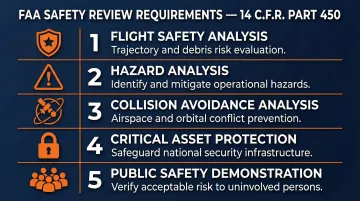
Safety review requirements under 14 C.F.R. Part 450:
- Flight safety analysis demonstrating public safety protection
- Hazard analysis identifying potential failure modes
- Collision avoidance analysis for orbital debris mitigation
- Critical asset protection measures
- Demonstration that operations will not endanger public health, safety, or property
Companies using non-traditional propulsion — such as Green Launch's hydrogen/oxygen light-gas system, which operates on a different propulsion principle than conventional rockets — should evaluate their pathway carefully. Under 51 U.S.C. § 50906, vehicles in developmental testing phases may qualify for the experimental permit pathway, which carries a 120-day statutory processing timeline versus 180 days for a full license.
Pre-application meetings with FAA/AST can clarify which pathway applies and flag potential issues before the formal review clock starts.
Payload review considerations:
- National security implications require additional scrutiny
- Foreign-built components trigger enhanced review
- Satellites must obtain separate FCC licenses for spectrum use
- Certain payloads require interagency coordination with Department of Defense or intelligence agencies
Payload licensing is only part of the equation — the physical launch site requires its own separate approval.
Launch Site (Spaceport) Licensing
Commercial launch sites must be licensed as launch site operators under 14 C.F.R. Part 420. The FAA evaluates site safety, airspace integration, environmental impact under NEPA, and compatibility with surrounding communities. As of April 2026, 14 active FAA-licensed commercial spaceports operate across the United States, including Mojave Air & Space Port (CA), Spaceport America (NM), and Mid-Atlantic Regional Spaceport (VA).
Liability, Insurance, and Financial Responsibility Requirements
The U.S. employs a two-tier financial responsibility system. Operators must obtain liability insurance up to the "maximum probable loss" (MPL) amount the FAA determines for third-party claims. The federal government then indemnifies operators for damages exceeding that amount up to $1.5 billion (adjusted for inflation since 1989, totaling approximately $3.1 billion) under 51 U.S.C. § 50915.
How MPL is calculated:
The FAA uses probability-based thresholds. For third-party losses, MPL represents losses with probability of occurrence no less than 1 in 10 million. For government property and personnel, the threshold is 1 in 100,000. Statutory caps limit required insurance to $500 million for third-party liability and $100 million for government property, regardless of calculated MPL.
Cross-waiver of liability requirements:
All launch participants—operators, customers, contractors, and subcontractors—must execute reciprocal waivers of claims under 14 C.F.R. § 440.17. These waivers cover property damage and losses, effectively limiting litigation among participating parties. Beyond shared risk, this structure keeps mission timelines intact by removing the financial uncertainty of post-launch disputes.
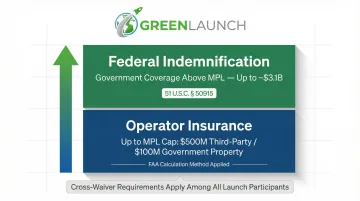
Operators must also demonstrate financial responsibility to cover government property and personnel at federal launch ranges, a separate requirement from third-party liability coverage. The indemnification provisions were recently extended to September 30, 2028 under Pub. L. 118-159, and operators should confirm the current extension status before financial commitments are made.
International Legal Obligations for U.S. Operators
The 1967 Outer Space Treaty (Article VI) holds the United States nationally responsible for space activities conducted by its private nationals. This is why U.S. operators must obtain federal authorization: launching without a license puts the U.S. in breach of its international obligations and exposes the operator to civil and criminal penalties.
The 1972 Space Liability Convention establishes two distinct liability regimes depending on where damage occurs:
- Absolute liability: The U.S. bears full liability for damage caused by U.S.-licensed launches to foreign nations on the surface of the Earth or to aircraft in flight, regardless of fault
- Fault-based liability: Damage caused in outer space requires proof of fault or negligence
Liability obligations run alongside separate registration requirements. Under the 1975 Registration Convention and 51 U.S.C. § 50919, U.S. operators must register launch vehicles and satellites with the United Nations Office for Outer Space Affairs (UNOOSA) through the U.S. government. The FCC enforces orbital debris mitigation rules under 47 C.F.R. Part 25, including a 5-year post-mission disposal mandate for satellites in Low Earth Orbit.
The 2025 Regulatory Reforms: What Operators Need to Know Now
The August 2025 White House Executive Order "Enabling Competition in the Commercial Space Industry" directed sweeping regulatory changes. The FAA was ordered to eliminate or expedite environmental reviews for launch and reentry licenses, reevaluate and potentially rescind burdensome requirements in 14 C.F.R. Part 450, and establish categorical exclusions under NEPA for launches within certain parameters—with a 120-day deadline for reporting actions taken.
Novel space activity authorization:
The Department of Commerce was directed within 150 days to propose an expedited, individualized mission authorization process for activities covered by Article VI of the Outer Space Treaty but not clearly governed by existing frameworks.
In March 2026, the Office of Space Commerce released its "Space Commerce Certification" proposal. It creates a voluntary certification framework for novel activities — in-space manufacturing, satellite servicing, and non-traditional propulsion systems — bypassing traditional rulemaking processes.
Leadership and accountability reforms:
The EO directed the FAA to appoint a senior noncareer executive as Associate Administrator for Commercial Space Transportation and the Department of Commerce to elevate the Office of Space Commerce. This signals a policy shift toward faster, more industry-friendly regulatory decision-making — one that operators using novel propulsion and launch technologies should track closely as implementation unfolds.
That progress, however, is uneven. As of April 2026, the DOT missed its December 2025 120-day reporting deadline for Part 450 reforms and NEPA categorical exclusions. The key reform status at a glance:
- Novel mission authorization (Commerce): Proposal released on schedule in March 2026
- Part 450 regulatory review (FAA): Reporting deadline missed; status unresolved
- NEPA categorical exclusions (FAA): No categorical exclusions established as of April 2026
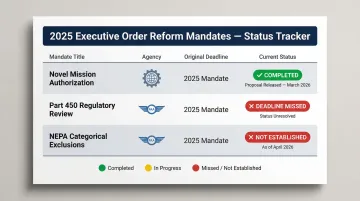
Critical FAA streamlining mandates remain stalled, leaving operators uncertain about near-term regulatory relief.
Frequently Asked Questions
Do you need permission to launch a satellite?
Yes. Launching a satellite from the U.S. requires an FAA launch license or permit for the launch vehicle and a separate FCC license for the satellite's radio frequencies. Foreign-built satellites may also require a payload review by the FAA.
What is the Commercial Space Launch Act?
The Commercial Space Launch Act is the foundational 1984 federal law signed by President Reagan. It established the FAA's authority to license commercial launches, created the liability and insurance framework, and has been amended several times to keep pace with industry growth.
What are the latest changes to FAA regulations?
An August 2025 Executive Order directed the FAA to streamline environmental reviews, reform 14 C.F.R. Part 450, and reduce regulatory barriers for commercial launch and reentry. The FAA missed its December 2025 reporting deadline, and no formal Part 450 reforms have been published as of April 2026.
Where are the FAA commercial space regulations located?
Primary regulations are in Title 14 of the Code of Federal Regulations (Parts 415, 417, 420, and 450), while the statutory framework is in Title 51 of the United States Code, Chapter 509.
What insurance is required for a commercial space launch?
Operators must carry third-party liability insurance up to the FAA-calculated maximum probable loss (MPL), capped at $500 million. The federal government provides indemnification above that threshold up to approximately $3.1 billion under 51 U.S.C. § 50915.
What is the difference between a launch license and an experimental permit?
A launch license is required for commercial operations — payload delivery for compensation. An experimental permit is available for reusable suborbital vehicles conducting research, development, or demonstration flights, with a streamlined 120-day review process suited to companies testing novel technologies.