Stratospheric launch systems offer a compelling alternative. By using the upper atmosphere—roughly 12 to 50 kilometers above Earth—as a staging point, these technologies dramatically reduce the energy needed to reach orbit. Less fuel, lighter structures, and cleaner emissions make stratospheric launches an emerging game-changer.
This guide covers what stratospheric launch systems are, how they work, the major types in development, their advantages over conventional rockets, real-world applications, and what challenges remain before they reach routine commercial service.
Key Takeaways
- Stratospheric launch systems stage from 12–50 km altitude where 99% of atmospheric mass is below, drastically cutting drag and fuel needs
- Three main types exist: balloon-rocket hybrids, air-launch systems, and light-gas guns, each with distinct cost, payload, and emissions profiles
- Key advantages include 40–90% cost reductions, near-zero emissions for some systems, and rapid launch cadence
- Best suited for small satellites (10–250 kg), atmospheric research, and defense applications
- Challenges include payload size limits, regulatory complexity, and limited flight heritage for newer systems
What Are Stratospheric Launch Systems?
Stratospheric launch systems use the stratosphere—the atmospheric layer between roughly 12 and 50 kilometers (approximately 40,000 to 164,000 feet) above Earth's surface—as either a launch point or staging altitude for delivering payloads to orbit or suborbital trajectories. Unlike traditional rockets that ignite at sea level, these systems lift or position launch vehicles in the upper atmosphere before the primary propulsion phase begins.
Why the Stratosphere Matters for Launch
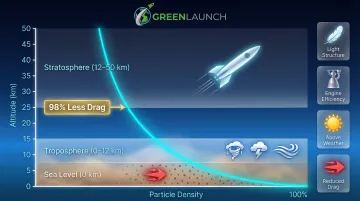
The stratosphere sits above 99% of Earth's atmospheric mass. At these altitudes, air pressure and drag drop exponentially—atmospheric density at 25 kilometers is roughly 2% of sea level density. This creates several strategic advantages:
- Dramatically lower aerodynamic drag reduces the velocity increment (delta-v) required to reach orbit
- No weather systems eliminate launch delays from storms, wind, or precipitation
- Thin air enables simpler engine designs because rockets operate in near-vacuum conditions from ignition
- Less structural stress allows lighter vehicle construction and larger payload surface areas
The physics are compelling: drag force is proportional to air density. Launching from where density is 2% of sea level means drag forces are reduced, translating directly to lower fuel requirements and smaller, cheaper rockets.
From Concept to Commercial Reality
The idea of high-altitude launch isn't new. Early high-altitude balloon research in the 1930s demonstrated the stratosphere's accessibility, while WWII-era ballistic experiments explored upper-atmosphere projectile behavior. NASA and military programs continued development through the Cold War, with the Super High Altitude Research Project (SHARP) at Lawrence Livermore National Laboratory achieving notable milestones in hydrogen-powered launch systems during the 1990s.
Modern materials, miniaturized electronics, and a rapidly expanding small satellite market have shifted stratospheric launch from research programs into commercial operations. Green Launch—whose CTO Dr. John Hunter led the original SHARP project—conducted its first vertical light-gas launch for space access in 2022, representing the kind of private-sector progress that's now driving the field forward.
Types of Stratospheric Launch Systems
Balloon-Rocket Hybrid Systems
Balloon-rocket hybrids lift a rocket-powered upper stage to stratospheric altitude using a high-altitude balloon (typically super-pressure or zero-pressure designs capable of reaching 20–30 kilometers). Once at altitude, the balloon releases the rocket, which ignites in near-vacuum conditions and carries the payload to orbit.
Companies like Zero 2 Infinity developed this approach with their Bloostar system, which lifts launchers to approximately 25 kilometers before rocket engines fire to deliver payloads to orbits as high as 1,000 kilometers. The key advantage: rocket engines operate with minimal aerodynamic constraints from ignition, enabling simpler nozzle designs, lower structural mass, and reduced vibration loads.
Environmental and engineering advantages:
- Zero emissions during the balloon ascent phase through dense lower atmosphere
- Reduced aerodynamic loading on rocket structures
- Ability to accommodate larger payload surface areas (antennae, solar panels) because aerodynamic stresses at launch altitude are negligible
- Gentler acceleration profiles protect sensitive instruments
Limitations include:
- Long ascent times (2–3 hours to reach launch altitude)
- Weather sensitivity during balloon deployment and recovery
- Balloon reusability challenges
Air-Launch Systems
Air-launch systems use a carrier aircraft to lift a rocket to high altitude (typically 10–15 kilometers) before releasing it for ignition. Dedicated air-launch vehicles like the Stratolaunch carrier aircraft are purpose-built for this role, operating above standard commercial cruising altitudes.
Primary advantages:
- Launch flexibility — no fixed ground infrastructure required
- Ability to select optimal launch azimuth and location for each mission
- Reduced atmospheric drag compared to ground launch
- Horizontal takeoff avoids the infrastructure costs of vertical launch pads
Key challenges:
- Requires large, specialized aircraft with significant capital costs ($200M+ for purpose-built carriers)
- Payload mass limited by aircraft lifting capacity
- Still launches from altitudes below the stratosphere proper, retaining some atmospheric drag effects
Virgin Orbit's LauncherOne (now defunct) and Stratolaunch represent this category, targeting small satellite markets with payloads under 500 kilograms.
Light-Gas Gun and Ballistic Launch Systems
Light-gas guns represent a fundamentally different approach: instead of rockets or balloons, a ground-based or elevated gas gun accelerates a projectile to hypersonic velocities using light gas (typically hydrogen) achieving the velocity needed for space access without chemical rocket propellant during the boost phase.
How it works:
Hydrogen gas, heated and pressurized in a combustion chamber, expands rapidly through a launch tube, accelerating a projectile to velocities approaching orbital speed. Hydrogen's extremely low molecular weight (2 atomic mass units) allows sound speed to far exceed that of conventional gunpowder or air-based systems.
This translates to muzzle velocities of 2–3 kilometers per second or more — sufficient to reach the stratosphere and beyond without rocket propellant during the boost phase.
Green Launch: Pioneering Light-Gas Technology
Founded in 2017 by a team including Dr. John W. Hunter (who led the SHARP project at Lawrence Livermore National Laboratory), Green Launch has demonstrated practical viability of hydrogen light-gas propulsion. The company completed 12 successful horizontal test firings in 2018.
Green Launch achieved its first vertical light-gas launch for space access in December 2021, reaching an estimated altitude of 30 kilometers at velocities exceeding Mach 3.
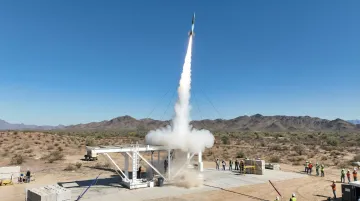
By October 2025, Green Launch had achieved projectile velocities of 2.97 km/sec (Mach 9) using a 54-foot launch tube with a proprietary hydrogen-and-oxygen combustion system. The system produces only water vapor as a byproduct, making it one of the most environmentally low-impact launch methods available.
For orbital missions, Green Launch pairs the light-gas launcher with a small solid rocket motor that circularizes the orbit after the projectile exits the atmosphere.
Green Launch targets a launch price of $100 per pound ($220 per kilogram) to orbit, with launch frequency capabilities of every 60–90 minutes — positioning the technology as ideal for small satellite operators requiring rapid, affordable access.
Comparison at a Glance
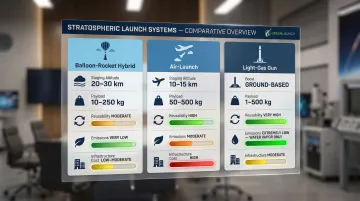
| System Type | Typical Altitude Range | Payload Size Suitability | Reusability Potential | Environmental Impact | Infrastructure Cost |
|---|---|---|---|---|---|
| Balloon-Rocket Hybrid | 20–30 km staging | 10–250 kg | Moderate (balloon recovery complex) | Very low (no lower-atmosphere combustion) | Low to moderate |
| Air-Launch | 10–15 km staging | 50–500 kg | High (aircraft reusable) | Moderate (combustion from altitude) | High (specialized aircraft) |
| Light-Gas Gun | Ground-based boost | 1–100 kg (scaling to 500 kg) | Very high (ground system fully reusable) | Extremely low (water vapor only) | Moderate (fixed installation) |
Why Launch From the Stratosphere? Key Advantages
Aerodynamic Drag Reduction
Atmospheric drag is proportional to air density, which decreases exponentially with altitude. At 25 kilometers — a typical balloon-launch staging altitude — air density is approximately 2% of sea level values.
A vehicle launching from this altitude faces 98% less drag than one launched from the ground. That reduction cuts the velocity increment required to reach orbit by 10-15% of total delta-v, directly lowering propellant mass, structural requirements, and cost.
Cost Reduction Potential
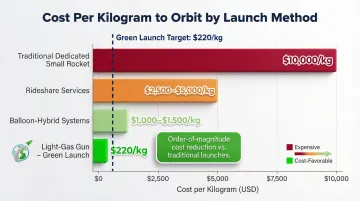
Traditional orbital rocket launches cost approximately $2,500-$10,000 per kilogram for small satellite operators using rideshare services, and significantly more for dedicated launches. The culprit is the rocket equation: the need to carry fuel to lift fuel creates exponential mass growth as mission requirements increase.
Stratospheric launch approaches eliminate the heaviest, most fuel-intensive portion of ascent. Balloon-lofted and light-gas systems avoid carrying the propellant and hardware needed to push through dense lower atmosphere, enabling:
- Smaller, lighter upper stages with simpler designs
- Higher payload mass fractions — 10-20% versus 1-4% for small ground-launched rockets
- Lower fixed infrastructure costs compared to traditional launch pads
Green Launch's light-gas system targets $220 per kilogram ($100 per pound) to orbit, representing an order-of-magnitude cost reduction. Even balloon-hybrid systems project costs 40-60% below conventional small launchers.
Environmental Sustainability Advantage
Conventional rocket first stages burn large quantities of hydrocarbon or hydrogen propellant through the densest, most chemically sensitive parts of the atmosphere. Black carbon soot from hydrocarbon-fueled rockets exhibits warming efficiency nearly 500 times greater than surface soot sources when injected into the stratosphere. That soot persists for 4-5 years and actively contributes to ozone depletion.
Stratospheric launch approaches shift or eliminate combustion in these sensitive layers:
- Balloon-lofted systems ascend with zero emissions, burning propellant only above 99% of atmospheric mass
- Light-gas systems like Green Launch's produce only water vapor, with demonstrated propellant capture efficiency exceeding 91% — meaning virtually nothing is released into the atmosphere during launch
Traditional rockets using RP-1 kerosene produce over 19 tons of CO₂ per ton of payload delivered to orbit. Green Launch's hydrogen system produces zero carbon emissions for suborbital launches and minimal emissions for orbital missions.
Payload Protection Benefits
Launching from altitude subjects payloads to significantly reduced vibration and acoustic loading. Traditional ground launches generate intense acoustic energy — up to 180 decibels — as exhaust plumes interact with launch structures and dense air. This forces expensive ruggedization of satellites and instruments.
Stratospheric staging eliminates most acoustic stress and reduces vibration loads by 40-60%, which matters most for:
- Sensitive scientific instruments with delicate optics or sensors
- Small commercial satellites not designed for military-grade shock tolerance
- Payloads with large deployable structures (solar panels, antenna arrays)
Testing has shown that modern commercial electronics can withstand 30,000 G acceleration forces with minor modifications — making ballistic launch viable for hardened cubesat-class payloads without full military-grade ruggedization.
Operational Flexibility Advantage
Balloon-based and gun-based systems aren't tied to fixed launch pads requiring multi-year construction timelines and substantial capital investment. Lighter infrastructure means:
- Geographic flexibility to launch from different sites optimizing orbital parameters
- Faster launch cadence with minimal turnaround — Green Launch targets 60-90 minute intervals
- Lower fixed overhead costs enabling profitable operation at lower annual launch volumes
- Rapid response capability for time-sensitive missions
For the small satellite market, that agility is a direct commercial advantage — customers can target specific orbital slots and launch windows instead of waiting months for an available rideshare slot.
Primary Applications and Use Cases
Small Satellite and Microsatellite Market
The miniaturization of electronics has created surging demand for satellites weighing 10-250 kilograms deployed into constellations for Earth observation, telecommunications, weather monitoring, and IoT connectivity. Industry projections estimate 15,000-20,000 small satellites will launch in the next decade, representing a $50-60 billion addressable market.
Stratospheric launch systems are exceptionally well-matched to this demand:
- Launches cost sub-$500K versus $5M+ for dedicated small rockets — a structure that fits microsatellite economics
- Covers the 10-250 kg payload range, spanning cubesat and microsatellite classes directly
- High launch frequency supports rapid constellation deployment
- Precise orbital insertion accommodates specific mission requirements
Green Launch explicitly positions itself for the cubesat and small satellite market, with current capability for cube-sat class payloads and plans to scale to 100-1,000 pound (45-450 kg) capacity.
Scientific Research Applications
High-altitude balloons and stratospheric platforms have served scientific research for decades—cosmic ray detectors, atmospheric chemistry sensors, and Earth-monitoring payloads routinely fly to the edge of space. Stratospheric launch systems extend this heritage by enabling rapid, repeatable, low-cost access for:
- Atmospheric sampling of the mesosphere and ionosphere for climate diagnostics
- Hypersonic vehicle testing at Mach 5-9 velocities in realistic flight conditions
- Microgravity experiments during suborbital trajectories
- Astronomy and astrophysics instruments requiring above-atmosphere observations
Green Launch has secured contracts with the National Science Foundation for mesosphere atmospheric sampling and has launched nine hypersonic combustion ramjets, achieving the record for high Mach number scramjet operation at Mach 8. These contracts reflect consistent demand from research organizations working outside the budget range of dedicated orbital rocket launches.
Defense, Surveillance, and Communications Applications
The stratosphere offers persistent surveillance and communications advantages impossible from lower altitudes. High-altitude platforms operating at 18-25 kilometers altitude have been explored for:
- Intelligence, surveillance, reconnaissance (ISR) with wide-area persistent coverage
- Communications relay for emergency response—NASA's STRATO program supported wildfire coordination
- Atmospheric and hypersonic weapons testing requiring realistic flight environments
- Rapid-response payload delivery to specific geographic locations
Military research has also explored stratospheric delivery for tactical payloads, including area-denial munitions. This dual-use range — serving both commercial satellite operators and defense customers — broadens the addressable market well beyond orbital launch alone.
Challenges and Limitations to Consider
Payload Mass and Size Constraints
Stratospheric launch systems—particularly balloon-lofted and gun-based approaches—currently favor smaller, lighter payloads compared to large conventional rockets. This limits their applicability:
- Balloon-rocket hybrids: Typically 10-250 kg payloads (balloon lift capacity limits)
- Light-gas guns: Currently 1-100 kg (scaling to 500 kg), with extreme acceleration forces requiring payload hardening
- Air-launch systems: Up to 500 kg depending on carrier aircraft capability
Heavy communications satellites (5,000+ kg) and crewed missions remain exclusive domains of traditional heavy-lift rockets. Stratospheric systems target the small satellite market, not replacements for Falcon 9 or Starship-class vehicles.
Regulatory and Airspace Complexity
Operating balloon-based or high-velocity launch systems requires coordination across multiple regulatory domains:
- Aviation authorities (FAA in the US) must approve operations through national airspace
- Range safety approvals for trajectory management, particularly for ballistic systems with limited maneuverability
- International treaty considerations for orbital debris mitigation and atmospheric protection
- Environmental impact assessments for novel propulsion technologies
Green Launch navigated this landscape through its testing contract with Yuma Proving Ground, operating within established U.S. military range safety frameworks. The Surface Danger Zone protocols require ballistic experts to verify all trajectories remain within approved areas, with meteorological monitoring before each launch to ensure compliance.
Commercial operators must obtain FAA Office of Commercial Space Transportation (FAA/AST) licenses before routine service — a process that adds both time and cost to any market entry plan.
Technology Maturity and Reliability Challenges
While individual components—high-altitude balloons, small rocket motors, gas guns—are proven technologies with decades of operational history, integrating them into reliable commercial-grade launch systems requires extensive testing:
- Launch cadence reliability must be demonstrated consistently, not just in controlled tests
- Payload integration processes need standardization for customer confidence
- Recovery and reusability systems require validation across varied conditions
- Propellant handling and safety protocols must meet commercial operational standards
Green Launch's path illustrates how this maturation unfolds in stages: 12 successful horizontal test firings in 2018, followed by the first vertical light-gas launch for space access in 2022. Each milestone builds the operational track record that aerospace customers and program managers need before committing payload contracts to an emerging system.
The Future of Stratospheric Launch Technology
Market Tailwinds Driving Investment
The commercial small satellite launch services market is projected to grow from approximately $4 billion in 2023 to $14-18 billion by 2030, representing a compound annual growth rate exceeding 15%. This growth is driven by:
- Constellation broadband services requiring hundreds to thousands of satellites
- Earth observation demand from agriculture, insurance, and government customers
- Defense and ISR applications requiring responsive space capabilities
- IoT and machine-to-machine connectivity from space-based networks
This expanding addressable market creates both capital availability for stratospheric launch development and customer demand for cost-effective, responsive launch services that stratospheric systems uniquely provide.
Advancing Enabling Technologies
Multiple technology trends are accelerating stratospheric launch system capabilities and economics:
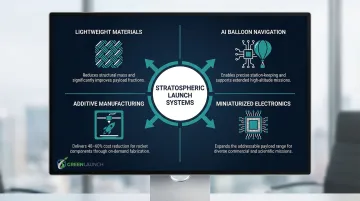
Lightweight materials: Carbon fiber composites and advanced alloys reduce structural mass, enabling higher payload fractions and greater balloon lift capacity. These materials also improve pressure vessel performance for gas gun systems.
AI-driven balloon navigation: Machine learning algorithms enable precise station-keeping and trajectory control. Google Loon demonstrated extended stratospheric missions with AI navigation, keeping balloons over target areas for weeks — technology directly applicable to balloon-launch positioning.
Additive manufacturing for rocket components: 3D-printed rocket engines and structures reduce manufacturing costs by 40-60% and enable rapid design iteration, making custom upper stages for balloon-rocket hybrids economically viable.
Miniaturized electronics: Continued electronics miniaturization increases the capable payload mass that can fit within stratospheric launch system size constraints, expanding addressable customer base.
Together, these advances lower costs, expand capability, and improve reliability — and their effects compound as the technology matures toward routine commercial service.
Reusability and Sustainability as Strategic Differentiators
As environmental scrutiny of the space industry intensifies and launch frequency demands increase, systems producing minimal atmospheric pollution and offering full reusability will gain structural competitive advantage.
Black carbon from hydrocarbon rocket fuels is almost 500 times more efficient at atmospheric warming than surface soot, and accumulates in the stratosphere for 4-5 years, threatening ozone recovery. Stratospheric launch systems that use hydrogen-oxygen propulsion — like Green Launch — produce only water vapor, positioning them favorably against inevitable environmental regulations.
Reusability advantages are equally compelling:
- Ground-based systems (light-gas guns) are inherently fully reusable with no expendable stages
- Balloon recovery and refurbishment programs can achieve 70-80% reuse rates
- Carrier aircraft in air-launch systems are fully reusable
These characteristics enable cost structures and environmental profiles that traditional expendable rockets simply cannot replicate — a durable advantage as regulatory pressure on launch emissions increases.
Path to Commercialization
Remaining milestones before routine commercial service include:
Technical demonstration: Achieving target payload capacities consistently across multiple launches, demonstrating launch cadence reliability (multiple launches per week), and validating payload integration and deployment processes.
Regulatory approval: Securing FAA/AST commercial launch licenses, completing environmental impact assessments, and establishing range safety protocols for commercial operations outside military test ranges.
Market validation: Attracting anchor customers from satellite operators or defense agencies, signing multi-launch contracts demonstrating sustained demand, and establishing pricing models that enable profitable operations.
Infrastructure scaling: Building commercial launch facilities beyond test ranges, developing payload processing and integration capabilities, and establishing recovery and refurbishment operations for reusable components.
Companies with established test records are best positioned to clear these hurdles. Green Launch, for example, completed a series of successful firings at Yuma Proving Ground that reached Mach 9 velocities, providing a validated technical foundation for commercial licensing. First commercial services are expected in the 2025-2027 window for suborbital applications, with routine orbital delivery targeted for 2027-2030.
Frequently Asked Questions
Can aerostat balloons carry people?
Aerostats (tethered, stationary balloons) differ from free-flying high-altitude balloons and carry no passengers. Conventional aerostats serve as surveillance, communications relay, or sensor platforms — not transport vehicles.
What is the difference between a stratospheric launch system and a traditional rocket launch?
Traditional rockets ignite at sea level and fight through the densest atmosphere, requiring massive fuel loads and heavy structures. Stratospheric launch systems stage from the upper atmosphere where thin air dramatically reduces drag and energy requirements, enabling smaller, lighter, cheaper rockets.
What types of payloads are best suited for stratospheric launch systems?
Current stratospheric systems target small satellites under 250 kilograms, scientific instruments, compact defense payloads, and atmospheric research equipment. Heavy telecommunications satellites and crewed capsules still require conventional heavy-lift rockets.
How high is the stratosphere and why does it matter for launches?
The stratosphere extends from roughly 12 kilometers to 50 kilometers altitude and contains less than 1% of atmospheric mass above its base. Launching from this altitude means drastically lower drag, enabling smaller rockets to reach orbit with significantly less fuel.
What makes light-gas gun technology different from conventional rocket propulsion?
Light-gas guns use pressurized hydrogen gas rather than chemical combustion to accelerate projectiles. Hydrogen's extremely low molecular weight enables much higher sound speeds and exit velocities than conventional propellants, achieving hypersonic speeds without a rocket first stage.
How does launching from the stratosphere reduce costs?
Staging from altitude skips the most fuel-intensive portion of flight — punching through dense lower atmosphere. The result is smaller, simpler upper stages that cost far less to build and operate, cutting per-kilogram delivery costs significantly.