Introduction
Commercial suborbital flights have carried billionaires past the Kármán line and enabled groundbreaking cancer research in microgravity — yet many still confuse them with orbital missions or dismiss them as tourist stunts. In practice, suborbital flight is a distinct technical and commercial category with serious applications in defense, research, and emerging launch infrastructure.
This guide is for aerospace professionals, research organizations, defense contractors, satellite developers, and technically curious readers who want to understand the mechanics, economics, and applications of commercial suborbital flight beyond the headlines.
We'll cover what suborbital flight actually is, how it differs from orbital missions, who the key players are, what it costs, and what it's used for. That includes emerging alternatives to conventional rockets — the part most guides skip entirely.
Key Takeaways:
- Suborbital flight requires ~1.4 km/s delta-v versus ~9.2 km/s for orbit — a 6× energy difference
- Blue Origin and Virgin Galactic lead tourism; sounding rockets serve research and defense
- Applications include microgravity research, hypersonic testing, atmospheric sampling, and payload qualification
- Ticket prices range from $200,000–$600,000; payload costs are far lower than ISS alternatives
- The market is projected to grow from $703 million (2023) to $3.2 billion by 2034
What Is a Commercial Suborbital Flight?
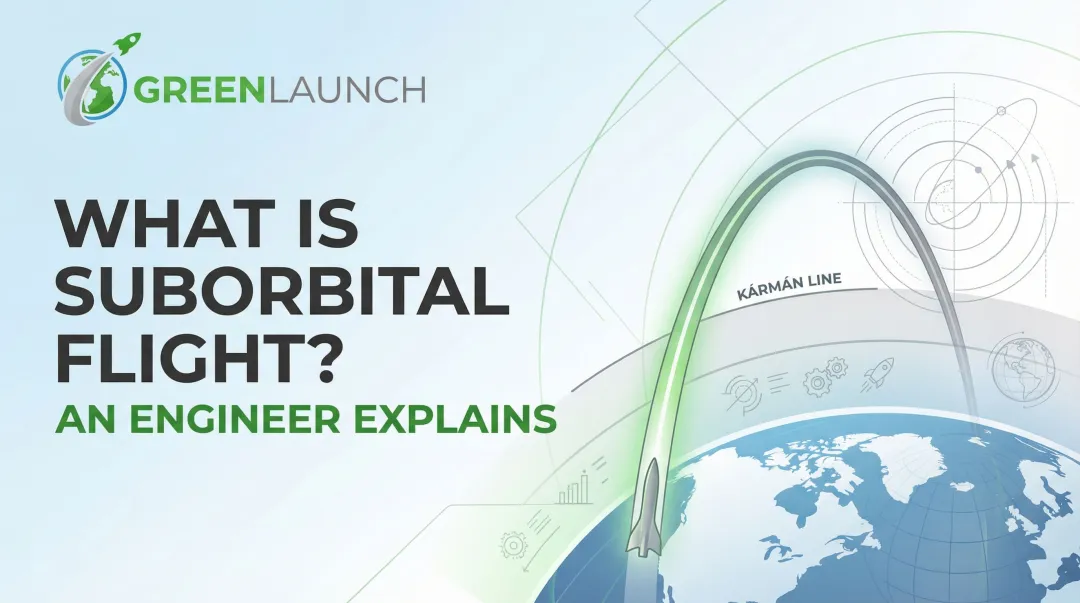
A suborbital spaceflight reaches outer space — crossing the Kármán line at approximately 100 km above sea level — but does not achieve the velocity needed to sustain an orbit. Instead of circling Earth, the vehicle follows a ballistic arc and returns to the surface.
How "Space" Is Defined
The definition of "space" depends on who you ask. The Fédération Aéronautique Internationale (FAI) sets the Kármán line at 100 km, while the U.S. military, FAA, and NASA award astronaut wings at 80 km (50 miles). Both Virgin Galactic (~86 km apogee) and Blue Origin (~107 km) qualify under one or both standards.
Why Suborbital Is Simpler Than Orbital
The physics explain the economics. Reaching Low Earth Orbit at ~300 km requires an orbital velocity of approximately 7.7–7.8 km/s and a total delta-v of 9.2–10 km/s when accounting for atmospheric drag and gravity losses. A vertical suborbital hop to 100 km needs only ~1.4 km/s delta-v — roughly one-seventh the energy.
That energy gap translates directly to lower cost, reduced hardware complexity, and faster turnaround times — which is why suborbital missions are increasingly attractive for research and testing applications.
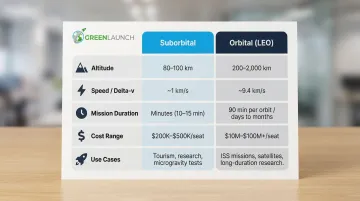
Suborbital vs. Orbital: Key Differences at a Glance
| Metric | Suborbital | Orbital (LEO) |
|---|---|---|
| Altitude | 80–1,500+ km | 160–2,000 km |
| Speed/Delta-v | ~1.4 km/s | ~7.8 km/s velocity; ~9.2–10 km/s delta-v |
| Mission Duration | 10–15 min total; 3–6 min microgravity | Days to years (90-min orbits) |
| Cost Range | $200K–$600K (tourism); ~$1M–$1.5M (payload) | ~$27,000/kg to ISS |
| Use Cases | Tourism, microgravity research, hypersonic testing, TPS qualification | Satellite deployment, sustained labs, deep space staging |
The Suborbital Flight Profile
A typical suborbital mission follows a defined sequence: engine burn to altitude, engine cutoff, a microgravity window (3–6 minutes for vertical hops, up to 13 minutes on larger sounding rockets), atmospheric reentry, and payload recovery. That microgravity window is what makes suborbital flights valuable for research — experiments get repeatable exposure to near-zero-g conditions without the cost or complexity of an orbital mission.
Key Applications of Commercial Suborbital Flights
Space Tourism and the Passenger Market
The consumer appeal is straightforward: crossing the Kármán line, experiencing microgravity, and seeing Earth from space. Virgin Galactic and Blue Origin have collectively flown 86+ individuals above the boundary of space as of late 2025.
Blue Origin's New Shepard completed its 14th crewed flight (NS-34) by mid-2025, while Virgin Galactic retired its VSS Unity spaceplane in June 2024 to focus capital on its next-generation Delta-class vehicles targeting 2026 commercial service.
Scientific Research and Microgravity Experiments
Suborbital vehicles provide 3–13 minutes of high-quality microgravity — enough to conduct cell biology, materials science, and fluid dynamics experiments at a fraction of ISS costs.
Concrete Examples:
- NEUROBETA Diabetes Research: In November 2022, the Swedish Space Corporation's SubOrbital Express-3 (MASER 15) mission provided 6 minutes of microgravity for Uppsala University's stem cell research targeting type-1 diabetes treatments
- T-Cell Studies: Blue Origin's New Shepard has flown the CRExIM payload to study microgravity effects on murine T-cells
- Plant Biology: Virgin Galactic's VSS Unity has been used to study transcriptomic dynamics in Arabidopsis thaliana
The cost advantage is significant: ISS NanoLab experiments cost $35,000+, while suborbital sounding rocket launches range from $1M–$1.5M depending on payload mass and altitude — substantially cheaper per experiment for short-duration work.
Defense and Rapid Payload Delivery
Suborbital trajectories are inherently relevant to defense. ICBMs follow suborbital ballistic arcs outside Earth's atmosphere, and the same physics enables rapid point-to-point delivery and hypersonic vehicle testing.
Two active DoD programs illustrate the investment:
- MACH-TB 2.0: In March 2026, Rocket Lab secured a $190 million contract from the DoD's Test Resource Management Center to conduct 20 hypersonic test flights using its HASTE vehicle. The program tests glide bodies and air-breathing systems at speeds exceeding Mach 5, bypassing congested government test ranges.
- Rocket Cargo: The Air Force Research Laboratory has awarded contracts to SpaceX and Blue Origin under the "Rocket Cargo" program to explore using suborbital trajectories for delivering military cargo globally within hours.
Technology Demonstration and Hardware Qualification
Suborbital flights serve as cost-effective proving grounds for testing avionics, propulsion components, and reentry systems under real space conditions before committing to expensive orbital launches.
Thermal Protection Systems (TPS):
- NASA's IRVE-3 (Inflatable Re-entry Vehicle Experiment 3) launched on a Black Brant XI sounding rocket in 2012, re-entering at Mach 10 to validate a flexible heat shield under 14 W/cm² of heat flux
- NASA's Low-Density Supersonic Decelerator (LDSD) utilized suborbital test flights to verify supersonic parachutes and inflatable decelerators for future Mars missions
Emerging Alternative Propulsion for Suborbital Payload Delivery
Non-rocket launch approaches are emerging as cost-reducing and environmentally differentiated options for delivering small scientific or defense payloads to suborbital altitudes.
Green Launch's hydrogen-oxygen light-gas combustion system uses a ground-based impulse launcher to accelerate payloads to suborbital — and potentially orbital — velocities. Unlike conventional rockets that carry all propellant internally, the launcher stays on the ground and is reused across missions.
Key performance characteristics:
- Produces only water vapor as a combustion byproduct
- Demonstrated 91%+ propellant capture efficiency, supporting repeated reuse
- Avoids the 19+ tons of CO2 per ton of payload generated by traditional chemical rockets
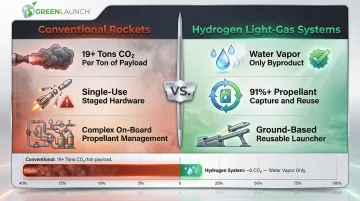
That emissions profile makes the system relevant for research organizations and defense clients seeking sustainable launch options for acceleration-tolerant payloads.
Major Players and Vehicles in the Commercial Suborbital Market
Crewed Suborbital Tourism Providers
Blue Origin's New Shepard
A fully autonomous, vertically launched reusable booster and capsule system, New Shepard carries up to 6 passengers to an apogee of approximately 107 km, delivering 3–4 minutes of microgravity within a 10–12 minute total flight. As of late 2025, Blue Origin had completed 15+ crewed missions and flown 86 individuals above the Kármán line.
Virgin Galactic's SpaceShipTwo (VSS Unity)
An air-launched spaceplane deployed from a carrier aircraft at ~50,000 feet, VSS Unity reached apogees of approximately 86 km. It completed its final commercial flight in June 2024 and was retired as the company shifted focus to its next-generation Delta-class vehicles.
The Delta-class vehicles, expected to enter commercial service in 2026, will feature 6 passenger seats and are designed to fly up to twice per week.
Uncrewed Sounding Rockets and Scientific Platforms
| Vehicle | Apogee | Payload Capacity | Primary Uses |
|---|---|---|---|
| Black Brant IX (Northrop Grumman/NASA) | Up to ~400 km | 500–1,500 lbs (226–680 kg) | Heavy scientific payloads, astronomy, microgravity |
| Terrier-Improved Orion (Northrop Grumman/NASA) | Up to ~200 km | 200–800 lbs (90–360 kg) | Atmospheric sciences, subsystem testing |
| Skylark L (Skyrora) | ~102 km | Up to 50 kg | Microgravity research, subsystem validation |
Skyrora, a UK-based provider, secured a launch license in 2025 and is targeting the lightweight, rapid-response microgravity market.
Emerging Entrants and Future Platforms
SpaceX's Starship is designed to support point-to-point suborbital transport, enabling intercontinental travel in under an hour. On the uncrewed side, ground-based launch technologies are drawing increasing attention as a lower-cost alternative to conventional rockets.
Green Launch, founded in 2017, is one company pursuing this approach. Its hydrogen-powered light-gas impulse system accelerates small, acceleration-tolerant payloads to suborbital and orbital velocities using ground-based infrastructure — no multi-stage rocket hardware required. The company conducted its first vertical light-gas launch for space access in 2022 after completing 12 successful horizontal test firings at Yuma Proving Ground.
These alternative launch architectures share a common goal: driving down the cost per launch for payloads that don't require the gentle ride of a chemical rocket.
How Much Does a Suborbital Flight Cost?
Passenger Tourism Pricing
Blue Origin does not publicly disclose standard ticket prices, though reputable media estimates place them between $200,000–$300,000+ per seat. Virgin Galactic increased its ticket prices from $450,000 in 2021 to $600,000 and $750,000 for future Delta-class flights.
The most expensive single ticket sold was $28 million in an online auction for Blue Origin's first commercial flight in June 2021.
Scientific and Payload Flight Costs
Sounding rocket launches vary widely by payload mass and altitude. Indicative costs for small sounding rocket payloads range from approximately $1M–$1.5M per launch, depending on configuration. In contrast, ISS access costs ~$27,000/kg for microgravity manufacturing.
For short-duration microgravity work (3–6 minutes), suborbital platforms are far more cost-effective than orbital alternatives. That cost gap is driven by a handful of well-understood variables.
Price Trajectory and Cost Drivers
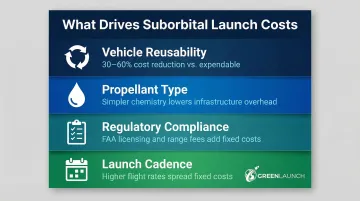
Four factors determine where suborbital launch costs land:
- Vehicle reusability — partially reusable systems cut costs by 30–60% versus expendable rockets
- Propellant type — simpler propellant chemistries (such as hydrogen/oxygen) reduce ground infrastructure overhead
- Regulatory compliance — FAA licensing timelines and range fees add fixed costs per campaign
- Launch cadence — higher flight rates spread fixed costs; Virgin Galactic targets 10+ flights per month by 2027 for this reason
Ground-based launch systems, like Green Launch's hydrogen light-gas platform, take a different approach entirely — eliminating staged rocket hardware and enabling rapid reuse from fixed infrastructure, which pushes per-launch costs well below conventional sounding rocket baselines.
Technical and Regulatory Challenges
Core Engineering Obstacles
Three obstacles dominate suborbital vehicle design:
- Aerodynamic heating: Reentry at Mach 10+ generates heat flux exceeding 14 W/cm², requiring advanced thermal protection systems on leading edges and heat shields.
- Propulsion and fuel management: Conventional chemical rockets depend on cryogenic storage and precise engine/airframe integration — managing combustion efficiency alongside fuel volume and weight is an ongoing constraint.
- Supersonic decelerators: Parachutes and drag devices must function reliably at supersonic speeds for safe payload and crew recovery, a requirement that remains difficult to validate without high flight rates.
FAA Regulatory Landscape
Commercial suborbital launches in the U.S. require a license from the FAA's Office of Commercial Space Transportation. Uncrewed developmental vehicles often operate under 14 CFR Part 437 Experimental Permits, which prohibit carrying property or humans for compensation. Passenger-carrying revenue flights require full launch licenses.
Key requirements span three areas: safety analysis, launch site approvals, and payload reviews. Crewed missions face significantly stricter standards than uncrewed payload flights — the regulatory path to commercial passenger service is considerably longer.
Safety Maturity
Suborbital spaceflight is not yet a mature technology. The catastrophic in-flight breakup of Virgin Galactic's VSS Enterprise in 2014 — caused by the copilot prematurely unlocking the feather system during transonic acceleration — highlighted the extreme aerodynamic forces at play.
The NTSB mandated mechanical fail-safes to prevent human error, underscoring that failure modes are still being discovered. For commercial operators, this means safety validation depends heavily on accumulating flight data — a challenge for any program still in low-cadence testing.
The Future of Commercial Suborbital Flight
Market Growth Outlook
The commercial suborbital transportation and space tourism market was valued at approximately $703 million in 2023. Market research firm IMARC projects the sector will grow at a CAGR of 14.3%, reaching $3.2 billion by 2034.
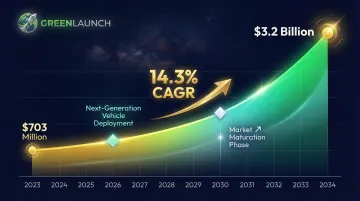
Reaching that figure depends on cost reduction, higher flight cadence, and successful next-generation vehicle deployment — three areas where reusability plays a central role.
Reusability as the Central Cost-Reduction Strategy
Reusable suborbital vehicles like New Shepard are already displacing expendable sounding rockets for many missions. Next-generation vehicles aim for much higher flight rates — 10+ flights per month — to bring per-seat and per-kg costs down dramatically.
Virgin Galactic's Delta-class vehicles are designed to fly twice per week, while Blue Origin's operational tempo suggests similar ambitions. Reusability eliminates the need to manufacture new hardware for every launch, compounding cost savings over time.
Point-to-Point Transport: A Long-Horizon Use Case
The concept of using suborbital trajectories for ultra-fast intercontinental cargo or passenger transport — such as London to Sydney in under an hour — remains a possibility rather than near-term reality.
Technical hurdles include managing extreme thermal loads during steep reentries, mitigating sonic boom overpressures (which can exceed 4.8 psf and cause structural vibrations over populated areas), and integrating these vehicles safely into commercial airspace.
SpaceX's Starship is the most prominent platform exploring this application, but peer-reviewed and FAA analyses identify significant regulatory and engineering barriers.
Alternative Propulsion: Hydrogen Light-Gas Systems
Alongside reusable rockets, a separate class of propulsion technology is targeting cost and environmental impact at once. Traditional RP-1 and MethylOx rockets produce over 19 tons of CO2 per ton of payload — hydrogen-oxygen light-gas systems produce only water vapor and enable over 91% propellant capture for indefinite reuse.
Green Launch's ground-based approach illustrates what this looks like in practice:
- Delivers small, acceleration-tolerant payloads to suborbital and orbital velocities
- Eliminates multi-stage rocket hardware through a reusable ground launcher
- Reduces per-launch infrastructure costs compared to conventional vehicles
- Produces no carbon emissions — water vapor is the sole combustion byproduct
For defense contractors, research organizations, and satellite developers that need rapid, repeatable access to space, this model offers a viable alternative to conventional launch without the environmental overhead.
Frequently Asked Questions
What is considered a sub-orbital flight?
A sub-orbital flight reaches outer space by crossing the Kármán line at ~100 km altitude but does not achieve the speed needed to sustain an orbit. The vehicle follows a ballistic arc back to Earth rather than circling the planet.
How much does a suborbital flight cost?
Passenger tourism seats run $200,000–$600,000+ with providers like Blue Origin and Virgin Galactic. Uncrewed scientific payload launches on sounding rockets cost roughly $1M–$1.5M depending on payload mass, altitude, and vehicle type — substantially cheaper than ISS access for short-duration experiments.
What is the difference between suborbital and orbital spaceflight?
Orbital flight requires ~7.7 km/s velocity to follow Earth's curvature and become a satellite, while suborbital flight only needs ~1.4 km/s delta-v to reach 100 km altitude before returning to Earth. This makes suborbital flight significantly less energy-intensive and less costly.
How long does a suborbital flight last?
Tourist-focused vertical hops (e.g., New Shepard) last about 10–12 minutes total with 3–4 minutes of microgravity. Longer-range suborbital trajectories for point-to-point transport concepts could last 30–45 minutes depending on distance covered.
What are the main scientific uses of suborbital flights?
Suborbital vehicles provide microgravity windows for biological research (cell growth, fluid behavior), atmospheric sensing, Earth observation, and hardware qualification testing. For experiments requiring only a few minutes of weightlessness, costs are a fraction of orbital alternatives.