Introduction
The energy cost of reaching low lunar orbit varies by a factor of 20 or more depending on the launch technology — a gap that reshapes the economics of every cargo mission. According to NASA mission analysis, delivering cargo from Earth's surface to LLO requires roughly 4.1 km/s beyond LEO insertion, with total delta-v budgets approaching 13 km/s when gravity and drag losses are included. The technology chosen to supply that delta-v determines how much of the launch mass is payload — and how much is propellant.
With Artemis, commercial lunar payload services, and private moon base planning advancing simultaneously, this comparison carries real operational weight. The choice of launch technology affects cost per mission, launch cadence, and the long-term feasibility of regular cargo delivery to the Moon.
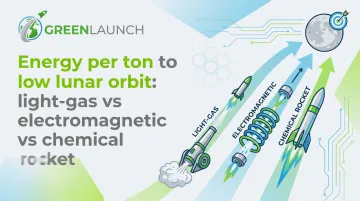
Each technology in this analysis occupies a different position on the efficiency-readiness spectrum:
- Chemical rockets dominate current operations but carry steep propellant mass penalties
- Electromagnetic launchers approach theoretical efficiency limits but depend on infrastructure that doesn't yet exist at scale
- Light-gas systems deliver energy efficiency well beyond chemical propulsion using demonstrated, ground-based hardware
Key Takeaways
- Chemical rockets are reliable but burn most of their energy accelerating propellant mass they then discard
- Electromagnetic launchers achieve over 96% electrical-to-kinetic efficiency but require multi-kilometer infrastructure
- Light-gas guns deliver 6–10x better energy efficiency than chemical rockets without the multi-kilometer track infrastructure EM systems require
- On an energy-per-ton basis, light-gas launch reaches LLO at a fraction of the thermodynamic cost chemical propulsion demands
Chemical Rockets: Dominant but Energy-Hungry
Chemical rockets work by burning propellant to generate thrust via reaction mass ejected at high exhaust velocity. For lunar missions, this means multi-stage combustion across Earth ascent, trans-lunar injection, and lunar orbit insertion. The rocket must carry its own propellant—which itself must be accelerated to orbit—compounding energy demand at every stage.
The Tyranny of the Rocket Equation
The Tsiolkovsky rocket equation governs all chemical propulsion:
Δv = v_e × ln(m_initial / m_final)
For trans-lunar trajectories requiring 13 km/s of total delta-v, the propellant mass can exceed payload mass by a factor of 50:1 or more. NASA's lunar lander design analysis documents mass ratios of 2.7 from LEO to post-lunar-orbit-insertion, and 7.0 from LEO to lunar surface for cargo—meaning 37% of LEO mass remains after LOI, and just 14% reaches the surface.
For Earth-to-LLO missions specifically, published propellant-to-payload ratios reach 74.8:1 for certain tanker scenarios—the direct result of carrying propellant to burn propellant at every successive stage.
Where the Energy Actually Goes
The minimum kinetic and potential energy needed to reach LEO is 33.5 MJ per kilogram, and Earth escape requires 62.6 MJ/kg. Yet chemical rockets expend far more total energy because most goes into accelerating propellant that is then discarded. A detailed energy analysis of Falcon 9 calculated an overall efficiency of 10.3% for expendable LEO missions—meaning 90% of the chemical energy released is lost to gravity drag, atmospheric drag, and propellant acceleration.
That 10.3% LEO efficiency degrades further on lunar trajectories. Multiple burns across a week-long transit compound each loss, and payload fraction typically falls below 2-3% of initial launch mass by the time a spacecraft reaches LLO.
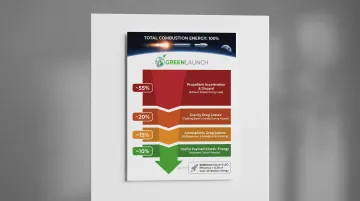
Propellant energy density is high but wasted:
- Kerosene-LOX: ~43 MJ/kg lower heating value
- LH2-LOX: ~141.8 MJ/kg higher heating value
- In both cases, ~90% of released energy goes to gravity drag, atmospheric drag, and accelerating propellant mass that is ultimately discarded
Why Chemical Rockets Still Dominate
Despite energy inefficiency, chemical rockets remain the only practical option for:
- Crewed missions requiring low-g ascent
- Fragile payloads (sensitive instruments, biological cargo)
- Mid-flight trajectory correction capability
- Proven heritage and operational reliability
These advantages come at a steep energy and cost premium per ton to LLO. For sustained lunar economy operations, that premium compounds directly with mission frequency—a structural limitation that alternative launch approaches are designed to address.
Electromagnetic Launchers: Maximum Efficiency, Maximum Constraints
Electromagnetic launchers—railguns, coilguns, and mass drivers—accelerate payloads along a track using electromagnetic force. They convert electrical energy directly into kinetic energy with no onboard propellant, which puts them at the top of the efficiency chart for reaching orbital or trans-lunar velocities.
Theoretical Efficiency Meets Engineering Reality
O'Neill's 1977 NASA mass driver study calculated optimized lunar launcher efficiency at 96.4% (electrical-to-payload kinetic energy) at 1,000 g acceleration, rising to ~97% at 100 g. A contemporary lunar mass driver thesis cites driver efficiency of 84%, with total chain efficiency of 71% when including solar array losses—still far superior to chemical rockets.
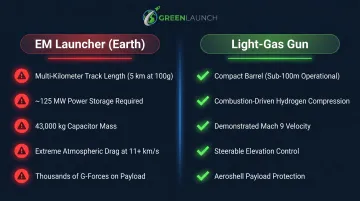
But Earth-based EM launchers face severe barriers:
- Atmospheric drag and heating: To reach LLO-bound velocities (~11+ km/s), a ground-based launcher must fire through dense lower atmosphere. Aerodynamic heating and drag consume a large fraction of muzzle kinetic energy before the payload clears the sensible atmosphere.
- Extreme acceleration loads: Payloads experience thousands of g's, limiting use to hardened, non-fragile cargo only.
- Massive infrastructure: Multi-kilometer track length, multi-hundred-megawatt power storage, and active guidance systems are not yet built at operational scale. O'Neill's design alone required a 488 m track at 1,000 g (or ~5 km at 100 g), ~125 MW of system power, and over 43,000 kg of capacitor mass.
Where EM Launchers Make Sense: The Moon
Those Earth-based constraints largely disappear on the lunar surface. No atmosphere, one-sixth the gravity, and a much lower escape velocity change the math entirely.
NASA studies of lunar EM launch show exit velocities of 1.7 km/s for 100 km LLO insertion, with accelerator lengths of just ~150 m at 983 g. The energy cost for lunar-to-LEO is approximately 5% of Earth-to-LEO. That figure points to a clear application: EM mass drivers are suited for exporting bulk materials off the Moon, not for getting payloads down to it from Earth.
Light-Gas Guns: The Energy-Smart Alternative
A light-gas gun uses a piston-driven or combustion-driven compression of a low-molecular-weight gas (typically hydrogen) to accelerate a projectile to hypersonic velocities. Because hydrogen has a much higher speed of sound than combustion gases, the theoretical maximum muzzle velocity is significantly higher than conventional propellant guns.
Laboratory light-gas guns have demonstrated velocities above 7.8 km/s—well into the range needed for space launch applications.
The Energy Efficiency Advantage
Unlike a rocket, a light-gas gun applies propulsive energy externally to the payload. The "propellant" (the driver gas) is not launched with the payload. This means the energy spent is almost entirely directed at accelerating the payload mass, not a massive propellant load.
For chemical rockets, the Tsiolkovsky equation forces propellant-to-payload ratios of 50:1 or higher for LLO missions. Light-gas guns eliminate this exponential penalty—energy input scales linearly with payload mass, not exponentially with delta-v.
Operational Profile for LLO Delivery
A payload launched from a light-gas gun still requires a small onboard propulsion system for trajectory correction and lunar orbit insertion burn. The mission delta-v breaks down as follows:
- Gun-provided: 9–11 km/s to escape Earth
- Onboard kick stage: ~0.9 km/s for final LLO insertion (NASA figures)
This hybrid approach—gun-launched with a minimal kick stage—cuts the total energy budget substantially compared to an all-chemical mission. The kick stage carries a fraction of the propellant a ground-launched rocket would need for the same delivery.
G-Load and Payload Constraints
Like EM launchers, light-gas guns impose high launch accelerations. JHU/APL studies note accelerations ~2 orders of magnitude higher than conventional launch, implying thousands of g's. This makes them unsuitable for fragile electronics or humans without engineering mitigation.
Best-suited payloads include:
- Raw construction materials
- Water and fuel precursor chemicals
- Radiation shielding mass
- Dense structural components
- Ruggedized equipment designed for high-g environments
Green Launch: Light-Gas Technology in Practice
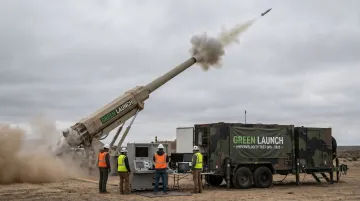
Green Launch's proprietary system—developed by CTO Dr. John W. Hunter, who led the SHARP project at Lawrence Livermore National Laboratory—uses a hydrogen-oxygen combustion driver with precision gas injection to prevent errant detonation in the combustion chamber.
Testing at Yuma Proving Ground has achieved 2.97 km/s (Mach 9) horizontally and Mach 3+ vertically. December 2021 vertical tests placed a 28-pound projectile at an estimated 30 km altitude, validating the approach for sub-orbital and space-access trajectories.
Those results confirm that light-gas technology can deliver meaningful launch velocity at operational scale today—a critical data point in any honest comparison of the energy cost per ton to low lunar orbit.
Energy Per Ton to Low Lunar Orbit: Three-Way Comparison
Establishing the Baseline
Low lunar orbit (LLO) is typically defined as a ~100 km circular orbit around the Moon. The standard delta-v budget from Earth's surface to LLO, per NASA's 1988 lunar mission analysis:
- Earth surface to LEO: 9.1 km/s
- LEO to trans-lunar injection: 3.2 km/s
- TLI to LLO insertion: 0.9 km/s
- Total LEO to LLO: 4.1 km/s
Total mission delta-v including gravity and drag losses approaches 13 km/s.
Energy Comparison Framework
For each technology, the useful energy delivered to LLO per ton of payload equals:
(Kinetic + potential energy of 1 tonne at LLO) ÷ (Total energy expended per tonne delivered)
This ratio varies by orders of magnitude across technologies:
- Chemical rockets carry their energy source but waste most of it on propellant mass
- EM and light-gas systems apply energy externally, with far better payload-to-energy ratios
These differences become concrete when you anchor to verified energy minima. LLO falls between LEO and Earth escape in energy cost, but the multi-burn trajectory makes it disproportionately expensive for propellant-carrying systems:
- LEO (500 km): 33.5 GJ/tonne
- Earth escape: 62.6 GJ/tonne
- LLO: between these bounds, but compounded by multiple burns over a week-long trajectory
Propellant Overhead Multiplier for Chemical Rockets
Because chemical rockets must launch propellant to burn propellant, the effective energy cost per ton of payload grows non-linearly with distance from Earth. LLO compounds this penalty through multiple discrete burns — each one requiring propellant that itself had to be launched.
NASA's 1988 analysis shows payload mass fractions for chemical systems:
| Mission Leg | Mass Ratio |
|---|---|
| LEO to post-LOI | 2.7 (37% payload retention) |
| LEO to lunar surface (cargo) | 7.0 (14% payload retention) |
For Earth-to-L1 tanker missions, propellant-to-payload ratios reach 74.8:1, meaning 98.7% of launch mass is propellant.
Realistic Efficiency for Gun-Based Systems
Gun-based systems offer much higher theoretical efficiency than chemical rockets, but real-world implementations must account for atmospheric exit drag — a high-velocity projectile loses a measurable fraction of muzzle kinetic energy before clearing the sensible atmosphere.
Three design variables drive how much energy survives that transit:
- Ballistic coefficient: higher mass-to-frontal-area ratios reduce drag deceleration
- Launch elevation angle: steeper trajectories shorten atmospheric path length
- Barrel length: longer barrels allow higher muzzle velocities, improving energy margins
Green Launch's 54-foot barrel reaches Mach 9 demonstrated velocities, with adjustable elevation up to 90 degrees and aeroshell protection to limit drag heating on ascent.
Summary Comparison Table
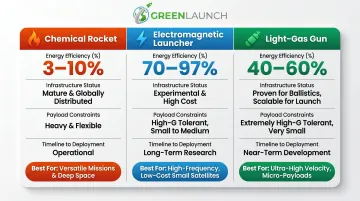
| Technology | Energy Efficiency | Infrastructure Status | Payload Constraints |
|---|---|---|---|
| Chemical Rocket | 3–10% (payload energy / total input) | Operational today | All payload types |
| Electromagnetic Launcher (Earth) | ~70–97% electrical-to-kinetic | Largely unbuilt; multi-decade timeline | Hardened cargo only; extreme g-forces |
| Light-Gas Gun | ~40–60% effective (after atmospheric drag) | Demonstrated at sub-scale; scalable near-term | Ruggedized cargo; high g-tolerance |
| EM Mass Driver (Lunar) | ~71–97% electrical-to-kinetic | Conceptual; requires lunar infrastructure | Hardened cargo only |
Which Technology Fits Your Lunar Mission?
Decision Factor 1: Payload Type and Mission Profile
Chemical rockets remain the only option for:
- Crewed missions requiring low-g ascent (<5 g)
- Fragile scientific instruments and biological cargo
- Satellites with delicate deployables or optics
Light-gas and EM systems are competitive for:
- High-volume, rugged bulk cargo (fuel, water, shielding, structural mass)
- Dense payload that can tolerate 1,000+ g launch environments
- Missions prioritizing cost-per-kilogram over launch flexibility
For a sustained lunar economy, bulk cargo will dominate mission manifests—exactly the category where gun-based launch excels.
Decision Factor 2: Infrastructure Timeline and Capital Cost
Infrastructure reality check:
- Chemical rockets: Available today but lock in high per-mission energy costs indefinitely
- EM launchers (Earth-based): Require multi-kilometer tracks, multi-hundred-MW power systems, and massive capital investment before first launch—timeline measured in decades
- Light-gas guns: Demonstrated at operational scale; scalable infrastructure without speculative technology leaps—deployable within 5–10 years for cargo missions
Light-gas systems like Green Launch's represent a near-term, buildable technology ready to serve the bulk cargo market at lower energy and cost per ton. That advantage compounds over time: there's no waiting on multi-decade EM infrastructure programs, and no accepting the permanent energy penalty that chemical propulsion locks in.
Call to Action
If you're evaluating launch alternatives for bulk cargo delivery to LLO, contact Green Launch to discuss how light-gas propulsion can reduce the energy and cost burden of your missions.
The team brings direct heritage from the SHARP program at Lawrence Livermore and has completed successful vertical light-gas launch demonstrations — a proven foundation for lunar cargo delivery at scale.
📧 Eric Robinson, Strategic Outreach: eric.robinson@greenlaunch.space | (408) 422-1096
📧 Dr. John W. Hunter, CTO: jwhunter2004@yahoo.com | (619) 933-6678
🌐 greenlaunch.space
Frequently Asked Questions
How much fuel does a rocket launch use and how much does that fuel cost?
A typical lunar mission rocket carries propellant-to-payload mass ratios exceeding 50:1 for Earth-to-LLO profiles. Raw propellant cost for a medium-lift vehicle typically runs $1–3 million—a small fraction of total mission cost—but the sheer volume required limits launch cadence and drives significant per-mission expense.
Do rockets really go 25,000 mph?
Orbital velocity in LEO is approximately 17,500 mph (~7.8 km/s), but trans-lunar trajectories require higher speeds. Earth escape-class trajectories reach around 25,000 mph (~11 km/s) to break free of Earth's gravity. Velocity matters critically to energy calculations because kinetic energy scales with the square of velocity—doubling speed quadruples energy requirements.
What is a light-gas gun and how does it work for space launch?
A light-gas gun compresses hydrogen to extreme pressures using a piston or combustion driver, then releases that pressure to accelerate a projectile far beyond what conventional propellant guns can achieve. Laboratory systems have demonstrated velocities above 7.8 km/s, making them viable for launching rugged payloads to orbit or trans-lunar trajectories with no onboard propellant needed for the initial boost phase.
Can electromagnetic launchers deliver payloads to the Moon?
Earth-based EM launchers face severe atmospheric drag challenges at the velocities needed for lunar missions, limiting their near-term practicality. However, EM mass drivers are considered highly practical on the lunar surface itself—no atmosphere, lower gravity—where they could efficiently launch bulk materials into lunar orbit or onto Earth-return trajectories at exit velocities around 1.7–2.4 km/s.
Why is chemical rocket propulsion so energy-inefficient for lunar missions?
The Tsiolkovsky rocket equation demands exponentially more propellant as total delta-v increases. For Earth-to-LLO missions requiring ~13 km/s, a rocket must burn fuel to carry fuel. The vast majority of combustion energy accelerates propellant that gets discarded, leaving only 3–10% to move the actual payload.
What types of payloads are best suited for light-gas launch systems?
Light-gas guns suit dense, structurally rugged payloads: water, raw construction materials, fuel precursor chemicals, radiation shielding, and hardened equipment. Modern commercial electronics can survive over 30,000 g with minor modifications. These categories align directly with the bulk cargo demands of a growing lunar economy, not crewed missions or sensitive instruments.