Introduction
Procuring launch services represents one of the highest-stakes procurement decisions an aerospace organization, government agency, or satellite manufacturer will face. Yet many organizations enter the RFP process without a clear strategy—exposing themselves to mission delays, cost overruns, and contractual disputes.
The complexity is real: launch contracts encompass payload integration, precise orbit specifications, risk allocation, liability limits, and scheduling across multiple providers with vastly different capabilities. A well-structured RFP isn't just a procurement formality—it's mission insurance.
This guide covers what a launch service provider RFP must include, how to evaluate providers objectively, and which pitfalls most commonly derail missions or produce bad contracts.
TLDR:
- Launch service RFPs require technical precision—vague payload specs and orbit parameters produce incomparable proposals
- Commercial RFPs offer flexibility, but without clear evaluation criteria, provider comparisons break down fast
- Evaluation must weigh technical heritage, schedule confidence, pricing, and—increasingly—environmental impact
- Median smallsat launch delays reach 128 days—build in timeline flexibility and mandate reflight guarantees
- Emerging providers with non-traditional propulsion—such as hydrogen light-gas systems—can deliver strong cost and sustainability advantages
What Is a Launch Service Provider RFP (and When Do You Need One)?
A Launch Service Provider (LSP) RFP is a formal solicitation document issued by an organization seeking launch services. It invites qualified providers to submit competitive proposals for delivering payloads to orbit or suborbital trajectories, covering technical, pricing, and contractual requirements.
Launch contracts are inherently complex. They govern payload integration, orbit specifications, risk allocation, liability limits, and scheduling — elements that determine mission success and legal exposure alike. Direct negotiation without an RFP typically produces unclear requirements, incomparable pricing, and disputes after award.
A range of organizations issue LSP RFPs, each with different procurement rules and mission priorities:
- Government agencies (NASA, Space Force, Space Development Agency)
- Satellite manufacturers and constellation operators
- Scientific research institutions
- Defense contractors
- Commercial space companies deploying constellations
Government issuers operate under FAR regulations, while commercial entities have more flexibility — though both still need clearly defined evaluation criteria to run a fair competitive process.
Before issuing an RFP, many organizations start with an RFI. According to FAR 15.201, an RFI (Request for Information) surveys available launch options and provider capabilities when the government "does not presently intend to award a contract." An RFP, by contrast, is a binding solicitation that triggers formal proposals and contract negotiation. Knowing which document you need — and when — prevents wasted effort on both sides.
Key Components of a Well-Written Launch Service Provider RFP
Payload and Mission Specifications
The RFP must define:
- Payload mass and volume: exact dimensions and mass budget
- Orbit parameters: target inclination, altitude, and orbit type (LEO, SSO, GTO, polar)
- Interface requirements: mechanical and electrical integration specifications
- Acceptable launch windows: primary and backup dates
Vague definitions produce proposals that can't be compared side-by-side—and often force costly renegotiation after award.
Launch Vehicle and Certification Requirements
Specify whether providers must use certified launch vehicles. For example:
- NASA's NPD 8610.7D categorizes launch vehicles by risk:
- Category 2: 89% demonstrated reliability (medium risk)
- Category 3: 95% demonstrated reliability (low risk)
Requiring full certification significantly narrows the eligible bidder pool—but may be necessary for high-value payloads.
That said, broadening eligibility to include providers using non-traditional propulsion—such as Green Launch's hydrogen light-gas impulse systems, which completed first vertical launch testing in 2022—can reduce costs, lower environmental impact, and increase competition, particularly for acceleration-tolerant smallsat payloads.
Payload Integration and Deployment Requirements
Describe:
- Integration responsibilities (who owns transport, testing, deployment)
- Required deployer or adapter types (e.g., Cal Poly's CDS rail-based system vs. Planetary Systems' tab-based CSD)
- Environmental testing obligations
- Who bears integration costs and risk
CubeSat deployer standards:
| Standard | Constraint Mechanism | Key Features |
|---|---|---|
| Cal Poly CDS (Rev 14.1) | Rail-based | Standard 1U-12U dimensions; requires rails ≥8.5mm wide |
| PSC CSD | Tab-based | Preloaded payload tabs; allows 15% more payload volume |
Specify the exact deployer system in your Statement of Work to ensure compatibility.
Schedule and Manifest Flexibility
Define:
- Required launch date
- Acceptable delay windows
- How manifest adjustments will be handled
- Provider's launch cadence and backlog
Critical context: A 2020 BryceTech study found that all 1,078 smallsats launched commercially over five years experienced delays, with a median slip of 128 days. Launch vehicle issues accounted for 34% of these delays.
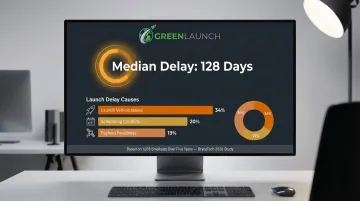
Action: Build flexible integration timelines and mandate reflight guarantees or liquidated damages for provider-caused delays.
Risk Allocation, Liability, and Insurance Requirements
Schedule risk and liability are directly connected: when delays occur, the question of who absorbs the cost lands squarely in your contract's liability provisions. Get these terms right upfront.
Industry norms:
- Launch providers typically limit liability to relaunch cost or refund—not unlimited damages
- Under 51 U.S.C. 50914, launch licensees must obtain liability insurance up to $500 million for third-party claims
- The statute mandates reciprocal cross-waivers of claims, meaning each party accepts responsibility for its own property damage or employee injury
Your RFP should specify acceptable liability caps and require bidders to detail their insurance coverage—both launch phase and in-orbit—so you can evaluate total risk exposure, not just launch price.
Pricing Structure and Contract Type
State whether the contract will be:
- Firm-fixed-price
- Task-order-based
- Block-buy arrangement
Instruct bidders to provide fully-burdened pricing that includes all integration, support, and mission assurance costs. A lower headline price that excludes integration fees can easily add 20–40% to your actual mission cost.
Evaluation Criteria: How to Assess and Score LSP Proposals
Technical Capability and Heritage
Look for:
- Number of successful launches
- Payload classes served
- Mission types completed
Don't discount newer providers with novel technologies. Green Launch's hydrogen light-gas propulsion system, for example, produces only water vapor as exhaust — achieving virtually zero carbon emissions compared to traditional hydrocarbon rockets that generate over 19 tons of CO2 per ton of payload delivered to orbit.
Mission Assurance and Reliability
Assess:
- Quality management systems
- Failure analysis processes
- Certification status (NASA Category 2/3, AS9100)
For government missions, reliability classification is often a pass/fail threshold.
Schedule Confidence and Launch Availability
Key factors to evaluate:
- Provider's current manifest and booking lead times
- Demonstrated ability to meet contracted launch windows
- How they handle delays and communicate slips
- Average schedule slip data from past missions
With median smallsat delays reaching 128 days, schedule reliability deserves heavy evaluation weighting — and those delays translate directly into cost overruns on your end.
Pricing Competitiveness and Value
Compare fully-burdened costs across providers, accounting for:
- Integration services
- Insurance facilitation
- Mission support requirements
Price rarely dominates in well-structured RFPs. NASA's Europa Clipper RFP weighted Mission Suitability at 1,000 points (Technical: 700, Management: 250), with Mission Suitability and Past Performance combined outweighing Price as an evaluation factor.
Sustainability and Environmental Considerations
Environmental impact is now a formal weighted criterion in many government and commercial RFPs, driven partly by FAA NEPA compliance timelines that add schedule risk for hydrocarbon-fueled launches.
Propellant comparison:
| Propellant Type | Primary Emissions | Stratospheric Impact |
|---|---|---|
| Hydrocarbon (RP-1) | Black carbon, CO2, H2O | Black carbon absorbs solar radiation, warming stratosphere and contributing to ozone loss |
| Hydrogen/Oxygen (LH2/LOX) | H2O only | No black carbon; produces no aerosol-forming emissions in the stratosphere |
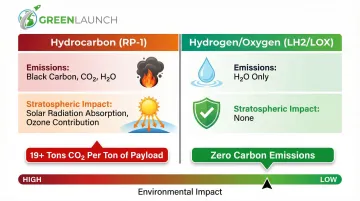
Providers using eco-friendly propellants may score favorably, particularly as FAA NEPA compliance timelines add schedule risk for hydrocarbon-fueled launches.
Government vs. Commercial Launch RFPs: Key Differences
Government RFPs
Operate under strict procedural procurement rules:
- Formal certification requirements
- Defined evaluation methodologies
- Segmented competitions (e.g., NSSL's dual-lane approach)
NSSL Phase 3 dual-lane strategy:
| Feature | Lane 1 | Lane 2 |
|---|---|---|
| Target Missions | Risk-tolerant vehicles to commercial orbits | DOD's highest-value payloads to stressing orbits |
| Contract Structure | Multiple award IDIQ; 5-year base + 5-year option | Requirements contracts for 3 providers; 5-year ordering period |
| Certification | Requires 1 successful launch; annual on-ramps | Requires min. 2 successful launches by Oct 2026; no on-ramps |
Lesson from GAO protest: In B-417839, Blue Origin successfully protested the Air Force's NSSL Phase 2 RFP because its "when combined" best-value methodology failed to evaluate proposals on individual merits. Action: Section M of your RFP must explicitly weight all factors and evaluate proposals independently.
Commercial RFPs
Offer more flexibility in:
- Negotiation terms
- Vehicle selection
- Contractual language
Satellite industry risk norms — strict liability limits, manufacturer indemnification, limited recourse after ignition — often conflict directly with government procurement regulations. This mismatch is a leading cause of "no-bid" responses from qualified providers. Resolve it before issuing the RFP: loop in both procurement counsel and commercial launch industry experts during the solicitation drafting phase.
Common Mistakes to Avoid When Issuing a Launch Service RFP
Underspecifying Technical Requirements
Vague payload definitions, undefined orbit parameters, or missing interface standards produce incomparable proposals and force post-award renegotiation.
The Space Development Agency learned this during Tranche 0, when integrating satellites from different manufacturers proved difficult because commercial buses were less standardized than expected. RFPs must mandate strict adherence to Interface Control Documents (ICDs).
Ignoring the Integration and Deployment Lifecycle
Organizations often focus exclusively on the launch event, neglecting:
- Transport logistics
- Customs clearance
- Pre-launch environmental testing
- Deployer compatibility
These gaps cause significant schedule delays and cost overruns.
Using a Rigid Evaluation Framework That Excludes Emerging Providers
Overly prescriptive certification requirements may inadvertently disqualify innovative, cost-effective providers.
Structure the RFP with tiered eligibility criteria or an on-ramp mechanism. NASA's NLS II does this well — its annual on-ramp provision accepts proposals from new providers every August, keeping the competitive pool open while giving emerging technologies a path to qualify.
Navigating the LSP RFP Process: A Step-by-Step Timeline
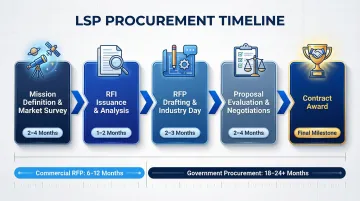
Typical procurement phases:
- Mission definition and market survey: 2–4 months
- RFI issuance and response analysis: 1–2 months
- RFP drafting and industry day: 2–3 months
- Proposal evaluation and negotiations: 2–4 months
- Contract award
These phases add up quickly — and the gap between commercial and government procurements is substantial:
| Procurement Type | Typical Timeline |
|---|---|
| Commercial RFP | 6–12 months (issuance to signature) |
| Government procurement | 18–24+ months (draft RFP to final award) |
Example: NSSL Phase 3 Lane 1 RFP was issued in October 2023, proposals were due in December 2023, and initial awards were made in June 2024—an 8-month cycle just for the IDIQ base.
Sequence the LSP RFP alongside two other contracts:
- Satellite construction contract
- Insurance placement
Risk of loss typically transfers at ignition under 51 U.S.C. 50914 cross-waivers. That means your launch contract timeline must align with satellite delivery milestones and insurance attachment dates — or you risk an uninsured coverage gap.
Frequently Asked Questions
What is a launch service provider RFP?
A launch service provider RFP is a formal solicitation document issued by an organization (government, commercial, or research) to invite qualified launch providers to submit competitive proposals for delivering payloads to a specified orbit. It covers technical specifications, pricing structures, and contractual requirements necessary for mission success.
What should be included in a launch service RFP?
Core elements include:
- Payload and mission specifications with orbit requirements
- Launch vehicle certification criteria and integration responsibilities
- Deployer/adapter specifications and risk/liability terms
- Insurance requirements, pricing structure, and schedule expectations
- Evaluation methodology with weighted scoring factors
How long does a launch service RFP process typically take?
Commercial RFPs generally take 6-12 months from issuance to contract signature. Government procurement cycles (NASA, Space Force) typically span 18-24+ months due to mandatory evaluation periods, certification requirements, and potential GAO protests.
What evaluation criteria matter most when selecting a launch service provider?
Key weighted factors include:
- Technical heritage — verified successful launch track record
- Schedule reliability — consistent delivery within contracted windows
- Mission assurance certification (NASA Category 2/3, AS9100)
- Fully-burdened pricing, not just headline cost
- Sustainability credentials, including propellant choice and environmental impact
What is the difference between Lane 1 and Lane 2 in government launch RFPs?
Under frameworks like NSSL Phase 3, Lane 1 targets risk-tolerant, commercially-addressable vehicles with flexible annual on-ramping and requires only one successful prior launch. Lane 2 requires fully certified vehicles (minimum two successful launches) for complex national security orbits under a five-year requirements contract structure with no on-ramps.
Can emerging or non-traditional launch providers respond to government RFPs?
Yes. Many government RFPs—like NASA's NLS II on-ramp—explicitly invite emerging providers to qualify. Innovative technologies, including alternative propulsion systems such as hydrogen light-gas launchers, can compete provided they meet baseline payload delivery and reliability thresholds. On-ramp mechanisms allow new entrants to demonstrate capability without affecting existing contract awards.