
Introduction
Somewhere between 50 and 85 kilometers above your head sits a layer of atmosphere that almost nothing can reach on purpose. Balloons run out of buoyant lift long before they get there. Satellites orbit comfortably above it but can't slow down and stay.
This creates what engineers sometimes call the "ignorosphere" — a zone that's poorly measured precisely because it's so hard to occupy.
For aerospace, defense, satellite, and atmospheric research organizations, that gap matters. Climate modeling, communications research, and hypersonic characterization all depend on direct data from this altitude band. Without it, models rely on guesswork stitched together from remote sensing and brief rocket passes.
This article breaks down three distinct problems that often get lumped together: delivering a payload through the mesosphere, deploying it once it arrives, and sustaining operations there. Each requires different engineering, and confusing them leads to unrealistic mission planning.
Key Takeaways
- Thin mesospheric air defeats balloon lift yet still creates drag and heating that challenge many spacecraft.
- Delivery, deployment, and persistence are separate engineering problems, not one continuous solution.
- Sounding rockets, suborbital vehicles, photophoretic flyers, and light-gas systems each close a different gap.
- Match payload mass, dwell time, and altitude precision to the right insertion method.
The Mesosphere: The Atmospheric Region Between Balloons and Satellites
The mesosphere sits above the stratosphere and below the thermosphere. According to NOAA, it spans roughly 50 to 85 kilometers, though a NASA rocket-sounding reference from the 1960s places the upper boundary closer to 90 km. The exact number shifts with the convention a researcher uses, because atmospheric layers blend into one another rather than ending at sharp cutoffs.
A Layer That Changes Constantly
This is not a uniform shell of air. Pressure and density drop steadily with altitude, while temperature behaves in reverse of what you'd expect near the ground: it decreases as you climb into the mesosphere, reaching around -15°C near its lower edge.
Composition shifts too. Below about 80 km, the mix stays close to the familiar 78% nitrogen, 21% oxygen ratio found at sea level. Above that, gravitational separation and oxygen dissociation start changing the average molecular weight, and constituents like ozone, water vapor, and atomic oxygen begin driving thermal structure.
What Actually Happens Up There
The mesosphere isn't just empty space waiting to be crossed. It's an active layer that:
- Hosts noctilucent clouds: ice particles forming 50-86 km up that can reflect sunlight after sunset
- Burns up incoming meteors through atmospheric friction and heat
- Carries gravity waves that transport energy from the lower atmosphere upward
- Supports seasonal zonal and meridional wind circulation patterns that differ between winter and summer
Direct observations here feed into climate modeling, space-weather forecasting, and communications research. Remote sensing from orbit tells you a lot, but it can't replace an in-situ measurement taken at the actual altitude where a phenomenon occurs.

Why Conventional Systems Miss the Mesosphere
Three platform types dominate atmospheric access. All three hit hard physical limits short of sustained mesospheric access.
The Balloon Ceiling
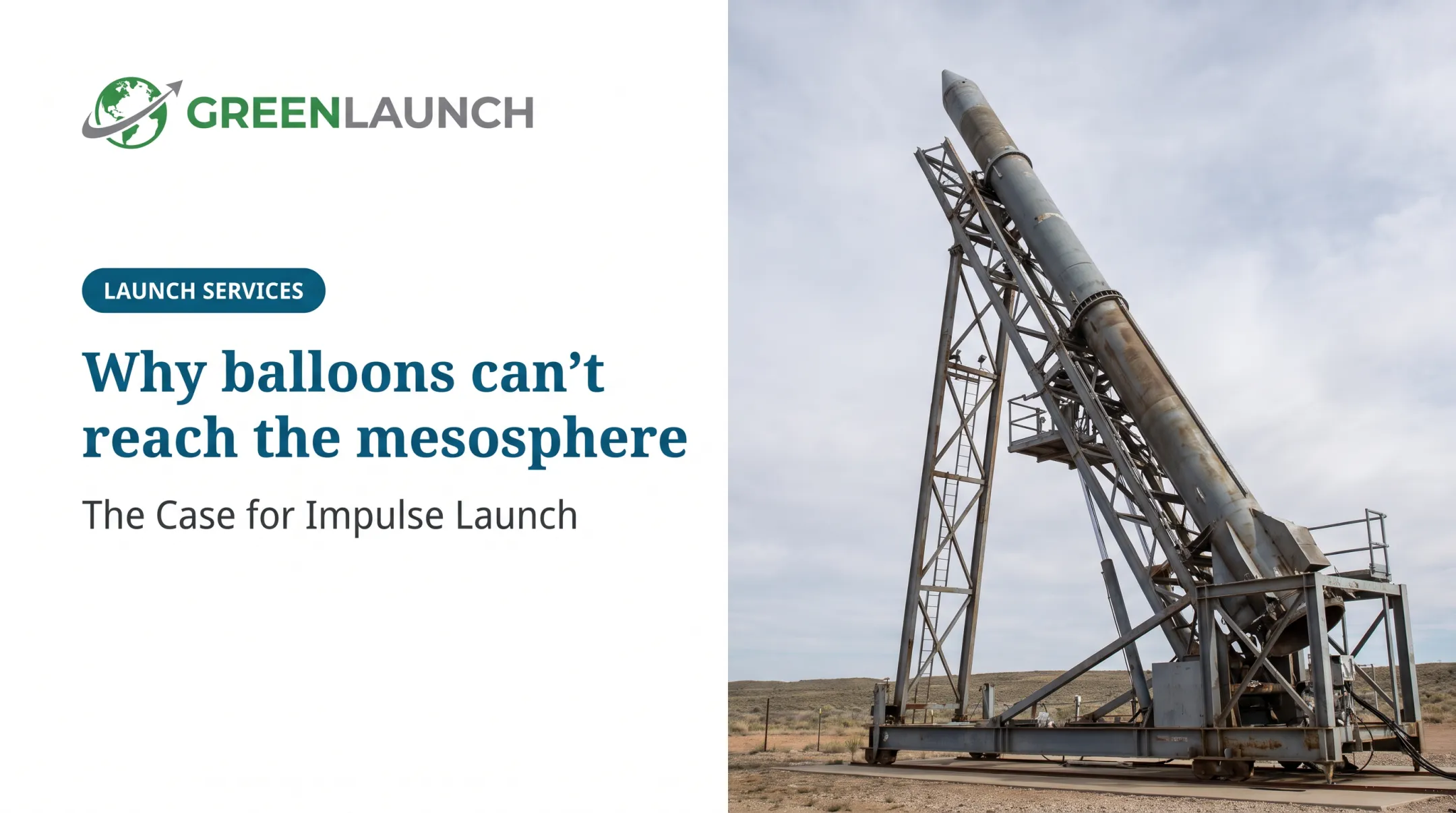
Buoyant lift depends on the density difference between the gas inside an envelope and the air outside it. As altitude climbs, outside air density collapses. NASA's highest recorded scientific balloon altitude sits around 160,000 feet, where air density runs 100 to 200 times lower than at sea level. According to JAXA, balloons simply cannot float above approximately 50 km. Beyond that point, no practical envelope size solves the problem.
The Aircraft Ceiling
Wings and propellers need air molecules to push against. NASA's lift equation makes the dependency explicit: lift scales directly with air density. As density falls, an aircraft needs more speed, more wing area, or both, just to maintain the same lift. Thermal loads and control-authority problems compound the issue, so conventional powered flight runs out of options well before mesospheric altitudes.
The Satellite Gap
Satellites don't avoid the mesosphere by choice — orbital mechanics won't let them linger there. Atmospheric drag, even the faint trace present near 100-150 km, is strong enough to degrade an orbit over time. That's why JAXA's own comparison places satellites above roughly 250 km and reserves the 50-250 km band for sounding rockets, the one platform built to pass directly through it.
Comparison at a glance:
| Platform | Altitude access | Dwell time | Best use case |
|---|---|---|---|
| Balloon | Below ~50 km | Hours to days | Stratospheric research |
| Aircraft | Below ~20 km | Hours | Reconnaissance, comms relay |
| Sounding rocket | 50-250+ km | 5-20 minutes | Brief in-situ sampling |
| Satellite | 250+ km | Continuous | Remote sensing, not direct sampling |
Sounding rockets fill the gap partially, but only for minutes at a time on a parabolic arc. That's the core access problem: the mesosphere is reachable as a transit zone, but nearly impossible to use as a stable operating environment.
How Mesospheric Payload Delivery Could Work
Getting a payload into the mesosphere follows a clear sequence. Each stage has its own failure modes:
- Launch or ascent
- Atmospheric insertion
- Separation and stabilization
- Data collection or communication
- Descent, disposal, or recovery
Insertion Methods
- Sounding rockets and suborbital vehicles — the workhorse for brief experiments. NASA's Improved-Orion missions have reached roughly 71 miles to study meteor ablation, noctilucent clouds, and upper-atmosphere chemistry. Limitation: not built for repeated measurements at the same altitude over time.
- Lighter-than-air or aerodynamic carriers — release small sensors near the target altitude, then fall back. They need specialized materials and precise timing, because remaining air density at release is too thin for much maneuvering.
- Photophoretic flyers — an emerging low-mass option. Light on an unevenly absorbing surface creates asymmetric heating that pushes gas molecules off the warmer side, producing thrust in low-pressure air. A 2025 study published in Nature showed a 1-cm perforated structure levitating at 26.7 Pa under simulated sunlight and proposed a scaled design for a 10-milligram payload near 75 km. The result is still laboratory-only; horizontal control and overnight power loss remain unsolved.
- Guided, propelled delivery — high-velocity systems, including light-gas propulsion, that place payloads on controlled suborbital trajectories toward a specific release point.

Where Green Launch Fits This Picture
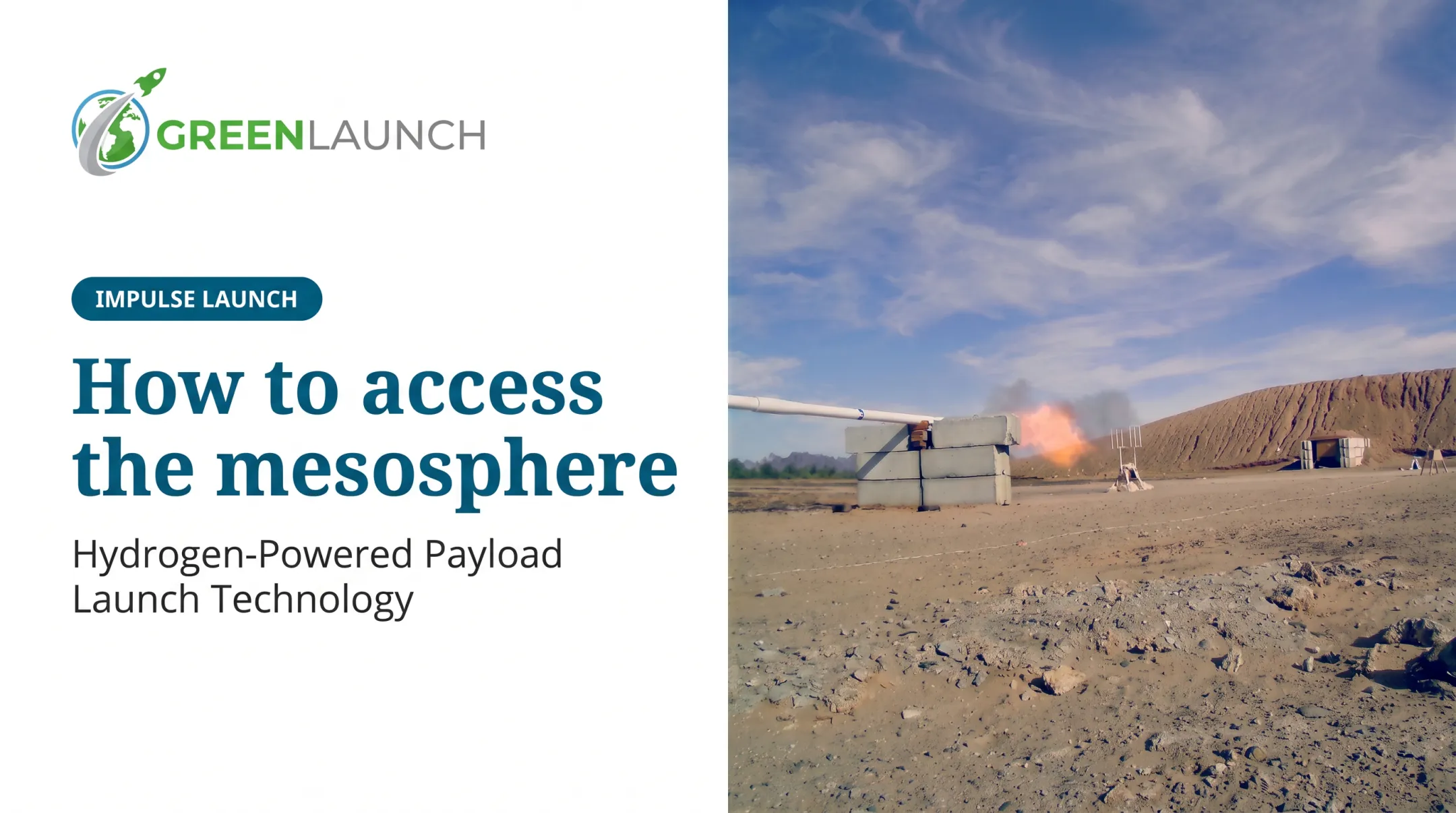
Green Launch sits on the launch-technology pathway, not as a persistent mesospheric platform. It uses hydrogen combustion to drive projectiles through a launch tube at extreme velocity — testing has reached Mach 9 in horizontal configurations and more than Mach 3 on a vertical shot. That acceleration is built for inserting a payload quickly and repeatably, which is a different job than keeping something aloft for hours.
Comparing the options by what actually matters:
| Method | Payload mass | Dwell time | Technology readiness |
|---|---|---|---|
| Sounding rocket | Kilograms to hundreds of kg | Minutes | High (operational for decades) |
| Photophoretic flyer | Milligrams to grams | Hours (proposed) | Low (lab demonstration only) |
| Light-gas launch | Grams to pounds | Seconds (transit) | Medium (active flight testing) |
No single method wins outright. A climate researcher needing repeatable altitude profiles wants something different than a defense customer testing hypersonic materials for a few seconds of exposure.
Mission Applications and Design Requirements
Different customers need different things from mesospheric access. The payload should drive platform choice, not the reverse.
Scientific Payloads
Atmospheric researchers typically need sensors for:
- Temperature, pressure, and wind profiling
- Gas composition and trace-chemistry sampling
- Gravity-wave and noctilucent-cloud observation
- Meteoric dust and ablation-material collection
Instrument performance changes with target altitude. A sensor calibrated for 60 km will not necessarily behave the same way at 85 km, where density and composition shift enough to affect sampling, calibration, and signal quality.
Communications and Defense Interest
Some organizations are testing temporary relay nodes and signal-propagation experiments in this band; most of that work is still experimental. Defense and aerospace teams often prioritize:
- Responsive, on-demand testing windows
- Hypersonic-environment characterization
- Tracking and telemetry research
Design Requirements That Don't Go Away
Regardless of mission type, every mesospheric payload has to account for:
- Mass and volume limits set by the insertion method
- Power budget sized for the full mission duration
- Thermal control for rapid heating on ascent or descent
- Radiation and UV exposure at near-space altitudes
- Data-link availability throughout the observation window
- End-of-mission plan: recovery, disposal, or controlled reentry
The most workable planning sequence starts with altitude and dwell time, then works backward to insertion method, sensor package, and communications plan. Lock those mission constraints first so the platform is chosen against real mass, power, and recovery limits—not retrofit later at higher cost.
Green Launch's Light-Gas Launch Perspective
Green Launch was formed in 2017 to develop sustainable, cost-effective light-gas propulsion for high-altitude and orbital payload delivery. The company's technology traces back to hydrogen-launcher research pioneered at Lawrence Livermore National Laboratory, where hydrogen combustion accelerates payloads to extreme velocity without the emissions profile of a chemical rocket first stage.
Documented Progress
- 2017 — Testing contract signed with Yuma Proving Ground
- 2018 — Twelve successful horizontal test firings completed
- December 21, 2021 — First vertical light-gas launch, sending a 28-pound projectile beyond Mach 3 through a 54-foot tube
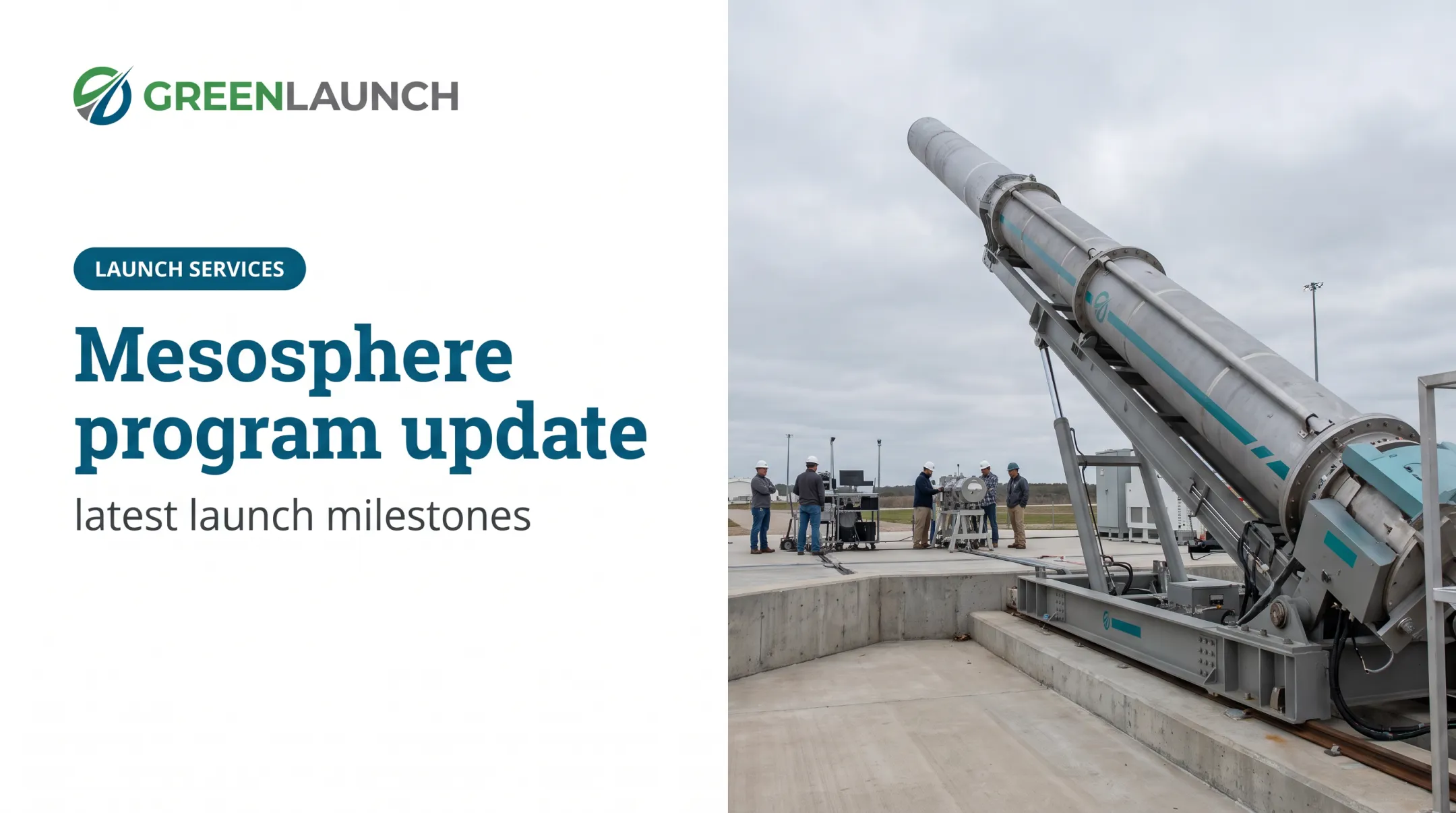
- Ongoing — Phase 2 development targeting a 200 km apogee with a one-month turnaround on sounding experiments

Green Launch has also identified atmospheric sampling of the mesosphere as a practical near-term application, with the National Science Foundation noted as a near-term customer conversation in 2022.
Its vehicles use a wound fiberglass structure that holds up under launch compression and stays transparent to RF signals—useful for antenna-based payloads.
An Insertion Technology, Not a Substitute for Persistent Flight
Light-gas propulsion is one piece of the mesospheric access puzzle. It inserts instruments quickly and repeatably, and it complements platforms built for longer dwell time rather than replacing them.
Organizations evaluating a mesospheric mission should work through payload requirements, target altitude, trajectory, and environmental constraints before deciding whether a light-gas approach is the right fit. Green Launch's technical team can help map those constraints to launch parameters and flight cadence.
Frequently Asked Questions
What is the approximate height of the mesosphere above Earth's surface?
Most references, including NOAA, place it between roughly 50 and 85 km. Some older NASA sources extend the upper boundary to 90 km, since the exact edges depend on scientific convention.
What does the mesosphere do?
It's where meteors burn up, noctilucent clouds form, and gravity waves carry energy upward from the lower atmosphere. It also plays a role in seasonal wind circulation and temperature layering.
Why can't balloons reach the mesosphere?
Buoyant lift depends on air density, which drops sharply with altitude. Balloons max out around 50 km because there simply isn't enough dense air left to push against, no matter how large the envelope.
Can satellites operate in the mesosphere?
Satellites can observe it remotely from higher orbit, but they can't maintain a stable low-altitude orbit within it. Atmospheric drag degrades any orbit that dips too close to this layer over time.
What kinds of payloads could be delivered to the mesosphere?
Common examples include temperature and pressure sensors, wind-tracking instruments, gas-composition samplers, and dust collectors. The right choice depends on mass limits, power needs, dwell time, and the chosen delivery method.