Introduction
The cost per pound to reach orbit has dropped from the Space Shuttle's $54,500/kg to under $3,000/kg with modern heavy-lift vehicles, cutting mission costs enough to open orbital access to universities, startups, and small defense agencies. For procurement teams, satellite operators, and research institutions, this metric is a key planning benchmark. But the headline number conceals enormous variation: actual price depends on rocket type, orbit destination, payload mass, rideshare versus dedicated launch, and whether the quoted figure reflects commercial retail pricing or a provider's internal cost structure.
Misreading these distinctions creates real risk. Most procurement teams discover the gaps only after signing a contract: integration fees, insurance premiums, and range costs left out of the initial quote that collectively derail timelines and budgets. Selecting the wrong vehicle class compounds the problem — overpaying for excess lift capacity, or choosing a low-cost option that can't reach your target orbital parameters, wastes both capital and schedule margin.
This guide covers current cost-per-pound benchmarks across vehicle classes, the technical and operational factors that drive pricing up or down, what's actually included (and what's not) in a launch contract, and how to build a realistic budget that accounts for the full mission cost stack.
Key Takeaways
- Current cost per pound to LEO ranges from a few hundred dollars (reusable heavy-lift at scale) to $25,000+ (dedicated small launchers)
- Reusability, launch cadence, and vertical integration drive costs most; SpaceX's internal cost runs roughly 25% of its retail price
- Rideshare gives small payloads the lowest per-pound rate; dedicated launches cost 3-4× more but give you schedule control
- Budget an extra 20-40% beyond base quotes for hidden costs: integration hardware, insurance, and licensing
- Emerging technologies like light-gas propulsion can cut costs significantly for acceleration-tolerant payloads
How Much Does It Cost Per Pound to Reach Orbit?
There is no single "price per pound to orbit." The figure varies by rocket, orbit (LEO vs. GTO vs. SSO), payload mass, flight model (rideshare vs. dedicated), and whether the number cited reflects commercial selling price or provider marginal cost. Many widely circulated cost figures conflate these variables, creating confusion during mission planning.
The risk of misreading these numbers is significant: underbudgeting your mission, selecting the wrong vehicle class, or overpaying for capabilities you don't need. Understanding the pricing tiers helps avoid these pitfalls.
Budget/Rideshare Tier
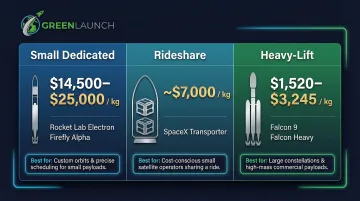
Cost range: $7,000/kg
Rideshare programs aggregate small payloads onto high-cadence launch vehicles, distributing fixed costs across multiple customers. SpaceX's Transporter program charges $7,000/kg for payloads above 50 kg to sun-synchronous orbit. ISRO's Small Satellite Launch Vehicle offers dedicated small-launch capability at $7,000-$8,200/kg for 500 kg payloads — sitting between pure rideshare and premium dedicated options on the cost curve.
Best for: Universities, startups, research institutions with flexible schedules and small payloads under 200 kg. Rideshare customers accept the provider's predetermined orbit and launch schedule in exchange for dramatically lower per-unit costs.
Mid-Range Dedicated Small Launcher Tier
Cost range: $14,500-$25,000/kg
Dedicated small launch vehicles provide orbital precision and schedule control at a premium. Firefly Alpha charges approximately $15 million for 1,030 kg to LEO ($14,563/kg), while Rocket Lab's Electron costs roughly $7.5 million for 300 kg ($25,000/kg). This 2-4× price premium over rideshare buys mission-specific orbital insertion and eliminates manifest wait times.
Best for: Commercial satellite operators requiring specific orbital parameters, responsive launch windows, or payloads incompatible with rideshare constraints.
Heavy-Lift / High-Volume Tier
Cost range: $1,520-$3,245/kg
Medium-to-heavy lift vehicles use economies of scale and reusable boosters to cut per-unit costs. Falcon 9's $74 million list price delivers 22,800 kg to LEO at $3,245/kg. Falcon Heavy's $97-$150 million range provides 63,800 kg capacity at $1,520-$2,350/kg. At this scale, reusable boosters with 30+ reflights amortize hardware costs across dozens of missions, compressing per-launch expenses.
Best for: Large satellite operators, constellation builders, and government agencies deploying payloads over 1,000 kg — where payload mass makes the per-kg savings decisive.
Commercial List Price vs. Provider Marginal Cost
This distinction matters. SpaceX's internal cost per Falcon 9 launch is estimated at $15-$28 million — roughly 20-38% of its $74 million selling price. This margin subsidizes internal projects like Starlink while setting a formidable competitive floor for emerging providers.
For mission planners, that gap has a practical consequence: a new entrant pricing at $50 million per launch isn't necessarily overcharging — they may simply lack the volume to match SpaceX's cost base yet.
Key Factors That Affect Cost Per Pound to Orbit
Launch pricing is shaped by technical, operational, and market forces in combination — no single variable dominates. Vehicle design, operational cadence, orbit destination, and supply chain structure each pull the per-pound cost in different directions.
Orbit Destination
Where you're going determines how much you'll pay. Geostationary Transfer Orbit (GTO) and beyond demand additional propellant and staging compared to Low Earth Orbit, significantly raising cost per unit mass. LEO missions to 400 km altitude require approximately 9.4 km/s delta-v; GTO missions require 12+ km/s. This energy penalty translates directly to higher propellant loads, larger upper stages, and reduced payload fractions. Sun-synchronous orbits launched from lower latitudes may carry range or trajectory premiums due to inclination requirements.
Reusability vs. Expendable Design
Fully or partially reusable first stages compress amortized manufacturing costs across multiple flights. SpaceX Falcon 9 booster B1067 reached 33 flights by early 2026, with refurbishment costing approximately 10% of a new rocket. High-flight-count boosters sharply cut per-launch expenses compared to expendable vehicles where full hardware costs sit on a single mission.
Vehicle Scale and Launch Cadence
Providers launching 50+ times annually spread fixed costs—ground operations, staff, infrastructure—across more missions, reducing per-launch overhead. SpaceX executed 134 Falcon flights in 2024. In contrast, low-cadence government vehicles concentrate fixed costs on very few flights. NASA's Space Launch System costs at least $2.5 billion per launch partly because fixed infrastructure costs are distributed across only one or two annual missions.
Payload Mass and Fill Rate
A 500 kg payload on a 10,000 kg-capacity vehicle pays proportionally more per pound than one that maximizes capacity — the rocket costs nearly the same either way. Rideshare aggregators solve this by pooling payloads to fill unused capacity, distributing costs across multiple customers.
Vertical Integration and Supply Chain
Providers manufacturing most components in-house — engines, avionics, structures — avoid external supplier markups and iterate faster. SpaceX produces 85% of its rocket components internally, cutting production costs by 40-60% compared to traditional outsourced models. That internal control shortens development cycles and keeps per-unit manufacturing costs lower than outsourced alternatives.
What Goes Into the Total Cost of a Launch Mission?
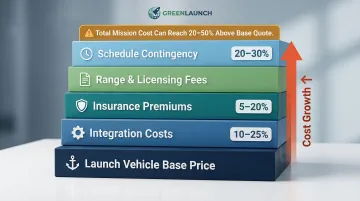
The per-pound launch price is only one component of total mission cost. Payload operators frequently underestimate the full cost stack, which can run 20-50% above the base launch quote. Each line item below is worth modeling before you sign a launch contract.
Launch Vehicle Price
The headline figure from the provider's price list or negotiated contract. Published list prices often exceed negotiated rates for anchor customers with multi-launch commitments. This is your largest single cost item — but the remaining items below routinely add 20-50% on top.
Payload Integration and Interface Costs
Integration includes payload adapter hardware, structural interface components, vibration and acoustic testing, fairing or dispenser fees, and integration labor at the launch site. Industry sources indicate integration costs typically range from 10-25% of the base launch price, varying by payload complexity and provider integration infrastructure.
Launch Insurance
Calculated as a percentage of payload replacement value. Commercial mission insurance premiums range from 5-20% of policy value, depending on launch vehicle flight heritage and payload systems. A $50 million satellite might carry $2.5-$10 million in insurance premiums. Newer vehicles with limited track records command higher rates.
Range, Licensing, and Ground Operations Fees
Often invisible in provider quotes but real costs nonetheless. The U.S. Space Force is shifting $4 billion in range infrastructure costs to commercial launch firms, and proposed FAA regulations would charge $0.25-$1.50 per pound of payload mass for licensing fees. For smaller payloads, these fees can rival integration costs as a percentage of total mission spend.
Mission Assurance and Schedule Risk
Launch delays create hidden costs through extended storage, payload retesting, and team standby expenses. A six-month slip can cost hundreds of thousands in labor and facility fees. Cheap launches that slip repeatedly accumulate costs that erase initial savings. Experienced teams budget 20-30% contingency for schedule risk, making on-time performance as valuable as the launch price itself.
Comparing Launch Options: Budget, Mid-Tier, and Premium
Choosing a launch approach involves trade-offs across cost, schedule control, payload compatibility, and reliability. The "cheapest per pound" option isn't always the lowest total mission cost when integration complexity, schedule certainty, and orbital precision are factored in.
Rideshare vs. Dedicated Launch Trade-Offs:
| Factor | Rideshare | Dedicated Small Launch | Heavy-Lift Dedicated |
|---|---|---|---|
| Cost per pound | ~$3,175/lb | $6,575–$11,340/lb | $690–$1,470/lb |
| Schedule flexibility | Fixed manifest | Mission-specific window | Negotiable |
| Orbital accuracy | Predetermined | Precise insertion | Precise insertion |
| Payload volume limits | Strict | Moderate | Large capacity |
| Typical lead time | 6-18 months | 3-12 months | 12-24 months |
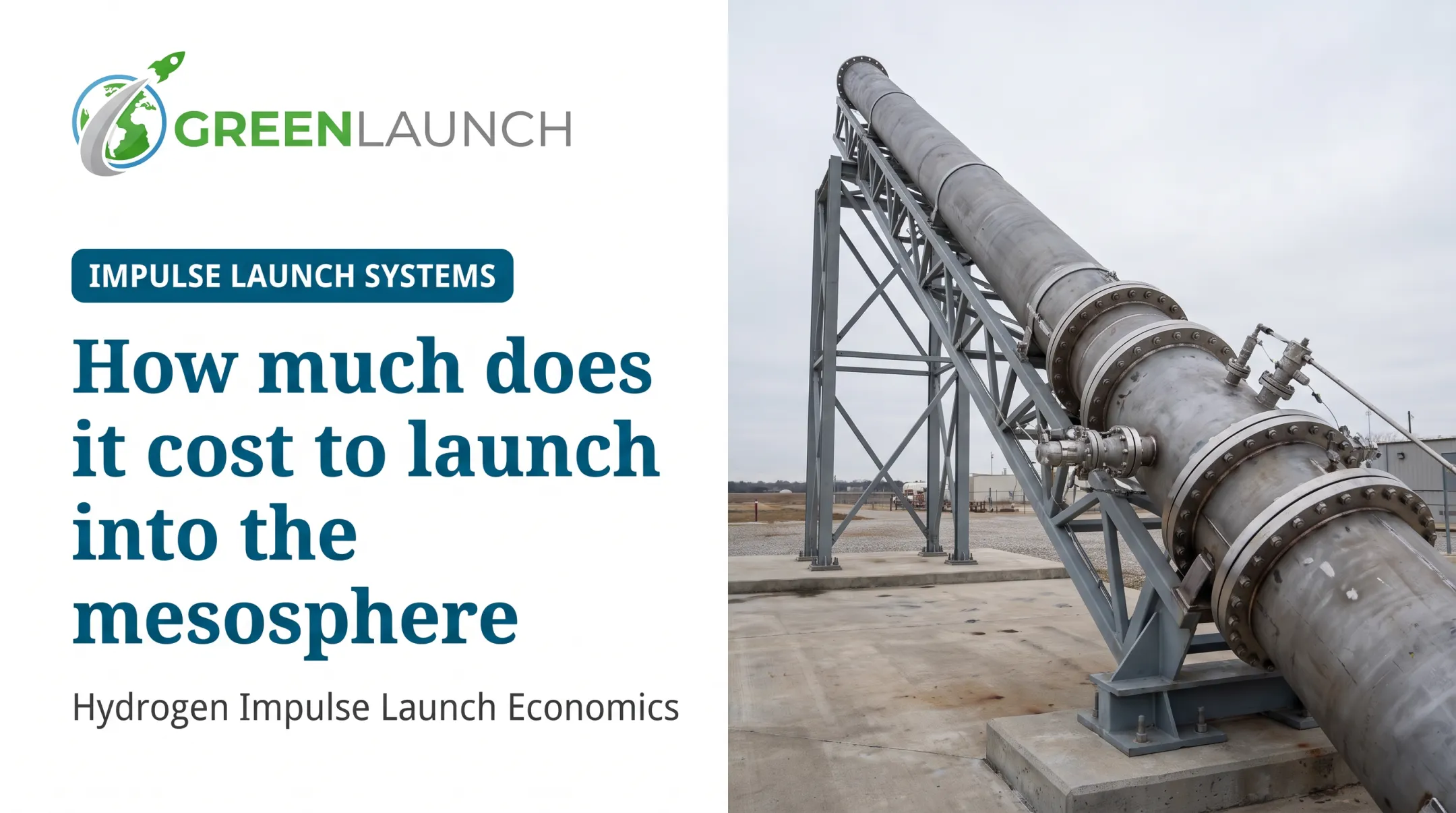
Emerging propulsion technologies represent a distinct cost-reduction category outside traditional rockets. Green Launch's light-gas system uses hydrogen and oxygen combustion to accelerate payloads through a ground-based impulse launcher. It has completed successful vertical launch tests exceeding Mach 3. The approach targets $100–$200/lb for acceleration-tolerant payloads—relevant for defense applications, atmospheric research instruments, and cubesat-class satellites where launch cadence every 60–90 minutes keeps per-mission costs well below rideshare rates.
For government, defense, or classified missions, premium vehicles with strong flight heritage often justify higher per-pound costs. When mission success probability outweighs marginal savings, a proven reliability record—not price—drives the final selection.
How to Build a Realistic Launch Budget
The right launch budget starts with mission requirements, not price. Selecting the cheapest option without validating it against payload specifications, orbital requirements, and schedule needs creates downstream risk that wipes out whatever you saved upfront. Before approaching providers, clarify:
- Target orbit and inclination (LEO, SSO, GTO, specific altitude)
- Payload mass and volume envelope
- Required launch window or mission timeline
- Acceptable launch site(s) and range constraints
- Regulatory requirements (ITAR, classification level)
Total Cost of Mission Framing
Don't budget against the base launch price alone. The full picture looks like this:
Base launch price + Integration costs (10-25%) + Insurance (5-20% of payload value) + Range/licensing fees + Schedule contingency (20-30%)
A $5 million rideshare slot can realistically reach $6.5–$8 million once these are added. Build that range into your financial model from day one.
Engage Multiple Providers Early
Competitive quotes reveal market positioning and surface outliers. The lowest per-pound price on paper may not be the most cost-effective option once integration complexity, slot availability, and provider reliability enter the equation. Request detailed statements of work that spell out what's included — and what triggers additional fees.
Budget Adequate Contingency
NASA's Cost Estimating Handbook recommends probabilistic Joint Cost and Schedule Confidence Level analysis for projects over $250 million. For smaller missions, a flat 20-30% contingency above the base quote covers typical schedule slips and unforeseen integration costs.
Common Mistakes Payload Operators Make When Estimating Launch Costs
Most budget overruns and schedule failures in payload delivery trace back to the same planning errors. Watch for these:
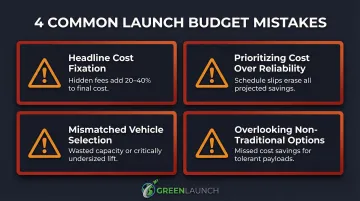
- Headline cost fixation — Integration, insurance, and range fees can add 20-40% to the launch contract price. Ignoring these line items creates budget shortfalls during execution.
- Choosing lowest cost over reliability — A launch that slips six months carries real schedule and financial consequences, especially for time-sensitive payloads with limited shelf life. Flight heritage and on-time delivery record matter as much as price.
- Mismatched vehicle selection — Booking a heavy-lift rocket for a 100 kg payload wastes capital. Conversely, selecting a small launcher without accounting for adapter and separation system mass can leave you unable to accommodate the actual integrated payload.
- Overlooking non-conventional options — Light-gas propulsion, high-altitude balloon launch, and air-launch systems offer compelling cost profiles for specific payload classes. Defense and scientific research applications with acceleration-tolerant payloads may find these alternatives deliver better economics and faster access than traditional rockets.
Frequently Asked Questions
What is the cost per pound to launch a payload into space?
Current cost per pound to LEO ranges from $7,000/kg ($3,175/lb) for rideshare services to $25,000/kg ($11,340/lb) for dedicated small launchers. Commercial list prices differ significantly from provider internal costs—SpaceX's marginal cost is estimated at 20-38% of its retail price.
How much does it cost to launch a satellite into low-Earth orbit?
Full mission costs range from $350,000 for a 50 kg cubesat on rideshare to $15+ million for dedicated small launch to $74 million for Falcon 9 dedicated missions. Total cost depends on payload mass, orbit specificity, integration complexity, and insurance requirements.
How much does it cost to build and launch a satellite?
For small satellites, launch costs often exceed manufacturing costs—a $200,000 cubesat might pay $350,000-$1 million for launch. For large GEO communications satellites costing $200+ million, the $60-$100 million launch represents 30-50% of total mission expense.
Why has the cost per pound to orbit fallen so sharply in recent years?
Average LEO launch costs declined 5.5% annually from 2000-2020, driven primarily by reusable launch vehicle development (particularly first-stage recovery and reuse), increased commercial competition, higher launch cadence distributing fixed costs, and vertical integration by leading providers eliminating supply chain markups.
What is the cheapest way to launch a small satellite or payload?
Rideshare programs on high-cadence rockets like SpaceX Transporter offer the lowest cost per pound at $7,000/kg for payloads with flexible schedules and standard orbital requirements. Companies like Green Launch are developing light-gas impulse launchers that may further reduce costs for acceleration-tolerant payloads to $100–$200/lb.
How does orbit type affect cost per pound to launch?
Higher orbits require significantly more energy. GTO missions cost 40-60% more per kilogram than LEO due to additional propellant and staging requirements. SSO missions from equatorial launch sites may carry 10-20% premiums due to inclination change penalties and trajectory constraints.