
Introduction
The commercial suborbital launch market has undergone a dramatic transformation over the past five years. The FAA Aerospace Forecast projects total authorized space operations will grow from 174–183 in FY2025 to 259–566 by FY2034, reflecting the sector's rapid expansion from government-only programs to accessible commercial options. Between 2020 and 2024 alone, 432 licensed launches and reentries occurred—accounting for over 56 percent of all U.S. space activity since 1989.
That growth hasn't made pricing any simpler. Costs swing dramatically depending on payload size, vehicle type, altitude requirement, and mission customization — and choosing the wrong option can mean wasted budget or mission failure.
This guide covers current pricing ranges across providers, the key cost drivers, what's typically included in a contract, and how to build a realistic budget for a 2026 research launch.
Key Takeaways
- Suborbital research launch costs in 2026 range from roughly $10,000–$50,000 for shared payload slots to $500,000+ for fully dedicated mission vehicles
- The biggest cost drivers are payload mass, altitude target, launch vehicle type, and integration complexity
- Academic institutions and early-stage developers typically benefit most from budget-tier shared slots; defense agencies and large scientific payloads warrant dedicated vehicles
- Premium options pay off when microgravity duration, data quality, or altitude specs are non-negotiable; budget options suit technology readiness testing
How Much Does a Suborbital Research Launch Cost?
There is no single fixed price for a suborbital research launch. Costs scale dramatically based on mission profile, vehicle class, and provider. Misunderstanding this often leads to underbudgeting or selecting the wrong vehicle entirely.
Two planning errors account for most budget surprises: assuming all suborbital launches are interchangeable (they are not), and overlooking integration, range, and data services priced separately from the base launch rate. Most commercial providers use Request for Quote (RFQ) models — not public rate cards — so early vendor discussions matter more than published price sheets.
Budget-Tier Launches ($10,000–$100,000)
Typical inclusions:
- Shared payload slot on a multi-manifest suborbital vehicle
- Limited payload mass (under 5–15 kg)
- Standard altitude of 100–120 km
- Basic telemetry
- Minimal customization (integration support varies by provider)
This tier suits universities, early-stage researchers, and companies testing hardware readiness without needing dedicated flight conditions — CubeSat-class experiments, biological sample tests, and sensor demonstrations are common use cases.
Budget-Tier Examples:
- NASA RockSat Program: $30,000 (full payload), $16,000 (half), $10,000 (quarter)
- UP Aerospace and Exos Aerospace: Custom RFQ pricing; no public rate card
Emerging Option: Green Launch operates in this tier using proprietary hydrogen-oxygen light-gas propulsion — a ground-based system that eliminates propellant staging and vehicle recovery entirely. Payloads are accelerated to orbital-insertion velocities from a fixed launch infrastructure, with per-launch costs targeting the lower end of this range. The system is designed for lightweight, acceleration-tolerant payloads in the CubeSat-class.
Mid-Range Dedicated Launches ($100,000–$500,000)
Typical inclusions:
- Dedicated or semi-dedicated payload capacity (15–300 kg)
- Controlled flight profiles
- Altitude flexibility (up to 200+ km)
- Telemetry and data recovery
- Payload integration support and mission coordination
This tier fits defense testing organizations, research institutions with validated payloads requiring controlled conditions, and companies that need proprietary data without mission-sharing constraints.
Example: Rocket Lab's HASTE variant secured a $190 million contract for 20 hypersonic test flights under the DoD MACH-TB 2.0 program, with payload capacity up to 700 kg and deployment at speeds exceeding 7.5 km/s.
Full-Scale / High-Performance Launches ($500,000 and Above)
Typical inclusions:
- Full vehicle dedication
- High-altitude trajectories (200 km+)
- Extended microgravity windows (6–13+ minutes)
- Advanced telemetry with real-time monitoring
- Payload recovery options
- Range safety coordination and full mission management
- Post-mission data analysis
This tier is used by government agencies (NASA, MDA, DoD), large research institutions, and commercial payload developers with proven hardware that needs real operational conditions.
Example: NASA Sounding Rocket Program (Black Brant series) operates via case-by-case agreements based on mission requirements, offering the longest microgravity durations available in suborbital flight.
Key Factors That Affect Suborbital Launch Pricing
Suborbital launch pricing is shaped by a combination of technical, operational, and business factors. A customer's specific requirements across even two or three of these variables can shift total cost significantly.
Launch Vehicle Type and Propulsion Technology
Rocket-based vehicles (liquid propellant, solid propellant, hybrid) have fundamentally different cost profiles. Newer commercial small launch vehicles have compressed prices significantly. Emerging non-rocket approaches offer even lower-cost pathways.
Propulsion System Cost Implications:
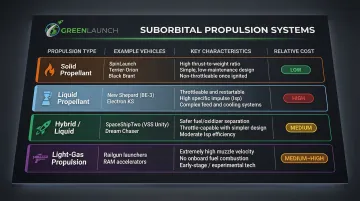
| Propulsion Type | Example Vehicles | Characteristics |
|---|---|---|
| Solid Propellant | NASA Black Brant, UP Aerospace SpaceLoft | High reliability and performance, but subjects payloads to extreme mechanical loads (up to 25G+ during ascent) |
| Liquid Propellant | Rocket Lab HASTE | Uses LOX/RP-1 with 3D-printed Rutherford engines; offers adjustable thrust output and improved vacuum performance |
| Hybrid / Liquid | Exos Aerospace SARGE | Uses LOX/Ethanol; allows for "soft launch" (~7G max) with gimbaled engine control |
| Light-Gas Propulsion | Green Launch | Uses hydrogen-oxygen combustion; eliminates staging complexity and vehicle recovery costs; acceleration-tolerant payloads only |
Reusability Impact: Reusable launch vehicles spread development and manufacturing costs across multiple missions, potentially reducing launch costs by up to 65% compared to disposable rockets. Rocket Lab's Electron, for instance, recovers its first stage for reflight, cutting per-mission build costs. Expendable vehicles carry full build cost per flight.
Green Launch's Non-Rocket Approach: Green Launch's light-gas gun propulsion uses hydrogen and oxygen, producing only water vapor as exhaust. The system captures over 91% of propellant for reuse, and the ground-based launcher stays on-site — eliminating vehicle recovery entirely. This architecture targets delivery costs of $100 per pound to Low Earth Orbit, well below the cost floor of conventional rocket launches.
Payload Mass, Volume, and Altitude Requirement
Most providers price per kilogram or per payload slot. Heavier/larger payloads move customers into higher-cost vehicle classes.
Mass-to-Cost Relationship: Budget-tier providers typically accommodate payloads from under 1 kg (nanosatellite-class) up to 15–50 kg. Mid-range providers handle 15–300 kg. Premium vehicles can carry several hundred kilograms. Each step up in payload mass requires more capable — and more expensive — vehicles.
Altitude's Impact: Reaching 100 km (Kármán line) is far less demanding than a 400 km or 1,000 km apogee. Higher suborbital trajectories require significantly more delta-v and therefore more capable vehicles. For example, the Black Brant XII-A can carry a 90.7 kg payload to an apogee exceeding 1,400 km, whereas smaller vehicles are limited to lower altitudes.
Microgravity Duration Trade-Off:
| Vehicle Class | Typical Microgravity Duration | Example Vehicles |
|---|---|---|
| Budget / Shared | 3–5 minutes | UP Aerospace SpaceLoft, Exos Aerospace SARGE |
| Premium / Dedicated | 6–13+ minutes | NASA / ESA Sounding Rockets |
Longer microgravity windows are critical for materials science experiments examining heat and mass transport during solidification, and for biological experiments requiring extended cellular exposure times.
Mission Customization and Integration Requirements
Off-the-shelf payload accommodation (standard interfaces, standard vibration environments) costs far less than custom integration requiring vehicle modifications, non-standard mounting, unique telemetry streams, or special thermal/pressurization accommodations.
Integration Cost Drivers:
- Custom payload adapter plates
- Multiple payloads per flight
- External viewports or real-time downlink capabilities
- Non-standard environmental qualification testing
- Specialized telemetry wiring and systems compatibility checks
Payload integration — as outlined in the NASA Sounding Rocket Program Handbook — involves mechanical assembly, telemetry wiring, and environmental qualification (vibration, bend, operational spin, and mass property measurements). Commercial providers charge extra for any deviation from standard. Integration add-ons typically run $5,000 to $100,000+, depending on payload complexity.
Lead Time and Launch Cadence
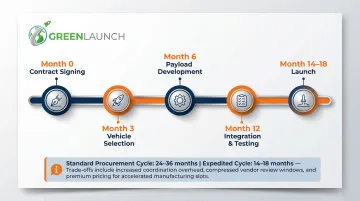
Expedited launch timelines (under 12 months) typically carry significant cost premiums. Standard procurement cycles (18–24 months) allow better pricing.
The BLAST/Project HASTE Case Study: The Missile Defense Agency (MDA) and Johns Hopkins Applied Physics Laboratory (APL) collaborated on Project BLAST (Budget Launch of Affordable Suborbital Targets) to demonstrate a lower-cost approach to national missile defense testing. The team compressed end-to-end development to 18 months — covering launch vehicle selection, payload development, integration, and launch operations — and launched on Rocket Lab's HASTE vehicle within 14 months of contract signing.
By using an existing commercial propulsion system rather than building custom boosters, the team executed flight testing at a fraction of the traditional cost. Speed is achievable — but it comes at a price premium.
Volume Discounts: High-cadence programs (multiple missions per year with the same provider) often unlock volume discounts. One-off missions pay full rack rate. Factoring in cadence from the start is one of the most overlooked levers for reducing per-launch cost.
Full Cost Breakdown: What Goes Into the Total Price
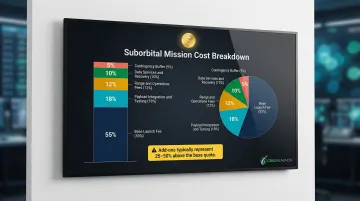
The "launch price" quoted by a provider typically covers only a portion of the total mission cost. First-time buyers frequently underestimate downstream expenses that add 25–50% to the base quote.
Base Launch Fee
This is the headline number most providers advertise: the core charge for vehicle, propellant, and flight. Ranges from $10,000 (shared slot) to $500,000+ (dedicated, high-performance mission).
Understand what is and is not included before comparing providers. Some vendors bundle integration; others do not.
Payload Integration and Testing
Covers mechanical and electrical interface checks, vibration/shock testing, and pre-flight validation at the launch site. Often charged separately by vehicle integrators or range operators.
Costs depend on payload complexity. Standard payloads using off-the-shelf interfaces are the most affordable entry point; custom integrations that require vehicle modifications can run 2–3× higher.
Range and Operations Fees
Covers range safety approval, launch licensing (FAA Part 450 in the U.S.), radar tracking, telemetry ground stations, and range operations personnel.
Government-operated ranges (NASA Wallops, White Sands) and commercial ranges negotiate services case-by-case. Neither the FAA, NASA Wallops, nor Spaceport America publishes a public rate card for suborbital missions — costs are negotiated through direct agreements or contracts.
Data Services, Recovery, and Post-Flight Analysis
Most of these are optional add-ons, but they can push total mission costs up 15–30% for research programs where data integrity is critical. Common line items include:
- Telemetry data packages — basic feeds included in budget slots; dedicated downlinks priced separately
- Payload recovery — required for missions involving physical sample or hardware return
- Post-flight data processing — ranges from raw data handoff to full analysis support
- Premium monitoring — real-time downlinks and higher data fidelity, typically available on dedicated missions
Budget vs. Premium Suborbital Launch Options—What's the Difference?
Budget and premium suborbital launches differ across four dimensions that directly affect whether your research succeeds—not just what you spend.
Key Comparison Dimensions:
Microgravity Duration: Budget options typically offer 2–4 minutes; premium dedicated vehicles deliver 6–8+ minutes. Biological and materials science experiments often require stable microgravity well beyond the shorter window.
Reliability and Flight Heritage: Established providers carry more demonstrated flight records; newer entrants offer lower prices but shorter track records. Review published success rates and request references before committing.
Data Quality and Telemetry: Budget shared slots typically provide basic telemetry with limited bandwidth. Premium options offer dedicated downlinks, real-time monitoring, and higher data fidelity, which matters most when research validity depends on high-resolution measurements.
Long-Term Value: A low-cost launch that misses altitude targets or delivers unusable data wastes the entire research budget. The right price point is the lowest one that still meets your experiment's core requirements—not the lowest price overall.
How to Plan and Estimate Your Suborbital Research Budget
Smart budget planning starts with mission requirements. Define what your payload needs first, then identify the vehicle class and provider that fits—not the other way around.
Planning Considerations
Define your payload's minimum requirements first:
- Mass, volume, altitude, and microgravity duration
- Data type (recovered hardware vs. telemetry only)
- Acceleration tolerance limits
- Environmental conditions (thermal, vibration, shock)
These parameters narrow the field to viable vehicle classes before you request a single quote.
Get quotes from at least 2–3 providers. Request the full scope of work — integration, range fees, and data services — not just the headline launch fee. For each provider, ask:
- What is included in the base launch fee?
- What additional costs will I incur (integration, range, telemetry, recovery)?
- What is the total mission cost estimate?
This gives you a fair cost comparison across providers with different pricing structures.
Build in a 20–30% contingency. Integration overruns, schedule delays, and range fees are difficult to predict at booking — especially for first-time payloads where compatibility issues or environmental qualification failures can surface late.
Common Budget Mistakes
Focusing only on the base launch price. Total mission cost is always higher than the headline number — integration, range, and data costs routinely add 25–50% above the base quote.
Over-specifying payload requirements. If a rideshare manifest would meet your scientific objectives, requiring a dedicated vehicle can multiply costs without a corresponding scientific benefit.
Frequently Asked Questions
What is the typical cost of a suborbital research launch in 2026?
Costs range from shared payload slots (~$10,000–$50,000) to fully dedicated missions ($500,000+). Total mission cost including integration and range fees is always higher than the base launch price—typically 25–50% above the headline number.
How does suborbital differ from orbital launch for research purposes?
Suborbital missions reach space (above 100 km) but don't achieve orbital velocity, offering microgravity windows of minutes rather than hours or days at a fraction of the cost. They're the practical choice for technology validation and experiments that need real space exposure without extended duration.
What payload sizes are typically supported by affordable suborbital providers?
Budget-tier providers typically accommodate payloads from under 1 kg (nanosatellite-class) up to 15–50 kg. Green Launch's system, for example, has demonstrated compact payload designs approximately 1.25 inches in diameter by 4 inches long—purpose-built for acceleration-tolerant research hardware.
How long does it take to book and fly a suborbital research launch?
Lead times range from 6–12 months for established providers with open manifest slots to 18–24 months for custom integrations or new vehicle programs. Expedited options are available at a premium—Project BLAST demonstrated 14-month contract-to-launch turnaround using commercial vehicles.
What types of experiments are best suited for suborbital research launches?
The most common payload types include microgravity science (biology, materials, fluids), technology validation, atmospheric measurements, sensor/instrument testing, and missile defense test targets. The 3–13 minute microgravity window is long enough for discrete measurements and initial validation, but not for sustained biological or materials studies.
Are there hidden costs in suborbital research launch pricing?
Hidden costs are common—range and licensing fees, payload integration and testing, telemetry data services, hardware recovery, and travel to the launch site are frequently omitted from base quotes. Always request a full mission cost breakdown before contracting to avoid budget surprises.