But while mass drivers dominate the conversation, a quieter technology has already demonstrated the velocities needed for lunar launch — without requiring kilometers of track, megawatt power grids, or superconducting coils. Light-gas launchers use compressed hydrogen to accelerate payloads to hypervelocity in compact, self-contained systems that can be shipped, assembled, and fired on the lunar surface with early-mission resources. The engineering reasons are hiding in plain sight.
Key Takeaways
- Mass drivers need kilometers of precision track and 125–1,000 MW of power before launching anything
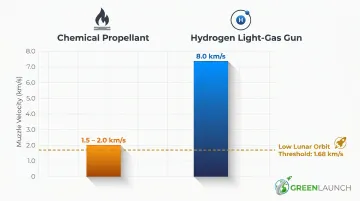
- Light-gas guns have reached 8.0 km/s in testing, nearly 5x the 1.68 km/s needed for low lunar orbit
- Lunar vacuum and low gravity benefit both approaches equally — light-gas systems just don't require pre-built infrastructure to get started
- When you're building the first lunar economy, deployment speed outweighs theoretical efficiency every time
Why the Moon Needs a Better Launch Architecture
Moving cargo off the lunar surface using Earth-launched chemical rockets is expensive in a way that compounds with scale: it requires importing propellant into the Moon's gravity well. A frequently cited 1992 NASA cost study estimated roughly $10,000 per kilogram of fuel lifted from Earth to the lunar surface using expendable launchers — a figure that makes traditional rocket-based lunar operations economically unsustainable for anything beyond exploration missions.
The Moon's escape velocity is only 2.38 km/s, and reaching low lunar orbit (LLO) requires just 1.68 km/s — far lower than the 13+ km/s delta-v needed to reach cislunar space from Earth's surface. This fundamental difference makes the Moon an ideal candidate for non-rocket launch systems that would be impractical on Earth.
That physics advantage only translates into economic value if the right launch mechanism is in place. A functioning cislunar economy depends on moving lunar-derived materials — oxygen extracted from regolith, water-ice from polar craters, structural metals like aluminum and titanium — off the surface cheaply and repeatedly. The choice of launch architecture is the foundational infrastructure decision: get it wrong, and lunar industrialization stalls before it scales.
The Case for Electromagnetic Mass Drivers
A lunar electromagnetic mass driver uses a long track lined with electromagnetic coils to accelerate a payload bucket through sequenced magnetic pulses, reaching escape velocity with zero propellant. The Moon's vacuum eliminates atmospheric drag, and the low gravity reduces the acceleration force needed to reach escape velocity. The physics genuinely favor it.
The genuine strengths are compelling:
- Near-zero marginal energy cost once the system is operational
- Long theoretical lifespan with minimal mechanical wear
- Solar-powered operation using indigenous energy rather than imported fuel
- No propellant logistics for ongoing operations
Those advantages aren't just theoretical — the engineering has been tested. Gerard K. O'Neill and Henry H. Kolm built three mass driver prototypes between 1976 and the early 1980s at Princeton and MIT, achieving accelerations up to 1,800 g. At that acceleration, only 160 meters of track would be needed to reach lunar escape velocity. General Atomics' 2023 AFOSR report proposed evolving the U.S. Navy's Electromagnetic Aircraft Launch System (EMALS) — already operational on the USS Gerald R. Ford — for lunar application. And Elon Musk's public endorsement in February 2026 brought mass drivers into the mainstream space industry conversation.
The credibility is real. What the concept lacks is a workable path from prototype to lunar deployment — and that gap is where the engineering case starts to unravel.
How Light-Gas Launch Actually Works
A light-gas gun uses a heavy piston to compress a low-molecular-weight gas — hydrogen — to extreme pressure behind a projectile. When the pressure reaches a critical threshold (often 4,000+ atmospheres), a partition bursts and the compressed, heated hydrogen expands into the launch barrel, accelerating the projectile to hypervelocity.
The physics advantage is simple: no gun projectile can exceed the velocity of the propellant gases in the barrel. Hydrogen's speed of sound is approximately 1,270 m/s at normal temperature and pressure — far higher than heavier conventional gases. When heated by compression, hydrogen's sound speed increases further, enabling muzzle velocities 4–5× what chemical propellants can achieve. NASA Ames two-stage light-gas guns have achieved 8.0 km/s muzzle velocity, nearly five times the 1.68 km/s needed for low lunar orbit.
Scale and Heritage
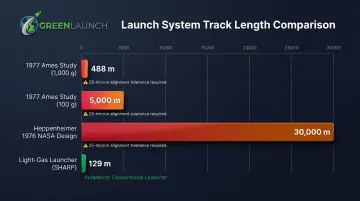
That velocity performance comes from a physically compact system. A light-gas launcher is a self-contained barrel-and-chamber device — the world's largest, Lawrence Livermore National Laboratory's SHARP (Super High Altitude Research Project), used an 82-meter pump tube and 47-meter barrel, totaling roughly 129 meters. Mass driver designs, by contrast, require 488 meters to 30 kilometers of precision-aligned electromagnetic track.
Green Launch, led by CTO Dr. John W. Hunter — the physicist who directed SHARP at LLNL — has translated that heritage into flight-tested hardware:
- Achieved Mach 9 (2.97 km/s) during horizontal test campaigns at Yuma Proving Ground
- Completed 12 successful horizontal firings from December 2017 through March 2018
- Conducted the first vertical light-gas launch for space access in December 2021, reaching an estimated 30 kilometers altitude at speeds exceeding Mach 3
Each result is documented test data, not modeled projection.
Lunar Resource Compatibility
Green Launch uses hydrogen and oxygen as propellants — both extractable from lunar water-ice deposits near the poles. The combustion reaction (H₂ + O₂ → H₂O) produces only water vapor as exhaust, which can then be recovered and reused. That creates a practical resource loop on the Moon:
- Mine water-ice from polar deposits
- Electrolyze into hydrogen and oxygen propellant
- Fire the launcher; capture exhaust water vapor
- Re-electrolyze and repeat
No exotic consumables. No resupply chain from Earth for the propellant itself.
Engineering Realities That Undermine Lunar Mass Drivers
Mass drivers face four interconnected engineering problems on the lunar surface that light-gas systems largely avoid.
Track Length and Terrain
Achieving 1.68 km/s orbital velocity over an electromagnetic track requires substantial length. Historical mass driver studies specify:
- 488 meters at 1,000 g acceleration (1977 Ames Summer Study)
- ~5 km at 100 g acceleration (same study, payload-survivable loads)
- 30 km total (10 km acceleration section) in Heppenheimer's 1976 NASA design
Even the shortest design requires precision-aligned electromagnetic coil segments on uneven regolith, across crater topography, with no existing grading infrastructure. The 1977 Ames design specified piles driven into regolith every 10 meters with screw-jack mounts and optical alignment accurate to 25 microns. That tolerance is tighter than most semiconductor fabrication specs — and it has to hold across kilometers of crater-pocked terrain.
Power Supply Dependency
Mass drivers require massive, steady electrical power to charge and discharge hundreds of coil stages in rapid sequence. Historical designs specify:
- 125 MW (1977 Ames Study)
- 200 MW scaling to gigawatts via beamed solar power (Heppenheimer, 1976)
- 1,000 MW with 76 GJ energy storage (Kolm, 1980)
Building a megawatt-scale solar or nuclear power grid on the lunar surface before any launch capability exists creates a chicken-and-egg problem: the infrastructure meant to reduce surface-to-orbit costs requires the most expensive lunar construction project in history to deploy.
Superconducting Coil Requirements
Most serious mass driver designs rely on superconducting coils (like Nb₃Sn specified in the 1977 Ames study) to achieve efficiency targets. Superconductors require cryogenic temperatures — typically below 10 K for low-temperature variants. That's already a demanding baseline on Earth.
The lunar surface swings from -173°C during lunar night to +127°C during lunar day — a 300°C range. Holding superconducting conditions across those thermal cycles demands continuous cryogenic management, insulated tunnels, and active cooling infrastructure layered onto an already complex system.
Lunar Dust and Precision Systems
Lunar regolith is electrostatically charged, abrasive, and fine-grained — with particles smaller than 10-20 microns. NASA confirms there is currently no method to electrically ground equipment on the lunar surface, meaning dust adheres to all surfaces and degrades thermal radiators, electronics, and mechanical systems.
A precision electromagnetic track with levitating payload buckets and tight magnetic tolerances is uniquely exposed to this failure mode. A sealed, barrel-based system keeps propellant and payload fully enclosed, isolated from the environment entirely.
The 100-Launch Validation Gap
Those environmental challenges compound an even more fundamental problem: no mass driver system has ever been validated at operational scale. The General Atomics AFOSR report set a concrete benchmark — demonstrate 100 launches without replacing launcher components — and nothing has come close. No integrated system has been tested in relevant environments, let alone proven durable across operational cycles. Light-gas systems, by contrast, carry documented test heritage from decades of NASA and LLNL operations.
Why Light-Gas Launch Is the Practical Choice for Lunar Operations
Deployment Without Pre-Existing Infrastructure
A light-gas launcher can be shipped as a modular system, landed, assembled, and operated without requiring a power grid, kilometers of track, or large construction crews. The first generation of lunar launch infrastructure must be buildable with early-mission resources — not dependent on the mature lunar economy it is meant to create.
Green Launch has demonstrated this modularity through its Yuma Proving Ground test campaigns, where systems were assembled, tested, and reconfigured across multiple horizontal and vertical firing campaigns. The company's pneumatic manifold systems are explicitly designed "to allow for easy transportability and assembly," a philosophy directly applicable to remote lunar operations.
Operational Flexibility and Payload Variety
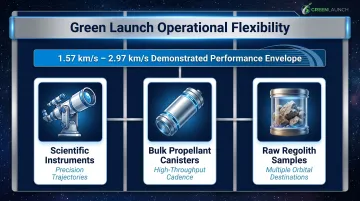
Mass drivers are optimized for specific payload masses and trajectories. A light-gas launcher can vary chamber pressure, gas load, and barrel configuration to accommodate different payload sizes and target orbits. This flexibility matters for nascent lunar operations that may need to launch scientific instruments, propellant canisters, and raw regolith at different times and to different destinations.
Green Launch has demonstrated velocity ranges from approximately 1.57 km/s to 2.97 km/s across test campaigns — a broad performance envelope that supports:
- Scientific instrument payloads on precision trajectories
- Bulk propellant canisters requiring high-throughput cadence
- Raw regolith samples bound for different orbital destinations
Demonstrated Performance as a Decision Factor
Green Launch completed its first vertical light-gas launch in December 2021, building on 12 successful horizontal test firings from 2018 and continued testing through 2025. This test heritage far outpaces the current technology readiness level of lunar electromagnetic mass drivers, which have no integrated system demonstrations in lunar-relevant environments.
Decision-makers in defense and aerospace weigh demonstrated capability over theoretical projections. A system that has reached Mach 9 in atmospheric testing and Mach 3+ in vertical launch is credible. A system still at the feasibility-study stage carries program risk that most lunar mission planners cannot afford to absorb.
Path to Cost Reduction
Mass drivers offer theoretically lower marginal launch costs at scale. Reaching that scale requires infrastructure buildout measured in decades — gigawatt power plants, multi-kilometer track construction, and sustained crew presence before a single payload ships.
Light-gas systems reach operational status far sooner. A working launcher generating real launch data now is more valuable to a lunar program than an optimized design waiting on infrastructure that doesn't yet exist.
Green Launch targets $100/lb to low Earth orbit for eventual orbital delivery services. While this figure reflects Earth-based operations, the underlying cost structure — minimal propellant expense, reusable hardware, rapid turnaround — applies equally or better in the lunar environment where atmospheric drag is eliminated entirely.
Frequently Asked Questions
What is a lunar mass driver?
A lunar mass driver is a proposed electromagnetic catapult — a long track of powered coils that accelerates a payload to orbital velocity using magnetic force rather than propellant. The Moon's low gravity and vacuum make it theoretically suitable, though no operational system has been built.
Would a bullet travel faster on the Moon?
Conventional bullets rely on chemical combustion, and muzzle velocity is roughly the same on the Moon as on Earth — gravity doesn't affect acceleration inside the barrel. Without atmospheric drag, though, a projectile sustains that velocity across much greater distances, making terminal speed at range dramatically higher.
How does a light-gas gun work?
A light-gas gun uses a piston to compress hydrogen behind a projectile. Because hydrogen's speed of sound is much higher than conventional gases, the projectile can reach velocities far beyond what chemical propellants allow — up to 8.0 km/s in documented testing.
What are the main challenges of building a mass driver on the Moon?
Three core problems dominate. First, the track requires kilometers of precisely aligned structure on uneven regolith. Second, the power demand (125–1,000 MW) far exceeds any lunar infrastructure that exists today. Third, superconducting coils must survive 300°C thermal swings between lunar day and night.
Can a light-gas launcher reach lunar orbit velocity?
Yes. Achieving the approximately 1.68 km/s needed for low lunar orbit is well within demonstrated light-gas gun capability — NASA Ames systems routinely operate at 7–8 km/s. The Moon's lack of atmosphere eliminates the drag losses that degrade performance on Earth.
What lunar resources would a launch system need to move?
Early priorities include oxygen extracted from regolith (for propellant), water ice from polar regions, and structural metals such as aluminum and titanium. Delivering these materials to cislunar orbit at low cost is what makes non-rocket launch systems worth pursuing in the first place.