The complexity stems from the fact that your satellite must physically, electrically, and operationally integrate with a launch vehicle it has never touched before. Every interface—from how your spacecraft bolts to the adapter ring to how it separates cleanly in orbit—must be precisely specified, reviewed, and verified before launch day. Regulatory authorities require proof that your payload won't endanger public safety or national security. Range safety teams need documented assurances that your propulsion system or batteries won't accidentally activate during ground processing.
This guide walks through the key document types, technical interface categories, regulatory requirements, and timeline satellite customers should follow when preparing for launch. Whether you're launching a CubeSat on a rideshare mission or a dedicated primary payload, understanding this documentation landscape early will help you avoid costly surprises and keep your mission on track.
Key Takeaways
- The Interface Control Document (ICD) governs all mechanical, electrical, and mission interfaces between your satellite and the launch vehicle
- Required submittals include mass properties, dimensions, stiffness data, orbit parameters, separation tolerances, connectors, and environmental limits
- FAA licensing, payload reviews, and range safety filings are mandatory for U.S. commercial launches
- The documentation process begins 2–3 years before launch for complex missions and continues through liftoff
- Your launch provider's propulsion technology directly shapes which documents are required, so provider selection is a documentation decision as much as a technical one
What Is a Satellite Launch Service Requirements Document?
The Launch Service Interface Requirements Document (LSIRD) or Interface Control Document (ICD) serves as the master agreement between you and your launch provider. It spells out every requirement governing how your satellite and the launch vehicle must interact to achieve mission success. The ICD governs physical interfaces, electrical connections, environmental limits, and mission design constraints — covering everything from payload separation to contamination tolerances.
The ICD is developed for each mission and maintained collaboratively. Typically, the launch provider develops and holds the document, but you supply the initial requirements. For rideshare or secondary payloads, a Secondary Payload Adapter (SPA) supplement may serve as the governing document instead. Commercial providers like SpaceX now draft and maintain mission ICDs, a shift from legacy models where government customers controlled the documentation.
Secondary payloads have zero authority to impact the primary mission's integration cycle, launch date, or go/no-go decisions. Your documentation must be scoped accordingly — including accepting contamination or environmental constraints imposed by the primary spacecraft. If the primary payload requires ultra-clean conditions, you'll need to match those standards even if your satellite would normally tolerate looser cleanliness levels.
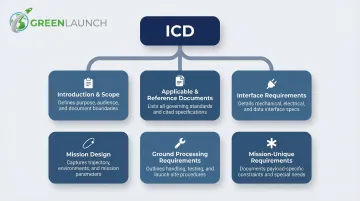
Key Sections of a Launch Service ICD
Every LSIRD or ICD contains several core sections, each serving a specific purpose:
- Introduction and scope — establishes the mission objective, payload description, target launch dates, and which systems fall within the ICD's jurisdiction
- Applicable and reference documents — lists all governing specifications forming the contractual baseline, including the System Interface Specification (SIS) and standards such as IEST-STD-CC1246E (contamination control) and NASA-STD-6016 (materials and outgassing limits)
- Interface requirements — defines the physical, electrical, and data connections between your spacecraft and the launch vehicle; this is the technical core of the document
- Mission design — covers orbital parameters, separation requirements, and trajectory constraints
- Ground processing requirements — details everything from arrival at the launch facility through liftoff
- Mission-unique requirements — captures anything outside the launch vehicle's standard capabilities
These industry standards aren't optional recommendations. Your spacecraft design and verification plans must integrate them early, or you'll face expensive redesigns late in the integration flow.
Stakeholders in the Documentation Process
Multiple parties review and approve your launch documentation:
- Spacecraft/payload contractor (your team) provides requirements and verifies compliance
- Launch vehicle contractor integrates your satellite into their mission plan and validates interfaces
- Launch range authority (e.g., Yuma Proving Ground or Cape Canaveral Space Force Station) enforces safety and operational standards
- Regulatory bodies such as NASA's Launch Services Program or the FAA ensure legal compliance
Each stakeholder has veto authority over different aspects of your mission. Range safety can ground your launch if hazardous materials aren't properly documented. The FAA can deny authorization if your payload raises national security concerns. The launch provider can reject your spacecraft if it exceeds their standard environmental specifications.
Key Technical Interface Requirements Every Satellite Customer Must Document
Mechanical Interface Requirements
You must define the structural interface between your spacecraft and the payload adapter in detail. This includes interface drawings showing bolt patterns and mounting surfaces, your spacecraft coordinate system, and maximum physical envelope (length, width, height). Any hardware that protrudes past the separation plane must be explicitly called out, as it may interfere with the separation system.
These specifications drive the launch vehicle's choice of separation mechanism. A 3U CubeSat uses a completely different deployer than a 500 kg Earth observation satellite. Undisclosed protrusions — like an antenna crossing the separation plane — force costly redesigns of either your spacecraft or the adapter.
Mass Properties Documentation
Declare your Not-to-Exceed (NTE) mass and fundamental frequencies with generous margins. NTE mass is the absolute upper limit for your spacecraft. It's used for trajectory and collision avoidance modeling, and exceeding it late in the flow invalidates your ICD and forces expensive re-analysis.
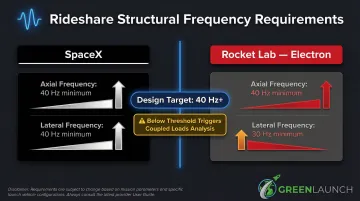
Stiffness requirements prevent your satellite from coupling with launch vehicle structural modes during ascent. SpaceX requires minimum fundamental frequencies above 40 Hz, while Rocket Lab specifies greater than 40 Hz axial and 30 Hz lateral. Designing to 40 Hz+ keeps your satellite compatible with most major rideshare programs without negotiation. Drop below that threshold and you'll face additional coupled loads analyses that may disqualify your satellite entirely.
Electrical Interface Requirements
Once structural and mass requirements are locked, electrical interfaces need the same rigor. Document all required connectors with pin counts, power loops, and data loops. Separation loop circuits must be specified for both the SPA side (for your spacecraft to use) and the spacecraft side (for the launch vehicle to use). If you need telemetry up to or after T-0, specify interleaved telemetry requirements that allow data transmission during ascent.
Power and command needs vary widely: continuous bus power until separation, one-time pyrotechnic arm commands, or both. Each scenario drives different connector specifications — getting this wrong means your satellite won't power on, or won't separate cleanly.
Mission Design Documentation
Define orbit insertion parameters with tolerances, not just target values. Your ICD must specify:
- Semi-major axis with acceptable range
- Eccentricity tolerance
- Inclination accuracy (e.g., ±0.15 degrees)
- Perigee and apogee tolerances
Separation requirements include spacecraft attitude at separation, allowable spin rates, angular acceleration limits, and separation velocity. For example, Rocket Lab's Electron achieves injection accuracy of ±0.15° for inclination and ±15 km for both perigee and apogee on typical 500 km SSO missions. If your mission requires tighter tolerances, flag this early as a mission-unique requirement.
Load and Environmental Interface Documentation
Provide the environmental limits your spacecraft can tolerate:
- Random vibration (GRMS levels across frequency bands)
- Shock (peak acceleration in G's, duration)
- Acoustic levels (Overall Sound Pressure Level in dB)
- Temperature ranges (minimum and maximum during ground processing and flight)
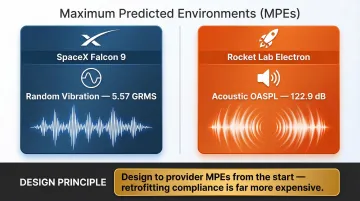
Launch providers publish Maximum Predicted Environments (MPEs) representing their standard flight baseline. SpaceX's random vibration MPE is 5.57 GRMS, while Rocket Lab specifies 122.9 dB acoustic OASPL. If your spacecraft can't meet these standard MPEs, you're requesting mission-unique accommodations — which add both cost and schedule risk. Design to provider MPEs from the start; retrofitting compliance late in development is far more expensive than building to them upfront.
Regulatory & Licensing Documentation for Commercial Launches
FAA's Role Under the Commercial Space Launch Act
The FAA serves as the primary regulator of U.S. commercial launches under 49 U.S.C. §70101. Any U.S. entity—or any entity launching on U.S. soil—must obtain FAA authorization before launch, with certain small rocket classes exempt. The Streamlined Launch and Reentry Licensing Requirements (SLR2) Final Rule consolidated legacy regulations into 14 CFR Part 450, effective March 2021.
FAA Authorization Pathways
Two main authorization types exist:
Launch license covers orbital and larger missions. A single license can now authorize multiple launches from multiple sites under SLR2, streamlining the approval process for launch operators with recurring missions.
Experimental permit applies to reusable suborbital vehicles used in R&D. This pathway allows faster authorization for developmental testing but doesn't permit operational missions.
As a payload customer, you typically don't hold the license — the launch vehicle operator does. You are still responsible for providing accurate information about your satellite's purpose, orbit, ownership, and any hazardous materials.
FAA Payload Review Process
Even when the launch operator holds the license, the FAA may conduct a separate payload review under 14 CFR 450.43 to ensure your satellite doesn't jeopardize public health and safety, U.S. national security, or foreign policy interests.
You must submit:
- Payload name, class, and function
- Physical dimensions, weight, and composition
- Hazardous and radioactive materials, plus explosive potential
- Orbital parameters and intended operations (including disposal plans)
- Encryption associated with data storage and transmission
Payload reviews typically take 60–90 days but can extend if your satellite presents novel hazards or foreign policy questions. Submit your payload determination request early — delays here cascade directly into your mission schedule.
Range Safety Documentation Requirements
Beyond FAA payload review, range safety authorities require you to document all spacecraft hazards and demonstrate that sufficient controls exist to prevent accidental activation during ground processing and launch. Required disclosures include:
- Propulsion system type and propellants
- Stored energy sources (batteries, pressurized systems)
- Pyrotechnic devices
- Nuclear materials
- Lasers
The legacy AFSPCMAN 91-710 has been superseded by SSCMAN 91-710 Volume 7, published December 2022, which serves as the current Range Safety User Requirements Manual for the Eastern and Western Ranges. Range safety authorities require documented inhibits—such as multiple enable switches or remove-before-flight pins—for all energized systems.
Ground Processing & Environmental Documentation
Handling and Safety Procedures
Ground processing documentation covers everything from your satellite's arrival at the launch facility to liftoff. You must declare all spacecraft hazards and provide handling, fueling, and safety procedures to protect range personnel. Propulsion systems using novel or green propellants may require additional documentation since legacy safety standards were written for hazardous propellants like hydrazine.
Green propellants like AF-M315E (ASCENT) and LMP-103S have reduced hazard classifications from "catastrophic" to "critical", eliminating the need for heavy SCAPE suits. Personnel handling ASCENT require only minimal PPE such as lab coats, rubber gloves, and splash guards. However, you still must submit a Risk Analysis Report (RAR) and Ground Safety Plan (GSP) to range authorities.
Contamination Control Documentation
Specify your spacecraft's cleanliness requirements in your integration documentation:
- Particle contamination levels
- Non-Volatile Residue (NVR) limits
- Outgassing specifications (Total Mass Loss and Collected Volatile Condensable Material)
On rideshare missions, the most contamination-sensitive payload drives the contamination control plan for all co-manifested satellites. If a high-value optical payload requires Visibly Clean-Highly Sensitive (VC-HS) standards, you must accept or match those stricter requirements even if your satellite would normally tolerate looser cleanliness levels. SpaceX requires VC-HS per NASA-SN-C-005D, with TML not exceeding 1.0% and CVCM not exceeding 0.1% per ASTM E595.
Purge and Environmental Control Requirements
If your satellite requires nitrogen (GN₂) purge or specific temperature and humidity conditions inside the payload fairing prior to launch, document each of the following parameters in your payload integration plan:
- Flow rate and pressure: SpaceX delivers GN₂ at 0–50 psig with 5–50 SLPM
- Purity specification: MIL-PRF-27401G, Type 1, Grade B or equivalent
- Cleanliness level: particulate and NVR requirements for the purge supply line
- Physical location: exact connection points on the spacecraft or dispenser interface
These are often flagged as mission-unique requirements that add cost and schedule complexity. Satellites that can tolerate standard fairing conditions without active purge typically move through range approval faster and avoid the non-recurring engineering charges that mission-unique environmental systems trigger.
Documentation Timeline: When to Start and What Happens When
Early Phase: Initial Requirements Submission
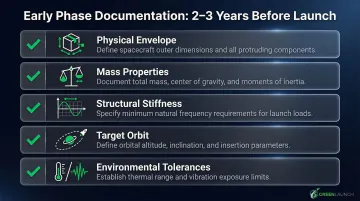
For complex dedicated missions, submit your initial requirements to the launch provider 2–3 years before your target launch date. Earlier submission allows time to resolve conflicts between spacecraft and launch vehicle requirements before designs are locked. Late discovery of incompatibilities forces expensive redesigns or, worse, disqualification from your intended launch slot.
During this phase, capture the following spacecraft parameters at minimum:
- Physical envelope — outer dimensions and any protrusions
- Mass properties — total mass, center of gravity, moments of inertia
- Structural stiffness — fundamental frequency in lateral and axial axes
- Target orbit — altitude, inclination, and insertion accuracy requirements
- Environmental tolerances — vibration, acoustic, thermal, and shock limits
Default to conservative specifications. Tight tolerances or restrictive environmental limits trigger mission-unique accommodations that cost time and money.
Middle Phase: Requirements Iteration and Conflict Resolution
Once initial requirements are exchanged, both teams identify mission-unique requirements (items falling outside the launch vehicle's standard capabilities), resolve interface conflicts, and update the ICD. This is an iterative, collaborative process involving engineering review boards and configuration change requests.
Typical conflicts include:
- Fundamental frequency below the provider's threshold (requires coupled loads analysis)
- Environmental limits tighter than standard MPEs (requires special testing or accommodation)
- Center of gravity outside acceptable range (may require adapter redesign or ballast)
Unresolved conflicts don't disappear — they escalate into schedule holds or design freezes that compress your remaining timeline.
Final Phase: Verification and Launch Readiness
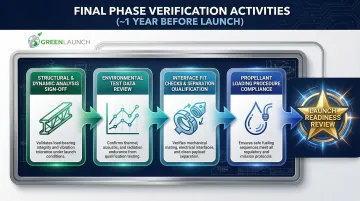
Approximately one year before launch, formal verification begins. The launch team verifies that all ICD requirements are met through analysis, inspection, and test.
This process continues through Launch Readiness Reviews, where stakeholders formally confirm the spacecraft and launch vehicle are ready to fly. Key verification activities typically include:
- Structural and dynamic analysis sign-off
- Environmental test data review against ICD limits
- Interface fit checks and separation system qualification
- Propellant loading procedure compliance on launch day
Certain requirements stay active through launch day itself — propellant loading procedures, range safety confirmations, and separation commands all have documentation tied to them. Your compliance record closes only after successful on-orbit separation.
How Your Launch Provider's Technology Shapes Your Documentation
Launch vehicle architecture directly shapes what interface documentation is required. A traditional multi-stage liquid rocket has well-established ICD templates built around fairing environments, separation systems, and umbilical interfaces. These templates reflect decades of operational experience with similar propulsion systems, making documentation straightforward by comparison.
Emerging launch technologies introduce different interface characteristics that require custom documentation approaches. Reading your launch provider's System Interface Specification (SIS) or User's Guide early is critical—this document defines what's standard and what's mission-unique for that specific vehicle.
Green Launch's Light-Gas Propulsion System
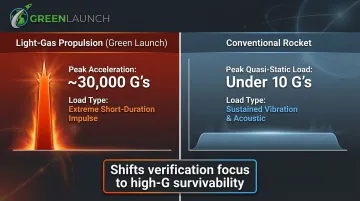
Green Launch's hydrogen light-gas propulsion system is a distinct launch architecture. Powered by hydrogen and oxygen rather than conventional rocket propellants, it creates a unique environmental and interface profile. Instead of sustained vibration and acoustic loads, the impulse launcher delivers extreme, short-duration acceleration—a fundamentally different structural challenge for payload designers.
Computational models indicate light-gas gun systems can produce maximum effective accelerations of approximately 30,000 G's, compared to typical rocket quasi-static loads under 10 G's. That gap changes structural verification requirements entirely—the focus shifts to high-G survivability, not random vibration or acoustic tolerance.
Because these environmental differences touch every layer of interface documentation, early engagement is essential. Satellite customers evaluating Green Launch should request the applicable interface specification before drafting any LSIRD. That document defines the specific velocity profile, vibration signature, and separation mechanism your spacecraft design must be verified against—none of which map cleanly to conventional rocket templates.
Frequently Asked Questions
What is an Interface Control Document (ICD) in the context of satellite launches?
An ICD is the master bilateral document defining all requirements between your satellite and its launch vehicle. It covers mechanical, electrical, orbital, and thermal interfaces, and is developed collaboratively by you and your launch provider throughout the integration process.
How far in advance should I begin the launch documentation process?
For complex missions, submit initial requirements 2–3 years before launch, with formal verification beginning about one year out. Starting early reduces the risk of costly design conflicts that could delay or disqualify your mission.
Who is responsible for obtaining the FAA launch license—the satellite owner or the launch provider?
The launch vehicle operator typically holds the FAA license, but you may be required to participate in a separate payload review. You must provide details on your satellite's purpose, orbit, and hazardous materials to support the application.
What technical data about my satellite do I need to provide to the launch provider?
Your launch provider will typically require:
- Mass and center-of-gravity measurements
- Fundamental frequency (axial and lateral)
- Maximum physical envelope dimensions
- Orbit insertion parameters with tolerances
- Electrical connector requirements and separation specifications
- Mission-unique environmental limits for your spacecraft
Are documentation requirements different for small satellites and rideshare payloads?
Yes. Secondary/rideshare payloads use a supplemental ICD scoped to the Secondary Payload Adapter interface, have no authority over primary mission decisions, and must accept environmental and contamination standards driven by the most demanding co-manifested satellite.
What spacecraft hazards must be declared in launch service documentation?
Range safety authorities require declaration of all hazardous systems, including:
- Propulsion system type and propellants
- Pressurized systems and pyrotechnics
- Batteries, lasers, and nuclear materials
Documented inhibits for each energized system are mandatory to prevent accidental activation during ground operations.