Introduction
Traditional sounding rocket missions follow a familiar but frustrating pattern: from program initiation to launch, the timeline stretches months to years, with per-flight costs ranging from hundreds of thousands to millions of dollars. For researchers and defense agencies needing to fly the same component five or ten times per year, this pace is fundamentally incompatible with modern R&D workflows.
Sandia National Laboratories has noted that traditional Department of Defense flight tests create a risk-averse environment where "by the time we're flying with DOD, the technology had better work. There's no room for failure." That constraint kills early-stage, exploratory testing — exactly the kind that accelerates innovation.
Compounding the problem: the NASA Sounding Rocket Program conducts approximately 20–30 missions per year worldwide, leaving individual research programs competing for scarce launch slots with little margin for iteration.
What follows breaks down the cost and cadence constraints of traditional sounding rockets, defines what a viable alternative actually requires, and examines how light-gas propulsion systems are directly addressing that gap.
Key Takeaways
- Traditional sounding rockets carry per-flight costs averaging $3.5 million and require months-long mission lifecycles
- Higher launch cadence compresses R&D timelines directly—Sandia's HOT SHOT program targets cutting development time from 15 years to under five
- Credible alternatives need order-of-magnitude cost reductions and weekly—or faster—launch cadence without sacrificing altitude or payload performance
- Hydrogen light-gas propulsion supports near-daily launch operations with simpler ground infrastructure and no toxic exhaust byproducts
- Defense labs, universities, and satellite developers gain the most from rapid, affordable suborbital access
What Are Sounding Rockets and Why Are They Still Relevant?
Sounding rockets are unguided, suborbital launch vehicles designed to carry scientific instruments and experimental payloads to altitudes between 50 km and 1,500 km. Unlike ground-based testing, they replicate the combined stresses of flight; unlike orbital missions, they cost far less. NASA's program has conducted approximately 2,900 missions since 1959, underscoring how reliably this technology fills a gap that ground tests and orbital launches cannot.
Ground tests cannot replicate atmospheric drag, thermal environments, and microgravity simultaneously. Full orbital launches cost tens of millions of dollars and require years of preparation. Sounding rockets sit between these two options — delivering minutes of real flight data and payload recovery at a fraction of the cost and timeline.
That value is visible in defense applications. Sandia National Laboratories revived sounding rockets through its HOT SHOT program specifically to compress development timelines — with a stated goal of cutting R&D time for new weapons systems from 15 years to fewer than five. HOT SHOT targets the testing gap between ground validation and full-scale missile flight tests, where no adequate substitute previously existed.
Mission Lifecycle Complexity
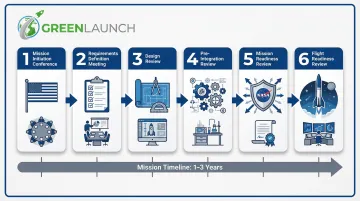
A typical NASA sounding rocket mission follows a rigorous review process:
- Mission Initiation Conference (MIC)
- Requirements Definition Meeting (RDM)
- Design Review (DR)
- Pre-Integration Review (PIR)
- Mission Readiness Review (MRR)
- Flight Readiness Review (FRR)
This thoroughness ensures mission success but introduces significant lead time. Development spans 1 to 3 years from initiation to launch, creating structural barriers for teams needing rapid iteration.
The Cost and Cadence Bottlenecks of Traditional Sounding Rockets
Cost Drivers: Solid-Propellant Infrastructure
Traditional sounding rockets rely on surplus military solid-propellant motors—Terrier, Black Brant, Improved Orion—which come with hidden costs. These motors are classified as Class 1.3 explosives, requiring:
- Specialized storage in explosive hazard facilities or earthen-covered magazines
- Strict adherence to explosive quantity safety distances (EQSD)
- Dedicated handling procedures and late-stage initiating device installation
- Extensive range safety infrastructure for flight termination systems
In Fiscal Year 2011, NASA's Sounding Rocket program spent $45.9 million on 13 launches, equating to approximately $3.5 million per launch. While this bundled cost includes integration, testing, and range operations, the number tells the story plainly: $3.5 million per flight, before a single instrument leaves the ground.
The Lifecycle Time Burden
Each mission requires alignment across the NSROC contractor, range safety office, and principal investigator through multiple formal reviews. For a single high-stakes mission, that rigor is defensible. For a research team that needs five hardware iterations in a year, the same process becomes a wall.
The NASA program supports 20–30 missions annually across all customers worldwide. For any individual research team, access is far more limited. This scarcity forces researchers to overload single flights with multiple experiments, increasing complexity and reducing flexibility.
The "No Room for Failure" Problem
That overloaded-flight pressure has a direct consequence: every launch must succeed. Kate Helean, deputy director for technology maturation at Sandia, articulated the constraint directly: "By the time we're flying with DOD, the technology had better work. There's no room for failure."
The inability to afford early-stage failures at low cost prevents exploratory and iterative research. In software and hardware engineering, rapid prototyping and frequent testing are best practices. Traditional sounding rocket economics make this approach financially impossible for suborbital testing.
Bundled Costs That Don't Fit Every Program
Traditional programs bundle in payload fabrication, environmental testing (vibration, vacuum, thermal), range operations, and post-flight data processing. For complex, instrument-heavy payloads, those services are worth the overhead. For teams flying rugged, standardized hardware, they add cost without adding capability — and there's currently no opt-out.
What Qualifies as a True Sounding Rocket Alternative?
Performance Baseline: Altitude and Payload
A credible alternative must deliver payloads ranging from a few kilograms to tens of kilograms to comparable altitudes. The NASA Sounding Rocket Program Handbook provides authoritative performance benchmarks:
| Launch Vehicle | Payload Mass | Approximate Apogee |
|---|---|---|
| Black Brant IX (Mod 2) | 500 lbs (226.8 kg) | ~450 km |
| Black Brant IX (Mod 2) | 1,500 lbs (680.4 kg) | ~200 km |
| Terrier-Improved Orion | 300 lbs (136.1 kg) | ~200 km |
| Terrier-Improved Orion | 900 lbs (408.2 kg) | ~75 km |
These benchmarks define the floor: upper atmosphere or mesosphere access, with enough flight time for meaningful data collection. Hitting that floor while cutting cost is where alternatives earn their claim.
Cost Threshold: Order-of-Magnitude Reduction
Cost savings alone are insufficient if they compromise reliability or capability. A true alternative must deliver meaningfully lower cost per launch—ideally by an order of magnitude—while maintaining acceptable success rates.
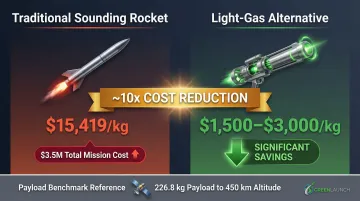
Dividing the $3.5 million average mission cost by official payload capacities establishes a transparent cost-per-kilogram baseline. For example, delivering 226.8 kg to 450 km costs approximately $15,419 per kilogram. An alternative offering $1,500–$3,000 per kilogram would represent a transformative improvement.
Cadence as a Primary Requirement
The ability to launch weekly or daily is not a luxury—it is the core value proposition for many applications. Rapid iteration is essential for:
- Materials testing under real flight conditions
- Atmospheric sensor calibration across seasonal variations
- Defense component validation in multiple flight regimes
- Technology readiness level advancement through repeated trials
Achieving this cadence requires systems that can refuel and relaunch without hardware replacement between shots — something solid-propellant motors cannot offer.
Propellant and Environmental Considerations
That same cadence requirement makes propellant choice a practical constraint, not just an environmental one. Solid-propellant motors produce complex combustion byproducts and require extensive hazard clear areas — at Poker Flat Research Range, a cleared radius of 1.5 to 5.5 kilometers is required around the launch pad. Each launch triggers a range safety review cycle that compounds scheduling delays.
A green propellant profile simplifies range safety approvals, reduces ground handling risks, and aligns with sustainability mandates. Hydrogen and oxygen combustion produces only water vapor, eliminating toxic residue management.
Green Launch's Light-Gas Propulsion Approach
Green Launch has developed a proprietary light-gas propulsion system using hydrogen and oxygen, building on the Super High Altitude Research Project (SHARP) led by CTO Dr. John W. Hunter at Lawrence Livermore National Laboratory. SHARP achieved muzzle velocities up to 3.1 km/s (approximately Mach 9) with projectiles ranging from 4.4 kg to 5.9 kg — the quantitative foundation the system is built on.
Green Launch conducted its first vertical light-gas launch for space access in 2022. That test confirmed the core propulsion concept works vertically, not just in horizontal laboratory conditions.
Light-Gas Propulsion Technology: A Proven Lower-Cost Path
How Light-Gas Propulsion Works
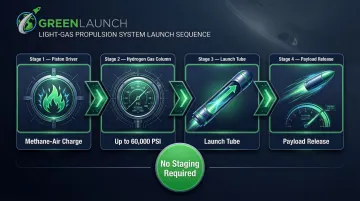
Light-gas propulsion uses a compressed light gas—hydrogen—to accelerate a payload to high velocity through a launch tube, achieving suborbital or orbital trajectories without staged solid motors, pyrotechnics, or complex recovery systems. Instead of controlled combustion of solid or liquid propellants in rocket stages, a piston (driven by methane-air explosion or powder) compresses hydrogen gas to extreme pressures—up to 60,000 psi—which then propels the projectile.
The core components driving this process are:
- Piston driver: A methane-air explosion or powder charge compresses the hydrogen column
- Hydrogen gas column: Achieves pressures up to 60,000 psi before release
- Launch tube: Guides and accelerates the payload to target velocity
- No staging required: No solid motors, pyrotechnics, or recovery systems needed
This technology was developed and validated through decades of ballistic research at NASA Ames Research Center, Lawrence Livermore National Laboratory, and Sandia National Laboratories, where two-stage light-gas guns have been extensively used for hypervelocity impact research.