
The answer comes down to a simple mismatch: balloons rely on passive buoyancy, not powered thrust. Briefly grazing a layer of the atmosphere is very different from operating there with a working payload.
This article breaks down the physics: atmospheric density, gas expansion, envelope strength, payload weight, and the rare missions that have actually touched the lower mesosphere.
Key Takeaways
- Buoyant lift drops as air gets thinner, capping most balloons well below the mesosphere.
- Lower pressure at altitude forces lifting gas to expand, stressing or rupturing the envelope.
- Adding more helium fails: a bigger envelope and extra gas mass add weight too.
- A few specialized flights have grazed the lower mesosphere; most balloons never get close.
Where the Atmosphere Changes from Stratosphere to Mesosphere
Earth's atmosphere doesn't have hard walls between layers, but scientists use consistent boundaries for reference. According to NOAA's atmospheric layer data, the troposphere runs from the surface to roughly 6–20 km depending on latitude.
The stratosphere picks up from there and extends to about 50 km. The mesosphere begins at that 50 km mark and continues to roughly 85 km.
"Near space" is a popular but informal term. It typically covers the region from about 20 km to 100 km — spanning the upper stratosphere and mesosphere. Reaching near space does not mean reaching outer space or achieving orbit. Outer space and orbit depend on altitude thresholds and orbital velocity, not on floating in thin air.
What Changes at the Boundary
At typical high-altitude balloon float levels (30-40 km), air is already extremely thin. Push higher toward the 50 km stratosphere-mesosphere boundary, and conditions get even more extreme:
- Pressure drops from roughly 1.2 kPa at 30 km to about 0.08 kPa at 50 km
- Density falls from around 0.018 kg/m³ to near 0.001 kg/m³
- Temperature actually rises through this stretch, from about -46°C at 30 km to near -2°C at 50 km

Lower density means less air to displace—and displaced air is the only mechanism that keeps a balloon aloft.
How Buoyancy Limits a Balloon's Climb
Balloons work on Archimedes' principle: an object rises when the weight of the air it displaces exceeds its own total weight. That total includes the envelope, the lifting gas, the payload, rigging, and any onboard instruments.
As a balloon climbs, the surrounding air thins out. The same volume of displaced air weighs less at higher altitudes, which means less upward force even as the balloon itself keeps expanding.
The Gas Expansion Problem
The ideal gas law explains what happens next. Internal gas pressure roughly matches the falling external pressure during ascent. Since pressure and volume move in opposite directions for a fixed amount of gas, the helium or hydrogen expands as the balloon climbs.
A radiosonde envelope launched at around 5 feet across can stretch to 20-25 feet before it ruptures, according to the National Weather Service's education materials on weather balloons.
Two design philosophies handle this expansion differently:
- Zero-pressure balloons vent excess gas through open ducts as they expand, eventually losing enough gas that they descend or the envelope bursts
- Super-pressure balloons use a sealed, stronger envelope that holds internal pressure steady, trading some altitude for much longer flight duration
What Mission Planners Actually Model
Balloon engineers juggle several interdependent variables before every launch:
- Payload mass — heavier instruments demand more lift
- Envelope material and thickness — thinner film weighs less but tolerates less stress
- Lifting gas choice — helium is safer, hydrogen provides slightly more lift
- Launch temperature — affects gas density and initial buoyancy
- Ascent rate and weather — wind shear and temperature inversions change performance mid-flight
Get any one of these wrong, and the balloon either underperforms or fails structurally before reaching its target altitude.
Why the Mesosphere Is So Difficult for Balloons
Most weather and scientific balloons burst or reach float altitude well below 50 km, right around where the mesosphere starts. That means a mesosphere-capable balloon has to keep climbing through the exact conditions that already push ordinary balloons to their limits.
The engineering challenge is a contradiction: the envelope must be light enough to preserve lift, yet strong enough to survive massive expansion, brutal cold, near-vacuum conditions, ultraviolet degradation, and mechanical stress all at once.
Why "Just Add More Gas" Doesn't Work
It's tempting to think a bigger gas volume solves everything. It doesn't. NASA's scientific balloon program notes that standard zero-pressure balloons use polyethylene film only about 0.002 cm thick and typically top out around 42 km, flying for up to two weeks at that altitude.
Scaling up runs into the same wall every time:
- More envelope area means more material weight
- More gas volume means more gas mass
- Reinforcement to handle the added stress adds even more weight
- Parachute systems and instruments for recovery and science eat into the lift budget

Net result: the extra lift gets eaten up by the extra weight needed to carry it.
Reaching a higher altitude briefly is also different from hovering there. A balloon needs equilibrium between internal gas density, outside air density, and total system weight to actually stay put, not just pass through.
Can Any Balloon Reach the Mesosphere?
Technically, yes. But it's rare, and it's not what routine weather or scientific balloon missions are built for.
The clearest documented case comes from Japan. A 2017 paper in the Journal of Astronomical Instrumentation describes the BS13-08 balloon, launched on September 20, 2013.
It used an 80,000 m³ envelope built from ultra-thin polyethylene film just 2.8 micrometers thick, carrying a light 3.2-kg payload. That flight reached 53.7 km, solidly into the lower mesosphere by NOAA's boundary definition, and reported as matching the unmanned balloon altitude world record.
A similar flight in 2002 used a 60,000 m³ balloon with 3.4-micrometer film to reach 53.0 km with a 4.6-kg payload.
Why This Isn't Routine Operations
| Flight Type | Documented Altitude | Duration/Notes |
|---|---|---|
| Standard NWS radiosonde | ~30 km (100,000 ft) before rupture | Minutes; envelope grows 4-5x before bursting |
| NASA standard zero-pressure balloon | Up to 42 km | Up to two weeks at float |
| NASA super-pressure test balloon | ~33.5 km | 100+ days planned |
| Japan BS13-08 (record flight) | 53.7 km | Ultra-thin film, minimal payload |
Notice the tradeoff pattern. The record-setting flight used an extremely light payload and a very thin, fragile film. It wasn't hauling a full instrument suite, and it wasn't designed for extended float time.
An exceptional record doesn't translate to routine payload delivery. Survivability, controllability, and recovery all become harder the higher, and thinner-skinned, the balloon gets.
What Can Reach Higher Than a Balloon?
Balloons are limited because they depend entirely on atmospheric density for lift. Once density drops too low, there's nothing left to push against. Powered vehicles don't have that ceiling in the same way. They generate their own thrust or aerodynamic lift instead of borrowing it from the air.
Sounding rockets are the traditional answer here. NASA describes them as low-cost flight options supporting science research between 100 and 1,400 km, territory no balloon will ever touch. But rockets bring their own complications: velocity control, thermal protection, guidance systems, and atmospheric drag. Those demands scale up as payloads get faster and heavier.
A Different Approach to the Same Problem
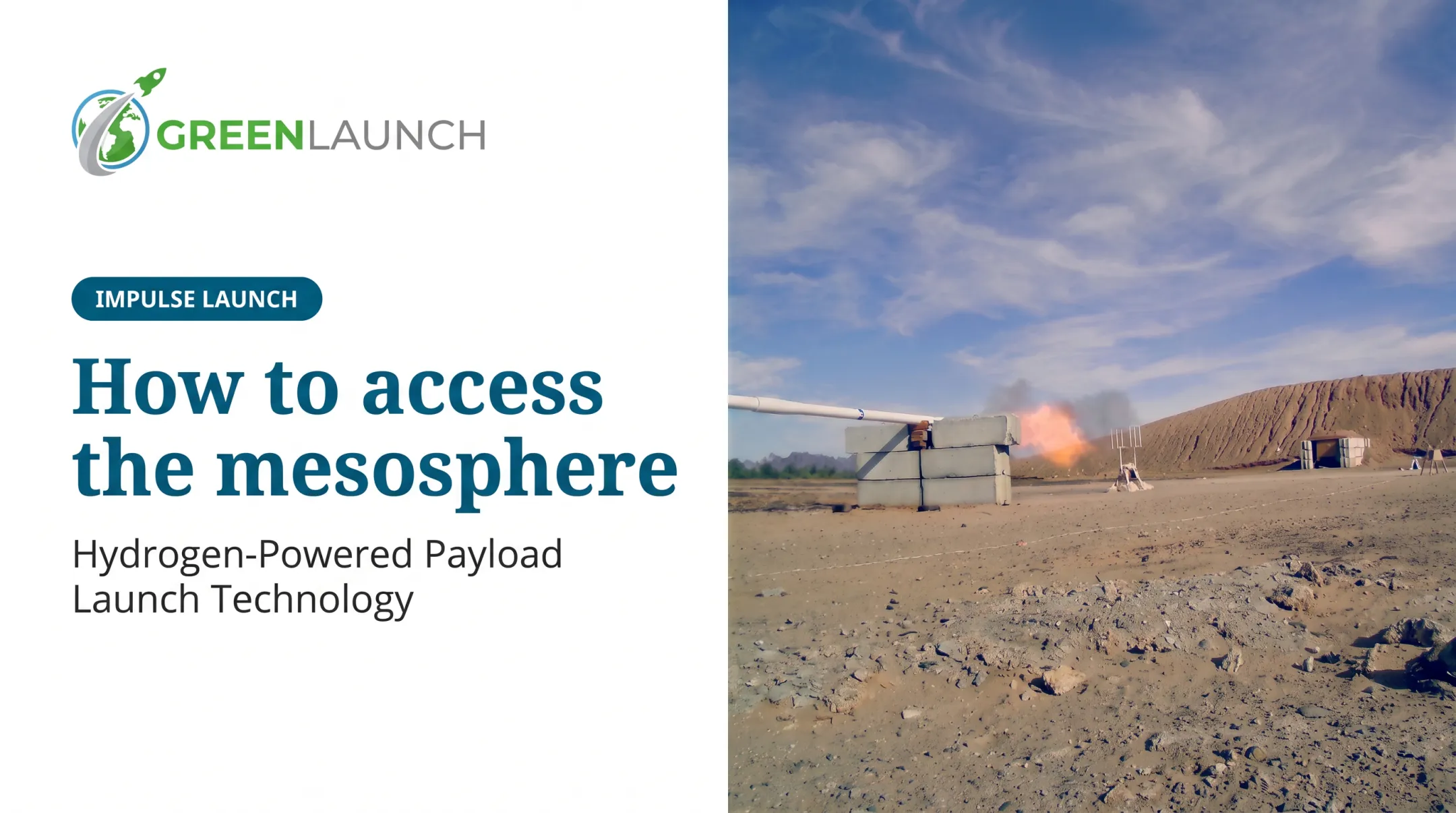
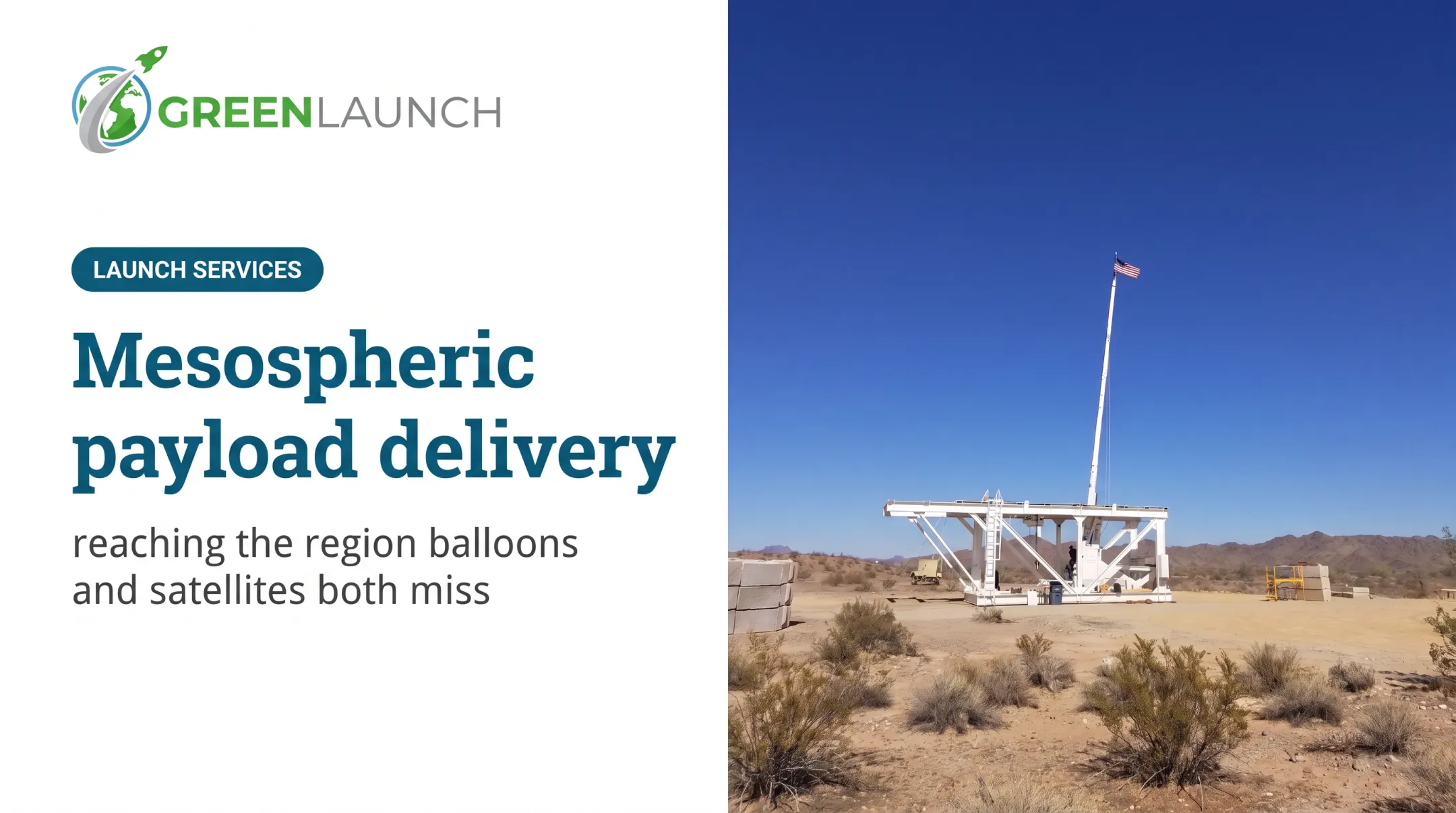
Green Launch has spent years developing a hydrogen-based light-gas propulsion system that fires payloads through the lower atmosphere at extreme velocity before a smaller rocket stage takes over for the remaining boost.
The company's test milestones include a December 2021 vertical launch that accelerated a payload beyond Mach 3 into the stratosphere using a 54-foot launch tube. That is a very different physics problem than trying to coax more lift out of a helium envelope.

Green Launch has also worked on atmospheric sampling missions aimed at the mesosphere for climate researchers, including discussions with the National Science Foundation around 2022.
That contrast matters. Rather than fighting for every extra kilometer with a passive gas envelope, an impulse-launched vehicle with a specialized fiberglass body is built to punch through thin air and keep going.
This kind of approach tends to matter most for:
- Aerospace and defense organizations needing repeatable high-velocity testing
- Satellite manufacturers working with cube-sat class payloads
- Scientific research groups that need atmospheric sampling at altitudes balloons can't sustain
The right method always depends on payload mass, target altitude, velocity, and how long the mission needs to last.
Frequently Asked Questions
What is the highest altitude ever reached by a balloon?
Japan's BS13-08 balloon reached 53.7 km in 2013, using an ultra-thin 2.8-micrometer film and a light 3.2-kg payload. That's well beyond the altitude of routine weather balloons, which typically rupture around 30 km.
Why do weather balloons stop rising?
The surrounding air becomes too thin to provide enough buoyant lift, and the lifting gas keeps expanding as outside pressure drops. Standard radiosonde envelopes stretch from about 5 feet to 20-25 feet before bursting.
Can a weather balloon reach the mesosphere?
Ordinary weather balloons generally burst well below the mesosphere's roughly 50 km starting point. Only specialized designs with ultra-thin film and minimal payloads have reached the lower mesosphere.
Why does helium help a balloon rise?
Helium is far less dense than the surrounding air, so it creates a net buoyant force. But the gas is only one part of the total system. Envelope weight and payload mass matter just as much.
Would using more helium make a balloon reach the mesosphere?
More gas increases initial lift, but it also requires a larger, heavier envelope to contain it. That added weight cancels out much of the benefit, and it still can't overcome thinning air at higher altitudes.
Is the mesosphere the same as outer space?
No. The mesosphere is an atmospheric layer roughly 50-85 km up. "Where space begins" depends on convention: the Karman line sits at 100 km, while the U.S. military uses 50 miles (about 80 km).