Suborbital flight has gained significant momentum across scientific research, commercial payload delivery, and emerging launch technologies. Unlike orbital missions that require spacecraft to "fall around" Earth continuously, suborbital trajectories offer a faster, cheaper gateway to space for experiments, atmospheric sampling, and technology demonstration. As an engineering solution, suborbital flight delivers minutes of microgravity and access to near-space environments at a fraction of orbital costs—making space more accessible than ever.
Key Takeaways
- Suborbital flight crosses the space boundary (50-62 miles altitude) but lacks horizontal velocity to maintain orbit
- Requires dramatically less energy than orbital insertion: ~1.4 km/s vs. ~9.2 km/s delta-v
- Provides 2-5 minutes of weightlessness at apogee for research and tourism applications
- Applications include atmospheric sampling, hypersonic testing, satellite technology demonstration, and commercial space tourism
- Hydrogen light-gas propulsion, as used by Green Launch, reduces launch costs and eliminates hydrocarbon emissions versus conventional chemical rockets
The Physics of Suborbital Flight: How It Works
Suborbital flight follows the same physics as that baseball thrown skyward, just at vastly greater scales. A vehicle launches upward with enough velocity to reach space altitude, but its parabolic trajectory intersects Earth's surface before completing one full orbit—the defining characteristic that separates suborbital from orbital flight.
Energy Conversion and Trajectory Dynamics
As the vehicle climbs, kinetic energy converts to gravitational potential energy. The faster you throw that baseball, the higher it goes; the same principle applies to spacecraft. During ascent, velocity decreases as altitude increases until the vehicle reaches zero vertical velocity at apogee—the highest point of the trajectory. Gravity then reverses the process, converting potential energy back to kinetic as the vehicle accelerates downward through reentry.
The key engineering difference between suborbital and orbital flight lies in how velocity is distributed between vertical and horizontal directions. Suborbital vehicles prioritize vertical ascent — climbing high enough to cross the Kármán line, but not accelerating sideways fast enough to continuously "fall around" Earth.
Achieving orbit requires both reaching altitude and sustaining extreme horizontal speed: approximately 17,500 mph (28,000 km/h) at low Earth orbit altitudes. Without that horizontal velocity, the trajectory curves back to the surface regardless of peak altitude reached.
The Microgravity Experience
That apogee — the peak of the arc described above — is also where suborbital flight delivers its most valuable research window. When engines shut off and the vehicle coasts unpowered, payloads experience genuine freefall: 2 to 5 minutes of microgravity depending on trajectory design. For scientific experiments and instrument calibration, this window is long enough to produce meaningful results while keeping mission complexity and cost far below orbital alternatives.
Delta-v: The Engineering Metric
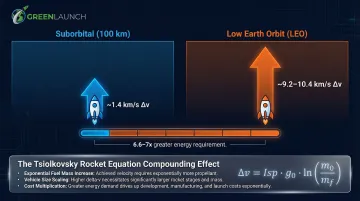
Engineers measure mission energy requirements using delta-v (change in velocity) — the total velocity change a vehicle must achieve regardless of direction. The numbers tell the story clearly:
- Suborbital to 100 km: ~1.4 km/s delta-v, derived from basic physics as roughly √(2gh)
- Low Earth orbit: ~9.2–10.4 km/s delta-v, accounting for orbital velocity plus gravity and drag losses
That six- to seven-fold delta-v gap has compounding consequences. Because propellant mass scales exponentially with delta-v (per the Tsiolkovsky rocket equation), the downstream effects on fuel load, vehicle size, thermal protection, and cost are far larger than the raw ratio suggests. Suborbital access stays cheaper not just because the number is smaller, but because the physics penalize the orbital case at every design level.
Suborbital vs. Orbital Flight: Key Differences
The distinction between suborbital and orbital flight fundamentally comes down to velocity and trajectory geometry.
Orbital Flight Defined
Orbital flight occurs when a spacecraft reaches orbital velocity—the precise horizontal speed required so that its curved trajectory matches Earth's curvature. At low Earth orbit altitudes around 400 km, this requires approximately 17,500 mph (7.8 km/s). At this speed, the spacecraft continuously "falls" toward Earth while Earth's surface curves away at the same rate, producing perpetual freefall around the planet rather than toward it.
The Velocity Gap
The speed difference between suborbital and orbital flight is dramatic. Historical suborbital missions like Mercury-Redstone 3 reached 5,134 mph to achieve 116.5 miles altitude, while modern commercial vehicles like Blue Origin's New Shepard reach approximately 2,235 mph (Mach 3) to cross the 62-mile space boundary. Both fall short of the ~17,500 mph needed for orbit by a factor of three to eight times.
This velocity gap drives fuel requirements up sharply. The Tsiolkovsky rocket equation means each additional km/s of delta-v demands proportionally more propellant mass, larger engines, and heavier structure — compounding costs as the velocity target rises. That's precisely why orbital access costs so much more than suborbital.
Cost Implications
The energy difference translates directly to economics. Orbital launch costs via SpaceX's Smallsat Rideshare program run $7,000 per kg to low Earth orbit, while dedicated Falcon 9 missions average $3,364 per kg for bulk payloads. Suborbital providers don't publish standard per-kg pricing, but the significantly lower energy requirements enable faster turnaround, smaller vehicle sizes, and reduced operational complexity.
For context, NASA charges $20,000 per kg to transport commercial payloads to the ISS—illustrating the premium for sustained orbital access versus brief suborbital exposure.
Common Misconception Clarified
A vehicle that achieves orbit and then intentionally de-orbits before completing one full revolution is NOT classified as suborbital. The critical distinction is whether the vehicle ever achieved orbital velocity. If it reached the horizontal speed necessary to maintain orbit, subsequent deceleration makes it a de-orbited spacecraft, not a suborbital vehicle.
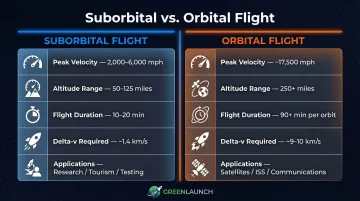
| Flight Characteristic | Suborbital | Orbital |
|---|---|---|
| Peak Velocity | 2,000-6,000 mph (Mach 3-9) | ~17,500 mph (Mach 23) |
| Altitude Range | 50-125 miles (80-200 km) | 250+ miles (400+ km) |
| Flight Duration | 10-20 minutes total | 90+ minutes per orbit |
| Delta-v Required | ~1.4 km/s | ~9-10 km/s |
| Typical Applications | Research, tourism, testing | Satellites, ISS, communications |
How High Is "Suborbital"? Understanding the Altitude Boundary
The definition of "space" varies depending on who you ask, creating two commonly recognized thresholds for suborbital flight.
The Kármán Line (100 km / 62 miles)
The Fédération Aéronautique Internationale (FAI) established the Kármán line at approximately 100 km (62 miles) above sea level as the internationally recognized boundary between Earth's atmosphere and outer space. The boundary has a clear technical basis: above this altitude, a vehicle moving fast enough to generate aerodynamic lift from the thin atmosphere would already be traveling at orbital velocity. In other words, you can't "fly" above the Kármán line using wings alone — you'd have to be going fast enough to orbit. This makes it the official standard for international spaceflight records and astronautical achievements.
The U.S. Definition (80 km / 50 miles)
NASA and the U.S. military award astronaut wings to individuals who fly above 50 statute miles (approximately 80 km). This lower threshold creates a practical second boundary for mission classification, particularly relevant for commercial spaceflight regulations and crew recognition in the United States.
Both Virgin Galactic and Blue Origin design their tourism flights to exceed these boundaries, though Virgin Galactic's flights cross the 50-mile U.S. threshold while Blue Origin's New Shepard exceeds the 100 km Kármán line.
Why the Distinction Matters
Flights that achieve high altitude and high speed but never cross the 80-100 km threshold—such as high-altitude research aircraft or stratospheric balloons—are not classified as suborbital spaceflights. The space boundary crossing is the essential criterion, not just altitude or velocity alone.
Real-World Applications of Suborbital Flight
Suborbital trajectories serve distinct mission profiles where brief space exposure delivers value without the cost and complexity of orbital insertion.
Scientific Research and Microgravity Experiments
Suborbital flights provide 2 to 5 minutes of continuous microgravity at a fraction of ISS mission costs, making them ideal for short-duration experiments in materials science, fluid dynamics, and biological research. Researchers can iterate experiments on monthly cycles rather than waiting years for orbital opportunities.
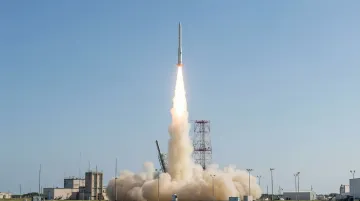
NASA's Sounding Rockets Program Office maintains high operational tempo, launching 17 missions in FY2024 for atmospheric science, astrophysics, and technology demonstration. The rapid turnaround enables statistical analysis through repeated flights under varying conditions—impossible with orbital platforms.
Atmospheric Sampling and Climate Research
The mesosphere and ionosphere between 50-200 km altitude remain difficult to study. Satellites orbit too high, while aircraft fly too low. Suborbital rockets fill this gap, delivering sensor packages directly into these atmospheric layers for in-situ measurements of temperature, composition, and dynamics critical to climate modeling and space weather prediction.
Hypersonic Vehicle Testing
Suborbital trajectories enable hypersonic propulsion testing in realistic flight environments. Scramjet engines and other advanced propulsion concepts require sustained high-Mach-number flight through the atmosphere—conditions achievable via suborbital launch but impossible to replicate in ground facilities.
Space Tourism
Commercial operators have transformed suborbital flight into an experience industry. Blue Origin's New Shepard provides passengers several minutes of weightlessness during 11-minute autonomous flights past the Kármán line, while Virgin Galactic sells tickets at $750,000 per seat for similar experiences crossing the 50-mile U.S. threshold.
Next-Generation Sustainable Propulsion
That commercial momentum has also pushed propulsion technology in a new direction. Green Launch's hydrogen light-gas system uses hydrogen and oxygen propellants that produce only water vapor—no combustion byproducts, no carbon emissions.
The environmental contrast with conventional rockets is stark. Traditional chemical rockets release over 19 tons of CO₂ per ton of payload delivered. For research organizations and defense customers flying frequent suborbital missions, that difference adds up fast.
A Brief History of Notable Suborbital Milestones
From a wartime rocket test in 1942 to a fully commercial tourism flight in 2021, the trajectory of suborbital spaceflight spans eight decades of engineering ambition.
The V-2 and Early Pioneers
The V-2 rocket on October 3, 1942, reached 60 miles altitude at 3,300 mph during a 296-second flight—the first human-made object to touch space. This German military rocket demonstrated that reaching space was physically achievable, setting the stage for postwar space programs.
Mercury-Redstone 3: First American in Space
On May 5, 1961, Alan Shepard's Freedom 7 mission reached 116.5 miles (187.5 km) during a 15-minute, 28-second suborbital flight, making him the first American in space. The flight provided approximately 5 minutes of weightlessness and proved human spaceflight viability before John Glenn's orbital mission nine months later.
SpaceShipOne and the Ansari X Prize
Four decades after Shepard's flight, private enterprise entered the picture. SpaceShipOne won the $10 million Ansari X Prize on October 4, 2004, becoming the first privately-developed crewed vehicle to reach 100 km twice within two weeks. The prize-winning flight reached 112 km, demonstrating that private enterprise could achieve what only governments had accomplished previously.
Blue Origin and the Commercial Era
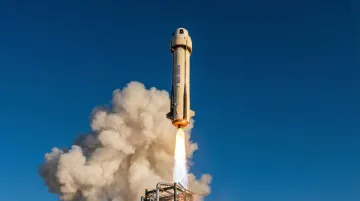
Blue Origin's New Shepard program launched its first crewed flight on July 20, 2021, carrying four passengers past the Kármán line to 107 km on a fully autonomous 10-minute flight. This milestone marked the beginning of routine commercial suborbital tourism operations.
Hypersonic and Beyond: Where Suborbital Is Heading
Suborbital flight is expanding well beyond tourism. Point-to-point hypersonic transport — flying from New York to London in under 90 minutes — is now an active engineering target for several programs. Meanwhile, small-payload operators and researchers are leveraging the same suborbital corridor to test hypersonic vehicles, sample the upper atmosphere, and deploy cubesat-class satellites at a fraction of traditional launch costs.
Frequently Asked Questions
What is the difference between orbital and suborbital flight?
Orbital flight requires reaching approximately 17,500 mph horizontal velocity to continuously fall around Earth rather than toward it. Suborbital flight reaches space altitude but lacks sufficient horizontal velocity to maintain orbit, so the vehicle returns to Earth following a parabolic trajectory.
What height is considered suborbital?
The FAI Kármán line at 100 km (62 miles) serves as the international standard for space boundary. The U.S. military and NASA recognize 80 km (50 miles) as the threshold for awarding astronaut wings. In practice: international missions and treaties use the 100 km standard, while U.S. military and FAA licensing typically apply the 80 km threshold.
What is a suborbital launch vehicle?
A suborbital launch vehicle is any rocket or propulsion system designed to carry payloads or crew to space altitude without achieving orbital velocity. Examples include Blue Origin's New Shepard, NASA sounding rockets, and ground-based impulse systems like Green Launch's hydrogen light-gas launcher.
How high did Alan Shepard fly?
Alan Shepard's Mercury-Redstone 3 mission on May 5, 1961, reached an apogee of 116.5 miles (187.5 km), making him the first American in space. The suborbital flight lasted 15 minutes and 28 seconds from launch to splashdown.
How do suborbital and orbital launch costs compare?
Orbital launches carry a steep premium. SpaceX's Falcon 9 runs approximately $3,364/kg for dedicated missions or $7,000/kg via the Smallsat Rideshare program. Suborbital launches cost substantially less because they require far less energy — no need to sustain the velocity needed to maintain orbit.