This guide examines what suborbital launch vehicles are, how they differ from orbital systems, the propulsion technologies that power them, and why they matter across defense, science, and commercial applications.
Key Takeaways
- Suborbital vehicles cross the 100 km Kármán line but lack the velocity to sustain orbit, following ballistic trajectories back to Earth
- They require 85% less energy than orbital launches, enabling faster development cycles and lower per-flight costs
- Core applications span microgravity research, defense testing, technology qualification, and atmospheric research
- Propulsion ranges from solid and hybrid motors to hydrogen light-gas systems that eliminate hydrocarbon emissions
- The suborbital market is projected to reach $3.15 billion by 2031, driven by scientific payloads and defense contracts
What Are Suborbital Launch Vehicles?
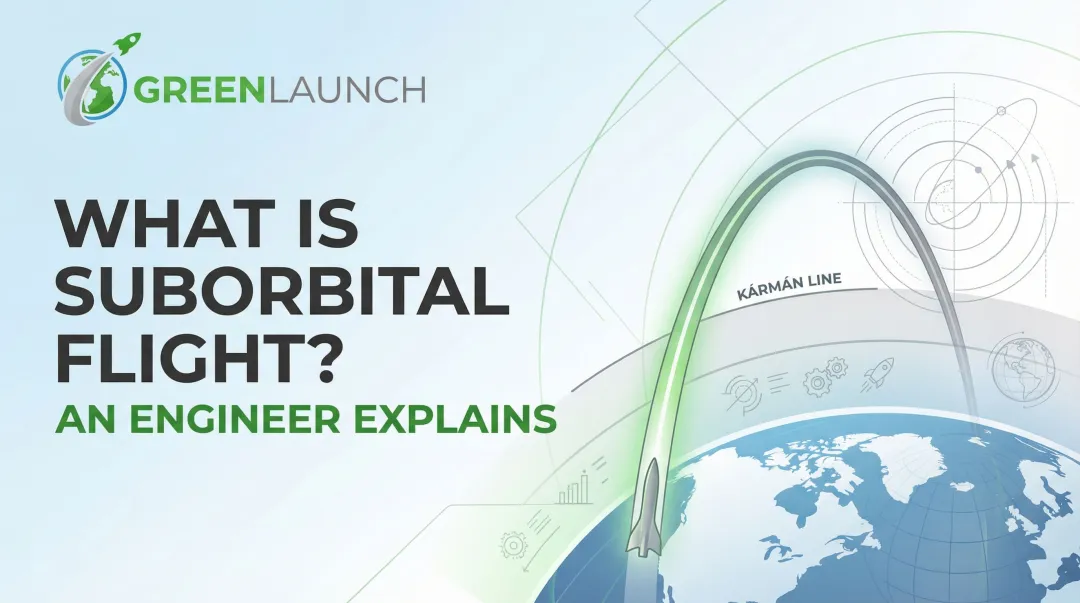
A suborbital launch vehicle reaches outer space—crossing either the internationally recognized Kármán line at 100 km or the U.S. threshold of 80 km—but follows a ballistic trajectory that returns it to Earth without completing an orbit. The critical distinction is velocity: these vehicles lack the horizontal speed needed to sustain orbital motion around Earth.
The Physics of Suborbital Flight
Reaching Low Earth Orbit requires approximately 28,000 km/h of velocity. Suborbital vehicles travel at roughly 6,000 km/h, requiring substantially less propellant mass and simpler structural design. Lower propellant mass and simpler structures mean lower development costs and faster turnaround between missions.
Reaching a 300 km LEO orbit demands approximately 9.2 km/s of delta-v, while a vertical suborbital flight to 100 km requires only 1.4 km/s—roughly 85% less energy.
Typical Flight Profile
Suborbital missions follow a predictable sequence:
- Powered ascent — rocket motor ignites and accelerates the vehicle
- Engine cutoff — propulsion terminates before reaching peak altitude
- Microgravity phase — brief period of weightlessness at apogee, lasting 4-7 minutes depending on trajectory
- Reentry and descent — vehicle returns through atmosphere and recovers via parachute or powered landing
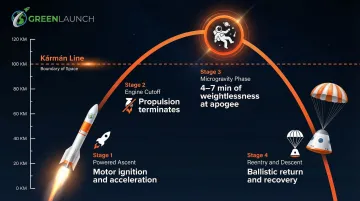
Total mission duration ranges from minutes to over an hour, depending on the altitude profile and payload requirements.
Vehicle Categories
Expendable sounding rockets represent the traditional approach—small, uncrewed vehicles that launch scientific payloads and are not recovered. NASA's Black Brant series typifies this category, with missions costing approximately $1.5 million per flight.
Reusable suborbital vehicles like Blue Origin's New Shepard are designed for rapid refurbishment and reflights, supporting both crewed and uncrewed missions with reduced per-flight costs through operational reuse.
Non-rocket impulse systems take a different approach to the acceleration problem. Light-gas launchers — such as the hydrogen-oxygen system developed by Green Launch — use controlled combustion of hydrogen and oxygen to drive a gas column that accelerates payloads to high velocities. The primary combustion byproduct is water vapor, making this a cleaner alternative to hydrocarbon propellants.
The Altitude Boundary Debate
The Kármán line sits at 100 km internationally, but the U.S. awards astronaut wings at 80 km. This 20 km difference affects vehicle classification, regulatory requirements, and mission planning—particularly for commercial space tourism operations targeting official "spaceflight" status.
Suborbital vs. Orbital: Understanding the Key Differences
Suborbital and orbital flight look similar on paper — both involve rockets, altitude, and space. The engineering reality is far more demanding for orbital systems, driven by a single number: velocity.
The Delta-v Gap
Delta-v—the velocity change a vehicle must achieve—defines launch system complexity. A 300 km LEO orbit requires 9.2 km/s, while 100 km suborbital requires 1.4 km/s. This 6.5:1 ratio cascades through every aspect of vehicle design:
- Propellant mass fraction increases exponentially with delta-v requirements
- Structural loads multiply as fuel tanks grow larger
- Engine complexity rises to manage higher thrust and longer burn times
Vehicle Complexity and Cost
The cost difference is substantial. NASA Black Brant IX sounding rocket missions cost approximately $1.5 million, while small orbital launchers like Rocket Lab's Electron run $7-8 million per flight—a 5x difference for similar payload classes.
Orbital vehicles require:
- Multi-stage separation systems with precision timing
- Advanced guidance and navigation for orbital insertion accuracy
- Heavy-duty thermal protection for high-velocity reentry (7.8 km/s vs. <2 km/s for suborbital)
- Significantly larger propellant tanks and more complex engine systems
Suborbital vehicles can use simpler solid or hybrid motors with off-the-shelf components, reducing both development timelines and operational overhead.
Trajectory and Reentry
Orbital spacecraft follow elliptical paths around Earth's center of gravity. Reentry from orbit generates extreme aerodynamic heating, requiring ablative shields or ceramic tiles to survive temperatures exceeding 1,650°C.
Suborbital vehicles follow parabolic arcs with peak velocities well below orbital speeds. Lower reentry velocities produce manageable thermal environments, allowing simpler recovery methods like parachutes or retro-thrust without heavy ablative shielding.
What Suborbital Is NOT
Vehicles that achieve orbital velocity and then de-orbit before completing one full revolution (like certain military trajectories) are not suborbital. The defining characteristic is that the vehicle never possessed enough horizontal velocity to orbit in the first place—it's following a ballistic arc from launch.
Propulsion Technologies Powering Suborbital Launch Vehicles
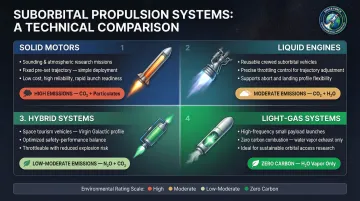
Four propulsion approaches compete in today's suborbital market — each with distinct trade-offs across performance, cost, reusability, and environmental footprint.
Solid Rocket Motors
Solid motors power most sounding rockets due to their simplicity and reliability. Propellant and oxidizer are pre-mixed in the motor casing as a solid grain—typically aluminized hydroxyl-terminated polybutadiene (HTPB)—enabling storage for months without degradation.
Key advantages:
- Rapid launch readiness with no fueling required
- High thrust-to-weight ratios for quick acceleration
- Minimal ground support equipment
- Proven reliability across thousands of flights
Limitations:
- No throttle control once ignited
- Single-use only; cannot be shut down and restarted
- Lower specific impulse than liquid systems
NASA's Black Brant V motor generates 15,596-17,155 pounds of thrust for 32-34 seconds, providing the initial boost for atmospheric research missions.
Liquid and Hybrid Rocket Engines
Liquid propellant systems offer superior performance and control. Blue Origin's BE-3PM engine uses liquid hydrogen and oxygen to generate 110,000 lbf of thrust, with deep-throttling capability down to 20,000 lbf for controlled vertical landings. This throttling capability makes reusable operations practical, directly reducing per-flight costs.
Hybrid systems split the difference. Virgin Galactic's SpaceShipTwo combines solid fuel (HTPB) with liquid oxidizer (nitrous oxide), generating 50,000-85,000 pounds of thrust for approximately 60 seconds. The hybrid approach allows safe shutdown capability while maintaining simpler ground operations than fully liquid systems.
Non-Chemical Propulsion: Light-Gas Launchers
Emerging systems bypass chemical combustion entirely. Light-gas guns use compressed hydrogen—heated and injected into a launch tube—to accelerate payloads through gas expansion rather than combustion.
Companies like Green Launch have pioneered hydrogen/oxygen light-gas propulsion that eliminates traditional hydrocarbon propellants entirely. This approach produces only water vapor as a byproduct, dramatically reducing environmental impact compared to kerosene-based systems. The technology builds on Lawrence Livermore National Laboratory's SHARP project, which successfully launched 5 kg scramjets at Mach 9 (3.1 km/s) in 1995.
Propellant Sustainability Comparison
That emissions profile matters beyond optics. Recent studies show kerosene/LOX engines emit black carbon, CO2, and water vapor, with black carbon contributing to stratospheric warming and ozone depletion. Solid motors emit alumina particles and reactive chlorine (HCl), which also deplete ozone.
Hydrogen/oxygen systems produce water vapor and minimal NOx — no black carbon, no chlorine compounds. As the FAA and international bodies move toward launch emissions reporting requirements, this distinction will increasingly affect launch site approvals and mission licensing timelines.
Mission Suitability by Propulsion Type
- Solid motors: Best for low-cost, simple, high-cadence sounding missions with fixed trajectories
- Liquid engines: Optimal for reusable crewed vehicles requiring throttling and precision control
- Hybrid systems: Middle ground for tourist vehicles balancing safety and performance
- Light-gas systems: Emerging option for rapid, high-frequency payload delivery with minimal logistical overhead and zero-carbon emissions
Applications of Suborbital Launch Vehicles
Scientific Research and Microgravity Experiments
Suborbital flights deliver 4-7 minutes of high-quality microgravity at a fraction of ISS access costs. Blue Origin's New Shepard provides approximately 3 minutes of microgravity, while ESA's TEXUS and MASER sounding rockets extend this to 5-7 minutes, with MAXUS missions reaching 13 minutes.
This duration suffices for diverse experiments:
- Protein crystal growth for pharmaceutical research
- Cell biology investigations under microgravity conditions
- Fluid physics and combustion science studies
- Materials processing and manufacturing research
Real-world example: Swedish Space Corporation's SubOrbital Express-3 mission in 2022 carried Uppsala University experiments investigating microgravity effects on stem cells and insulin-producing beta cells for diabetes research, demonstrating practical medical applications at a fraction of orbital mission costs.
Atmospheric Science Access
Sounding rockets uniquely access the 30-115 km altitude band: too high for balloons, too low for stable satellite orbits. This region is critical for atmospheric physics, plasma dynamics, and solar observation at UV/X-ray wavelengths absorbed by the lower atmosphere.
NASA's Sounding Rocket Program conducts approximately 20 missions annually supporting upper atmosphere research, solar physics, planetary atmospheres, and high-energy astrophysics. The FOXSI missions captured high-resolution hard X-ray images of solar flares, while Hi-C missions recorded the highest-resolution extreme ultraviolet images of the Sun's corona, results that ground-based observatories cannot replicate.
Defense Testing, Technology Qualification, and Surveillance
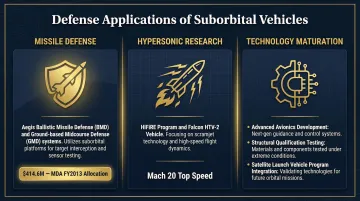
Suborbital vehicles are well-established testbeds across three defense mission areas:
- Missile defense: The Missile Defense Agency uses suborbital target vehicles to validate interceptor systems like Aegis BMD and Ground-based Midcourse Defense. The MDA's Ballistic Missile Defense Targets program requested $414.6 million in FY 2013 for target hardware and support.
- Hypersonic research: Programs like HIFiRE and DARPA's Falcon HTV-2 test hypersonic glide vehicles and scramjet technologies at speeds up to Mach 20, validating components before more expensive orbital demonstrations.
- Technology maturation: Avionics, propulsion components, and structural elements gain exposure to real spaceflight g-loads, vibration, and thermal environments, reducing qualification risk for downstream satellite programs.
Space Tourism and Point-to-Point Transportation
Commercial crewed tourism has driven significant public attention toward suborbital flight, with Blue Origin completing 38 New Shepard flights as of January 2026. Seat prices began at $28 million at auction in 2021 and are estimated at $200,000-300,000 for routine flights.
Beyond tourism, the more commercially significant long-term application is rapid cargo delivery. Suborbital trajectories can move high-value, acceleration-tolerant payloads between distant points in under an hour — a mission profile that aligns closely with uncrewed, ground-based launch approaches.
Point-to-point cargo transport is still years from commercial viability. Technical barriers include reentry heating management, extreme ascent loads, and regulatory integration with national airspace systems. Feasibility studies by RAND and USTRANSCOM continue evaluating the concept.
The Suborbital Launch Market: Key Players and Commercial Opportunities
Market Size and Growth
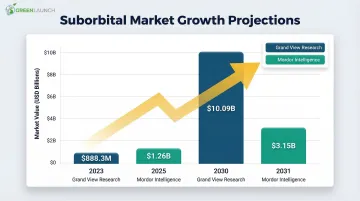
The suborbital market is expanding rapidly. Grand View Research valued the global space tourism market at $888.3 million in 2023, projecting growth to $10.09 billion by 2030 at a 44.8% CAGR. Mordor Intelligence projects more conservative growth from $1.26 billion in 2025 to $3.15 billion by 2031.
Current Market Structure
Government scientific programs dominate expendable sounding rocket flights—NASA, ESA, and national space agencies maintain steady cadences for atmospheric research and solar observation.
Reusable commercial vehicles target tourism and payload delivery, with Blue Origin and Virgin Galactic leading crewed operations. Emerging players are developing scientific payload launch capabilities and defense applications.
Defense and hypersonic testing represent a consistent procurement market, with ongoing contracts for target vehicles, technology qualification flights, and sensor verification missions.
Notable Players and Market Positioning
These three market segments map directly onto the major players competing for contracts today:
- Blue Origin leads crewed tourism with New Shepard's vertical takeoff/landing architecture, offering approximately 3 minutes of weightlessness above 100 km.
- Virgin Galactic operates SpaceShipTwo—a winged, air-launched vehicle with horizontal takeoff and landing, appealing to passengers who want a different flight profile.
- Northrop Grumman and UP Aerospace continue serving scientific and defense customers with expendable sounding rockets, including the well-established Black Brant family.
- Green Launch brings light-gas propulsion to the payload launch segment—using hydrogen/oxygen combustion that produces only water vapor—offering a lower-cost, lower-emissions alternative to conventional rocket providers with fast turnaround between launches.
The Dual-Use Advantage
Suborbital vehicles serving both government and commercial customers can spread fixed operating costs across higher flight rates, driving per-flight costs down for both segments. The more missions a vehicle can fly per year—across scientific, defense, and commercial payloads—the better the unit economics for every customer on the manifest. That's why the most competitive entrants are deliberately building multi-mission portfolios rather than betting on a single market.
Frequently Asked Questions
What is a suborbital launch?
A suborbital launch sends a vehicle or payload beyond the edge of space (above 80–100 km) but without achieving the horizontal velocity needed to maintain orbit. The vehicle follows a ballistic arc, reaching space briefly before returning to Earth under gravity.
What is the difference between orbital and suborbital launch?
Orbital launches require approximately 28,000 km/h to sustain continuous freefall around Earth; suborbital launches reach roughly 6,000 km/h and follow parabolic trajectories. That velocity gap drives markedly different vehicle sizes and costs — orbital launches typically run 5–10x more expensive than equivalent suborbital flights.
What are the two types of launch vehicles?
Expendable launch vehicles (ELVs) are discarded after each flight, keeping upfront costs low at the expense of higher per-flight costs. Reusable launch vehicles (RLVs) are recovered and reflown, trading higher initial investment for lower long-term operating costs. Both categories span suborbital and orbital missions.
What are suborbital launch vehicles used for?
Primary applications include scientific and microgravity research, atmospheric sampling in altitude bands inaccessible to balloons or satellites, defense system testing and technology qualification, space tourism, and emerging point-to-point cargo delivery concepts.
What propulsion systems do suborbital launch vehicles use?
Most use solid, liquid, or hybrid chemical rocket motors. Solid motors dominate expendable sounding rockets for simplicity and reliability; liquid engines power reusable vehicles that require throttle control. Ground-based light-gas systems represent an emerging alternative, using hydrogen combustion to accelerate acceleration-tolerant payloads to high velocities while producing only water vapor as exhaust.
What payloads are suited to suborbital launch?
Suborbital vehicles can carry scientific instruments, atmospheric sensors, small satellites, and defense test payloads. Uncrewed platforms are particularly well-matched to acceleration-tolerant hardware — sensors, CubeSats, and material samples — where the priority is rapid, repeatable, low-cost access to high-altitude regimes rather than gentle handling.