Introduction
As lunar missions scale beyond one-off demonstrations to sustained science, resource extraction, and commercial operations, one infrastructure challenge keeps surfacing: how do you move material off the Moon without spending millions per kilogram? Rockets work. The economics don't.
Chemical propulsion requires consumable propellants shipped from Earth or manufactured on-site through energy-intensive processes. Either way, per-kilogram costs make bulk lunar export prohibitively expensive at any serious scale.
Light-gas launchers (ground-based systems that use rapidly expanding compressed gas to accelerate projectiles to orbital velocities) offer a different path entirely. But the choice of working gas isn't a technical afterthought. It's the single variable that determines whether the system can reach escape velocity at all. On the Moon, hydrogen is the only practical gas that makes the entire concept viable — and this article breaks down exactly why.
Key Takeaways
- Hydrogen's molecular weight of 2 g/mol gives it the highest speed of sound of any practical gas, directly setting the upper velocity limit for projectiles
- Lunar escape velocity is only 2.38 km/s—well within hydrogen's demonstrated 8+ km/s capability from Earth-based testing
- Lunar polar ice deposits support on-site hydrogen production via electrolysis, enabling a self-sustaining propellant cycle
- No other practical gas comes close: helium cuts peak velocity by ~30%, and nitrogen barely clears escape velocity with no margin to spare
What Is a Lunar Light-Gas Launcher?
A light-gas launcher accelerates payloads using compressed gas expansion rather than chemical combustion. The system works through a two-stage cycle: a driver stage (typically gunpowder or a piston mechanism) compresses a working gas to extreme pressure and temperature. When that pressure peaks, a rupture disc breaks and the gas expands rapidly down the launch tube, accelerating the projectile.
The working gas is the performance bottleneck. A projectile cannot outrun the gas pushing it. Because expansion velocity is capped by the gas's speed of sound, the choice of working gas determines whether a launcher can deliver payloads to orbit or merely reach high velocity without escaping the Moon's gravity.
The Physics of Hydrogen: Why Molecular Weight Determines Muzzle Velocity
The Governing Equation
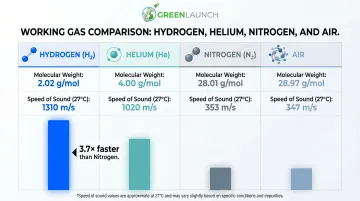
The speed of sound in a gas follows: a = √(γRT/M), where γ is the ratio of specific heats, R is the universal gas constant, T is absolute temperature, and M is molecular weight. Sound speed is inversely proportional to the square root of molecular weight—meaning lighter gases produce higher sound speeds at identical temperatures.
Molecular weights (NIST-verified):
| Gas | Molecular Weight (g/mol) | Speed of Sound at ~27°C (m/s) |
|---|---|---|
| Hydrogen (H₂) | 2.016 | 1,320 |
| Helium (He) | 4.003 | 973 |
| Nitrogen (N₂) | 28.013 | 354 |
| Air (average) | 28.97 | 331 |
Hydrogen's molecular weight is 14 times lower than nitrogen and 2 times lower than helium. At room temperature, that means sound speeds 3.7x faster than nitrogen and 1.36x faster than helium.
How This Translates to Launcher Performance
Since projectiles cannot outrun the expanding gas, the working gas's speed of sound sets the hard ceiling on muzzle velocity. NASA's LGGUN validation data quantifies the real-world impact:
| Working Gas | Maximum Muzzle Velocity (km/s) | Velocity vs. H₂ |
|---|---|---|
| Hydrogen | 5.7 | Baseline |
| Helium | 4.0 | -30% |
| Nitrogen | 2.4 | -58% |
| Argon | 2.0 | -65% |
Nitrogen's 2.4 km/s maximum barely exceeds lunar escape velocity (2.38 km/s), leaving no margin for system losses. Argon can't reach escape velocity at all. Only hydrogen provides comfortable operational headroom.
Temperature Amplifies the Advantage
Speed of sound increases with temperature (√T). Reaching the ~2,280 m/s sound speed needed for lunar circular orbit requires heating hydrogen to approximately 687°C—achievable in two-stage gas guns where piston compression heats the gas to thousands of Kelvin.
Achieving the same 2,280 m/s with nitrogen would require temperatures roughly 14 times higher due to its molecular weight disadvantage, creating severe materials engineering challenges with no practical solution at scale.
Demonstrated Hardware Performance
These theoretical ceilings hold up in practice. Multiple facilities running hydrogen guns have consistently hit velocities that alternative gases simply cannot reach:
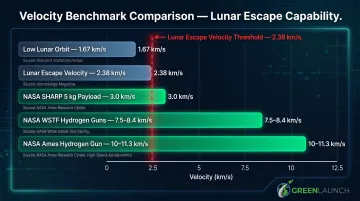
- NASA Ames Research Center (1.28"/0.22" two-stage gun): 10–11.3 km/s, more than 4x lunar escape velocity
- NASA White Sands Test Facility (four hydrogen guns): 7.5–8.4 km/s
- Lawrence Livermore SHARP project (5 kg projectiles, 1990s): 3 km/s, already clearing lunar escape requirements
That 1990s SHARP result is particularly telling: a 5 kg payload cleared the lunar escape threshold using technology that is now three decades old. The velocity advantage hydrogen delivers isn't a narrow engineering preference — it's the difference between a system that works and one that doesn't.
Key Advantages of Hydrogen as a Working Gas for Lunar Launchers
No working gas matches hydrogen across the three factors that matter most for lunar launchers: achievable velocity, infrastructure efficiency, and on-site sourcing potential.
Advantage 1: Maximum Achievable Projectile Velocity
Lunar Requirements vs. Hydrogen Capability:
| Parameter | Velocity (km/s) |
|---|---|
| Low lunar orbit | ~1.67 |
| Lunar escape velocity | 2.38 |
| NASA SHARP (5 kg payload) | 3.0 |
| NASA WSTF hydrogen guns | 7.5–8.4 |
| NASA Ames hydrogen gun | 10–11.3 |
Hydrogen-driven systems already exceed lunar escape velocity by 26–375% in demonstrated Earth-based testing. On the Moon, where there's no atmosphere to slow projectiles after barrel exit, these margins translate directly to reliable orbital insertion with room for trajectory optimization and payload variability.
Helium reaches only 4.0 km/s maximum—still adequate for lunar escape but with reduced margin. Nitrogen's 2.4 km/s limit provides near-zero tolerance for engineering losses, making operational reliability impossible to guarantee.
Advantage 2: Energy Efficiency and Reduced System Mass
Because hydrogen accelerates projectiles to target velocity using lower pressure and shorter barrel length than any alternative, the launcher infrastructure can be lighter and simpler. Every kilogram of hardware on the Moon must be transported from Earth or fabricated locally—infrastructure mass directly drives mission cost.
Terrestrial Cost Context:
Green Launch has demonstrated hydrogen light-gas propulsion at Yuma Proving Ground, achieving Mach 9 velocities, and targets $100–200/lb for acceleration-tolerant payloads. By comparison, current rideshare costs run approximately $3,175/lb, with dedicated small-launch costs reaching $6,575–11,340/lb. While these figures reflect Earth-based economics, the proportional cost advantage comes from reusable ground infrastructure, low-cost propellant, and the elimination of complex rocket avionics — advantages that hold on the Moon.
Hydrogen's efficiency advantage means launchers can be built with lower structural mass for equivalent performance, reducing both transport costs and local manufacturing requirements.
Advantage 3: Recyclability and Potential Lunar Sourcing
The Moon's vacuum environment enables near-perfect propellant recovery. With no atmosphere to mix with or disperse the expelled hydrogen, a closed muzzle capture system can collect gas after each shot and recompress it for reuse. Green Launch has demonstrated >91% propellant capture in terrestrial testing—on the Moon, recovery rates could approach 100%.
In-Situ Resource Potential:
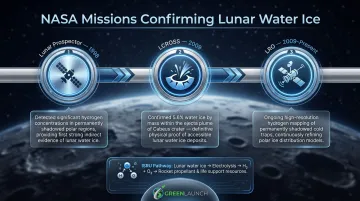
Multiple NASA missions have confirmed hydrogen-rich deposits at the lunar poles:
| Mission | Year | Finding |
|---|---|---|
| Lunar Prospector | 1998 | Significant hydrogen concentrations in permanently shadowed regions |
| LCROSS | 2009 | 5.6% (±2.9%) water ice by mass in Cabeus crater regolith |
| LRO | 2009–present | Ongoing mapping of hydrogen cold traps |
NASA's In-Situ Resource Utilization (ISRU) roadmap identifies water electrolysis (PEM and SOE methods) as the pathway to produce hydrogen and oxygen from lunar ice. A mature lunar infrastructure could eliminate propellant transport from Earth entirely.
Helium and nitrogen provide no equivalent path. Neither exists in extractable quantities on the lunar surface, which means any system built around them remains permanently dependent on Earth supply chains.
How the Lunar Environment Amplifies Hydrogen's Advantages
No Atmospheric Drag
Earth's atmosphere is the primary reason light-gas guns haven't replaced rockets for orbital launch. A projectile exiting the barrel at 8 km/s faces extreme aerodynamic heating and deceleration—the SHARP/Jules Verne Launcher concept required scramjet augmentation specifically to overcome atmospheric losses.
The Moon has a surface pressure of approximately 3 × 10⁻¹⁵ atm—effectively hard vacuum. A projectile exiting at 2.4 km/s travels directly to orbit with zero drag loss. Muzzle velocity equals orbital velocity with no correction needed. That single constraint — the one that makes light-gas guns impractical on Earth — simply doesn't exist on the Moon.
Reduced Gravity Lowers Energy Requirements
The Moon's surface gravity (1.624 m/s²) is 16.6% of Earth's, and escape velocity (2.38 km/s) is roughly 21% of Earth's 11.2 km/s. A lunar launcher needs to impart approximately 1/22nd the kinetic energy per unit mass required for Earth escape.
This shifts light-gas launch from "theoretically possible but impractical" to "demonstrated technology at demonstrated velocities." Hydrogen guns have already achieved the required performance in terrestrial laboratories. Lunar deployment is a matter of engineering scale — the physics has already been proven.
Hydrogen Safety in Vacuum
Hydrogen's flammability range in air is 4–74% by volume, with a minimum ignition energy of just 0.02 millijoules—extremely low. On Earth, this creates significant handling and safety constraints during injection, compression, and recovery.
On the lunar surface, there is no atmospheric oxygen. Hydrogen cannot ignite or detonate without an oxidizer present. The primary terrestrial safety concern vanishes entirely, removing the need for flame suppression systems, atmospheric monitoring, and the strict containment protocols required at Earth-based facilities.
Heritage From SHARP and Green Launch
The SHARP project at Lawrence Livermore National Laboratory, led by Dr. John Hunter (now Green Launch's CTO), became operational in December 1992 and achieved 3 km/s with 5 kg payloads using hydrogen. Green Launch has since achieved 2.97 km/s (Mach 9) in vertical testing at Yuma Proving Ground using hydrogen-oxygen propellants. Both results sit at or above the velocity threshold required for lunar surface launch — no theoretical extrapolation needed.
What Happens When You Choose a Heavier Working Gas
The Velocity Penalty is Non-Negotiable
NASA LGGUN data shows the molecular weight penalty is severe and compounds across system performance:
| Working Gas | Molecular Weight | Max Velocity | Penalty vs. H₂ |
|---|---|---|---|
| Hydrogen | 2.016 | 5.7 km/s | Baseline |
| Helium | 4.003 | 4.0 km/s | -30% |
| Nitrogen | 28.013 | 2.4 km/s | -58% |
| Argon | 39.948 | 2.0 km/s | -65% |
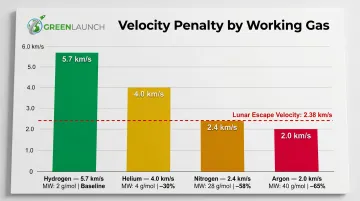
Nitrogen's 2.4 km/s maximum barely clears the 2.38 km/s lunar escape threshold. Any system losses—barrel friction, gas leakage, projectile drag within the tube—drop performance below escape velocity. The margin disappears before the projectile leaves the barrel.
Structural and Operational Cascade
To compensate for lower sound speed, heavier gases require higher compression pressures and temperatures to reach equivalent velocities. NASA LGGUN documents maximum operating pressures of 400-1,000 bar for hydrogen systems. Matching hydrogen's velocity with nitrogen or helium would push pressures beyond structural limits, requiring heavier barrel construction, increasing failure risk, and multiplying system mass.
The NASA LGGUN manual notes that when eroded wall material "weighs down" the working gas, it produces "substantial reductions in muzzle velocity." Intentionally choosing a heavier gas creates this same penalty from the start. No engineering workaround recovers velocity lost to molecular weight.
Historical Validation
That structural cascade is exactly what empirical testing at SHARP, NASA Ames, and NASA WSTF confirmed in practice. Each program converged on hydrogen because no alternative gas held up across all three performance dimensions: speed of sound, compressibility, and recoverability. Helium offers closer performance but cannot be sourced on the Moon, making it a non-starter for sustained lunar operations. Nitrogen and heavier gases don't work for lunar-relevant velocities — the physics closes that door before engineering gets a chance to open it.
Conclusion
Physics dictates hydrogen's dominance as a working gas for lunar light-gas launchers — not engineering preference. Its molecular weight advantage over every practical alternative sets the ceiling on achievable muzzle velocity, determines the scale of energy and infrastructure required, and decides whether closed-loop propellant recovery is even worth attempting.
The Moon's vacuum environment eliminates atmospheric drag and hydrogen combustion risk—the two factors that make light-gas launch impractical on Earth. Combined with confirmed polar ice deposits that enable in-situ hydrogen production via electrolysis, hydrogen becomes not only the ideal working gas today but the basis for a lunar launch operation that no longer depends on propellant shipped from Earth.
Green Launch's Mach 9 hydrogen propulsion platform, built on Dr. John Hunter's experimental work with the SHARP project at Lawrence Livermore National Laboratory, demonstrates this isn't speculative engineering. The performance data exists. The question for lunar deployment is no longer whether hydrogen light-gas launch works — it's how quickly the infrastructure to support it gets built.
Frequently Asked Questions
What happens when you light hydrogen gas?
Hydrogen ignites in air across a wide concentration range (4-74% by volume) and burns cleanly to produce water vapor and heat. In a sealed light-gas launcher barrel operating in vacuum, the gas is compressed and expanded mechanically—not combusted—so ignition is not part of the launch mechanism.
Is hydrogen 14 times lighter than air?
Hydrogen's molecular weight (~2 g/mol) is roughly 14 times lower than air's average molecular weight (~29 g/mol). This molecular weight difference—not gravitational weight—drives hydrogen's effectiveness as a launcher working gas by producing a higher speed of sound, which directly increases muzzle velocity.
Why is hydrogen preferred over helium in light-gas launchers?
Hydrogen's molecular weight (M≈2) is half that of helium (M≈4), giving hydrogen a higher speed of sound and therefore a higher muzzle velocity ceiling. Helium is also extremely rare on the Moon, while hydrogen can potentially be sourced from lunar polar ice deposits via electrolysis.
Can hydrogen be sourced from the Moon's surface?
Yes. Lunar Prospector (1998) and LCROSS (2009) confirmed water ice in permanently shadowed polar regions, with LCROSS measuring ~5.6% water by mass in Cabeus crater. NASA's ISRU roadmap identifies water electrolysis as the production pathway for launch-grade hydrogen.
What payload sizes can a lunar hydrogen light-gas launcher realistically deliver?
Research concepts span CubeSat-class payloads (under 1 kg) for early demonstrations to tens or hundreds of kilograms for resource export. Achievable mass scales with barrel length, operating pressure, and hydrogen temperature at injection.