Introduction
Twenty years ago, launching cargo into space meant calling NASA, Roscosmos, or a handful of government-controlled agencies. Today, the space cargo market looks radically different: dozens of private companies worldwide now compete for contracts, prices have dropped by 95%, and launch schedules measured in months have shrunk to weeks—or even hours.
What was once a government monopoly has opened into a competitive commercial market. Cargo launches now span everything from ISS resupply crates to CubeSats to bulk atmospheric research payloads.
SpaceX alone conducted 134 of 259 global orbital launches in 2024, representing over half of all space launches worldwide.
This article examines how many companies actively launch cargo into space, who the major players are, what they're sending up, and which emerging technologies stand to reshape the market over the next decade.
TLDR:
- Dozens of companies offer commercial cargo launches, but the market is heavily concentrated at the top
- SpaceX dominates with 80% of U.S. launches, while China, Europe, Japan, and India maintain active programs
- Cargo types range from ISS supplies to small satellite constellations to atmospheric research payloads
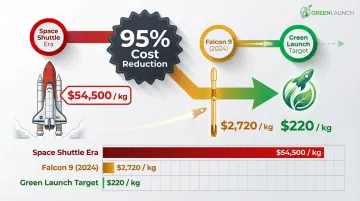
- Reusable rocket technology has reduced costs from $54,500/kg to roughly $2,720/kg for dedicated launches
- Light-gas propulsion systems like Green Launch's offer a lower-cost path for acceleration-tolerant small payloads
What Counts as a Commercial Cargo Launch?
A commercial cargo launch delivers physical payloads—non-crewed equipment—to orbit or beyond, typically under contract for a paying customer. This sets cargo missions apart from crewed spaceflights and from satellite deployments where the same operator owns both rocket and payload.
Two Primary Cargo Mission Types
Orbital station resupply covers missions delivering food, water, scientific equipment, and crew supplies to the International Space Station or other platforms. These run under long-term government contracts and require spacecraft designed specifically for rendezvous and docking.
Third-party payload delivery covers commercial launches carrying satellites, scientific instruments, or materials for external customers. This includes dedicated launches for single large payloads and rideshare missions where multiple smaller payloads split a single rocket's capacity.
How Regulation Defines the Boundaries
These mission categories also affect how companies get licensed. The FAA's Office of Commercial Space Transportation regulates U.S. commercial launches under Title 51 U.S. Code, licensing "launch or reentry operations" rather than distinguishing between "launch provider" and "cargo operator" as separate classes.
The FAA's Part 450 regulations — with a mandatory transition deadline of March 2026 — allow a single license to cover multiple vehicle configurations and launch sites. In practice, this means a company can operate very differently from its competitors and still fall under the same regulatory umbrella.
Some companies own both the rocket and the cargo contract (vertically integrated providers like SpaceX), while others provide only the transportation service (launch-as-a-service providers like Rocket Lab). For customers, knowing which model a provider uses determines how much control they have over scheduling, orbit selection, and payload integration.
How Many Companies Launch Cargo Into Space Today?
Direct Answer: As of 2024, dozens of entities worldwide hold commercial launch licenses or actively conduct cargo launches, though the number performing regular, operational missions is significantly smaller—approximately 10-15 companies account for nearly all commercial cargo activity.
Market Concentration at the Top
The commercial launch landscape is highly concentrated. SpaceX conducted 134 of 259 global orbital launches in 2024, accounting for roughly 52% of all launches worldwide. Within the U.S. market specifically, SpaceX performed 80% of all launches, reflecting near-monopoly status across the American commercial space sector.
Three-Tier Provider Structure
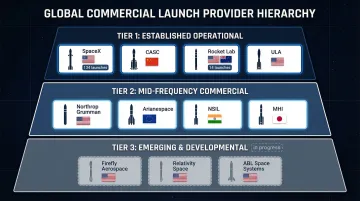
Tier 1: Established Operational Providers
- SpaceX (134 launches in 2024)
- China's CASC (Long March family)
- Rocket Lab (14 Electron launches in 2024)
- ULA (Vulcan Centaur operational)
Tier 2: Mid-Frequency Commercial Providers
- Northrop Grumman (Cygnus cargo spacecraft)
- Arianespace (Ariane 6 operational as of 2024)
- India's NSIL (PSLV/GSLV commercial services)
- Japan's MHI (H3 recovered after early failure)
Tier 3: Emerging and Developmental Providers
- Firefly Aerospace
- Relativity Space
- ABL Space Systems
Geographic Distribution
U.S. providers conducted 154 of 259 global launches in 2024, representing nearly 60% of worldwide activity. China followed with 68 launches, while Europe, Japan, India, Russia, and New Zealand collectively account for the remaining launches. At least eight countries now maintain active commercial cargo launch capabilities.
What This Means for Customers
More launch providers exist than ever before, offering customers real choice in pricing, schedule, and orbital insertion capabilities. Reliability, cadence, and cost vary dramatically across providers, so the decision is rarely straightforward.
SpaceX's dominance comes down to three factors: low pricing (approximately $2,720/kg for dedicated Falcon 9 launches), high reliability, and rapid cadence. Competitors are measured against that baseline. Booking exclusively with SpaceX often yields the best price, but securing backup contracts with secondary providers reduces bottleneck risk as demand continues to grow.
Key Players in Space Cargo Launches
SpaceX
SpaceX dominates the global commercial launch market through its reusable Falcon 9 and Falcon Heavy rockets, plus the Dragon cargo spacecraft used for ISS resupply under NASA's Commercial Resupply Services contracts. The company's 134 launches in 2024 represent more than all other global providers combined.
Key Capabilities:
- Falcon 9 payload to LEO: 22,800 kg
- Dedicated launch cost: approximately $2,720/kg
- Rideshare pricing: $7,000/kg to Sun-Synchronous Orbit
- Launch cadence: 2-3 launches per week
Starship, currently in development, could increase upmass capacity to 150 metric tonnes and further reduce per-kilogram costs once operational for cargo missions.
Northrop Grumman
Northrop Grumman's Cygnus spacecraft serves as NASA's secondary ISS cargo vehicle alongside SpaceX's Dragon. Following retirement of the Antares 230+ rocket, Cygnus now launches aboard SpaceX Falcon 9 rockets, with Northrop partnering with Firefly Aerospace to develop the Antares 330 as a future domestic launch vehicle.
Rocket Lab, ULA, and Arianespace
Beyond the ISS-focused providers, several companies serve distinct market segments. Rocket Lab has carved out a strong position in small payload launches via its Electron rocket, targeting the CubeSat and small satellite market:
- Payload to LEO: 300 kg
- Cost: approximately $25,000/kg
- 14 launches completed in 2024
United Launch Alliance (ULA) made a major transition in 2024, retiring the Atlas V in favor of the Vulcan Centaur. Two certification flights established it for high-value government and commercial missions:
- Payload to LEO: 27,200 kg
- Estimated cost: ~$4,040/kg
Arianespace completed its Ariane 6 maiden flight in July 2024, giving Europe a new independent path to orbit:
- Payload to LEO: 21,650 kg
- Estimated cost: ~$3,560/kg
China and Other Global Players
Western providers aren't the only ones reshaping the market. Several state-affiliated and commercial operators across Asia have built meaningful launch capacity of their own.
China's CASC operates the Long March family for government and commercial missions, including the Tianzhou cargo spacecraft that resupplies the Tiangong space station. Nine Tianzhou missions have launched to date, and an upgraded version is pacing three missions per two-year cycle.
Japan's MHI recovered from its March 2023 H3 failure and completed multiple successful flights in 2024. The H3 carries 6.5 metric tons to GTO, positioning it as a competitive mid-class option for regional and international customers.
India's NSIL (NewSpace India Limited) offers commercial services on both the PSLV (1,750 kg to Sun-Synchronous Orbit) and the heavier LVM3 (10 tonnes to LEO), with growing interest from international satellite operators.
What Types of Cargo Are Being Launched?
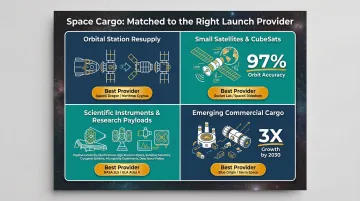
Space cargo falls into four major categories, each with distinct customer requirements and launch provider selection criteria:
1. Orbital Station Resupply Food, water, equipment, and scientific experiments destined for the ISS and future commercial stations require specialized pressurized and unpressurized cargo modules with rendezvous and docking capabilities. SpaceX (Dragon) and Northrop Grumman (Cygnus) are the only providers currently serving this market for NASA.
2. Small Satellites and CubeSats Communications satellites, Earth observation systems, and defense payloads dominate launch manifests. Small satellites under 1,200 kg accounted for 97% of the 2,873 spacecraft launched in 2024, with communications constellations (primarily Starlink) representing 77% of that total.
3. Scientific Instruments and Research Payloads Universities, research institutions, and government agencies deploy specialized sensors, atmospheric sampling equipment, and experimental hardware. These payloads often require specific orbital parameters or rapid deployment schedules that influence provider selection.
4. Emerging Commercial Cargo Concepts In-space manufacturing materials, propellant for orbital refueling depots, and point-to-point Earth logistics are the next frontier — categories still in early development but attracting serious investment.
Across all categories, launch providers delivered approximately 2,171,391 kg of spacecraft mass to orbit in 2024 — and cargo type largely determines which provider gets selected:
- Small rideshare payloads → SpaceX Transporter missions or Rocket Lab Electron
- Large government cargo → Dragon or Cygnus dedicated missions
- Specific orbital parameters → Dedicated launch services with precise insertion capability
- Time-sensitive deployments → Providers with frequent launch schedules and flexible manifests
What's Driving the Space Cargo Market's Rapid Growth?
Reusable Rocket Economics
The primary growth driver is reusable rocket technology proven out by SpaceX, which has reshaped what cargo missions cost. The Space Shuttle cost approximately $54,500/kg to LEO, while the Falcon 9 reduced this to roughly $2,720/kg—a 95% cost reduction that makes cargo missions economically viable for vastly more customers than a decade ago.
The global space economy is projected to reach $1.8 trillion by 2035, up from $630 billion in 2023, driven largely by expanded access to orbit enabled by lower launch costs.
Government Contracts as Market Anchors
NASA's Commercial Resupply Services (CRS-2) contracts, awarded in 2016, carry a maximum potential value of $14 billion through 2024. That guaranteed revenue gave private cargo providers the financial footing to scale operations and pass cost savings to commercial customers. Department of Defense contracts serve the same anchoring function for national security missions.
Rideshare Missions and Constellation Demand
With that stable foundation in place, the commercial market developed its own demand engine. Rideshare missions—where multiple small payloads share a single rocket—generate sustained, predictable cargo demand that supports higher launch cadences. Satellite constellation programs (Starlink, OneWeb, Planet Labs) generate continuous launch requirements that enable providers to maintain high flight rates and further optimize operational efficiency.
Small satellite proliferation reinforces this pattern — Planet Labs alone has launched over 200 imaging satellites since 2013, with each successive batch benefiting from lower per-kg costs than the last.
Beyond Rockets: Alternative Technologies Reshaping Cargo Access
While chemical rockets dominate today's cargo launch market, alternative propulsion technologies are emerging that reduce costs and environmental impact—particularly for high-frequency, smaller-cargo segments where traditional rockets become less cost-effective.
Light-Gas Gun Launch Systems
Light-gas gun technology uses compressed gas (typically hydrogen) to accelerate payloads to hypersonic velocities, offering measurably lower cost-per-kilogram for hardened cargo such as bulk materials, propellants, or standardized supply canisters. Unlike chemical combustion rockets, these systems generate thrust through gas expansion rather than burning fuel.
Green Launch's Hydrogen Impulse Technology
Founded in 2017, Green Launch develops hydrogen-powered light-gas launch systems as an eco-friendly alternative to traditional rockets. The company's Chief Technical Officer, Dr. John W. Hunter, previously led the SHARP (Super High Altitude Research Project) hypervelocity program at Lawrence Livermore National Laboratory, where he achieved Mach 8 scramjet operation—the world record for hypersonic free-flight engine performance.
Green Launch's test record and cost targets set it apart from conventional launch providers:
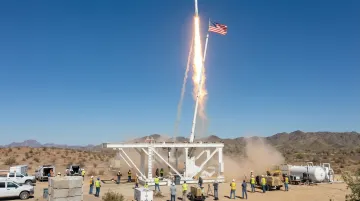
- Conducted successful vertical launches at Yuma Proving Ground, reaching Mach 3+ and approximately 30 km altitude
- Targets orbital delivery at $100 per pound ($220/kg)—roughly 90% less than current Falcon 9 rideshare pricing
- Hydrogen-oxygen combustion produces only water vapor as exhaust
- Demonstrated over 91% propellant capture efficiency, enabling hydrogen reuse and near-zero atmospheric emissions
- For context: traditional rockets produce over 19 tons of CO₂ per ton of payload delivered to orbit
Key Trade-Off: G-Force Tolerance
Not all cargo can withstand the extreme acceleration of non-rocket launch methods. Light-gas systems subject payloads to forces potentially exceeding 30,000 Gs—acceptable for ruggedized electronics, bulk supplies, or propellant containers, but incompatible with delicate instruments or biological payloads.
This makes the technology well-suited for propellant delivery to orbital refueling depots and standardized supply canisters—segments where cost per kilogram matters most and payload hardening is already standard practice.
Frequently Asked Questions
What is a commercial space launch?
A commercial space launch is any spaceflight conducted by a private company that carries payload to orbit or beyond, typically under contract for a paying customer such as a satellite operator, government agency, or research organization. The FAA licenses these operations under Part 450 regulations.
What was the first commercial space company?
Arianespace, founded in March 1980, is widely recognized as the world's first commercial launch service provider. Originally established by the French space agency CNES and the European Space Agency, Arianespace dominated the commercial satellite launch market through the 1990s and early 2000s, placing more than 1,100 satellites into orbit since inception.
How much does it cost to launch cargo into space?
Launch costs vary dramatically by provider and payload size. SpaceX Falcon 9 rideshare missions cost $7,000/kg to Sun-Synchronous Orbit, while dedicated small launch vehicles like Rocket Lab's Electron run approximately $25,000/kg. Emerging ground-based and alternative systems target significantly lower per-kg costs for acceleration-tolerant payloads.
What types of cargo are most commonly sent to space?
Communications and Earth observation satellites represent the majority of cargo mass, accounting for 77% of spacecraft launched in 2024. ISS resupply materials (food, water, science experiments), defense payloads, and components for commercial space stations and in-space manufacturing comprise the remaining cargo volume.
How is space cargo launch different from satellite deployment?
Satellite deployment is a subset of cargo launch: the rocket carries a satellite as its payload and releases it into the target orbit. Beyond satellites, cargo launches also include station supplies, scientific instruments that return to Earth, and bulk materials like propellants.