Introduction
Sending cargo to the lunar surface costs approximately $1.5 million per kilogram with conventional rockets — roughly 555 times more expensive than LEO delivery. The cause isn't engineering complexity or political gridlock. It's basic physics: the rocket equation. Every kilogram sent to the Moon requires exponentially more propellant to lift, accelerate, decelerate, and land. That propellant adds mass, which demands even more propellant, compounding upward until 90-95% of a rocket's launch mass is fuel that burns once and disappears.
This expense caps what's economically viable to send. High-value instruments? Justifiable. Bulk water for life support? Construction materials? Propellant for fuel production? Economically brutal. The result is a hard ceiling on lunar ambitions: we can land flags and rovers, but we cannot sustain infrastructure.
Light-gas launch systems with near-total propellant recovery restructure this equation. By capturing and reusing approximately 99% of the hydrogen or helium propellant after each shot, these systems transform propellant from a consumable expense into a durable operational input.
The dominant cost driver shifts from variable fuel spend to fixed infrastructure amortized across many launches, enabling bulk cargo delivery to the Moon at marginal costs rockets cannot approach. This article examines the mechanics, economics, and logistics implications of that shift.
Key Takeaways
- Rockets consume 100% of their propellant each flight; lunar missions compound that cost with each round trip
- 91% propellant recovery has already been demonstrated in light-gas systems—with a ~99% target recovery rate built into the operating model
- Near-total recovery shifts costs from variable propellant to fixed infrastructure spread across launches
- High cadence becomes viable at low marginal cost—bulk lunar cargo (water, fuel, materials) becomes economically feasible
- At scale, lunar delivery stops being a one-off expense and starts functioning like freight
What Is Light-Gas Launch and How Does Propellant Recovery Work?
Propellant choice isn't incidental—it determines both maximum velocity and whether that propellant can be recovered. Light-gas systems use hydrogen or helium precisely because these gases enable hypervelocity acceleration and can be mechanically recaptured after launch.
The Physics of Light-Gas Propulsion
Muzzle velocity in any gas launcher is constrained by the speed of sound in the propellant gas. Hydrogen propagates sound at 1,286 m/s at 0°C—approximately 3.8 times faster than air (331-343 m/s). Helium carries sound at 972 m/s, about 2.8 times air's speed. This molecular advantage directly translates to higher projectile velocities.
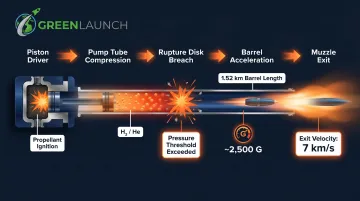
The core mechanism: a large piston compresses hydrogen or helium in a pump tube. When pressure exceeds a rupture disk threshold, the gas expands rapidly into the launch barrel, accelerating the payload. Unlike chemical rockets, which generate thrust through irreversible combustion and molecular decomposition, light-gas systems compress gas mechanically. The propellant remains chemically unchanged.
Two-stage variant: Gunpowder or a secondary gas drives the piston, compressing the light gas to extreme temperatures and pressures before release. NASA Ames documented velocities of 6.24-8.06 km/s with conventional two-stage guns. The DARPA-funded distributed-injection design targets 7 km/s by injecting hydrogen at multiple points along a 1.52 km tube, moderating peak acceleration to approximately 2,500 G instead of the 20,000-30,000 G typical of conventional guns.
The Recovery Advantage: Why Light Gas Can Be Recaptured
Rocket propellants chemically react: kerosene and oxygen combust into CO₂ and water vapor at high temperature, and that transformation is one-way. In contrast, hydrogen or helium in a light-gas launcher is simply compressed and released — it remains hydrogen or helium. This physical process, not a chemical one, is what makes near-total recovery mechanically feasible.
Recovery system architecture: Expelled propellant is collected at the muzzle using baffles and fast-acting shutters, filtered, recompressed, and cycled back to storage. The Gilreath/DARPA design specified a recovery system sized to recapture hydrogen in 2 hours, with recompression to high-pressure storage taking an additional hour.
Green Launch uses hydrogen and oxygen as propellant, producing only water vapor as a byproduct. The company has demonstrated propellant recovery exceeding 91%, with a design target of 95-99%.
The 99% Recovery Equation: What It Does to Launch Economics
Conventional rockets dedicate 85-95% of total launch mass to propellant. MIT's rocket principles reference states: "Of the total mass, 90 percent is the propellants; 6 percent can be attributed to the structure...leaving only 4 percent for the payload." NASA data shows propellant mass fractions of 0.88-0.93 for orbital vehicles like Delta IV and Atlas V. Every launch burns this propellant completely.
In a light-gas system, only ~1% of propellant is unrecoverable loss per launch—friction heating, residual gas, minor leakage. The remaining 99% is recaptured, recompressed, and ready for the next shot. That single difference restructures the entire cost model.
What Happens to Variable Costs
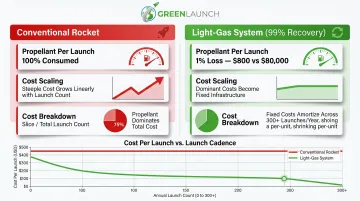
When propellant is 99% reusable, per-launch variable costs collapse. If hydrogen for a single shot costs $80,000 (per Gilreath 1998 estimates), losing only 1% per shot means propellant cost per launch is $800—not $80,000. The dominant cost driver shifts entirely:
- Propellant cost per launch: ~$800 (1% loss on $80,000 fill)
- Dominant costs become fixed: launcher infrastructure, maintenance, staffing
- Fixed costs amortize across hundreds of launches per year
This inversion is what makes the economics structurally different from rockets—not just incrementally cheaper.
Cadence as the Force Multiplier
Propellant stops being a consumable constraint. Launch frequency is limited by hardware readiness and payload prep, not restocking fuel. The Gilreath/DARPA study projected approximately 40-hour turnaround times and modeled 300 launches/year, yielding estimated costs of $5,500/kg to LEO—compared to Pegasus's $64,000/kg at the time. Even at 50 launches/year, per-kg costs remain a fraction of conventional rocket pricing.
Partially reusable rockets (first-stage recovery) still expend all upper-stage propellant, which means staging complexity remains and propellant loss continues. Light-gas systems have no stages to recover and no propellant inventory to replenish between shots—the reusability is more complete from the start.
Lunar Economics Before Light-Gas: The Scale of the Problem
NASA's CLPS contracts reveal lunar surface delivery costs around $1.5 million per kilogram—Intuitive Machines' 2027 mission: $116.9 million for 79 kg. Broader estimates range $300,000–$1.2 million/kg.
Why so high? Lunar missions require deep-space trajectory burns, landers, and often multiple rocket stages, each of which burns propellant that had to be launched in the first place. To send cargo to the Moon, you must also send the propellant needed to slow down and land. That propellant adds mass, which demands more propellant to lift it — a compounding loop with no easy exit.
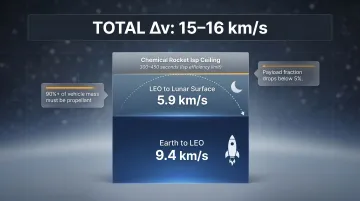
The numbers make this concrete. Lunar surface delivery requires roughly 15–16 km/s of total delta-v from Earth:
- 9.4 km/s to reach low Earth orbit
- 5.9 km/s from LEO to lunar surface
- 300–450 seconds specific impulse for chemical rockets — the efficiency ceiling
At that performance level, well over 90% of a vehicle's initial mass must be propellant. Payload fractions drop below 5%.
Only high-value, low-mass payloads can justify that cost structure. Instruments, samples, and select hardware clear the bar. Bulk commodities — water, regolith processors, construction materials, propellant — do not. Until the cost equation changes, large-scale lunar operations remain out of reach.
How 99% Propellant Recovery Rewrites Lunar Logistics
When the dominant cost driver moves from variable (propellant per launch) to fixed (infrastructure amortized over many launches), lunar cargo economics shift from experimental spaceflight to industrial logistics.
Structural shift: The Gilreath study projected sub-$1 million per mission at 300 launches/year, with $5,500/kg to LEO. For lunar trajectories, additional onboard propulsion (approximately 2.1 km/s for LEO circularization, plus trans-lunar injection and lunar descent stages) would add cost. The Earth departure phase, the most energy-intensive segment, is handled by the light-gas launcher at far lower cost.
Structural shift: The Gilreath study projected sub-$1 million per mission at 300 launches/year, with $5,500/kg to LEO. For lunar trajectories, additional onboard propulsion (approximately 2.1 km/s for LEO circularization, plus trans-lunar injection and lunar descent stages) would add cost. The Earth departure phase, the most energy-intensive segment, is handled by the light-gas launcher at far lower cost.
Comparing $5,500/kg (light-gas to LEO) against $1.5 million/kg (rocket to lunar surface) suggests potential cost reductions exceeding 50-270x for bulk cargo, even accounting for kick stages.
Newly viable payloads:
- Bulk water ice (life support, fuel production at lunar bases)
- Construction feedstocks (regolith processors, structural materials)
- Power system components (solar panels, batteries)
- Food and consumables for crewed outposts
- Propellant for in-situ fuel depots
The Moon has zero supply infrastructure. Everything must come from Earth. High-cadence, low-cost delivery is foundational to any sustained presence.
Compounding benefits: Lower marginal cost per shot justifies more launches, which spreads fixed costs further, reducing per-launch cost more. This compounding dynamic is structurally impossible for expendable rockets where propellant cost grows linearly with launch count.
Mission architecture shift: That compounding effect changes how planners think. Instead of asking "what can we afford to send on this one mission," operators can ask "what is our monthly cargo delivery rate." Lunar base designers, mining operations, and scientific outposts could build infrastructure around predictable supply chains rather than single-event resupply windows.
The G-force constraint: Light-gas launch imposes high acceleration: conventional two-stage guns reach 20,000-30,000 G; distributed-injection designs peak at approximately 2,500 G. Payloads must be ruggedized, which limits application to hardy cargo: fuel, raw materials, structural components, and hardened electronics.
Research by Witherspoon and Kruczynski identified the viable categories: fuel, water, food, solar panels, building materials, and small robust satellites. Green Launch has tested COTS electronics to 3,200 G. That constraint aligns precisely with bulk lunar logistics needs — the cargo categories rockets struggle most to deliver economically.
Beyond Cost: Cadence, Sustainability, and the Lunar Supply Chain Model
Hydrogen-oxygen propellant produces only water vapor when combusted — zero CO₂. By contrast, RP-1/LOX systems like Falcon 9 emit 19-27 tonnes CO₂ per tonne of payload. Light-gas systems with propellant capture release no carbon byproducts at all. No peer-reviewed lifecycle emissions comparison exists yet, but H₂/LOX combustion produces none of the carbon emissions that kerosene or solid propellants do — a meaningful distinction as launch frequency scales.
High cadence changes what's operationally possible on the lunar surface. Rather than batch deliveries spaced months or years apart, operators could receive regular cargo manifests — weekly, even daily at scale. That predictability enables:
- Forward-stocking of consumables and spare parts before they're needed
- Incremental equipment upgrades rather than single high-stakes deliveries
- Tighter coordination between surface activities and Earth-based logistics
- Reduced buffer inventory requirements, lowering total mission cost
Green Launch is building toward exactly this kind of repeatable cadence. Since 2022, the company has conducted vertical light-gas launches for space access. The team includes Dr. John W. Hunter, physicist behind the SHARP project at Lawrence Livermore National Laboratory — which achieved 3 km/s with 5 kg projectiles and demonstrated 8 km/s in laboratory configurations. That foundation supports Green Launch's focus on high-frequency, acceleration-tolerant cargo delivery for defense, scientific research, and commercial lunar logistics customers.
Frequently Asked Questions
How does a light gas gun work?
A large piston compresses lightweight gas (hydrogen or helium) to extreme pressure, which ruptures a valve disk and propels a projectile down a barrel. Because these gases have much higher speed of sound than air (hydrogen: 3.8x; helium: 2.8x), they accelerate projectiles to hypervelocities conventional propellants cannot achieve.
How fast is the light gas gun?
Light-gas guns achieve 6-10+ km/s depending on configuration. NASA Ames documented a standard 8.0 km/s condition for testing. Space-launch applications target 7 km/s or above to balance atmospheric transit stress with orbital velocity requirements. Green Launch has achieved 2.97 km/s (Mach 9) with its single-stage system.
What payloads can survive light-gas gun launch acceleration?
High G-forces (2,500-30,000 G depending on design) limit viable payloads to robust, dense items: bulk propellants, water, metals, hardened electronics, structural materials. Modern COTS electronics tested to 3,200 G; rocket motors sustained 15,000 G. Fragile instruments or biological cargo require alternative delivery.
How does propellant recovery reduce launch costs?
By recapturing ~99% of hydrogen or helium after each shot (91% demonstrated), operators convert propellant from a recurring expense into a near-fixed inventory. Each subsequent launch costs a fraction of the initial propellant investment, shifting the economics toward infrastructure amortization rather than per-shot fuel costs.
Can light-gas launch systems deliver cargo to the lunar surface?
Light-gas systems launch payloads from Earth at high velocity onto a lunar trajectory, handling the energy-intensive departure phase at far lower cost than rockets. A small onboard kick stage handles lunar orbit insertion and surface delivery from there.
What is the cost barrier of sending cargo to the Moon with traditional rockets?
Current lunar surface delivery costs approximately $1.5 million per kilogram under NASA CLPS contracts. The rocket equation compounds this: landing cargo on the Moon means launching all the propellant needed to slow down and land, stacking mass requirements until bulk cargo becomes economically unworkable.