
This article explores what makes the stratosphere unique, traces the pioneering missions that pushed humans and machines to its limits, examines the launch technologies operating there today, and reveals where this field is heading as commercial space demand accelerates.
TLDR:
- The stratosphere (12-50 km altitude) offers thin air, no weather, and temperature inversion — ideal for high-efficiency launches
- Historic missions like Explorer II (1935) and Joe Kittinger's 102,800 ft jump proved humans could survive extreme altitude
- Air-launch systems like Pegasus and Stratolaunch's Roc bypass dense atmosphere, gaining velocity head starts and weather flexibility
- Green Launch's light-gas propulsion uses hydrogen and oxygen combustion to accelerate payloads to Mach 9 with zero carbon emissions
- Defense and small satellite markets drive growing investment in stratospheric platforms for persistent ISR and rapid orbital delivery
What Is the Stratosphere?
The stratosphere is Earth's second atmospheric layer, extending from approximately 12 km (40,000 ft) to 50 km (164,000 ft) above sea level. It sits between the troposphere below — where weather happens and we live — and the mesosphere above. The lower boundary, called the tropopause, shifts with latitude: around 16 km at the equator but just 8 km near the poles.
Temperature Inversion and Ozone Absorption
Unlike the troposphere where temperature drops as you climb, the stratosphere experiences a temperature inversion. Temperatures actually rise with altitude because the ozone layer absorbs incoming ultraviolet radiation, converting it to heat. This inversion creates exceptional atmospheric stability — no convection currents, no clouds, no turbulence, and virtually no weather systems. The air is also bone-dry, with near-zero water vapor content.
At the stratopause (the upper boundary around 50 km), atmospheric pressure drops to roughly 1/1000th of sea-level pressure — a near-vacuum environment compared to the dense air we breathe.
Why This Matters for Launches
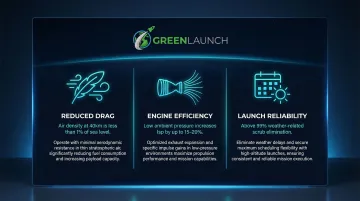
These physical characteristics create three critical advantages:
- Reduced drag: Thin air means far less aerodynamic resistance against ascending vehicles
- Engine efficiency: Rocket engines generate higher specific impulse in low-pressure environments because exhaust gases expand more completely against the nozzle
- Launch reliability: The absence of weather allows far greater scheduling flexibility — no storms, no wind delays, no scrubs
Reaching the stratosphere before igniting a rocket saves fuel, reduces structural stress, and improves payload capacity. That said, the stratosphere's top at 50 km sits well below the Kármán line at 100 km — the internationally recognized boundary of space. Any vehicle launched from the stratosphere still needs to cross roughly 50 km more of thinning atmosphere before reaching orbit.
A History of Stratosphere Launches
Piccard's 1931 Pressurized Ascent
On May 27, 1931, Swiss physicist Auguste Piccard and his assistant Paul Kipfer became the first humans to enter the stratosphere, ascending to 15,781 meters (51,775 ft) in a hydrogen balloon. Their revolutionary sealed, pressurized aluminum gondola proved that humans could operate at extreme altitude if properly protected from the near-vacuum environment.
Explorer Missions and the Stratobowl
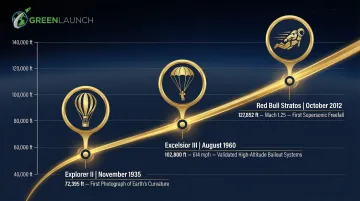
The U.S. Army Air Corps and National Geographic Society launched ambitious stratospheric balloon programs from South Dakota's Stratobowl. Explorer I suffered a dramatic structural failure at approximately 60,000 ft in 1934, forcing the crew to bail out. But on November 11, 1935, Explorer II successfully reached 72,395 ft — a record that stood for 21 years.
Explorer II's crew captured the first photographs showing Earth's curvature and the division between troposphere and stratosphere. The atmospheric data and life-support experiences from these missions directly influenced pressurized cabin design for World War II aircraft, notably the Boeing B-29 Superfortress.
Cold War Reconnaissance: U-2 and SR-71
Military needs drove further stratospheric exploration:
- U-2 Spy Plane: Operating above 70,000 ft, the Lockheed U-2 conducted high-altitude reconnaissance missions throughout the Cold War and remains operational today
- SR-71 Blackbird: Designed to cruise at Mach 3.2, the SR-71 operated safely above 85,000 ft, using the stratosphere's thin air for high-speed reconnaissance missions
These programs generated hard data on high-altitude propulsion behavior and human physiology that no ground-based test could replicate.
Record-Breaking Human Freefall Jumps
Two landmark jumps pushed human limits:
Project Excelsior (1960): USAF Captain Joe Kittinger jumped from 102,800 ft, reaching 614 mph in freefall. His multi-stage drogue parachute system prevented the fatal flat spins that occur in stratospheric freefall, validating high-altitude bailout systems.
Red Bull Stratos (2012): Felix Baumgartner shattered Kittinger's record, jumping from 127,852 ft and becoming the first human to break the sound barrier in freefall, reaching Mach 1.25 (843.6 mph). The mission provided critical data on human physiology at extreme altitude and supersonic speeds without aircraft protection.
| Mission | Date | Exit Altitude | Max Speed | Key Achievement |
|---|---|---|---|---|
| Explorer II | Nov 11, 1935 | 72,395 ft | N/A | First photo of Earth's curvature |
| Excelsior III | Aug 16, 1960 | 102,800 ft | 614 mph | Validated high-altitude bailout systems |
| Red Bull Stratos | Oct 14, 2012 | 127,852 ft | Mach 1.25 | First supersonic freefall |
Air-Launch-to-Orbit: The Pegasus Bridge
In the early 1990s, Orbital Sciences introduced Pegasus, the first privately developed air-launched orbital rocket. Released from a modified L-1011 airliner at approximately 40,000 ft, Pegasus demonstrated that rockets launched from altitude could deploy small satellites more flexibly and economically than ground-based systems. That proof of concept opened the door to a broader question: if altitude gives rockets a meaningful head start, what other launch architectures could exploit the same physics?
The Science Behind Stratospheric Launch
Rocket Engine Efficiency: Specific Impulse Gains
Rocket engines perform better in thin air due to reduced back-pressure against the exhaust nozzle. Specific impulse (Isp) — thrust per unit of propellant consumed — is how that efficiency is measured. The Rocket Lab Rutherford engine produces 311 seconds Isp at sea level but 343 seconds in vacuum, a gain of over 10%. Launching from the stratosphere, where ambient pressure is already near-vacuum, captures most of that gain from the moment of ignition.
Aerodynamic Drag Reduction
Ground-launched rockets must push through the densest atmospheric layers, creating significant drag that consumes propellant. Aerodynamic drag typically accounts for 0.1 to 0.3 km/s of a rocket's delta-v budget, while gravity losses consume 1.5 to 2.5 km/s. Starting at stratospheric altitude (35,000–100,000 ft) means the vehicle bypasses the worst drag environment, converting those saved delta-v margins directly into fuel savings or increased payload capacity.
Velocity Head Start and Gravity Losses
A rocket fighting gravity while moving slowly burns propellant just to stay aloft. Beginning at altitude — already moving at a carrier aircraft's speed — provides a meaningful velocity head start. A subsonic aircraft at 40,000 ft contributes only a fraction of the ~7.8 km/s needed for low Earth orbit. Even so, it effectively replaces an expensive first-stage booster and cuts the time the vehicle spends fighting gravity.
Weather Flexibility and Launch Windows
Ground-based launch pads are fixed installations vulnerable to local weather. Air-launch systems like Pegasus can fly above tropospheric weather, repositioning to clear-sky launch points and adjusting trajectories on short notice. Key operational advantages include:
- Repositioning to favorable weather windows without returning to a fixed pad
- Adjusting launch azimuth on short notice to hit different orbital planes
- Reducing costly weather scrubs that ground fixed-pad operations
The Remaining Challenge: Reaching Space
The stratosphere ends at 50 km — halfway to the Kármán line at 100 km. Stratospheric launch is a powerful head start, but a rocket must still ignite and complete the journey to orbital velocity. Starting that burn in near-vacuum, at speed, and above the densest drag layers means every kilogram of propellant works harder — which is precisely why stratospheric launch continues to attract serious engineering investment.
Methods of Stratospheric Launch
High-Altitude Balloon Launches
NASA Scientific Balloons: NASA's Columbia Scientific Balloon Facility launches 10-15 balloons annually, reaching float altitudes between 100,000 and 120,000 ft. Zero-pressure and super-pressure balloons can carry payloads up to 8,000 pounds, providing economical access for atmospheric research, cosmic ray studies, and Earth observation instruments.
World View Stratollite: World View Enterprises operates the Stratollite, a navigable stratospheric platform designed for persistent Intelligence, Surveillance, and Reconnaissance (ISR). Operating up to 95,000 ft with payloads up to 50 kg, the Stratollite provides continuous power for extended observation missions. Ondas Holdings acquired World View in 2026, and Palantir Technologies partnered with the combined entity to develop AI-enabled multi-domain ISR capabilities for defense applications.
Aircraft-Based Air Launch Systems
Pegasus Rocket: The Northrop Grumman Pegasus remains the most proven air-launch-to-orbit system. First flown in 1990, Pegasus is released from the L-1011 Stargazer at approximately 39,000-40,000 ft. The three-stage solid rocket delivers payloads up to 1,000 pounds to LEO, offering flexible launch azimuths and avoiding fixed pad infrastructure costs.
Stratolaunch Roc and Talon-A: Stratolaunch operates Roc, the world's largest aircraft by wingspan at 385 ft. Roc serves as a carrier for the Talon-A, a reusable hypersonic testbed. In March 2025, Talon-A2 successfully surpassed Mach 5, demonstrating reusable hypersonic capabilities for defense and research customers.
Light-Gas Propulsion: Green Launch's Approach
Green Launch takes a distinct path: rather than lifting a rocket into the stratosphere, their ground-based hydrogen-oxygen light-gas gun accelerates payloads to extreme velocities directly from a fixed installation. Developed by Dr. John Hunter — who led the SHARP project at Lawrence Livermore National Laboratory — the system uses precision gas injection to combust hydrogen and oxygen, driving payloads through a launch tube at hypersonic speeds.
Key performance specifications:
- Peak velocity: 2.97 km/sec (Mach 9), demonstrated at Yuma Proving Ground
- Target delivery cost: $100 per pound to low Earth orbit — substantially below current small rocket pricing
- Emissions: Water vapor only; propellant capture recovers over 91% of hydrogen for reuse
- December 2021 vertical test: Mach 3, ~30 km altitude with a 28-pound projectile
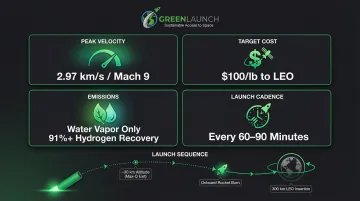
For orbital missions, the launcher provides initial velocity (~6 km/s), then an onboard rocket motor burns for approximately 100 seconds to complete insertion at 300 km altitude.
Intended applications include:
- Atmospheric sampling for the National Science Foundation
- Hypersonic vehicle testing at velocities up to Mach 9
- Small satellite deployment for cube-sat class payloads
The system's launch cadence — potentially every 60-90 minutes — allows rapid, repeatable access to space without the fixed pad infrastructure traditional rocket programs require.
Rocket-Boosted and Hybrid Platforms
Rockoons (1950s and Modern Revival): The U.S. Naval Research Laboratory pioneered "rockoons" — rockets lifted by balloon to ~70,000 ft before ignition. By bypassing the dense lower atmosphere, small Deacon rockets reached 50-100 km to study cosmic rays and solar flares. Modern startups are reviving this concept for cost-effective small satellite launches.
Virgin Galactic SpaceShipTwo: Virgin Galactic's suborbital spaceplane is released from the WhiteKnightTwo carrier aircraft at 43,000-50,000 ft, then ignites its rocket motor. In December 2018, VSS Unity reached an apogee of 271,268 ft (82.7 km), crossing into the mesosphere and demonstrating the viability of air-launched spaceplanes for research and eventually tourism.
The Future of Stratospheric Launch
Commercial Small Satellite Market Growth
The global small satellite market is projected to grow from $6.9 billion in 2024 to $30.6 billion by 2034, driven by LEO constellation deployment for communications and Earth observation. That tenfold expansion puts a premium on flexible, fast-turnaround launch options — exactly where stratospheric methods outperform traditional rockets for satellite manufacturers with tight schedules and tighter budgets.
Defense and ISR Expansion
Stratospheric platforms are becoming strategic assets for persistent surveillance and communications relay. The altitude provides wide-area coverage impossible for lower-altitude drones and more cost-effective than dedicated satellites.
World View's acquisition by Ondas and its subsequent Palantir partnership signal accelerating defense investment in stratospheric ISR. These platforms are increasingly positioned as critical nodes in multi-domain intelligence networks — persistent, affordable, and harder to target than orbital assets.
Sustainability and Cost Reduction
Environmental and economic pressures are reshaping the next generation of launch technologies:
- Green propellants: Hydrogen-oxygen systems like Green Launch's produce only water vapor, eliminating the 19+ tons of CO2 conventional rockets emit per ton of payload
- Reusable systems: Stratolaunch's Talon-A and other reusable hypersonic vehicles reduce per-flight costs Stratolaunch's Talon-A and comparable reusable hypersonic vehicles cut per-flight costs by amortizing hardware across multiple missions
- Minimal infrastructure: Air-launch and light-gas systems avoid the massive capital investment and environmental impact of fixed launch complexes
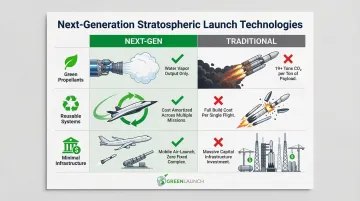
For small, responsive payloads — cubesats, atmospheric sensors, hypersonic test vehicles — stratospheric launch isn't a backup option. It's increasingly the primary one.
Frequently Asked Questions
Do any planes fly in the stratosphere?
Most commercial airliners cruise at the stratosphere's lower edge (35,000–42,000 ft) for fuel efficiency. Specialized aircraft like the SR-71 Blackbird and U-2 reached deep into the stratosphere above 70,000 ft. Today, the Airbus Zephyr solar-electric drone operates above 60,000–70,000 ft for persistent Earth observation — making it one of the few platforms capable of sustained high-altitude coverage without a launch vehicle.
What altitude range defines the stratosphere?
The stratosphere extends from approximately 12 km (40,000 ft) to 50 km (164,000 ft) above sea level. The lower boundary (tropopause) varies from about 8 km at the poles to 16 km at the equator due to atmospheric circulation patterns.
Why is the stratosphere a useful starting point for rocket launches?
Three main advantages: reduced aerodynamic drag from thinner air, better rocket engine efficiency at lower ambient pressure, and the ability to avoid weather systems. These factors reduce fuel consumption and increase payload capacity compared to sea-level launches.
What was the first successful manned stratosphere balloon launch?
Auguste Piccard's 1931 flight was the first human stratospheric ascent. The Explorer II mission in November 1935 reached 72,395 ft, returning the crew safely with the first photographs of Earth's curvature — a record that held for two decades.
What is air-launch-to-orbit and how does it differ from a traditional rocket launch?
Air-launch uses a carrier aircraft to lift a rocket to altitude, then releases and ignites it — giving the vehicle an initial velocity advantage while bypassing the densest atmospheric drag. Ground-based rockets must push through the full atmosphere from sea level, consuming significantly more fuel in the process.
How much fuel does launching from the stratosphere save compared to a ground launch?
Atmospheric drag accounts for approximately 0.1–0.3 km/s of a rocket's delta-v budget, while gravity losses consume 1.5–2.5 km/s. Launching from stratospheric altitude eliminates most drag losses and reduces gravity losses, translating into 10–15% fuel savings or equivalent payload capacity increases for air-launched systems.