
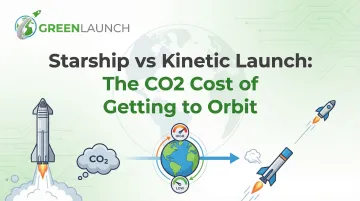
Starship is the most powerful rocket ever flown, burning liquid methane at a scale that produces thousands of tonnes of CO2 per launch. Kinetic launch eliminates combustion entirely during flight—making this comparison critical for satellite manufacturers, defense agencies, and scientific organizations now weighing launch options against net-zero commitments.
Key Takeaways
- Starship emits roughly 3,500 tonnes of CO2 per launch based on SpaceX's Kennedy Space Center Environmental Assessment
- Kinetic launch uses compressed gas propulsion with zero direct CO2 emissions during flight—exhaust is water vapor
- Black carbon from chemical rockets carries a warming effect ~500× greater at altitude than equivalent CO2 emissions at the surface
- Kinetic launch targets small, ruggedized payloads: CubeSats, atmospheric research instruments, and hypersonic test vehicles
- For compatible payloads, kinetic launch is the lower-emissions choice by a wide margin
Starship vs Kinetic Launch: Quick Comparison
| Metric | SpaceX Starship | Green Launch (Kinetic) |
|---|---|---|
| CO2 per launch (direct) | ~3,500 tonnes CO2e | 0 tonnes (flight phase) |
| Fuel type | Liquid methane + liquid oxygen | Hydrogen/oxygen light-gas (ground-based) |
| Payload class | 100–150 tonnes to LEO | Small payloads (CubeSats, <1,000 lbs scalable) |
| Orbital reach | LEO, lunar, Mars | LEO (300 km target altitude) |
| Reusability profile | Fully reusable rocket stages | Reusable ground infrastructure |
| Environmental suitability | Lowest CO2 per kg among chemical rockets | Near-zero launch emissions for compatible payloads |
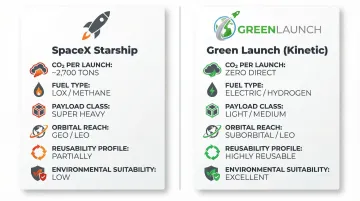
Context matters: Starship's emissions per kilogram of payload are lower than smaller chemical rockets due to massive capacity. But absolute CO2 volume per launch is among the highest of any vehicle currently flying. For operators with net-zero commitments launching small payloads, absolute per-launch CO2 is the metric that counts. Efficiency ratios built around 100-tonne manifests don't translate when you're deploying a single CubeSat.
What is Starship?
Starship is SpaceX's fully reusable, two-stage launch vehicle powered by Raptor engines burning liquid methane (CH4) and liquid oxygen (LOX). It can lift over 100 tonnes to low Earth orbit and carries approximately 6,750 metric tonnes of propellant at launch: 4,100 tonnes in the Super Heavy booster and 2,650 tonnes in the Ship itself. That propellant mass is the starting point for any honest CO2 accounting.
Methane was chosen over RP-1 (kerosene) specifically because it produces less soot and lower direct CO2 per unit of energy compared to kerosene. Complete combustion of methane reduces carbon deposits in engines, simplifying reusability and maintenance. SpaceX also plans to produce methane synthetically on Mars using the Sabatier process, combining Martian CO2 and water to create fuel for return flights.
However, the sheer scale of Starship's propellant load means absolute CO2 emissions per launch remain very large—even with cleaner-burning methane.
Use Cases of Starship
Those emissions get spread across whatever Starship is carrying. Understanding its primary use cases clarifies how the carbon cost is actually distributed.
Starship's primary targets include:
- Large commercial satellite deployment (Starlink constellation expansion at scale)
- NASA Artemis lunar missions, covering crew and cargo delivery to the Moon
- Mars colonization, including eventual crewed missions and point-to-point Earth travel
For satellite manufacturers, Starship's high payload capacity offers competitive cost-per-kilogram pricing, but only when launching large batches of satellites. Individual small payloads don't benefit from this efficiency, and the carbon cost spreads across the full stack whether or not that capacity is filled.
What is Kinetic Launch?
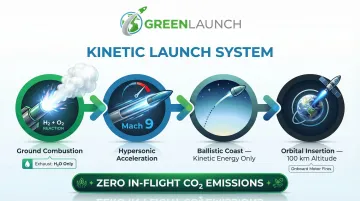
Kinetic launch skips onboard propellant entirely. Instead, a ground-based energy source accelerates a projectile to hypersonic velocities, releasing it into a ballistic trajectory toward orbit.
Green Launch's system uses a hydrogen-oxygen light-gas gun where rapid combustion of hydrogen and oxygen occurs in the gun barrel at ground level. The exhaust is H2O (water vapor), not CO2. The payload then coasts upward under kinetic energy alone, with a small onboard rocket motor handling final orbital insertion after the aeroshell is discarded at 100 km altitude.
The physics: Energy comes from combustion in the ground facility's launch tube, not from onboard chemical propulsion. The projectile is accelerated by compressed light gas (hydrogen or helium) to velocities exceeding Mach 3—recent tests have achieved Mach 9 (2.97 km/sec). Because the main launch energy comes from a ground installation rather than onboard combustion, the carbon footprint of the launch event can be cut to near zero. Powering the facility with renewable electricity decarbonizes the ground-side energy too—something a chemical rocket can never do, since its propellant chemistry is fixed.
Green Launch's technology was developed by Dr. John W. Hunter, who previously directed the SHARP (Super High Altitude Research Project) at Lawrence Livermore National Laboratory.
The company has conducted successful horizontal test firings and completed its first vertical light-gas launch, establishing technical proof of concept. The system has demonstrated 91% propellant capture efficiency, enabling hydrogen reuse and minimal atmospheric emissions.
Use Cases of Kinetic Launch
That combination of low emissions and high launch cadence makes kinetic launch a strong fit for small, ruggedized payloads:
- CubeSats and small satellite constellations
- Hypersonic research vehicles (Green Launch holds the record for Mach 8 scramjet operation)
- Scientific instruments for atmospheric sampling
- Military projectiles and defense applications
High-g tolerance is the key constraint: Modern electronics can withstand 30,000 Gs with minor modifications, making kinetic launch viable for standardized small satellites and aerospace/defense hardware. Crewed missions and fragile equipment are not suitable.
The economic case compounds the environmental one: because launch infrastructure is ground-based and reusable without refurbishment between shots, Green Launch targets $100 per pound to orbit—a fraction of what expendable chemical rockets charge. Launch cadence can reach 60 to 90 minutes between shots, enabling rapid-response deployment for time-sensitive missions.
The CO2 Cost: Breaking Down Emissions Per Launch
Starship's Carbon Footprint
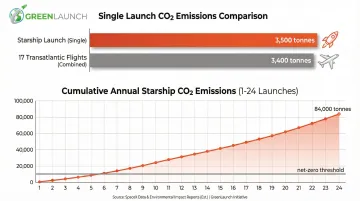
Based on SpaceX's Kennedy Space Center Environmental Assessment, 24 annual Starship launches are estimated to produce approximately 83,794 tonnes of CO2 equivalent per year. This translates to roughly 3,500 tonnes of CO2 per launch.
To contextualize that figure: a typical transatlantic flight emits about 200 tonnes of CO2 total (based on widebody aircraft averages). One Starship launch emits as much CO2 as approximately 17 full transatlantic flights.
As launch cadence scales toward SpaceX's goal of 24+ launches per year, these emissions accumulate fast, potentially exceeding 80,000 tonnes annually from Starship operations alone.
Kinetic Launch's Near-Zero Direct Emissions
Because Green Launch's propulsion is gas-gun driven and the exhaust is water vapor, direct in-flight CO2 from a kinetic launch event is near zero. The hydrogen-oxygen combustion occurs at the ground facility, producing only H2O.
Even the "cleanest" chemical rocket — liquid hydrogen — produces 98 tonnes of CO2 per trip when upstream hydrogen production via fossil-fuel-based steam methane reforming is factored in. Kinetic launch using H2/O2 at the ground still carries some upstream emissions, but these are a fraction of a full chemical rocket burn and can drop to zero if the facility runs on renewable power.
Black Carbon and High-Altitude Effects
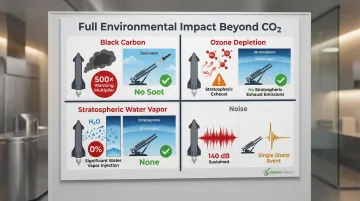
Research shows that black carbon (soot) emitted by rockets is nearly 500 times more efficient at warming the atmosphere than soot released near the surface by industry or aviation. Starship's methane combustion produces relatively less black carbon than kerosene-fueled rockets, but any soot injected into the stratosphere has an outsized warming impact.
Kinetic launch emits no black carbon during flight, eliminating this risk entirely.
The E-Fuel Paradox
Black carbon is one part of the emissions picture. The combustion chemistry itself is another — one that e-fuels cannot solve.
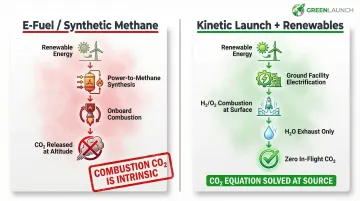
Even if methane is synthesized from renewable sources, the combustion CO2 cannot be eliminated; it's intrinsic to the chemistry. Power-to-methane systems can achieve lifecycle carbon neutrality only when the CO2 feedstock is biogenic and electricity is renewable, yet point-of-combustion CO2 is still released into the atmosphere on every flight.
Kinetic launch bypasses this constraint entirely. Electrify the ground facility with renewables, and the launch CO2 footprint drops to near zero — no combustion aloft, no stratospheric soot, no e-fuel accounting workarounds required.
Beyond CO2: The Full Environmental Picture
CO2 is only part of the environmental equation. Rocket launches also affect stratospheric chemistry, upper-atmosphere moisture, and local noise conditions — each with distinct regulatory and ecological implications. Here's how chemical propulsion and kinetic launch compare across all three.
Ozone Depletion Risk
Modeling studies indicate that increased rocket launch rates necessary to deploy megaconstellations could lead to stratospheric ozone losses exceeding the effect of now-banned ozone-depleting substances. Chemical rocket exhausts—including methane-fueled ones—inject reactive species (NOx, H2O, chlorine from solid boosters) into the stratosphere, driving catalytic ozone destruction cycles. Kinetic launches avoid this entirely — combustion stays on the ground, not in the stratosphere.
Stratospheric Water Vapor
Hydrogen-fueled rockets and some methane combustion produce significant stratospheric water vapor, which has its own greenhouse forcing at altitude. The ORACLE study projects that 100,000 annual flights of a hydrogen-fueled reusable rocket could increase global stratospheric water vapor by approximately 10% and mesospheric water vapor by 100%.
Because kinetic launch generates no in-flight combustion, it produces none of these upper-atmosphere moisture inputs — a meaningful distinction as launch cadence scales toward megaconstellation deployment.
Noise and Local Environmental Impact
Starship's 31 Raptor engines generate extreme acoustic pressure at launch—the SpaceX Environmental Assessment documents noise contours reaching 140 dB near the pad. Kinetic launch produces a single sharp acoustic event — more like a cannon firing than sustained rocket exhaust. For operators near sensitive ecosystems or populated areas, the practical implications include:
- Shorter noise duration, limiting wildlife disturbance windows
- Simpler acoustic modeling for FAA and local environmental review
- Reduced community relations friction in permit applications
Which Launch Method is Greener?
For small, ruggedized payloads that fall within kinetic launch parameters, the environmental choice is unambiguous. Kinetic launch produces near-zero in-flight CO2, zero black carbon, and zero ozone-depleting stratospheric exhaust. Payload compatibility determines which system applies — but within each use case, the emissions difference is stark.
Starship is the only viable option for:
- Large crew capsules
- Interplanetary missions
- Massive satellite batches (100+ tonnes)
In these cases, the per-kilogram CO2 cost is lower than any alternative chemical rocket, and SpaceX's reusability significantly reduces production-related emissions compared to expendable vehicles. That said, neither system is universally "greener" — context determines the answer.
The right choice depends on:
- Payload type and mass
- Mission architecture (LEO vs lunar vs Mars)
- Whether the operator has a net-zero commitment that accounts for launch emissions
For aerospace and defense organizations, small satellite and cubesat manufacturers, and research institutions whose payloads are compatible with kinetic launch parameters, Green Launch offers a path to achieve net-zero launch operations—something no chemical rocket can match. That distinction matters most for operators who have decarbonization commitments on paper but no launch provider capable of backing them up.
Conclusion
Starship is an engineering marvel and its methane fuel is cleaner than kerosene. But thousands of tonnes of CO2 per launch is not a sustainable baseline as launch cadence scales. Kinetic launch represents a structurally different approach where the CO2 equation is solved at the energy source level, not the propellant chemistry level.
As satellite constellations scale and launch cadence climbs toward hundreds of flights per year, that emissions baseline compounds quickly. Organizations with ESG commitments need to factor launch emissions into procurement decisions — the same rigor aviation customers now apply to flight carbon accounting.
Locking in carbon-intensive architectures before low-emission alternatives reach maturity is a decision the industry will carry for decades. For acceleration-tolerant payloads, Green Launch's hydrogen-powered impulse system is already past the concept stage — the company completed its first vertical light-gas launch in 2022. Evaluating it now, during constellation build-out, is when that choice still matters.
Frequently Asked Questions
How much CO2 does a Starship launch produce?
Based on SpaceX's Environmental Assessment filed with NASA for Kennedy Space Center operations, 24 annual Starship launches are estimated to produce approximately 83,794 tonnes of CO2 equivalent per year, or roughly 3,500 tonnes per launch. This is significantly higher than smaller rockets but lower per kilogram of payload delivered.
How environmentally friendly is SpaceX's Starship?
Starship uses liquid methane—the cleanest hydrocarbon rocket fuel available—and produces less soot than kerosene-fueled rockets. However, its sheer scale means absolute CO2 emissions per launch rank among the highest of any vehicle flying, and high-altitude exhaust carries warming effects beyond what the CO2 figure alone captures.
What is kinetic launch and how does it work?
Kinetic launch uses a ground-based light-gas gun to accelerate a payload to hypersonic velocities before release. The launch vehicle itself does not burn hydrocarbon fuel during flight, resulting in near-zero direct CO2 emissions. A small onboard rocket motor handles final orbital insertion after the projectile coasts upward under kinetic energy.
What payloads are best suited for kinetic launch?
Kinetic launch suits small, ruggedized payloads—CubeSats, hypersonic research vehicles, scientific instruments, and military hardware—that can withstand high-g acceleration. Modern electronics can tolerate up to 30,000 Gs with minor modifications, though crewed missions and fragile equipment are out of scope.
How does kinetic launch compare to other green launch alternatives like hydrogen rockets?
Hydrogen rockets eliminate direct combustion CO2 but carry indirect emissions from production—over 95% of hydrogen today comes from steam methane reforming at roughly 9 kg CO2e per kg of H2, and stratospheric water vapor injection adds further warming. Kinetic launch avoids in-flight combustion entirely; its ground facility can run on renewable electricity.
Can kinetic launch achieve orbital velocities?
Yes—kinetic launch systems reach orbital velocities when paired with a small onboard propulsion stage for final insertion. Green Launch has validated the approach through successful vertical light-gas launches reaching Mach 9, with the ground gun supplying the majority of the energy required to clear the lower atmosphere.