Introduction
In 2024, Aerostar kept a stratospheric balloon aloft for 336 consecutive days—a world record that signals just how far this technology has come. What was once a niche tool for atmospheric scientists now factors into defense operations, climate research, and commercial communications.
The 2024–2025 period has been unusually active. This roundup covers the major developments: Arctic military exercises, dual NASA launches from Fort Sumner, student-led research missions, and the growing case for balloons as a low-cost alternative to satellite deployment.
Key Takeaways
- Aerostar's Thunderhead balloon set a world record with 336 continuous days in flight, ending in March 2025
- Arctic Edge 2025 deployed high-altitude balloons for defense readiness testing in Alaska under NORAD/NORTHCOM
- NASA launched two scientific balloons simultaneously on September 14, 2025—the first dual launch since 2011
- Student teams from Caltech and San Antonio flew high-altitude payloads for climate research and STEM education
- Stratospheric balloons are emerging as a faster, cheaper path to persistent surveillance and communications coverage than traditional satellites
Major Stratospheric Balloon Launches: 2024–2025 Roundup
Aerostar's Record-Breaking HBAL684 Mission
Launched from Okeechobee, Florida in April 2024, Aerostar's HBAL684 Thunderhead balloon completed a 336-day stratospheric flight, concluding in March 2025. The system covered more than 80,500 nautical miles across the Caribbean, Midwest, South Pacific, and beyond.
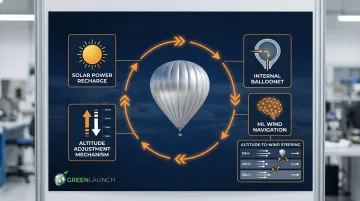
Navigation relied on machine-learning wind models that adjusted altitude to steer toward favorable wind patterns. This shattered all previous records for controllable stratospheric vehicles and opened a practical path for persistent, solar-powered platforms operating at stratospheric altitudes for months at a time.
NASA's Historic Dual Launch from Fort Sumner
On September 14, 2025, NASA launched two scientific balloons simultaneously from Fort Sumner, New Mexico—the first dual launch since 2011. Each mission had a distinct scientific objective:
- JPL-Remote: Reached 127,000 feet, flew ~13 hours, measured atmospheric gas layers to validate satellite data and extend a climate baseline running back to 1989
- Cosmic Dust Collection Project: Ascended to 125,000 feet for ~8.5 hours, sampling stratospheric contamination from cosmic dust
Coordinating two balloon operations from a single site on the same day restored a multi-payload launch capability that NASA hadn't used in over a decade.
HASP2 Student Platform Mission
The High Altitude Student Platform 2 (HASP2) launched from Fort Sumner on September 4, 2025, reaching approximately 122,000 feet and flying for nearly 12 hours. This collaborative mission between Louisiana Space Grant, NASA, and the Columbia Scientific Balloon Facility carried payloads from 11 student teams from universities across the U.S., Canada, Peru, and Belgium—four countries contributing hardware to a single stratospheric flight.
Aerostar's Arctic Edge 2025 Military Balloon
In early August 2025, Aerostar launched a high-altitude balloon from Joint Base Elmendorf-Richardson, Alaska as part of Arctic Edge 2025, a NORAD/NORTHCOM homeland defense exercise. The mission tested hydrogen use in high-altitude balloons under extreme Arctic conditions, focusing on communications and surveillance capabilities for defense applications near the U.S.-Russia maritime border.
Caltech GLOBO Mission
The Caltech CAOS club launched its GLOBO balloon mission from the Mojave Desert in June 2025. Rising over 20 kilometers, the balloon carried a CubeSat-like payload equipped with GPS, atmospheric sensors, cameras, and a gas detection system. The payload landed near Joshua Tree National Park approximately 100 miles from the launch site, successfully completing a student-designed atmospheric research mission inspired by LA wildfire air quality monitoring gaps.
Record-Breaking Technology: How Balloons Are Pushing New Limits
The Thunderhead System's Technical Innovation
What makes Aerostar's 336-day flight record truly significant is its semi-autonomous operation. The system uses rechargeable solar power and machine-learning wind navigation to steer at altitude by adjusting its weight through an internal air ballast system. By pumping outside air into a smaller internal "balloonet," the balloon modifies its altitude to catch favorable wind patterns, eliminating the traditional limitation of uncontrolled balloon drift.
The Thunderhead platform supports multiple mission types from a single platform:
- Persistent communications, including direct-to-handset cellular coverage
- Wildfire detection and maritime traffic monitoring
- Resilient tactical data links for defense applications
High-Altitude Airships (HAAs) provide persistent regional coverage at infrastructure costs of roughly $50 million, compared to approximately $9 billion for LEO satellite constellations, making stratospheric balloons a compelling cost-per-flight-hour alternative.
University-Accessible Stratospheric Technology
The Caltech GLOBO project shows how accessible stratospheric balloon technology has become. First-year students built a 10-inch 3D-printed cube carrying GPS, altitude/pressure sensors, a GoPro, real-time radio communication, and multi-gas sensors—all on a university budget. Advanced stratospheric research no longer demands institutional-scale budgets or specialized facilities.
Modular, Multi-Mission Capability
Emerging trends point toward modularity and multi-mission capability. CAOS plans to develop swappable sensor modules, live video transmission, and physics-focused payloads, meaning a single balloon frame can serve atmospheric science one mission and tactical surveillance the next—without rebuilding hardware from scratch.
Defense and Military Applications: Balloons at the Frontier
Arctic Edge 2025 Context
Arctic Edge 2025 was a NORAD and U.S. Northern Command exercise spanning Alaskan sites including Nome, Kotzebue, and Cold Bay. Focused on homeland defense, cruise missile tracking, and Arctic force interoperability near the U.S.-Russia maritime border, the exercise tested balloons as rapidly deployable, low-cost alternatives to satellites for communications and remote sensing during military operations.
Why Balloons Outperform Drones and Aircraft for Certain Missions
Stratospheric balloons offer distinct advantages for defense applications:
- Flight endurance: Days to months versus hours for drones or aircraft
- Operational cost: Significantly lower cost per hour than satellites or manned platforms
- High-altitude persistence: Above weather systems and most aircraft traffic
- Multi-sensor payloads: Can carry surveillance, communications, and sensor suites simultaneously
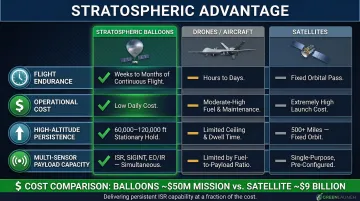
Infrastructure for HAA systems costs approximately $50 million compared to $9 billion for global LEO constellations, representing substantial savings for persistent surveillance missions.
Addressing Public Confusion
Those cost and capability advantages haven't stopped public confusion from becoming an operational reality. Aerostar executives noted that despite frequent balloon operations, large stratospheric balloons still generate media attention and public concern. Legitimate military and commercial flights operate transparently in coordination with the FAA and military air traffic control. That procedural transparency is what separates them from the 2023 Chinese surveillance balloon incident — a distinction the industry is actively working to communicate as flight volumes increase.
Scientific and Student-Led Missions Taking Flight
NASA's Long-Term Climate Data Continuity
NASA's Fort Sumner balloon campaign includes the JPL-Remote mission, which has built on continuous atmospheric data collection going back to 1989. Balloon measurements cross-validate satellite instruments, providing a ground-truth baseline that satellites alone cannot establish.
LCATS Program in San Antonio
The Lunar Caves Analog Test Sites (LCATS) program launched three student payloads coordinated with the FAA and U.S. Air Force at Kelly Field. Each payload measured:
- Atmospheric temperature and pressure
- Gamma radiation levels
- Microbial behavior at altitude
All three balloons landed intact on surrounding farmland, with payloads recovered successfully — matching the kind of methodical data collection NASA applies to planetary science missions.
Growing Role in STEM Education
Caltech's GLOBO project began as a class assignment inspired by LA wildfire air quality monitoring gaps and developed into a fully funded, club-run research mission. That shift from coursework to funded research reflects a broader pattern: balloon platforms are giving students direct access to real atmospheric science without the cost barriers of orbital missions.
Beyond the Stratosphere: The Next Frontier in Payload Delivery
Understanding the Ceiling of Balloon Missions
Most high-altitude balloons float between 18 and 37 kilometers (approximately 60,000 to 120,000+ feet), well above commercial air traffic and most weather systems. This altitude range makes them excellent for atmospheric research and persistent surveillance, but payloads that need to reach orbit require fundamentally different technology. Transitioning from balloon altitude to orbital velocity demands acceleration to approximately 7.8 km/s—speeds that no balloon can achieve through buoyancy alone.
Balloon-Assisted Launch as a Cost-Reduction Strategy
By launching from the stratosphere, a propulsion system can skip the densest part of the atmosphere, reducing fuel requirements, drag losses, and overall cost. Commercial rockoon developers estimate that bypassing the highest-density atmospheric layers reduces Delta-V losses by up to 2 km/s, translating to more than 70% propellant savings for an equivalent launcher. Several commercial teams are now developing rockoon systems specifically targeting small satellite deployment, where per-kilogram launch costs remain the primary barrier to entry.
Green Launch's Complementary Approach
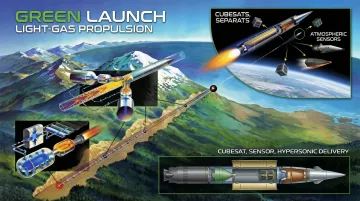
Green Launch offers a complementary solution using light-gas propulsion technology designed to achieve the high velocities needed for suborbital and orbital payload delivery. Using hydrogen and oxygen propellant, the system targets acceleration-tolerant payloads, including:
- CubeSats and small satellites
- Atmospheric samplers and sensor packages
- Hypersonic test vehicles and research instruments
For aerospace, defense, and scientific research organizations looking to move beyond balloon-altitude missions, Green Launch offers lower-cost access to space without the overhead of traditional rocket launches.
Frequently Asked Questions
What altitude does a stratospheric balloon reach?
Stratospheric balloons typically float between 18 and 37 kilometers (approximately 60,000 to 120,000+ feet), well above commercial aircraft and most weather systems. The specific altitude depends on balloon size, payload weight, and design specifications.
How long can a stratospheric balloon stay in flight?
Flight duration ranges from hours for scientific or student missions to months for advanced commercial systems. Aerostar's 336-day world record flight is the current benchmark for controllable stratospheric vehicles.
What are stratospheric balloons used for?
Major applications include atmospheric and climate research, military surveillance and communications, disaster response, wildfire detection, maritime monitoring, and STEM/student science missions. Increasingly, balloons serve as low-cost alternatives to satellites for persistent regional coverage.
What is the difference between a weather balloon and a stratospheric balloon?
Weather balloons are typically small, uncontrolled, and designed for short atmospheric data collection before bursting. Stratospheric balloons are larger, often steerable through altitude control, and built for multi-day or multi-month missions carrying complex scientific or commercial payloads.
Are stratospheric balloon launches regulated by the FAA?
Yes, high-altitude balloon launches require FAA coordination and airspace clearance under 14 CFR Part 101 Subpart D. Military launches also involve coordination with the Air Force and NORAD, depending on operational location.
Can stratospheric balloons be used to launch payloads into orbit?
Balloons can carry payloads to the upper stratosphere but cannot achieve the velocity needed for orbit on their own. They can function as a cost-reducing first stage by bypassing dense atmospheric layers, but a separate propulsion system must provide the ~7.8 km/s velocity required for orbital insertion.