
Introduction
Specific impulse (Isp) and acceleration are the two defining performance metrics for any propulsion system, yet engineers, researchers, and mission planners frequently confuse how to calculate them or relate them to each other.
The consequences of miscalculation ripple through entire mission designs: overestimating Isp leads to undersized propellant tanks and failed delta-v budgets; misunderstanding acceleration profiles can leave a payload structurally inadequate for the launch environment.
This guide provides a practical walkthrough of both metrics—how to calculate Isp step-by-step, how to derive acceleration from impulse parameters, and how to use a Specific Impulse & Acceleration Calculator to verify your calculations with real inputs.
Key Takeaways
- Specific impulse measures propulsion efficiency—the thrust produced per unit weight of propellant consumed per second
- Isp formula: Isp = F / (ṁ × g₀), where g₀ = 9.80665 m/s²
- Acceleration follows from: a = F / m, with F = Isp × ṁ × g₀
- Higher Isp means better propellant efficiency, but often comes with lower thrust-to-weight ratios
What Is Specific Impulse and Why Does It Matter in Propulsion?
Specific impulse (Isp) measures how efficiently a rocket or propulsion system uses propellant. Mathematically, it's the total impulse delivered per unit weight of propellant consumed. Think of it as the aerospace equivalent of "miles per gallon": higher numbers mean you travel farther on the same fuel.
Two Forms, One Common Mistake
Isp has two common forms:
- Isp in seconds (thrust divided by propellant weight flow rate): The universal standard in rocketry because the numerical value remains identical in both SI and Imperial units
- Effective exhaust velocity (ve in m/s): Related by Isp × g₀
A frequent calculation error is confusing these two forms. When someone reports an Isp of 450, they mean 450 seconds — not 450 m/s.
Isp vs. Thrust: Different Metrics, Different Purposes
Thrust is the raw force produced by an engine; Isp measures how efficiently that force is generated from propellant mass. High thrust does not equal high Isp. For example:
- LH2/LOX engines achieve high Isp (~450 s) but lower thrust density
- Kerosene/LOX engines produce higher thrust density but lower Isp (~310-330 s)
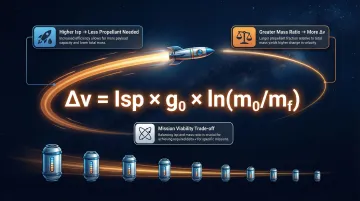
This tradeoff drives first-stage engine selection: kerosene/LOX for high-thrust liftoff, hydrogen/LOX for efficient upper stages. That efficiency gap becomes quantifiable through the Tsiolkovsky rocket equation, which links Isp directly to propellant mass:
Δv = Isp × g₀ × ln(m₀/mf)
Where:
- Δv = velocity change achievable
- m₀ = initial mass
- mf = final mass after propellant consumption
Higher Isp reduces the propellant mass needed for a given velocity change. For satellite mission designers working within launch vehicle fairing constraints, that mass savings is often the difference between a viable mission and a grounded one.
Sea-Level vs. Vacuum Isp
Engines operate differently depending on atmospheric backpressure. The RS-25 engine demonstrates this clearly:
- Vacuum Isp: 452.3 seconds
- Sea-level Isp: 366 seconds
The 86-second drop occurs because ambient atmospheric pressure reduces effective exhaust velocity. Vacuum Isp is always higher—which is why upper-stage engines optimized for vacuum use larger nozzles with higher expansion ratios.
The Specific Impulse Formula: How to Calculate Isp Step by Step
The Primary Formula
Isp (seconds) = Favg / (ṁ × g₀)
Where:
- Favg = average thrust (Newtons)
- ṁ = propellant mass flow rate (kg/s)
- g₀ = standard gravity (9.80665 m/s²)
Alternatively: Isp = ve / g₀ (where ve is effective exhaust velocity in m/s)
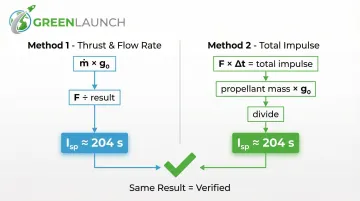
Worked Example 1: Thrust and Flow Rate Method
Given:
- Thrust: 500,000 N
- Mass flow rate: 250 kg/s
Step 1: Multiply mass flow rate by standard gravity 250 kg/s × 9.80665 m/s² = 2,451.66 N/(m/s²)
Step 2: Divide thrust by result 500,000 N ÷ 2,451.66 = 204 seconds
Result: Isp ≈ 204 s
Worked Example 2: Total Impulse Method
Formula: Isp = Itotal / (mpropellant × g₀)
Where Itotal = F × Δt
Given:
- Thrust: 1,000 N (constant)
- Burn time: 60 seconds
- Propellant consumed: 30 kg
Step 1: Calculate total impulse 1,000 N × 60 s = 60,000 N·s
Step 2: Calculate propellant weight 30 kg × 9.80665 m/s² = 294.2 N·s/(m/s)
Step 3: Divide total impulse by propellant weight 60,000 ÷ 294.2 = 204 seconds
Result: Isp ≈ 204 s
Unit Check: Avoiding Calculation Errors
Both methods above produce the same result — a useful cross-check before trusting your numbers. When using SI units (Newtons, kg/s), dividing by g₀ in m/s² yields Isp in seconds. Dimensional analysis confirms:
[N] / ([kg/s] × [m/s²]) = [kg·m/s²] / ([kg/s] × [m/s²]) = seconds
The units cancel correctly only when g₀ is included. Omitting it is the most common formula error.
Approximating Isp from Propellant Chemistry
When only propellant chemistry data is available:
Isp ≈ ve / g₀ where ve ≈ √(Rgas × Tc)
Key variables:
- Rgas = specific gas constant of exhaust products
- Tc = combustion chamber temperature
Use this approximation for preliminary design estimates only — measured thrust and flow rate data will always produce more reliable results. Hydrogen/oxygen propellants are a strong benchmark here: their combination of high chamber temperature and low exhaust molecular weight yields Isp values around 450 s at sea level and up to ~460 s in vacuum, near the top of chemical propulsion performance.
How to Calculate Acceleration from Specific Impulse and Impulse
From Isp Back to Thrust
Since Isp = F / (ṁ × g₀), thrust can be recovered as:
F = Isp × ṁ × g₀
This converts the efficiency metric directly into the force available to accelerate the vehicle.
The Acceleration Formula
Using Newton's second law:
a = F / mvehicle
Where mvehicle is the instantaneous vehicle mass. Acceleration is not constant throughout a burn — it increases as propellant mass is consumed and the vehicle gets lighter. The worked example below makes this concrete.
Worked Numerical Example
Given:
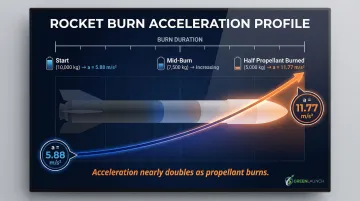
- Initial vehicle mass: 10,000 kg
- Propellant mass flow rate: 20 kg/s
- Specific impulse: 300 seconds
Step 1: Calculate thrust F = 300 s × 20 kg/s × 9.80665 m/s² = 58,840 N
Step 2: Calculate initial acceleration a = 58,840 N ÷ 10,000 kg = 5.88 m/s²
Step 3: Calculate acceleration after propellant consumption At 5,000 kg remaining mass: a = 58,840 N ÷ 5,000 kg = 11.77 m/s²
This demonstrates how acceleration nearly doubles as half the propellant burns, a fundamental characteristic of rocket flight.
Sustained burns like this represent one end of the spectrum. At the other end are short-duration maneuvers, where the same physics apply over a much shorter timescale.
Impulse-to-Acceleration for Impulsive Maneuvers
For short-duration maneuvers, impulse J = F × Δt gives the change in momentum, and:
Δv = J / m
This connects to the rocket equation: Δv = Isp × g₀ × ln(m₀/mf)
In practice, this means a higher Isp directly buys more Δv for the same propellant load — the core trade-off in every mission design.
Using a Specific Impulse & Acceleration Calculator: A Practical Walkthrough
Required Inputs
A typical calculator requires:
- Thrust (N or lbf)
- Propellant mass flow rate (kg/s)
- Vehicle mass (kg)
Advanced calculators accept exhaust velocity directly or total impulse and burn time as alternative inputs.
With those inputs in hand, here's how the calculations work through a concrete example.
Practical Example Walkthrough
Inputs:
- Thrust: 200,000 N
- Mass flow rate: 80 kg/s
- Vehicle mass: 15,000 kg
Step 1: Calculate Isp Isp = 200,000 ÷ (80 × 9.80665) = 255 s
Step 2: Calculate exhaust velocity ve = 255 s × 9.80665 m/s² = 2,501 m/s
Step 3: Calculate initial acceleration a = 200,000 N ÷ 15,000 kg = 13.3 m/s²
Outputs:
- Isp: 255 seconds
- Exhaust velocity: 2,501 m/s
- Initial acceleration: 13.3 m/s²
Common Calculator Mistakes to Avoid
- Unit conversion errors: Using lbf instead of N without conversion
- Flow rate confusion: Entering total propellant mass instead of mass flow rate
- Mass variation neglect: Using initial vehicle mass for average acceleration when burn duration is long
Always verify calculator outputs against at least one manual calculation — rounding errors and unit mismatches are far easier to catch before they propagate into mission-critical analysis.
The Isp–Acceleration Tradeoff: What Propulsion Engineers Need to Know
The Fundamental Physics
For a given power level, higher exhaust velocity (higher Isp) means lower mass flow rate, which means lower thrust, which means lower acceleration—even though propellant efficiency improves. This is why electric propulsion systems have excellent Isp but extremely low thrust.
Real System Categories
| System | Isp (s) | Thrust | Acceleration Profile |
|---|---|---|---|
| Chemical Rockets | 250–450 | Kilonewtons to meganewtons | High — suitable for launch |
| Ion Thrusters | 1,500–10,000 | Millinewtons to tens of millinewtons | Extremely low — ideal for deep-space cruise |
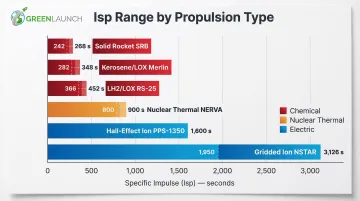
The ion thruster end of that spectrum illustrates just how sharp this tradeoff becomes. The NSTAR ion thruster used on Deep Space 1 achieved 1,950–3,126 seconds Isp but produced only 19–92 millinewtons of thrust — equivalent to the weight of a few sheets of paper.
Green Launch's Mission Context
Green Launch's hydrogen light-gas launch systems sit at the high end of the chemical propulsion Isp range (~450 s for H2/O2). Combined with the extreme projectile velocities required for suborbital and orbital delivery, this places the system firmly in the high-thrust, high-acceleration category — where electric propulsion cannot operate. For acceleration-tolerant payloads, that tradeoff favors ground-based impulse launch over both chemical rockets and ion drives on cost and deployment speed.
Isp Reference Values Across Common Propulsion Systems
| Propulsion Type | Example Engine | Isp (seconds) | Environment | Source |
|---|---|---|---|---|
| Solid Rocket Booster | Space Shuttle SRB | 242 s | Sea-Level | Wikipedia |
| Solid Rocket Booster | Space Shuttle SRB | 268 s | Vacuum | Wikipedia |
| Kerosene/LOX | SpaceX Merlin-1D | 282 s | Sea-Level | Wikipedia |
| Kerosene/LOX | Merlin Vacuum | 348 s | Vacuum | Wikipedia |
| LH2/LOX | RS-25 | 366 s | Sea-Level | L3Harris |
| LH2/LOX | RS-25 | 452 s | Vacuum | L3Harris |
| Nuclear Thermal | NERVA/CERMET | 800–900 s | Vacuum | NASA |
| Hall-Effect Ion | PPS-1350 | ~1,600 s | Vacuum | ESA |
| Gridded Ion | NSTAR | 1,950–3,126 s | Vacuum | NASA |
How to Use This Reference
Find your propellant combination in the table, then use the corresponding Isp value as your calculator input. Two common workflows:
- Sizing for thrust: Enter the target thrust and the reference Isp to solve for the required mass flow rate
- Sizing for acceleration: Enter vehicle mass alongside Isp to determine the achievable delta-v or acceleration profile
- Comparing systems: Use the sea-level vs. vacuum columns to understand how nozzle environment affects effective Isp for your mission stage
How to Convert SFC to Isp (and Other Unit Conversions)
The Inverse Relationship
Specific Fuel Consumption (SFC) and Isp are inversely proportional. SFC is commonly used for airbreathing engines while Isp is standard for rockets.
Conversion formulas:
- SI units: Isp = 1 / (g₀ × SFC) when SFC is in kg/(N·s)
- Imperial units: Isp = 3,600 / SFC when SFC is in lb/(lbf·hr)
Worked Conversion Example
To see how these formulas apply in practice, consider a typical commercial jet engine:
Given: Jet engine with SFC = 0.5 lb/(lbf·hr)
Calculation: Isp = 3,600 / 0.5 = 7,200 seconds
Airbreathing engines produce dramatically higher Isp values than rockets for a specific reason: atmospheric air serves as reaction mass but is not counted in the propellant weight flow denominator. Rockets must carry all their oxidizer onboard, which drives their Isp values down by comparison.
Frequently Asked Questions
Frequently Asked Questions
How to calculate acceleration from impulse?
Calculate acceleration by first computing thrust from impulse parameters (F = Isp × ṁ × g₀), then applying Newton's second law (a = F / m_vehicle). Because propellant mass decreases throughout a burn, acceleration is not constant — it increases as the vehicle lightens.
How do you calculate specific impulse?
Use the core formula Isp = F / (ṁ × g₀), where F is average thrust in Newtons, ṁ is mass flow rate in kg/s, and g₀ is standard gravity (9.80665 m/s²). The result is in seconds.
What is impulse in propulsion?
Impulse is the total change in momentum imparted to a vehicle, equal to thrust multiplied by burn duration (I = F × Δt). A larger impulse means a greater velocity change for a given vehicle mass.
How do you convert SFC to ISP?
Use the formula Isp = 3,600 / SFC (for SFC in lb/lbf·hr) or Isp = 1/(g₀ × SFC) for SI units. The two metrics are inversely related — a lower SFC corresponds to a higher Isp.
What is a good specific impulse for a rocket?
For chemical rockets, Isp of 300–460 seconds is considered high performance, with LH2/LOX near the upper limit around 452 s. Electric propulsion systems exceed 1,500–10,000 seconds but produce significantly lower thrust.
What is the difference between specific impulse and thrust?
Thrust is the absolute force produced by an engine (in Newtons), while specific impulse measures how efficiently that force is generated per unit propellant consumed. A high-thrust engine is not necessarily high-Isp, and vice versa.