This article explains how small satellites deliver measurable advantages, identifies which organizations capture the most value, and outlines what it takes to deploy these platforms successfully at scale.
Key Takeaways
- Small satellites under 500 kg—including CubeSats and nanosatellites—cut build and launch costs significantly through commercial off-the-shelf components and compact design
- Three core advantages: lower per-mission costs, 18-month development timelines versus 7-year traditional programs, and constellation-scale coverage
- The small satellite market will grow from $9.35 billion in 2025 to $32.13 billion by 2030, a 28% annual growth rate
- Organizations without small satellite strategies face slower innovation, higher financial risk per mission, and loss of market share to faster-moving competitors
What Are Small Satellites?
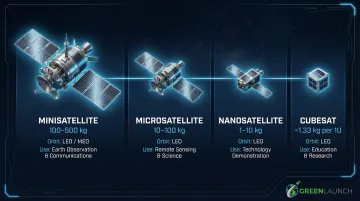
Small satellites are spacecraft under 500 kg, classified by mass into practical categories:
| Classification | Mass Range | Typical Orbit | Primary Use Case |
|---|---|---|---|
| Minisatellite | 100–500 kg | LEO / MEO | Operational Earth observation missions |
| Microsatellite | 10–100 kg | LEO | Multi-satellite constellations with high revisit rates |
| Nanosatellite | 1–10 kg | LEO | Rapid deployment, scientific experiments |
| CubeSat | ~1.33 kg per 1U unit | LEO | Standardized 10×10×10 cm form factor for education, tech demos |
The CubeSat standard, developed in 1999 by Cal Poly and Stanford, standardized satellite design by introducing a universal 10×10×10 cm building block. The Poly-Picosatellite Orbital Deployer (P-POD) acts as the universal interface between launch vehicles and CubeSats, eliminating custom integration work and cutting integration time and cost.
That standardization shaped where most small satellites operate. Most operate in Low Earth Orbit (LEO) at altitudes between 160 and 2,000 km. LEO's proximity reduces communication latency to 35–40 milliseconds versus 600 milliseconds round-trip for geostationary satellites — a difference that matters for Earth observation, IoT connectivity, and real-time data services.
Advances in miniaturized processors, compact sensors, and efficient solar panels now allow small satellites to handle missions that once required platforms in the 500 kg class. The hardware has caught up with the ambition — these are purpose-built systems, not scaled-down compromises.
Key Advantages of Small Satellites for Affordable Space Access
The following advantages are grounded in operational metrics—cost, speed, risk, and coverage—that mission planners, investors, and program managers track. Each advantage ties to measurable outcomes.
Advantage 1: Dramatically Lower Build and Launch Costs
Small satellites cost a fraction of traditional large satellites to design and build because they use commercial off-the-shelf (COTS) components—electronics, processors, and sensors developed for consumer or industrial markets—rather than bespoke space-grade hardware manufactured from scratch.
Rideshare launch models multiply this cost advantage. Small satellites can share rocket capacity with other payloads, splitting the cost of a single launch across multiple operators. SpaceX's Transporter series offers rideshare missions at $350,000 for 50 kg to Sun-Synchronous Orbit, plus $7,000 per additional kilogram—a benchmark price of approximately $7,000/kg. In contrast, dedicated heavy-lift launches like the retired Delta IV Heavy cost $350 million to $450 million per mission, and a single large geostationary satellite requires $150 million to $500 million to manufacture.
| Cost Category | Small Satellite / Rideshare | Traditional Large GEO Satellite |
|---|---|---|
| Launch Cost | $7,000/kg (SpaceX Transporter) | $110M–$450M total (dedicated launch) |
| Build Cost | $150K–$300K (3U CubeSat) to $500K–$1M (100 kg satellite) | $150M–$500M |
| Cost Drivers | COTS components, standardized deployers | Bespoke engineering, radiation hardening |
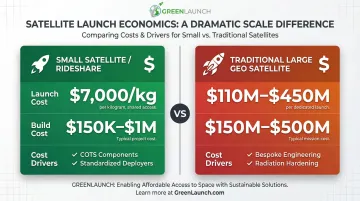
Why this matters:
- Lower per-unit cost enables organizations to fly, fail, learn, and iterate—a risk tolerance impossible when a single satellite represents hundreds of millions of dollars
- Faster innovation cycles and reduced financial exposure mean startups can compete with legacy aerospace contractors
- Emerging launch technologies are pushing costs lower still—Green Launch's hydrogen-oxygen light-gas system targets approximately $200/lb to orbit and produces no carbon emissions, a meaningful operational advantage for programs with environmental mandates or sustainability requirements
KPIs impacted: Mission cost per unit, cost per kilogram to orbit, program budget utilization, break-even timeline for commercial operators
When this advantage matters most: Universities with limited budgets, emerging space nations establishing sovereign capabilities, startups building commercial constellations, and programs where cost-per-data-point must remain commercially viable
Advantage 2: Faster Development and Deployment Timelines
Traditional large satellites take five to ten years from program inception to launch. Small satellites, particularly CubeSats and nanosatellites, achieve time-to-orbit in one to three years because their standardized designs, COTS components, and smaller teams compress every phase from design to testing.
The 1999 CubeSat specification and standardized deployers like the P-POD have created an ecosystem where components, interfaces, and launch hardware are pre-validated, removing months of custom engineering and testing. Developers can integrate off-the-shelf processors and batteries (including standard 18650 cells), bypassing lengthy custom-build phases entirely.
Why this matters:
- Faster deployment means organizations respond to emerging mission needs, technology updates, or market opportunities within months rather than years
- Shorter cycles reduce financial exposure: a program running 18 months ties up far less capital than one running 7 years before generating any return
- Commercial Earth observation and IoT constellation operators gain competitive advantage by deploying services years ahead of competitors locked into traditional development timelines
KPIs impacted: Time-to-orbit, development cycle length, capital deployment rate, iteration frequency, responsiveness to mission requirement changes
When this advantage matters most: Defense applications requiring rapid capability deployment, commercial operators racing to establish constellation coverage before competitors, and research institutions studying time-sensitive scientific phenomena
Advantage 3: Constellation-Scale Coverage and Mission Flexibility
The economics of small satellites make it feasible to launch not just one satellite, but constellations of dozens or hundreds—enabling continuous, global coverage that a single large satellite in geostationary orbit cannot match due to fixed positioning and revisit limitations.
Constellations deliver compounding value:
- High revisit rates: LEO orbits mean multiple passes over any point on Earth per day—hourly in dense constellations
- Built-in redundancy: One failed unit degrades performance slightly; the remaining constellation keeps the mission running
- Scalable architecture: Operators add units incrementally as demand grows, avoiding the all-or-nothing commitment of a single large asset
Real-world examples:
- Planet Labs operates approximately 200 satellites (Doves, SuperDoves, and SkySats) that orbit the poles every 90 minutes, capturing the entire Earth's landmass every day
- Spire Global operates over 170 satellites (as of 2024) that observe the Earth's surface an average of 200 times per day, delivering weather forecasting, maritime tracking, and aviation data

For Earth observation, high revisit rates enable same-day monitoring of agriculture, disaster zones, shipping lanes, and climate systems—data services that are commercially viable because the cost structure of small satellite constellations supports competitive pricing.
For IoT and communications, LEO constellations deliver connectivity at latency levels impossible from GEO—reaching fishing fleets, remote agricultural operations, and regions with no terrestrial infrastructure.
Spreading capability across many small satellites is also more resilient than concentrating it in a single large asset. A single-point failure in a geostationary satellite can eliminate years of investment with no fallback. A constellation degrades gracefully and can be refreshed incrementally.
KPIs impacted: Revisit frequency, geographic coverage percentage, constellation availability (uptime), data latency, cost per observation, service continuity during individual satellite failures
When this advantage matters most: Applications requiring continuous or high-frequency Earth coverage, defense programs requiring resilient and distributed space architectures, and commercial services targeting global or regional connectivity markets
What Happens Without Affordable Launch Access
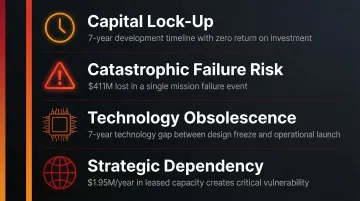
Organizations that rely solely on traditional large satellite programs — or delay adopting small satellite strategies — pay a steep price. The consequences span finances, mission continuity, and national security:
Multi-year program timelines lock up capital without generating returns. A seven-year development cycle means no revenue, no data, and no operational capability until launch—while competitors deploying small satellite constellations establish data pipelines, customer relationships, and orbital slots first.
A single launch failure can eliminate years of investment with no fallback. The 2019 launch failure of a UAE military observation satellite on a Vega rocket resulted in $411 million in insurance claims—the largest space insurance loss in history. Constellations distribute risk across multiple units, ensuring mission continuity.
Technology obsolescence sets in before a satellite even reaches orbit. A satellite designed in 2017 and launched in 2024 carries processors, sensors, and communication protocols that are already seven years obsolete. Small satellite programs iterate every 18 months, continuously refreshing capabilities.
Nations without sovereign launch access trade strategic autonomy for dependency. Leasing traditional satellite capacity costs $1.95 million per year for 36 MHz of Ku-band capacity — and during natural disasters, geopolitical tensions, or supply-chain disruptions, that dependency becomes a direct liability. As SpaceNews has reported, space sovereignty is no longer optional for nations seeking to protect their data and communications infrastructure.
How to Maximize the Value of Small Satellites
Small satellites deliver the most value when mission architecture matches the platform's actual strengths. Design for the constraints of a small form factor from day one—rather than shrinking a large satellite design—to fully exploit COTS components, standardized interfaces, and rideshare launch windows.
Key strategies:
- Track revisit rates, data throughput, and cost-per-observation at the constellation level, then adjust launch cadence or orbital distribution to optimize performance over time
- Choose launch partners that accommodate small payloads on flexible schedules — providers specializing in small payload economics can significantly compress time-to-orbit and reduce mission cost
- Use COTS components and standardized buses wherever possible; the ecosystem of pre-validated parts cuts development time and cost without sacrificing reliability
Green Launch's light-gas propulsion technology, for example, targets $200/lb to orbit using hydrogen-oxygen propellant that produces only water vapor — enabling high-cadence launches every 60 to 90 minutes with minimal environmental impact.
Applying these strategies from the start — rather than retrofitting them later — lets organizations build the ground infrastructure, data pipelines, and operational expertise needed to scale. That accumulated experience becomes a durable advantage as the market matures.
Conclusion
Small satellites' value lies in making space operationally and financially accessible, with measurable outcomes: lower per-mission costs, faster deployment timelines, and scalable constellation coverage that compounds as more satellites are added.
The small satellite market is projected to grow from $9.35 billion in 2025 to $32.13 billion by 2030, a 28% annual growth rate. This growth reflects capital flowing toward organizations that have adopted small satellite strategies and away from those locked into traditional programs.
The advantages of small satellites compound across missions. Organizations that build experience now—launching constellations, refining ground infrastructure, iterating on data pipelines—will have a structural head start as launch costs keep falling and on-orbit capability keeps expanding.
Frequently Asked Questions
What classifies a satellite as a "small satellite"?
Small satellites are defined by mass, typically under 500 kg. CubeSats follow the standardized 10×10×10 cm unit format (1U) developed in 1999, weighing approximately 1.33 kg per unit. The broader "small satellite" category spans three classes: nanosatellites (1–10 kg), microsatellites (10–100 kg), and minisatellites (100–500 kg).
How much does it cost to launch a small satellite?
Costs vary by mass and orbit. SpaceX's Transporter rideshare program charges $350,000 for 50 kg to Sun-Synchronous Orbit, plus $7,000 per additional kilogram. Total mission cost includes satellite build ($150K–$1M depending on size), integration, ground station infrastructure, and operations—not just launch.
What are the main applications of small satellites today?
Dominant use cases include Earth observation for agriculture and climate monitoring, IoT and telecommunications connectivity for remote regions, scientific research and technology demonstration, navigation augmentation, and maritime/air traffic monitoring. Commercial constellations increasingly serve real-time data services that generate subscription revenue.
What are the key limitations of small satellites compared to large spacecraft?
Small satellites face constraints in power generation (limited solar panel area), communication bandwidth (smaller antenna apertures), maneuverability (limited propellant), and operational lifespan. However, advancing miniaturization technology and constellation architectures offset these tradeoffs—redundancy and distributed capability compensate for what any single unit lacks.
How do rideshare launches work, and why do they reduce costs?
Rideshare launches allow multiple small satellite operators to share the cost of a single rocket by filling available mass capacity with several payloads. Instead of purchasing an entire launch vehicle for $100M+, operators pay only for their proportional share—typically measured in cost-per-kilogram—dramatically reducing per-mission launch cost.
What is the future outlook for the small satellite market?
The market is projected to grow from $9.35 billion in 2025 to $32.13 billion by 2030. Key drivers include AI-powered on-board processing, inter-satellite optical links, and miniaturized electric propulsion. As launch costs fall—including through non-rocket approaches like hydrogen-based impulse systems—more operators at smaller budget levels will gain viable paths to orbit.