Electromagnetic space launch systems convert electrical energy into kinetic energy, accelerating vehicles along a track using magnetic fields instead of burning propellant. These systems shift the "engine" from the vehicle to the ground, eliminating the tyranny of carrying fuel—which makes up most of a rocket's mass.
This article explores how electromagnetic launch works, the key technology types in development, the compelling economics, real-world projects from China to lunar concepts, and the stubborn challenges that separate concept from operational reality.
TLDR:
- Electromagnetic launchers use electric coils or rails to accelerate payloads along tracks, reaching orbital or suborbital velocities
- Key types include railguns, coilguns, maglev-assist hybrids, and full-orbit concepts like StarTram
- Mature systems could cost $43/kg versus $3,245/kg for reusable rockets, primarily because electricity is far cheaper than rocket fuel
- China's Galactic Energy plans maglev launch tests by 2028; lunar applications show near-term promise
- Major barriers: gigawatt-scale power delivery, extreme g-forces on payloads, coil synchronization at hypersonic speeds, and multi-billion-dollar infrastructure costs
What Is Electromagnetic Space Launch?
Electromagnetic space launch converts electrical energy into kinetic energy, accelerating a vehicle or payload along a track using magnetic fields rather than chemical combustion. A series of electromagnetic coils energized in rapid sequence creates a traveling magnetic field that pushes or pulls a magnetically coupled vehicle forward. The principle resembles maglev trains, but the power delivery is orders of magnitude greater.
The concept traces back to Dr. Gerard K. O'Neill's mass driver proposals in the 1970s. O'Neill's 1977 book The High Frontier detailed linear synchronous motors designed to launch lunar materials—1-10 kg payloads at 1-10 launches per second—from the Moon to orbital construction sites. In 1977, O'Neill and Dr. Henry Kolm (MIT) built Mass Driver I, a prototype that accelerated a 0.5-kg bucket to 36 m/s at over 33 g's using scavenged parts.
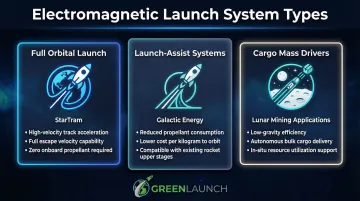
Today, that early prototype work has matured into funded engineering programs across three distinct categories:
- Full orbital launch systems like StarTram that accelerate payloads to near-orbital velocity
- Launch-assist systems that give rockets a high-speed head start before ignition
- Cargo-only mass drivers proposed for the Moon, where low gravity and no atmosphere make the physics far more favorable
What connects all three is a fundamental break from rocket economics. Conventional vehicles must carry their propellant—typically most of their total mass—while electromagnetic systems draw energy from fixed ground infrastructure. Capital investment moves from the vehicle to the launchpad, which means per-launch costs can drop sharply once the infrastructure is in place.
How Electromagnetic Launch Systems Work
The Linear Motor Principle
Electromagnetic launchers function as giant linear electric motors. A series of electromagnetic coils arranged along a track are energized in rapid sequence, creating a traveling magnetic field that accelerates a magnetically coupled vehicle forward.
Two primary configurations exist:
Linear Synchronous Motors (LSM): Used in mass drivers and StarTram, LSMs propel vehicles containing superconducting coils by generating a moving alternating current (AC) magnetic wave on the track. The vehicle "rides" this wave, with AC frequency increasing to accelerate continuously. Essentially, it's an electric motor unrolled into a long track.
Linear Induction Motors (LIM): These use a moving magnetic field to induce currents in a conductive reaction rail (armature), creating thrust without sliding electrical contacts. Advanced designs use exit-edge compensation to reduce magnetic drag at high speeds.
Magnetic Levitation and Friction Elimination
Many designs suspend the vehicle above the track using magnetic repulsion or attraction, eliminating friction entirely. This allows acceleration to hypersonic speeds without the mechanical wear that would destroy conventional rail systems within seconds. Without levitation, contact friction at 8 km/s would vaporize any mechanical interface.
The Atmosphere Problem
At hypersonic speeds (Mach 5+), air resistance generates enormous drag and stagnation heating. The Sutton-Graves equation shows that heating scales with the square root of atmospheric density and the cube of velocity—meaning a vehicle at 8 km/s faces 512 times more heating than one at 2 km/s.
Two engineering responses exist:
Evacuated tube launch: Systems like StarTram propose launching through a vacuum or low-pressure tube, eliminating atmospheric interaction until the vehicle exits at high altitude (6,000-8,000 meters). This reduces peak stagnation heating to 20-30 kW/cm² for brief durations (3-10 seconds)—manageable with ablative thermal protection.
High-altitude launch: Elevating the track exit to thin atmosphere reduces density, cutting heating dramatically. Both approaches trade engineering complexity for thermal survivability.
Energy Storage Challenge
A single launch requires an enormous burst of electrical energy delivered in seconds. Accelerating a 40-ton craft to 8 km/s demands roughly 94 gigawatts over a 30-second window—equivalent to the output of 60 large power plants concentrated into half a minute.
Two technologies can meet this demand:
| Technology | Energy Density | Power Density | Efficiency | Characteristics |
|---|---|---|---|---|
| SMES (Superconducting Magnetic Energy Storage) | 10-20 kJ/kg | Up to 100 MW/kg peak | >95% | Rapid discharge (<1 min), infinite cycle life, high capital cost |
| Supercapacitors | 4-7 Wh/kg | 500-10,000 W/kg | 95-98% | Fast charge/discharge, ~1 million cycles, lower cost than SMES |
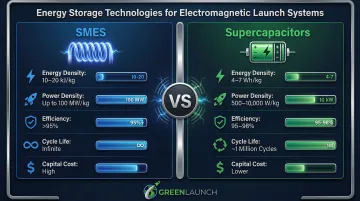
SMES stores energy in superconducting magnetic coils and can discharge it nearly instantaneously with minimal loss, making it ideal despite low energy density. Supercapacitors offer lower capital costs but higher self-discharge rates.
After Electromagnetic Acceleration Ends
For most Earth-launch concepts, the electromagnetically accelerated vehicle still ignites a conventional rocket engine at altitude to circularize its orbit. Electromagnetic launch acts as a first-stage replacement, not a complete propulsion system. The vehicle reaches 8 km/s horizontally but needs additional velocity and orbital maneuvering—tasks better suited to onboard propulsion.
This hybrid approach allows smaller rockets with larger payload fractions (10-20% versus 1-4% for traditional rockets) because the ground system provides most of the kinetic energy.
Types of Electromagnetic Launch Systems
Railguns
Railguns use direct electrical current through conductive rails to generate a Lorentz force on a conductive projectile. When current flows down one rail, through the projectile, and back via the other rail, the magnetic field created accelerates the projectile forward.
The U.S. Navy achieved a world-record 33-megajoule shot in 2010, launching projectiles to Mach 5+. The program was officially paused in 2021 due to fiscal constraints and shifting priorities toward hypersonic missiles. In February 2025, testing resumed at White Sands Missile Range to collect hypersonic firing data.
Rail erosion: Railguns suffer severe barrel degradation from sliding electrical contacts and plasma arcing at high currents (60+ kA). This limits barrel life dramatically, making high-cadence orbital launch impractical without major material breakthroughs.
General Atomics has proposed adapting carrier-based Electromagnetic Aircraft Launch System (EMALS) technology for lunar surface applications. EMALS is actively deployed on the USS Gerald R. Ford, having completed nearly 23,000 successful aircraft launches as of late 2023. On the Moon, low gravity (1/6th Earth's) and no atmosphere make electromagnetic launch physics far more favorable—exit velocities needed for orbit are only 1.68 km/s versus 8 km/s on Earth.
Coilguns and Mass Drivers
Coilguns use a series of coils energized in sequence to pull a ferromagnetic or superconducting projectile forward through inductive coupling. Unlike railguns, coilguns avoid sliding contact erosion, making them more viable for the high launch rates a space economy would require.
Coilguns still face their own durability constraints. Sandia National Labs testing of a 50mm coilgun showed that while coils survived 205 shots at high stress, failure modes include winding conductor breakage from mechanical fatigue and insulation breakdown from strain.
Timing synchronization: Multi-stage coilguns require microsecond-level trigger precision. Incorrect timing generates reverse electromagnetic forces that severely degrade projectile acceleration—potentially stopping the vehicle entirely.
Mass drivers are large-scale coilguns designed for bulk material transport. O'Neill's 1970s lunar mass driver concept exemplifies this: a kilometers-long track launching raw materials mined from the Moon toward orbital manufacturing facilities at rates of multiple launches per second.
Maglev Launch-Assist Systems
Launch-assist systems don't replace rockets—they give them a supersonic head start. NASA's 1994 MagLifter concept envisioned a superconducting maglev catapult built up a mountainside to accelerate a reusable vehicle to 600 mph (268 m/s) at 3 g's, replacing the first rocket stage.
Galactic Energy (China): Chinese private launch firm Galactic Energy is developing an electromagnetic maglev launch pad in Ziyang, Sichuan. In April 2025, they successfully tested a 1.4-meter diameter rocket model on the track. The system aims to accelerate rockets to supersonic speeds (Mach 1+) before ignition, with operational debut targeted for 2028.
Projected fuel savings: 20-40% compared to conventional launch, translating directly to larger payload capacity or lower structural stress. Chinese space industry observers frame this as a structural alternative to SpaceX's reusable rocket approach—reducing fuel consumption rather than recovering stages.
StarTram and Full Orbital Concepts
StarTram represents the most ambitious end of the spectrum: a maglev orbital launch system designed by Dr. James Powell and Dr. Gordon Danby. Two generations are proposed:
| Parameter | Gen-1 (Cargo Only) | Gen-2 (Passenger & Cargo) |
|---|---|---|
| Acceleration | 30 g | 2-3 g |
| Tunnel Length | 100-130 km | ~1,000 km |
| Exit Altitude | 4,000-8,000 m (mountain peak) | ~20 km (levitated tube) |
| Capital Cost | ~$19 billion | ~$67 billion |
| Operating Cost | ~$43/kg | Not detailed |
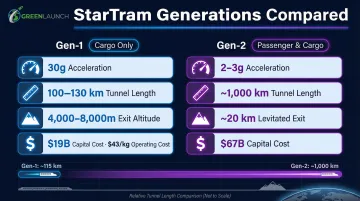
Gen-1 would launch cargo from a 130 km evacuated tunnel exiting from a mountain peak, reaching near-orbital velocity before a small onboard rocket completes orbital insertion. Gen-2 extends this to human passengers by reducing acceleration to 2-3 g over a 1,000 km tunnel. That requires the launch tube itself to be magnetically levitated 20 km above the surface.
The engineering challenges are substantial: maintaining a levitated structure tens of kilometers high against wind loads, managing gigawatt-scale power pulses, and ensuring coil synchronization at hypersonic speeds.
Light-Gas Propulsion: A Related Alternative
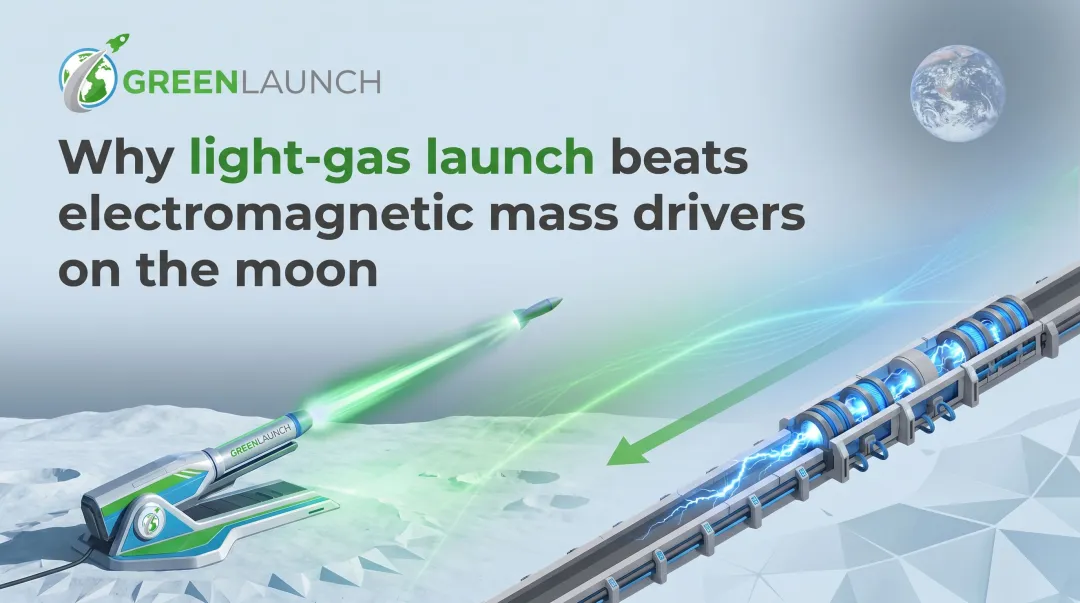
Light-gas propulsion—such as the technology developed by Green Launch—represents a distinct but related approach. Instead of electromagnetic coils, these systems use compressed hydrogen and oxygen gas to achieve extremely high muzzle velocities through combustion-driven acceleration.
Green Launch, led by Dr. John Hunter (who previously directed the SHARP light-gas gun program at Lawrence Livermore National Laboratory), has demonstrated:
- Vertical launch velocities exceeding Mach 3
- Horizontal velocities reaching Mach 9
The system offers a practical near-term path to similar velocity regimes as electromagnetic launch, with significantly lower infrastructure requirements—a 54-foot launch tube rather than multi-kilometer electromagnetic tracks.
Light-gas systems produce only water vapor as a byproduct and can capture 90-99% of propellant for reuse, offering environmental advantages comparable to electromagnetic systems. The approach is particularly suited for smaller payloads in the cubesat class, with Green Launch positioning its service at $100 per pound ($220/kg) to Low Earth Orbit. That price point puts orbital-class launch within reach for scientific research organizations and small satellite developers today, not a decade from now.
The Economics of Electromagnetic Launch
Fuel Versus Electricity
The cost difference between chemical propellant and electricity is striking. A quick comparison makes the case:
| Method | Energy / Cost Basis | Estimated Cost per kg |
|---|---|---|
| Electrical (100% efficiency) | 8.89 kWh at $0.0813/kWh (2024 U.S. industrial rate) | ~$0.72 |
| Electrical (50% efficiency) | Same rate, half efficiency | ~$1.50 |
| Falcon 9 (reusable) | Liquid propellant + cryogenic infrastructure | ~$3,245 |
| StarTram Gen-1 (projected) | Amortized infrastructure + operations + energy | ~$43 |
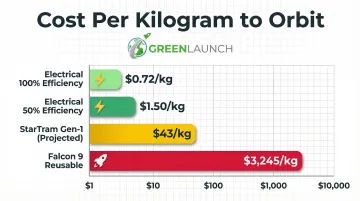
Liquid hydrogen alone requires ~40 MJ/kg of electrical energy just to liquefy—before accounting for the cryogenic handling infrastructure. SpaceX's Falcon 9 achieves ~$3,245/kg after multiple reuses. The StarTram projection of $43/kg represents a 75x cost reduction versus reusable rockets, though that figure comes from the concept inventors' conference papers rather than independent peer-reviewed audits.
Why the Economics Are Favorable
Three factors drive electromagnetic launch economics:
- Eliminates refurbishment cycles — the launch track doesn't burn up between missions, and high launch cadence spreads fixed costs across many flights (think airport economics, not rocket economics)
- Removes the propellant mass penalty — rockets dedicate 80-90% of total mass to fuel, then need more fuel to lift that fuel; electromagnetic systems sidestep this compounding problem entirely
- Runs on cheap, abundant energy — grid electricity costs roughly 1/1,000th the equivalent energy cost of rocket propellant per unit delivered to orbit, and that gap widens as launch volume scales
The Infrastructure Investment Barrier
Despite compelling long-term economics, upfront capital costs are staggering:
- StarTram Gen-1: ~$19 billion (cargo only)
- StarTram Gen-2: ~$67 billion (passenger-rated)
These figures come from the concept inventors' conference papers, not independent peer-reviewed economic audits. For context, NASA's entire 2024 budget was $25 billion, and no government or private entity has funded even preliminary engineering studies at this scale.
That gap between compelling unit economics and prohibitive first-dollar risk is why the field has advanced primarily through smaller-scale alternatives—ground-based impulse systems and light-gas launchers that target acceleration-tolerant payloads without requiring planetary-scale infrastructure investment upfront.
Current Projects and Real-World Applications
Galactic Energy's Maglev Launch Platform (China)
Chinese private launch firm Galactic Energy is developing an operational electromagnetic maglev launch pad in Ziyang, Sichuan. In April 2025, they successfully tested a 1.4-meter diameter rocket model on the track, demonstrating horizontal acceleration to supersonic speeds.
Target: Launch rockets at Mach 1+ before ignition, reducing fuel load by 20-40% and enabling larger payloads or lower structural stress. Operational debut is planned for 2028.
Strategic significance: Chinese space industry observers frame this as a structural alternative to SpaceX's reusable rocket approach—achieving cost reduction through fuel savings rather than stage recovery. If successful, it could establish a hybrid launch architecture combining electromagnetic assist with expendable upper stages.
General Atomics Lunar Electromagnetic Launch Proposal
General Atomics has proposed using solar-powered electromagnetic launchers on the Moon to move extracted resources into lunar orbit. The concept leverages EMALS technology already proven on aircraft carriers.
Why the Moon is ideal: Lunar gravity is 1/6th Earth's, and there's no atmosphere. Orbital velocity is only 1.68 km/s versus 8 km/s on Earth, making electromagnetic launch far more practical. Solar panels could provide steady power without requiring gigawatt-scale energy storage.
Mission application: Launching mined water ice, regolith, or manufactured materials to orbital depots avoids importing chemical rocket fuel from Earth for every resupply mission—critical for sustainable lunar infrastructure.
Green Launch: High-Velocity Light-Gas Technology
Green Launch represents a real-world example of high-velocity propulsion innovation addressing similar cost and sustainability goals. Founded by Dr. John Hunter, who led the SHARP light-gas gun program at Lawrence Livermore National Laboratory, Green Launch uses hydrogen and oxygen combustion to accelerate payloads through a launch tube.
Instead of electromagnetic coils, the system ignites compressed hydrogen and oxygen in a combustion chamber to generate high-pressure expansion, accelerating payloads to hypersonic velocities. The physics differ from electromagnetic launch, but the mission objective aligns: replace expensive chemical rocket first stages with ground-based acceleration infrastructure.
Performance milestones to date include:
- Vertical launch velocities exceeding Mach 3 (December 2021)
- Horizontal velocities reaching Mach 9 (2.97 km/s) by October 2025
- Propellant capture efficiency of 91%, enabling reuse across multiple launches
- Scramjet test vehicles successfully launched at Mach 8+
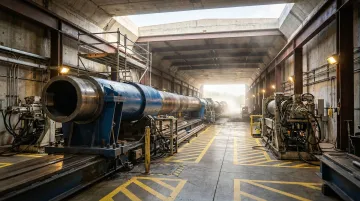
Hydrogen-oxygen combustion produces only water vapor. Traditional RP-1 and methalox rockets, by comparison, produce 19 tons of CO₂ per ton of payload delivered to orbit—making Green Launch's zero-carbon suborbital profile a meaningful differentiator for environmentally mandated research contracts.
Green Launch targets acceleration-tolerant payloads in the cubesat class and smaller, offering delivery at $100 per pound ($220/kg) to Low Earth Orbit. The system can launch every 60-90 minutes—what the company calls the "FedEx of Space"—enabling just-in-time orbital delivery that traditional rocket economics can't match.
Current contracts include suborbital payload delivery and atmospheric sampling missions with the National Science Foundation for mesosphere research. A 54-foot launch tube rather than a multi-kilometer electromagnetic track keeps infrastructure requirements low, making near-term commercial deployment practical at scales where electromagnetic launch systems are still years from readiness.
Challenges and the Road Ahead
Engineering and Materials Challenges
Coil synchronization: Multi-stage coilguns require microsecond-level trigger timing across hundreds or thousands of coils. Incorrect timing generates reverse forces that can stop a vehicle entirely. Achieving this precision at hypersonic speeds over 100+ km tracks remains unsolved at scale.
G-force survivability: Bulk materials easily withstand extreme acceleration, but complex payloads require hardening. Studies by JHU/APL for DARPA determined that standard satellite electronics can be hardened to survive approximately 2,500 g's with modifications. StarTram Gen-1's 30 g design stays well within this limit, but the engineering cost of hardening adds expense.
Pulsed power management: Delivering 94 gigawatts over 30 seconds requires massive superconducting magnetic energy storage (SMES) infrastructure. Current SMES systems operate at kilowatt to megawatt scales; scaling to gigawatts for repeated launches has no existing engineering template to draw from.
Elevated structure stability: StarTram Gen-2's concept of a magnetically levitated tube 20 km high faces extreme wind loads and structural dynamics challenges. No analogous engineering precedent exists—the tallest human-made structure (Burj Khalifa) is 830 meters.
Payload Limitations
Extreme acceleration restricts electromagnetic systems primarily to rugged, non-human cargo—at least for near-term designs. Realistic candidate payloads include:
- Raw materials (water ice, lunar regolith, metals)
- Liquid propellants for orbital depots
- Hardened small satellites with ruggedized electronics
- Bulk supplies (non-fragile consumables)
Human launch: StarTram Gen-2 was designed for 2-3 g passenger acceleration over a 1,000 km tunnel, within safe physiological limits for passengers. However, crewed electromagnetic launch remains far-future. A search of 2020-2025 NASA, ESA, and DARPA roadmaps reveals zero formal engineering study funding allocated to crewed electromagnetic ground-to-orbit concepts.
Path to Viability
The realistic near-term trajectory unfolds in three stages:
Launch-assist hybrids (2025-2035): Systems like Galactic Energy's maglev platform demonstrate 20-40% fuel savings with minimal risk. Hybrid approaches keep rockets but reduce their workload, offering immediate economic return on modest infrastructure investment.
Dedicated cargo launchers (2035-2050): Lunar electromagnetic launch becomes viable as lunar mining scales up. Low gravity, no atmosphere, and abundant solar power make the Moon the ideal proving ground — success there could justify Earth-based cargo systems.
Full orbital electromagnetic launch (post-2050): A long-term ambition dependent on breakthroughs in high-temperature superconductors (enabling lower-cost SMES), advanced materials for elevated structures, and infrastructure investment only justifiable once space economies reach sufficient scale.
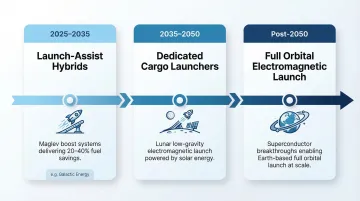
Each stage builds the economic and technical case for the next. Without demonstrating returns at smaller scales first, the investment required for full orbital systems is difficult to justify.
Frequently Asked Questions
How does an electromagnetic launch system work?
Electromagnetic launch systems use a series of powered coils or magnetic rails to accelerate a vehicle along a track using electric force rather than chemical combustion. The vehicle gains enough velocity to reach orbital or suborbital altitudes, often igniting a small onboard rocket afterward to complete orbital insertion.
What are the main types of electromagnetic space launch systems?
Four primary categories exist:
- Railguns — Lorentz force accelerates a conductor along two parallel rails
- Coilguns/mass drivers — sequenced coils pull a magnetic projectile forward
- Maglev launch-assist — hybrid systems provide boost before rocket ignition
- Full orbital concepts (e.g., StarTram) — evacuated tubes accelerate payloads to near-orbit velocity before a final rocket burn
How much cheaper could electromagnetic launch be compared to traditional rockets?
Mature electromagnetic systems like StarTram project costs as low as $43/kg versus $3,245/kg for reusable Falcon 9 launches. The advantage stems primarily from electricity being far cheaper than rocket propellant per unit of energy delivered, plus reusable ground infrastructure amortized across many high-cadence launches.
What are the biggest technical challenges facing electromagnetic space launch?
Power storage (delivering gigajoules in seconds), managing extreme g-forces on payloads, coil synchronization at hypersonic speeds, and enormous upfront infrastructure costs ($19-67 billion for StarTram concepts) are the primary obstacles separating concept from operational reality.
Can electromagnetic launch systems be used for crewed missions?
Crewed electromagnetic launch remains a far-future concept. StarTram Gen-2 was designed for 2-3 g passenger acceleration over a 1,000 km tunnel, but the engineering demands—elevated track structures, gigawatt power systems, and strict g-force tolerances for passengers—place human launch well beyond near-term feasibility.
How does light-gas propulsion relate to electromagnetic launch technology?
Light-gas propulsion, such as Green Launch's hydrogen-oxygen system, achieves comparable high-velocity launch goals using compressed gas acceleration in a combustion chamber rather than electromagnetic coils. It provides a near-term, lower-infrastructure path to similar muzzle velocities (Mach 9 demonstrated) for small payloads, with water vapor as the only byproduct and the ability to reuse propellant systems.