Introduction
In 2026, demand for microsatellite launches is outpacing available slots. Constellation operators, defense agencies, and research institutions are all competing for the same rideshare manifests. According to recent market analysis, launch demand is outpacing supply, creating scarcity and waitlists for rideshare slots, with SpaceX Transporter missions facing backlogs extending 18 to 24 months.
That congestion makes provider selection a strategic decision — one that can shift mission timelines by a year or more.
The microsatellite market — roughly 10–150 kg payloads — has expanded its options even as slots have tightened. Rideshare megafleets, dedicated small-lift rockets, and non-rocket propulsion alternatives each offer distinct tradeoffs in cost, schedule control, and orbit flexibility. Rising prices and longer wait times have reshuffled which tradeoffs actually matter.
This comparison evaluates the top five launch providers serving microsatellites in 2026: SpaceX Transporter, Rocket Lab Electron, Firefly Aerospace Alpha, ISRO PSLV, and Green Launch's light-gas propulsion system. We'll assess each on payload capacity, orbit access, launch cadence, cost structure, and reliability so you can match the right provider to your mission constraints.
Key Takeaways
- Microsatellites (10–150 kg) reach orbit via rideshare, dedicated small-lift rockets, or non-rocket alternatives—each suited to different mission profiles
- SpaceX Transporter has the lowest cost-per-kg, but booking backlogs run 12–18 months and orbits are largely limited to SSO
- Rocket Lab Electron delivers precise orbit insertion on dedicated launches, best for missions needing custom inclinations
- Firefly Aerospace Alpha and ISRO PSLV deliver competitive mid-tier options for larger payloads or cost-sensitive international customers
- At $100/lb with rapid turnaround, Green Launch's light-gas system is the lowest-cost option for acceleration-tolerant payloads
The Microsatellite Launch Market in 2026: What You Need to Know
Microsatellites—typically 10–150 kg, encompassing nanosatellites, minisatellites, and CubeSat stacks—have become the fastest-growing segment by launch count. The global nanosatellite and microsatellite market was valued at $3.22 billion in 2025 and is projected to reach $3.37 billion in 2026, driven by miniaturized electronics, commercial constellation demand, and defense rapid-response requirements.
Nearly 2,800 smallsats were launched globally in 2024 — and that number is still climbing.
Two Dominant Access Models
Mission operators face a fundamental choice between two launch models:
- Rideshare — Multiple payloads share a single launch vehicle, splitting costs but accepting the primary payload's predetermined orbit and launch schedule
- Dedicated small-lift — A rocket reserved for one or a few customers, providing schedule and orbit control at a premium price
Dedicated launch gives you schedule certainty and orbital precision — but costs 10–20 times more per kilogram than rideshare.
Why 2026 Is Different
That cost gap matters more when your launch options are shrinking. Bottlenecks are tightening: customers now struggle to get manifested on SpaceX, with typical lead times stretching to 12–15 months. For operators facing hard mission windows, knowing the full provider landscape — including emerging alternatives — is the difference between launching on schedule and slipping a year.
Top Microsatellite Launch Providers in 2026
The providers below were selected based on demonstrated flight heritage, payload mass capacity within the microsatellite class, orbit accessibility, launch cadence, and commercial availability. Mission operators should weigh these dimensions against their specific payload, timeline, and budget requirements.
SpaceX (Transporter Rideshare Program)
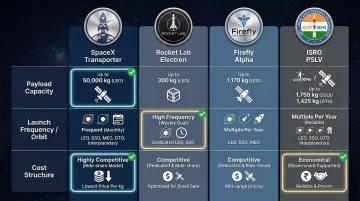
SpaceX's Transporter program runs quarterly dedicated rideshare missions on Falcon 9 from Vandenberg Space Force Base, delivering payloads to Sun-Synchronous Orbit. Transporter-16 carried 119 payloads to SSO in early 2026, representing the broadest, most frequent rideshare pipeline available globally.
Key Advantages and Constraints
Transporter leads on sheer volume and cost-per-kg efficiency. However, growing congestion means customers must book 12–18 months in advance and route through launch integrators, adding friction and cost. The program primarily serves SSO missions—operators needing non-SSO orbits or short lead times must look elsewhere.
| Criterion | Details |
|---|---|
| Payload Capacity | Rideshare slots from 0.5U CubeSats up to ~200 kg individual allocations; total manifest capacity several hundred kilograms |
| Launch Frequency / Orbit Options | Approximately 4 dedicated Transporter missions per year; primarily SSO at ~525 km altitude; limited orbit customization |
| Cost Structure | $350,000 for up to 50 kg to SSO, plus $7,000 per additional kg; launch integrator fees add to base pricing |
Rocket Lab (Electron)
Rocket Lab's Electron, launching from New Zealand and Virginia, is the leading dedicated small-satellite launch vehicle globally. As of early 2026, Electron has completed 85 launches, offering precise orbit injection to inclinations rideshare missions cannot match.
Orbit Flexibility and Government Credibility
Electron differentiates on orbit flexibility—any inclination, any altitude within LEO—and responsive launch scheduling that eliminates co-passenger schedule risk. Rocket Lab's $816 million SDA contract in December 2025 underscores its government credibility, particularly for defense missions with specific orbital requirements. The company is also developing Neutron for larger payloads.
| Criterion | Details |
|---|---|
| Payload Capacity | Up to 300 kg to LEO; optimized for 150–200 kg microsatellite class on standard missions |
| Launch Frequency / Orbit Options | Targeting 25+ launches in 2026; any LEO inclination (38–120 degrees) including SSO, mid-inclination, and high-inclination orbits; launches from Mahia, New Zealand and Wallops, Virginia |
| Cost Structure | Approximately $7.5–$8.4 million per dedicated launch; higher per-kg cost than rideshare but includes full orbit customization |
Firefly Aerospace (Alpha)
Firefly Aerospace's Alpha rocket targets the small-to-medium lift market with up to 1,030 kg to LEO capacity, making it well-suited for larger microsatellite batches or single heavier payloads. After achieving its first fully successful commercial orbital mission in March 2026, Alpha is building a growing government and commercial manifest.
Mass Flexibility and Domestic Supply Chain
Alpha offers payload mass flexibility above the Electron class, a U.S.-domestic supply chain appealing to national security customers, and an expanding service portfolio including lunar delivery (Blue Ghost lander secured a $177 million NASA contract) and on-orbit software capabilities. A practical choice for customers needing more mass margin than typical rideshare allows.
| Criterion | Details |
|---|---|
| Payload Capacity | Up to 1,030 kg to LEO (300 km) or 630 kg to SSO (500 km); supports larger microsatellite stacks or individual satellites in the 150–500 kg range |
| Launch Frequency / Orbit Options | Targeting multiple launches in 2026; SSO and mid-inclination LEO; U.S. domestic launch from Vandenberg SLC-2 |
| Cost Structure | Estimated $15 million per dedicated launch; positioned between Electron and Falcon 9 in cost |
ISRO (PSLV Rideshare — via NewSpace India Limited)
India's PSLV, commercialized through NewSpace India Limited (NSIL), has become a globally recognized rideshare platform for international microsatellite operators. With 64 successful PSLV missions as of January 2026, it offers strong reliability and competitive pricing that appeals to cost-sensitive commercial and academic customers.
Price Competitiveness with Export Control Considerations
PSLV differentiates on price competitiveness for international customers, demonstrated reliability across six decades of missions, and access to SSO inclinations highly suited for Earth observation microsatellites. It's particularly attractive for operators in Asia-Pacific, Europe, and research institutions. Note that lead times and geopolitical/export control considerations apply for U.S.-based customers.
| Criterion | Details |
|---|---|
| Payload Capacity | PSLV-CA supports 1,100 kg to 620 km SSO; PSLV-XL supports 1,750 kg to 600 km SSO; individual microsatellite slots from a few kg up to ~150 kg |
| Launch Frequency / Orbit Options | Approximately 3–5 PSLV missions per year; primarily SSO at 500–600 km; launches from Satish Dhawan Space Centre, Sriharikota, India |
| Cost Structure | Inquiry-based commercial pricing via NSIL; historically competitive vs. Western alternatives for international customers |
Green Launch (Light-Gas Propulsion System)
Green Launch takes a different approach to microsatellite launch: a hydrogen-oxygen propellant-driven gas cannon that accelerates payloads to high velocity without a conventional rocket. The technology was pioneered at Lawrence Livermore National Laboratory's SHARP project by Dr. John Hunter, now Green Launch's CTO.
The system targets dramatically lower cost-per-launch for hardened small payloads — a purpose-built alternative for missions where payload design can accommodate high-g acceleration.
Non-Rocket Advantages and High-G Environment
Green Launch is the only non-rocket provider in this comparison. Key differentiators include:
- Produces only water vapor — no CO₂ emissions vs. the 19+ tons per ton of payload typical of conventional rockets
- Targets $100/lb pricing through simple ground infrastructure rather than complex rocket assembly
- Capable of launching every 60–90 minutes from a fixed ground site
After conducting its first vertical light-gas launch in December 2021, achieving velocities exceeding Mach 3, Green Launch has demonstrated projectile velocities of 2.97 km/sec (Mach 9) as of October 2025. The company targets suborbital and orbital delivery for payloads suited to high-g environments—relevant for defense, scientific sensing, and hardened microsatellite missions.
Important consideration: Payloads must be designed to withstand extreme acceleration forces. Research indicates modern electronics can tolerate up to 30,000 Gs with minor modifications, making the technology accessible for properly hardened instruments.
| Criterion | Details |
|---|---|
| Payload Capacity | Demonstrated testing with payloads up to 28 lbs (~12.7 kg); targeting scalable architecture from cubesat-class to 100–1,000 lb payloads in future phases |
| Launch Frequency / Orbit Options | High-cadence potential (every 60–90 minutes) from fixed ground installation at Yuma Proving Ground, Arizona; suborbital missions demonstrated; orbital capability in development; contact Green Launch for current mission profile availability |
| Cost Structure | Targeting $100 per pound delivered to LEO through simplified propulsion infrastructure; hydrogen-oxygen propellant eliminates complex liquid fuel handling; pricing available on inquiry via eric.robinson@greenlaunch.space |
How We Evaluated These Providers
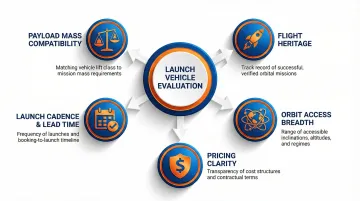
We assessed providers on five criteria:
- Payload mass compatibility with the microsatellite class (10–150 kg)
- Demonstrated flight heritage or current development stage
- Orbit access breadth (inclination and altitude flexibility)
- Launch cadence and booking lead time
- Pricing clarity (published rates vs. negotiated contracts)
Per-kg Cost Alone Will Mislead You
The single biggest error buyers make is selecting a provider based solely on per-kg cost without accounting for orbit constraints or scheduling delays. A mission delayed by 12–24 months due to rideshare congestion can cost far more in lost revenue or program delays than the savings from a cheaper launch price.
Match Your Launch Mode to Your Mission Profile
- Rideshare is ideal for cost-sensitive SSO payloads with flexible schedules
- Dedicated launch suits time-critical or orbit-specific missions requiring precise insertion
- Light-gas and alternative propulsion systems are worth evaluating when your payload can tolerate high-g acceleration and driving down launch cost is the primary objective
Choosing the right launch mode is only half the decision. Before contracting, verify regulatory readiness, range access, and integration support. Key details to confirm with every provider:
- Payload accommodation specifications
- Dispenser compatibility
- Frequency coordination assistance
- Insurance requirements
- Regulatory filing support
Conclusion
The microsatellite launch market in 2026 offers more provider options than any previous year—yet slot availability remains tighter than the provider list suggests. Choosing a provider based only on brand recognition or lowest advertised cost—without evaluating orbit suitability, cadence, and booking timelines—is a common and costly mistake that can delay missions by a year or more.
Define Your Requirements First
Before approaching providers, clarify your mission requirements:
- Target orbit (inclination, altitude, SSO vs. other)
- Payload mass and dimensions
- Launch timeline and schedule flexibility
- Payload environmental tolerance (g-forces, thermal, vibration)
- Budget constraints and cost priorities
Then evaluate both technical fit and commercial terms including integration support, insurance, and regulatory assistance.
Consider Emerging Alternatives
Cost is often the deciding factor once technical requirements are met. For missions where payloads can tolerate high-g launch profiles, Green Launch's hydrogen-powered light-gas system offers a ground-based alternative to conventional rockets—with a lower cost structure and no traditional propellant combustion products. It's a fit worth assessing if cost reduction is a clear priority and your payload is designed for acceleration-tolerant profiles.
Reach out to the Green Launch team at eric.robinson@greenlaunch.space or visit greenlaunch.space to discuss mission compatibility and pricing.
Frequently Asked Questions
What is a microsatellite, and what mass range does it cover?
Microsatellites typically cover the 10–150 kg mass range, with definitions sometimes extending to nanosatellites (1–10 kg) and minisatellites (up to 180 kg). Advances in miniaturized electronics now enable full mission capability within these compact form factors.
What is rideshare launch, and is it suitable for all microsatellite missions?
Rideshare means multiple payloads share one launch vehicle, splitting costs while accepting the primary payload's predetermined orbit and schedule. Orbit flexibility is limited, making dedicated launch the better choice for missions requiring specific inclinations, rapid deployment, or non-standard orbits.
How far in advance do I need to book a microsatellite launch slot in 2026?
Rideshare slots on SpaceX Transporter typically require 12–18 months lead time due to high demand. Dedicated launch providers like Rocket Lab may offer shorter booking windows depending on manifest availability. Demand currently outpaces supply across most providers, so early booking is strongly advised.
What is the typical cost to launch a microsatellite to LEO in 2026?
Rideshare pricing starts around $7,000/kg on SpaceX Transporter, while dedicated launches range from $7.5–$15 million per mission (Electron vs. Alpha). Total mission cost also includes integration, dispenser hardware, and regulatory fees beyond the base launch price.
What orbital altitudes and inclinations are most commonly available for microsatellite rideshare missions?
SSO at 500–600 km altitude is the most common rideshare destination, dominant on both Transporter and PSLV missions. This suits Earth observation missions requiring consistent lighting conditions. Communications or technology demonstration payloads needing different inclinations typically require dedicated launchers for orbit flexibility.
What does "light-gas propulsion" mean, and how does it differ from a conventional rocket launch?
Light-gas guns use rapidly compressed hydrogen to accelerate a projectile to orbital velocity without rocket combustion — targeting costs as low as $100/lb versus $5,000+/lb for conventional rockets, with water vapor as the only emission. Payloads must withstand high acceleration loads (up to 30,000 Gs), so the approach is best suited to hardened instruments and defense or scientific payloads. Green Launch is among the pioneers developing this technology for practical space access.