Introduction
Every kilogram delivered to the Moon carries an extraordinary cost burden. NASA's Commercial Lunar Payload Services program operates under delivery cost assumptions that can reach hundreds of thousands to over a million dollars per kilogram, depending on mission specifics. Sustaining a permanent lunar base demands moving bulk cargo—propellants, water, structural materials—economically and repeatedly, yet conventional rockets spend most of their capacity just getting propellant to orbit, leaving relatively little for actual payload. This mass fraction problem compounds at each stage of a lunar mission, pushing total delivered-cargo costs beyond what most base-sustaining logistics models can absorb.
This brief explains light-gas launch technology in terms that matter to mission planners: what it is, what it can realistically deliver, where it fits in the lunar logistics architecture, and what its limits are.
Light-gas launch is not a replacement for rockets. For specific categories of high-volume, rugged cargo, however, it offers a different cost and cadence profile — one that lunar base designers should account for in their planning.
Key Takeaways
- Light-gas guns compress hydrogen or helium with a piston to accelerate projectiles to 4–7+ km/s—roughly double the muzzle velocity of conventional powder guns
- Gun launch suits rugged, acceleration-tolerant cargo—propellants, structural materials, and consumables—not humans or fragile payloads
- The Moon's lack of atmosphere eliminates drag and heating on ascent, making surface-based gun launch more practical than on Earth
- Lunar planners should treat light-gas launch as a high-frequency, low-cost supply layer for consumables and propellant pre-positioning
The Lunar Logistics Problem: Why Conventional Rockets Aren't Enough
Any sustained lunar presence faces a supply chain challenge rooted in physics. Rockets spend roughly 90% of their mass carrying propellant, leaving only a small fraction for actual cargo. This mass fraction problem worsens with every stage of a lunar mission, compounding costs and limiting payload capacity. NASA's Moon to Mars Architecture white papers anticipate annual cargo demand of 2,000 to 10,000 kg to the lunar surface, underscoring the operational scale that makes economics matter.
The highest-volume, most frequent cargo needs of a lunar base don't require gentle handling. These categories are ideal candidates for a high-g, high-velocity launch system:
- Oxygen and hydrogen fuel
- Water and ice feedstock
- Bulk construction materials
- Structural stock and raw propellant precursors
Each tolerates acceleration forces that would destroy sensitive equipment — which is exactly what makes them tractable for alternative launch methods.
That distinction maps onto a framework mission architects use routinely: gentle payload (crew, instruments, computers) versus bulk payload (propellants, food, structural stock). For a mature lunar base, the economics tilt heavily toward solving the bulk side first — that's where volume drives cost, and where non-rocket launch methods offer the largest savings per kilogram delivered.
How Light-Gas Launch Works: The Physics Behind the Velocity
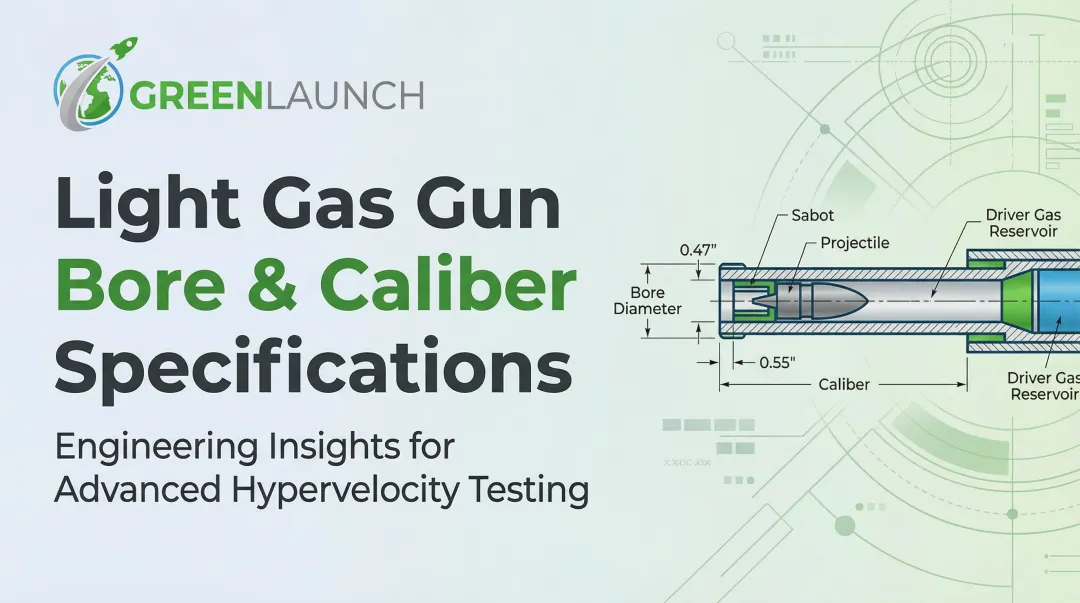
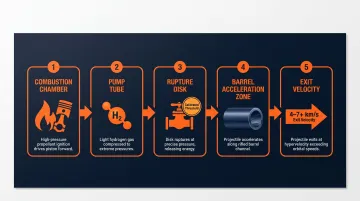
A light-gas gun operates on a straightforward principle: a large-diameter piston, driven by combustion of a fuel mixture, compresses a light working gas—hydrogen or helium—in a pump tube. A calibrated rupture disk holds pressure until the optimum point, then releases the gas into the barrel to accelerate the projectile.
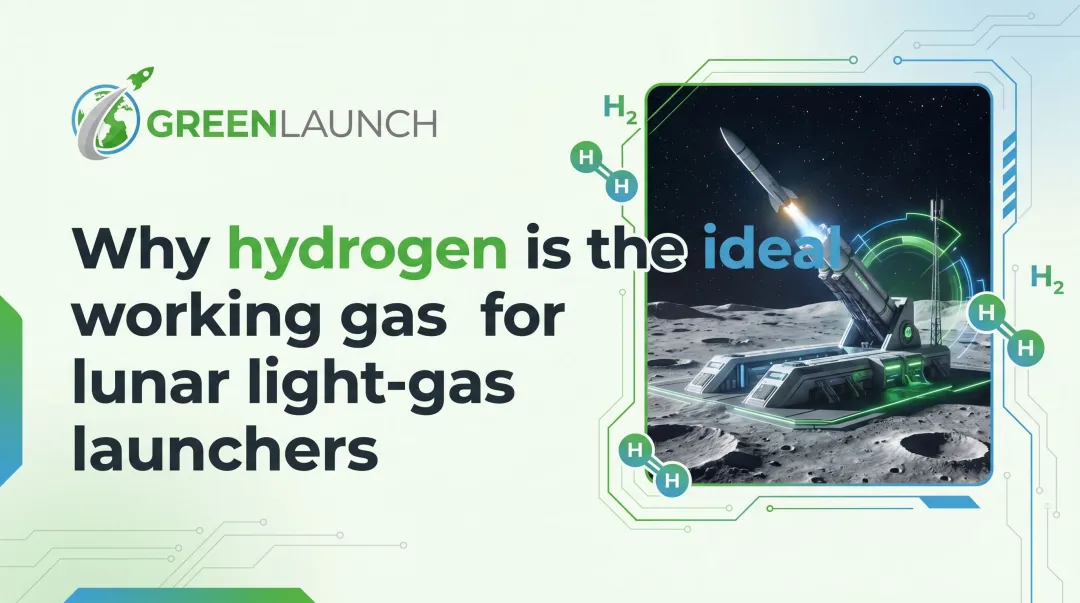
Hydrogen is the preferred working fluid because muzzle velocity is governed by the speed of sound in the propellant gas. Hydrogen's low molecular weight gives it a speed of sound approximately 3.8 times that of air at room temperature, and this ratio rises further with temperature. This allows the projectile to continue accelerating well beyond what conventional powder propellants can achieve.
Two primary configurations exist:
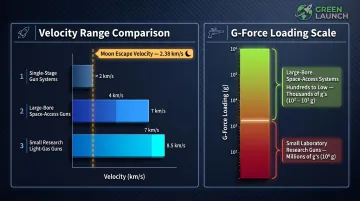
- Single-stage: Simpler design with a lower velocity ceiling, typically up to ~2 km/s
- Two-stage: Piston-driven compression of light gas, capable of 4–7+ km/s; space-access applications require two-stage or heated variants to reach the velocities needed for suborbital or orbital trajectories
The rupture disk plays a critical role as a precision valve. By holding full compression pressure until the optimal moment, then releasing it in one event, the system maximizes the energy available at the instant the projectile begins moving—a key efficiency advantage over continuous-burn propellant systems. NASA's Johnson Space Center HVIT facility validates this model, confirming that a scored rupture disc fails at high pressure and releases light gas into a near-vacuum second stage to drive the projectile to hypervelocity.
Pushing Velocity Further: Thermal Preheating
Scaling this principle to heavier payloads requires driving gas temperature higher before compression — which is where three-stage heated configurations come in.
Peer-reviewed work on three-stage light-gas guns with preheating shows that pre-heated refractory particles — such as aluminum oxide grit — transfer thermal energy to cold hydrogen flowing through a particle bed. This produces hot propellant gas without the structural challenges of extreme-pressure piston chambers at large scale, enabling heavier projectile masses while sustaining high exit velocities.
Performance Capabilities and Demonstrated Results
Research-scale light-gas guns have demonstrated velocities from 4 km/s up to approximately 8.5 km/s depending on projectile mass and barrel configuration. NASA's White Sands Test Facility reports two-stage light-gas guns accelerating projectiles up to 27,500 ft/s (approximately 8.4 km/s). The inverse relationship between projectile mass and achievable velocity means mission planners must trade payload mass against required delta-V at the outset of system design.
That mass-velocity trade-off connects directly to survivability. G-force loading on projectiles depends on bore size and system design, and large-bore systems designed for space access operate at far lower accelerations than small laboratory guns. Research on large-projectile systems indicates that space-access configurations can be engineered to operate in the range of hundreds to low thousands of g's rather than the millions of g's seen in small-scale guns. Ruggedized electronics and small payloads can survive launch intact at these acceleration levels.
Green Launch's testing milestones represent a meaningful step from laboratory physics to demonstrated operational capability:
- 2018: 12 successful horizontal test firings at Yuma Proving Ground, exploring different parameters of gas charge pressures, release peak pressures, vehicle weight, and resulting velocities
- 2022: First vertical light-gas launch for space access, with an estimated 30–40 km altitude achieved in a late-December 2021 test
Both test campaigns ran on Green Launch's hydrogen-oxygen propellant system, which produces water vapor as the sole combustion byproduct. For lunar base planners evaluating long-term logistics, that matters: no toxic residuals, simpler range permitting, and propellant components (hydrogen and oxygen) that are producible from water through electrolysis — a resource lunar facilities may eventually generate on-site.
The Lunar Base Application: Where Light-Gas Launch Fits the Architecture
Earth-to-LEO Propellant Ferry
One of the strongest near-term applications for light-gas launch in a lunar logistics chain is bulk propellant delivery to a low-Earth-orbit depot. From there, conventional upper stages or nuclear thermal vehicles complete the translunar injection. This reduces the cost per kilogram of propellant at the depot by using a much cheaper launch mechanism for the highest-volume commodity.
Architectural studies from the 1980s and 1990s explored light-gas gun systems for delivering building materials to LEO, with concepts projecting approximately 1,000 metric tons per year at significantly reduced cost compared to rockets. These studies required protective aeroshells and apogee kick motors to handle atmospheric transit and provide remaining delta-v. On the lunar surface, those constraints disappear entirely.
Moon-Surface Application
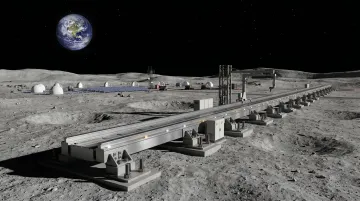
The lunar environment removes the primary constraint that limits Earth-based gun launch: atmospheric drag and heating on ascent. The Moon's escape velocity is approximately 2.38 km/s, and with no atmosphere to fight, a surface-mounted light-gas launcher could accelerate mined regolith, processed propellants, or raw materials into lunar orbit or toward L2 with a system well within demonstrated velocity ranges—at a fraction of the recurring cost of rocket launches from the surface.
Logistics Cadence Advantage
Unlike rockets, which require complex pre-launch processing, fueling operations, and long turnaround times, a mature light-gas launch system is designed for high-frequency, repeatable firing. Green Launch's developmental system targets the following operational tempo:
- Launch cadence: every 60–90 minutes per operational mission
- Cargo throughput: daily or higher firing rates for bulk materials
- Supply model: continuous flow rather than episodic resupply
This shift strengthens base operational resilience in ways episodic rocket delivery cannot match.
Green Launch's hydrogen-oxygen propellant system and demonstrated vertical launch capability are directly relevant to two mission planning decisions: Earth-based propellant pre-positioning to an LEO depot, and future lunar surface launcher design. Mission planners working through either trade should contact Green Launch to discuss system configuration options and payload compatibility for their specific architecture.
Payload Suitability: What Can and Cannot Be Gun-Launched
Well-Suited Cargo Categories
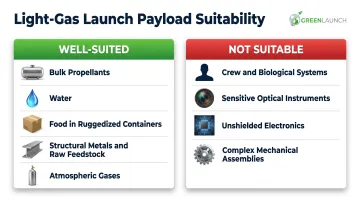
Light-gas launch is appropriate for bulk, mechanically robust materials that can be packaged to survive high-g acceleration and require no active systems during flight:
- Bulk propellants: Liquid hydrogen, liquid oxygen in pressure-hardened tanks
- Water: In reinforced pressure vessels
- Food: In ruggedized containers designed for high-g environments
- Structural metals and raw feedstock: Steel, aluminum, composite materials
- Atmospheric gases: Nitrogen, oxygen in reinforced vessels
Each category shares the same profile: high-density, mechanically robust, and tolerant of acceleration loads.
Explicitly Unsuitable Categories
Not every payload class fits this profile. Light-gas launch cannot handle:
- Crew and biological systems
- Sensitive optical instruments
- Unshielded electronics
- Complex mechanical assemblies with moving parts
Defense electronics hardening research shows that artillery environments subject components to approximately 15,000 g peak loads, while tank cannon rounds can reach up to 30,000 g.
With appropriate packaging, ruggedization, potting, and structural design, many electronic systems can survive these environments. Mission planners must evaluate each payload class individually rather than treating electronics as a blanket exclusion.
Projectile Recovery and Reuse
For Earth-based systems, ablative heat shields manage atmospheric reentry heating, and crushable honeycomb structures absorb ground impact. The ruggedness required to survive launch also makes recovery and reuse of the projectile body feasible, which drives per-launch costs down over time — a meaningful offset against the upfront infrastructure investment that planners should factor into their 10-year logistics models.
Frequently Asked Questions
How does a light gas gun work?
A piston driven by combustion compresses a light gas (hydrogen or helium) in a pump tube. When pressure reaches a calibrated threshold, a rupture disk opens and the expanding gas accelerates the projectile down the barrel to velocities of 4–7+ km/s, far exceeding conventional propellants.
What velocity can a light gas gun achieve?
Velocities range from 4 km/s in large-bore space-access configurations up to 7–8.5 km/s in smaller research systems. Heavier projectiles achieve lower velocities, so mission planners must balance payload mass against required delta-v.
Could a railgun shoot into space?
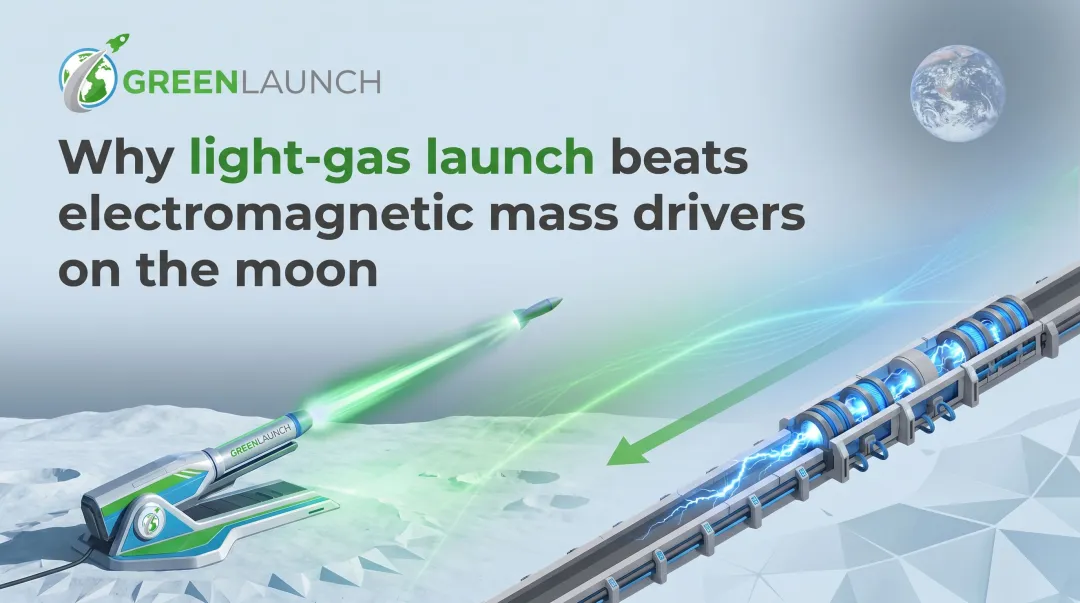
Railguns use electromagnetic acceleration rather than gas expansion, and both technologies face atmosphere drag and heating challenges for direct orbital launch. Light-gas guns sidestep the severe barrel erosion and extreme pulsed-power demands that constrained the U.S. Navy's railgun program, which saw only 12–24 rounds per barrel before erosion ended service life.
Is light-gas gun launch safe for all payload types?
No. Gun launch subjects payloads to high acceleration loads—hundreds to thousands of g's in large-bore space-access designs. It is safe and practical only for mechanically robust, ruggedized cargo. Humans, sensitive instruments, and fragile electronics cannot survive these environments without prohibitively complex packaging.
What payloads are best suited for light-gas gun launch to support a lunar base?
Bulk propellants, water, atmospheric gases, food in hardened containers, and structural raw materials are the primary candidates. These are the high-volume, rugged consumables that a permanent base needs in large, repeated quantities—exactly where light-gas launch delivers the greatest economic advantage.
How does light-gas launch compare to conventional rockets for lunar logistics?
Rockets offer flexibility for any payload type, but at high per-kilogram cost and low cadence. Light-gas launch delivers far lower recurring cost and higher firing frequency for bulk cargo. In a mature lunar logistics architecture, the two are complementary: rockets handle sensitive or crewed missions; light-gas guns handle the volume.