Introduction
Demand for global communications, Earth observation, and national security applications is driving a rapid proliferation of small satellite constellations — and the pressure is reaching every layer of the deployment stack, from launch to on-orbit operations. In 2024 alone, 2,790 small satellites were launched, accounting for 97% of all spacecraft. This explosive growth has exposed bottlenecks in legacy infrastructure originally designed for single, expensive platforms built over years.
Today's operators need fundamentally different capabilities: faster manufacturing, higher launch cadence, and autonomous fleet management. The industry is responding with a new generation of enabling technologies across four core domains — dedicated launch vehicles, digital manufacturing, deployable structures, and autonomous operations.
This article breaks down each domain, examines the specific technologies driving progress, and highlights what decision-makers need to weigh when fielding lower-cost, operationally redundant fleets on compressed timelines.
Key Takeaways
- Dedicated small launch vehicles enable precise orbit insertion on demand; hydrogen-oxygen propulsion cuts costs and environmental impact
- Digital twins, parallel assembly, and automated testing compress satellite production from months to days
- Deployable antennas, solar arrays, and booms enable compact stowage during launch while delivering full operational capability on orbit
- AI-driven ground systems, distributed station networks, and onboard autonomy cut the operational overhead of large constellation management
- Together, these advances let commercial and government operators deploy satellite fleets faster and at lower cost than ever before
The Small Satellite Revolution: Demand Drivers for Rapid Fleet Deployment
The scale of today's smallsat market is staggering. A few data points illustrate the scope:
- Starlink: 10,168 active satellites as of April 2026, with a planned constellation up to 34,400 units
- OneWeb: 652 satellites in orbit
- Amazon Kuiper: 241 satellites launched, FCC-approved for 7,700 total
- Industry-wide: approximately 24,700 satellites projected to be ordered and launched through 2030
Legacy infrastructure cannot absorb this volume. The numbers point to a sustained demand environment that only fundamentally different deployment technologies can serve.
Traditional satellite programs operated on 24-48 month timelines, producing a handful of expensive, long-lived platforms where a single failure meant mission loss and massive capital write-offs. Today's smallsat model inverts that logic entirely.
Risk is now distributed across hundreds or thousands of units — if one fails, the constellation keeps operating. More importantly, operators can refresh hardware every 18-24 months rather than engineering for 15-year lifespans. That's only viable if deployment technologies can match the pace.
Speed to orbit determines market position. Operators who deploy faster lock in customer commitments, respond to emerging threats, and iterate hardware based on real on-orbit data — while slower competitors are still on the pad. That pressure demands fundamentally different technologies at every stage of the deployment pipeline.
Launch Technologies: The Critical Deployment Bottleneck
Dedicated Small Launch Vehicles vs. Rideshare Models
Launch access represents the most critical constraint in fleet deployment. The core tradeoff lies between rideshare and dedicated launch approaches, each offering distinct advantages.
Rideshare launches allow smallsats to piggyback on large vehicles at low cost—SpaceX's Transporter program charges $350,000 for 50 kg to sun-synchronous orbit, with additional mass at $7,000 per kg. This pricing makes rideshare attractive for budget-constrained missions. However, operators accept constrained orbital parameters determined by the primary payload, fixed schedules that may delay deployment by months, and limited flexibility for mission-specific trajectories.
Dedicated small launch vehicles offer the opposite value proposition. Rocket Lab's Electron costs approximately $7.5 million per launch ($25,000 per kg), while Firefly Alpha ranges from $15-19 million and ABL RS1 costs $12 million ($10,000 per kg). The per-kilogram cost runs 3-5x higher than rideshare, but dedicated launch provides:
- Precise orbit insertion to the exact altitude and inclination required
- On-demand scheduling aligned with constellation deployment timelines
- Mission-specific trajectories impossible to achieve through rideshare
- Rapid responsiveness for time-sensitive deployments
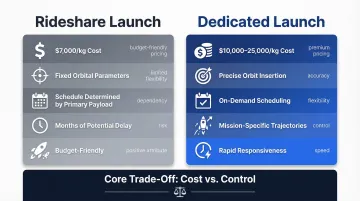
For rapid fleet deployment, these advantages increasingly outweigh cost considerations. When building a constellation of hundreds of satellites, placing them in the wrong orbit or waiting six months for a rideshare opportunity negates the entire speed advantage.
Launch cadence—the number of launches a provider can execute annually—acts as a rate-limiting factor. Rocket Lab achieved 21 Electron launches in 2025, demonstrating how vertical integration, reusability programs, and streamlined integration processes enable higher cadence. Firefly demonstrated rapid responsiveness on its VICTUS NOX mission, launching just 27 hours after receiving orders—a capability that constellation operators building time-sensitive coverage networks can't afford to ignore.
Emerging Launch Technologies for High-Cadence Deployment
Alternative launch approaches aim to eliminate the infrastructure and cost barriers of conventional rockets. Light-gas propulsion is one promising path: these systems use low-molecular-weight gases like hydrogen to achieve higher expansion velocities than conventional propellants—translating directly into greater projectile speed.
Green Launch has developed a proprietary hydrogen-oxygen light-gas combustion system designed for CubeSat-class payloads. The system uses a combustion chamber with hydrogen fuel, oxygen oxidizer, and multiple igniters to accelerate payloads through a ground-based launch tube. Green Launch has demonstrated velocities up to Mach 9 (2.97 km/sec) with single-stage combustion. Their first vertical launch in December 2021 exceeded Mach 3 and reached an estimated 30 km altitude.
The environmental profile sets this approach apart from conventional rockets:
- Near-zero emissions: hydrogen-oxygen combustion produces only water vapor, versus 19+ tons of CO2 per ton of payload for RP-1 and methane rockets
- 91%+ propellant recovery: captured gas is recycled, releasing virtually nothing into the atmosphere for suborbital launches
- Minimal ground infrastructure: no concrete pads or flame deflectors—just a launch tube and gas handling systems
The main challenge for light-gas systems is payload acceleration tolerance. Green Launch's system imposes 30,000 Gs on payloads, requiring robust design and component hardening. Modern commercial electronics can withstand these forces with minor modifications, making the approach well-suited for acceleration-tolerant CubeSat missions.
Air-launch systems take a different angle on the same infrastructure problem. Virgin Orbit's LauncherOne used a Boeing 747 carrier aircraft to deploy rockets at altitude, eliminating fixed-pad infrastructure and enabling global launch flexibility. Virgin Orbit ceased operations in 2023, but the model validated a key concept: non-traditional launch methods can meaningfully reduce schedule risk for fleet operators placing satellites across diverse orbital planes.
Satellite Manufacturing at Scale: Digital Engineering and Automation
Digital Twins, Parallel Assembly, and Automated Testing
Digital engineering has fundamentally transformed smallsat production economics. Digital twins—virtual replicas of the entire factory floor and satellite design—allow manufacturers to simulate, optimize, and validate production processes before building any hardware. Raytheon used digital twins to reach critical design review for Maxar's WorldView Legion payload in just 12 months, while reducing size, weight, and power by a factor of two to three.
This approach dramatically reduces trial-and-error cycles. Engineers can identify interference issues, thermal problems, and assembly bottlenecks virtually, then iterate solutions in software rather than reworking physical hardware. The result: first-round system testing compressed from weeks to a single day.
Production throughput has scaled accordingly. Starlink achieved delivery rates of 70 satellites per week in 2025—over 3,600 units annually from a single production line. Spire Global maintains capacity to design, manufacture, and test 200+ satellites per year, while Terran Orbital expanded its Irvine facility to 250 satellites annually.
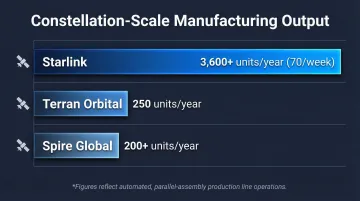
Parallel assembly lines enable this throughput. Rather than building satellites sequentially, manufacturers operate multiple identical production lines where work cells perform specialized tasks simultaneously. Modern facilities can mechanically build a satellite bus in approximately one week, then perform bus-to-payload integration in minutes with a single operator.
Automated test procedures are equally critical. Script-based test "playlists" replace hundreds of manual steps with software instructions that execute consistently, around the clock. Spire's automated test software and integrated requirements planning reduced build cycle time by over 40% and conversion costs by 75%. The result is lower labor costs, faster certification, and fewer errors—all essential when producing dozens to hundreds of units for a single fleet deployment.
Standardized Bus Platforms and COTS Integration
Standardization unlocks volume production. Smallsat bus platforms using commercial off-the-shelf (COTS) components—processors, reaction wheels, GPS receivers, radios—reduce design cycle time and enable plug-and-play assembly.
CubeSat form factors from 1U through 16U exemplify this shift: standardization has created a broad supply chain where vendors compete on performance and price within defined mechanical and electrical interfaces.
Multiple vendors now offer standard bus platforms with short lead times. NanoAvionics provides buses from 10 kg to 200+ kg with lead times starting at seven months, while GomSpace offers ready-to-assemble platform kits from 6U to 16U. These platforms provide faster time to market, predictable procurement, and lower risk compared to custom designs.
The core trade-off is optimization versus speed. Custom designs can deliver tighter power budgets, better mass distribution, and specialized thermal management. For constellation operators, though, those gains rarely justify the cost:
- Custom designs impose long lead times, complex supply chains, and higher per-unit costs
- Standardized platforms enable faster procurement, simpler fleet-wide qualification, and easier component replacement
- COTS components create supplier competition that keeps prices predictable across large orders
A 5% performance penalty across 500 satellites is a manageable trade-off. A six-month procurement delay or a 20% cost overrun is not.
Deployable Structures: Maximizing Capability Within Minimal Volume
Stowing, Restraint, and Actuation Approaches
Deployable structures are essential for over 90% of small satellites. Compact stowage during launch allows small vehicles to carry capable payloads, while reliable on-orbit deployment enables the power generation, communications aperture, and sensing functions required for mission success. The design challenge lies in transitioning from compact stowed configuration—constrained by launch vehicle fairing volume—to full operational size in the harsh space environment.
Main stowing approaches include:
- Parallel folds: Multiple panels fold accordion-style. Advantage: simple, predictable. Risk: hinge friction and alignment.
- Origami/kirigami patterns: Complex fold patterns achieve high packing ratios. Advantage: extreme compaction. Risk: deployment sequence complexity.
- Telescoping: Nested tubes extend sequentially. Advantage: linear deployment. Risk: friction in telescoping joints.
- Spooled/coiled: Tape springs or booms coil around a hub. Advantage: high strain energy storage for deployment. Risk: uncontrolled deployment speed.
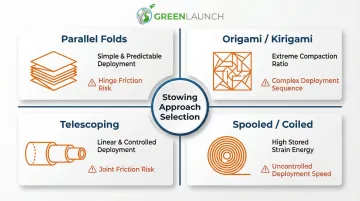
Stow approach selection directly constrains restraint and actuation choices—all three must work together reliably across hundreds of identical units.
Restraint mechanisms hold structures during launch, then release on command. Common approaches include:
- Burn wires: Electrical current melts a wire restraining the mechanism. Dominant in CubeSats due to low mass, low cost, and simplicity—but workmanship-sensitive.
- Pin pullers: Pyrotechnic or mechanical actuators withdraw pins. More reliable but heavier and more expensive.
- Release nuts: Threaded fasteners release via motor or pyro actuation. High load capacity but complex.
- Latch/tight-fit approaches: Friction holds structures until deployment force overcomes resistance. Simple but requires precise force margins.
Matching restraint to actuation method is critical. A burn-wire restraint releasing a coiled boom requires precise stored energy calculation—too little and deployment stalls, too much and components break.
Design Best Practices for Reliable Fleet-Scale Deployment
Deployable failures are a leading cause of satellite failures, resulting in nearly $800 million in insurance claims over 23 years. For constellation operators, a 1% deployment failure rate across 1,000 satellites means 10 failed units—unacceptable economics.
The most impactful design principles for fleet-scale reliability:
- Reduce deployment stages. Every additional stage multiplies failure risk. A three-stage deployment has three opportunities to fail; a single-stage has one. Simplify wherever possible.
- Prototype early with low-fidelity models. Test stow-and-deploy sequences with cardboard, 3D-printed parts, and benchtop hardware before committing to flight-like designs. Identify failure modes cheaply and iterate rapidly.
- Apply generous force margins. NASA and ECSS best practices recommend 3× margins when obtained via analysis, 2× with flight-like hardware testing, and 1× for spring-out failure cases. Vacuum eliminates air damping, thermal cycling shifts material properties, and zero-G removes gravity assistance—conservative margins account for all of it.
- Design for self-sequencing. One deployment event should geometrically or mechanically trigger the next—no additional commands or actuators required. A solar array panel's deployment angle physically releasing the next panel's latch is a clean example. Fewer failure points per unit means dramatically better odds across a 500-satellite constellation.
These principles enable constellation-scale reliability. When deploying 500 satellites, design approaches proven on 5-10 units provide insufficient confidence. Fleet operators need deployment success rates exceeding 99.5%, achievable only through rigorous design discipline.
Fleet Operations: Automation, AI, and Ground Infrastructure
Operating dozens to thousands of satellites creates an operational scaling problem that manual processes cannot solve. Ground operations viable for a single spacecraft become prohibitively expensive and error-prone at fleet scale. A team of 10 operators managing one satellite cannot simply scale to 1,000 operators for 100 satellites: the economics don't work, and coordination complexity becomes unmanageable.
Automated scheduling systems now handle routine contact planning, balancing ground station availability, satellite power budgets, and data priority across the fleet. Predictive maintenance algorithms forecast component degradation, enabling proactive intervention before failures occur.
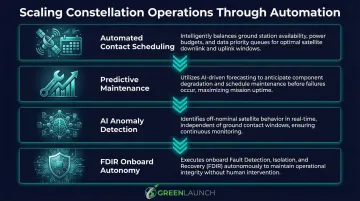
AI-driven anomaly detection identifies off-nominal behavior without waiting for ground contact. A CubeSat case study showed that artificial neural networks could detect complex thermal anomalies while keeping memory usage within 10% of available microcontroller capacity — proving feasibility without dedicated hardware.
Distributed ground station networks now underpin constellation operations at scale. Key providers include:
- KSAT — 300+ antennas across 28 locations, optimized for polar and inclined LEO orbits
- Swedish Space Corporation — 10 strategic stations supplemented by 11 partner sites
More contact opportunities per satellite per day reduce data latency and improve command responsiveness for time-sensitive missions. Software-defined architectures allow rapid reconfiguration as constellation geometry changes.
Standardized onboard autonomy is now a baseline requirement, not a differentiator. The ECSS-E-ST-70-11C FDIR standard requires spacecraft to autonomously detect anomalies, isolate failed units, and recover to safe states without waiting for ground intervention.
This self-management capability reduces dependence on contact windows and makes large-constellation economics commercially viable.
Inter-satellite links (ISLs) address one of the hardest latency problems in constellation design. Starlink's optical ISLs, introduced in v1.5 and v2 Mini generations, let satellites route data through the mesh to the nearest ground station rather than waiting for direct line-of-sight. The contrast is instructive: OneWeb's Phase 1 constellation, built without ISLs, shows measurable handover gaps and significant latency variation. For constellations beyond a few hundred satellites, ISLs stop being optional.
Frequently Asked Questions
What are the key technologies enabling rapid deployment of small satellite fleets?
Four domains work together: high-cadence launch vehicles for precise orbit insertion, digital manufacturing that compresses production from months to days, deployable structures that maximize on-orbit capability within compact volumes, and AI-driven ground operations that let small teams manage large fleets. Operators who advance all four simultaneously pull ahead of those optimizing just one.
What is the difference between rideshare and dedicated launch for building a small satellite constellation?
Rideshare costs less ($7,000/kg on SpaceX Transporter vs. $10,000–25,000/kg for dedicated vehicles) but locks you into the primary payload's orbit and fixed schedules, potentially delaying deployment by months. Dedicated launch costs more per flight but delivers precise orbit insertion on your timeline, making it the better choice for rapid, mission-critical fleet buildout.
How long does it take to manufacture and launch a small satellite fleet today?
Automated facilities can assemble a satellite bus in roughly one week and complete system testing in about one day using digital twins. The real bottleneck is launch cadence: securing dozens of slots with the right orbital parameters can add months to over a year depending on vehicle availability and mission requirements.
What role do deployable structures play in small satellite missions?
Deployable solar arrays, antennas, and booms let satellites stow in 10U CubeSat volumes or less during launch, then expand to apertures several meters wide on orbit. That small-stow, large-deploy approach enables capable communications, power generation, and sensing missions on platforms that fit cost-effectively into small launch vehicles or rideshare slots.
What are the biggest technical challenges in rapidly deploying large small satellite constellations?
Four challenges dominate: matching production throughput to available launch slots; achieving better than 99.5% deployable mechanism reliability across hundreds of identical units; managing orbital congestion as LEO population grows; and scaling ground operations through automation and AI anomaly detection rather than proportionally growing headcount.
How does light-gas propulsion technology compare to traditional rockets for small satellite launches?
Light-gas propulsion systems accelerate projectiles using low-molecular-weight gases like hydrogen, which achieve higher gas expansion velocities than traditional chemical propellants due to hydrogen's extremely low molecular weight. Systems like Green Launch's hydrogen-oxygen technology produce only water vapor as exhaust, compared to 19 tons of CO2 per ton of payload from conventional rockets, with lower infrastructure costs from ground-based launch tubes rather than traditional launch pads. The key constraint is payload acceleration tolerance: light-gas systems impose thousands of Gs, requiring robust component hardening for CubeSat-class satellites.