Introduction
With the FAA projecting U.S. launches will triple by 2034, the atmospheric cost of reaching orbit is under unprecedented scrutiny. The industry faces a fundamental choice between two propulsion philosophies: traditional chemical rockets that burn hydrocarbon or solid fuels at stratospheric altitudes, and emerging kinetic launch systems that use compressed hydrogen gas to accelerate payloads mechanically.
The stakes extend far beyond CO2. Chemical rockets inject black carbon soot, nitrogen oxides, and ozone-depleting chlorine directly into the stratosphere, where warming and ozone depletion effects are amplified by orders of magnitude compared to ground-level emissions. NASA projects global launch tonnage will surge from 3,500 tonnes annually to over 30,000 tonnes by 2040, driven by mega-constellations.
At that scale, what comes out of a launch system matters as much as what goes up. Kinetic launch produces water vapor as its only exhaust — no soot, no chlorine, no NOx injected into the upper atmosphere. This comparison examines what that difference means across CO2 equivalency, stratospheric chemistry, ozone impact, and long-term atmospheric risk.
Key Takeaways
- Chemical rockets emit CO2, stratospheric black carbon, and ozone-depleting compounds—Falcon 9 produces ~387 tonnes CO2e per launch, Starship ~3,491 tonnes
- Kinetic launch uses hydrogen-oxygen combustion to mechanically accelerate payloads, producing only water vapor and no carbon emissions
- Stratospheric black carbon from rockets is estimated to have nearly 500 times the warming potential of surface-level soot
- Small satellite operators and research institutions face growing regulatory pressure to choose low-emission launch providers
- Chemical rockets suit heavy-lift and crewed missions; kinetic launch is the low-emission option for small payloads where sustainability matters
Chemical Rocket Launch vs. Kinetic Launch: Quick Comparison
| Dimension | Chemical Rocket | Kinetic Launch |
|---|---|---|
| CO2 Emissions per Launch | 387 tonnes (Falcon 9), 3,491 tonnes (Starship) | Near-zero; propellant gases produce water vapor, not CO2 |
| Black Carbon Output | RP-1 rockets emit ~10 tonnes of soot per heavy-lift launch into stratosphere | Zero; no hydrocarbon combustion |
| Ozone Layer Impact | Solid motors emit chlorine; all types inject NOx and water vapor at altitude | No chlorine; minimal stratospheric disruption |
| Payload Capacity | Heavy-lift (22+ tonnes to LEO), crewed missions, deep space | Small-to-medium payloads (CubeSats, scientific instruments) |
| Regulatory Risk | Increasing FAA/FCC scrutiny; WMO flags spaceflight emissions as poorly understood | Compliant by design; water vapor is the sole atmospheric byproduct |
What is Chemical Rocket Launch?
Chemical rocket propulsion generates thrust by combusting liquid or solid propellants—typically kerosene (RP-1), liquid methane, liquid hydrogen, or solid composites—to produce high-velocity exhaust gases. This technology has dominated space access for seven decades because it delivers exceptional thrust-to-weight ratios and the heavy-lift capability needed for large satellites, crewed missions, and planetary exploration.
Propellant Types and Emission Profiles
Different propellants produce distinctly different atmospheric footprints:
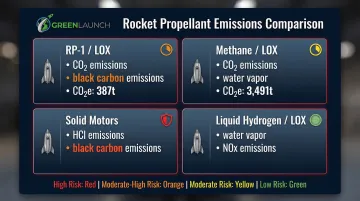
- Kerosene (RP-1) + Liquid Oxygen: Falcon 9 burns this combination, producing CO2 and significant black carbon soot. The FAA estimates 387 tonnes CO2e per Falcon 9 launch, based on 23,226 tonnes for 60 launches.
- Liquid Methane + Liquid Oxygen: Starship uses this cleaner-burning hydrocarbon, but still emits substantial CO2—approximately 3,491 tonnes CO2e per launch based on 83,794 tonnes for 24 launches.
- Solid Rocket Motors: Emit chlorine gas (HCl), alumina particles (~300 g/kg), and CO2, with direct ozone depletion effects.
- Liquid Hydrogen + Liquid Oxygen: Produces primarily water vapor rather than CO2, but still injects it at stratospheric altitudes where it has warming effects.
The Stratospheric Black Carbon Problem
CO2 tallies understate the climate impact of kerosene rockets. The real problem is black carbon: soot injected directly into the stratosphere at 15–50 km altitude, where particles persist for 1.4 to 3.8 years instead of the weeks they'd survive in the lower atmosphere. Stratospheric soot from kerosene rockets has warming efficiency almost 500x greater than surface black carbon, according to peer-reviewed atmospheric modeling.
A heavy-lift launcher burning 1,000 tonnes of kerosene-based propellant emits roughly 10 tonnes of black carbon into the stratosphere per launch. At projected 2040 cadence levels, researchers modeled a 10 Gg/year black carbon emission scenario that would cause stratospheric warming of up to 1.5 K and ozone losses of 16 Dobson Units (4%) in the Northern Hemisphere.
Secondary Atmospheric Effects
Black carbon is one layer of the problem. Chemical rockets also trigger these stratospheric effects:
- Nitrogen Oxides (NOx): High-temperature combustion produces NOx that converts ozone into oxygen, contributing to ozone layer depletion.
- Chlorine Compounds: Solid motors emit HCl that directly attacks ozone through well-understood catalytic cycles (chain reactions that repeatedly destroy ozone molecules).
- Water Vapor: Even hydrogen rockets inject water at altitudes where it acts as a potent greenhouse gas and participates in ozone chemistry.
The WMO's 2022 Scientific Assessment of Ozone Depletion explicitly warns that rocket emissions involve "chemistry and radiative interactions that are poorly understood and, in some cases, not yet studied," flagging the risk that scaling launch activity could undermine Montreal Protocol ozone recovery goals.
Use Cases of Chemical Rocket Launch
Chemical rockets remain irreplaceable for:
- Crewed missions requiring abort capability and proven life-support integration
- Heavy payloads exceeding 500 kg (communications satellites, space station modules, deep-space probes)
- Rapid-response military launches where readiness overrides environmental considerations
The industry accepted these emissions historically because no alternative existed at these capability levels. That calculus is shifting. NASA projects launch tonnage will grow tenfold to 30,000+ tonnes annually by 2040, and for acceleration-tolerant payloads — small satellites, research instruments, atmospheric samplers — kinetic launch systems offer a path to orbit without the stratospheric soot penalty.
What is Kinetic Launch?
Kinetic launch uses stored mechanical or pneumatic energy—rather than in-flight hydrocarbon combustion—to accelerate payloads to launch velocity. In light-gas gun systems, high-pressure hydrogen gas serves as the working fluid to drive projectiles to hypersonic speeds, with the combustion of hydrogen and oxygen producing water vapor as the primary byproduct.
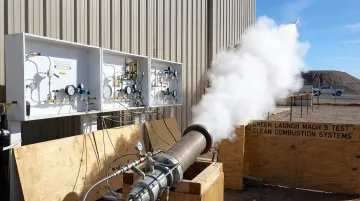
Green Launch's system combusts hydrogen and oxygen in a ground-based chamber to generate high-pressure gas that propels payloads through a 54-foot launch tube. The hydrogen-oxygen reaction produces only water as its combustion byproduct—what company leadership describes as "a little bit of a steam cloud" emerging at the end of each shot. No carbon-based fuels are involved in the primary propulsion stage. This approach builds directly on Dr. John Hunter's work leading the SHARP (Super High Altitude Research Project) at Lawrence Livermore National Laboratory from 1992–1998, where the world's largest hydrogen impulse launcher achieved record velocities.
Atmospheric Impact Profile
Because the primary combustion occurs on the ground and produces only water vapor, kinetic launch differs sharply from multi-stage chemical rockets, which deposit soot and reactive gases at the precise altitudes where climate forcing is maximized—from sea level through the stratosphere. Kinetic launch eliminates that contamination pathway entirely during the acceleration phase.
Green Launch has demonstrated propellant capture efficiency exceeding 91%, meaning less than 9% of propellant reaches the atmosphere during suborbital launches. For orbital missions requiring final orbital insertion, a small solid rocket motor aboard the payload completes the process—a fraction of the propellant mass burned by traditional all-rocket systems.
Payload Constraints and Demonstrated Capability
Kinetic launch is currently optimized for small-to-medium payloads: cubesats, scientific instruments, atmospheric samplers, and defense sensors. Green Launch has achieved:
- 12 successful horizontal test firings at Yuma Proving Ground in 2018, demonstrating variable gas charges and velocities
- First vertical light-gas launch in December 2021, reaching Mach 3+ and an estimated 30 km altitude with a 28-pound projectile
- Mach 9 velocities (2.97 km/sec) in recent testing as of October 2025
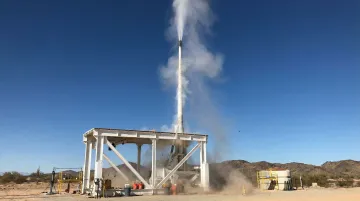
Each milestone closes the gap between research-grade hardware and commercially deployable launch infrastructure.
Use Cases of Kinetic Launch
Kinetic launch fits missions where:
- Payload mass stays under ~100 kg near-term, scaling to 100–1,000 pounds in future phases
- Payloads can tolerate high acceleration (modern electronics withstand 30,000 Gs with minor modifications)
- Frequent, low-cost access is needed for atmospheric research, ionosphere studies, or rapid satellite deployment
- Emissions profiles matter for regulatory compliance, sustainability commitments, or corporate responsibility goals
Green Launch's target customers—aerospace and defense organizations, scientific research institutions (including the National Science Foundation for mesosphere sampling), and satellite manufacturers—represent segments where the small-payload, low-emissions profile aligns with mission requirements and growing environmental accountability.
Market research from Euroconsult projects 26,104 small satellite launches (≤500 kg) between 2023–2032, valued at $113.3 billion through 2033—a market trajectory that positions kinetic launch well ahead of projected demand growth.
Environmental Impact Head-to-Head: Which Launch Method is Cleaner?
CO2 and Greenhouse Gas Emissions
Per-launch CO2 emissions vary dramatically by propellant choice:
- Falcon 9 (RP-1/LOX): 387 tonnes CO2e per launch
- Starship (Methane/LOX): 3,491 tonnes CO2e per launch
- Green Launch (Hydrogen/Oxygen): Near-zero CO2; water vapor only
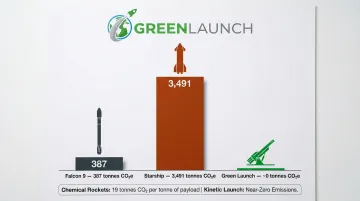
Green Launch's internal analysis puts RP-1 and methane rockets at 19 tonnes of CO2 per tonne of payload delivered to orbit. Their system produces virtually no CO2 with propellant capture.
Even "clean" hydrogen-LOX rockets like the Delta IV still inject water vapor at stratospheric altitudes — warming effects that ground-based combustion avoids entirely.
Black Carbon and Stratospheric Contamination
At scale, black carbon may matter more than CO2. Kerosene rockets deposit soot with a black carbon emission index of 30–50 g/kg during stratospheric flight, where it persists for years — absorbing solar radiation and disrupting atmospheric temperature profiles in ways surface-level emissions don't.
Research published in Journal of Geophysical Research: Atmospheres found that a 10 Gg/year black carbon scenario—representing tenfold growth in current emissions—would create a 40 Gg stratospheric burden within six years, causing warming of up to 1.5 K and statistically significant ozone depletion poleward of 30°N.
Kinetic launch produces zero black carbon. The hydrogen-oxygen reaction yields only water — no soot, no stratospheric loading. That distinction carries direct regulatory and atmospheric implications for the ozone layer, addressed next.
Ozone Layer and Long-Term Atmospheric Risk
Chemical rocket propellants threaten ozone recovery through multiple pathways:
- Solid motors: Emit 0.2 Gg/year of chlorine that directly destroys ozone
- All rockets: Produce NOx from high-temperature combustion that converts ozone to oxygen
- Reentry heating: Generates additional NOx; one study found reentry NOx accounted for 51% of ozone decline in contemporary emissions scenarios
The WMO's 2022 assessment warns that sustained growth in launches "could substantially offset remediation of upper stratospheric O₃ achieved with the Montreal Protocol." Kinetic launch avoids chlorine emissions entirely and eliminates high-altitude NOx generation from multi-stage burns.
When to Choose Each Method
Choose chemical rockets when:
- Payload mass exceeds kinetic launch capability (currently >100 kg)
- Crewed missions or abort capability is required
- Deep space trajectories demand high delta-v beyond LEO
Choose kinetic launch when:
- Mission fits small-to-medium payload envelope
- Minimizing atmospheric impact is a priority (regulatory, sustainability, or reputational)
- Frequent, cost-effective access matters more than single-launch heavy-lift
With global launch frequency projected to grow tenfold in the coming decade, atmospheric impact is shifting from a footnote to a licensing factor. Organizations choosing propulsion now are effectively choosing their regulatory exposure later.
Real-World Application: Green Launch's Kinetic Technology in Practice
Green Launch has moved kinetic launch from theoretical concept to demonstrated capability through rigorous field testing. The 12 horizontal test firings at Yuma Proving Ground in 2018 proved variable gas charge control and velocity repeatability. The December 2021 first vertical launch—achieving Mach 3+ and 30 km altitude—validated that light-gas systems can reach stratospheric altitudes on the first vertical attempt.
Most recently, Green Launch achieved 2.97 km/sec (Mach 9) velocities using precision gas injection technology designed to prevent errant detonation. This addresses a detonation control problem that limited legacy combustion-based launchers for decades. The company has also demonstrated propellant capture efficiency exceeding 91%, enabling near-zero atmospheric release for suborbital missions.
The Regulatory and Commercial Case Converge
Those technical milestones carry increasing commercial weight as environmental oversight tightens. NASA's projection of a tenfold increase in global spaceflight over the next two decades coincides with intensifying regulatory scrutiny. The FAA's updated NEPA procedures (Order 1050.1G, effective July 2025) formalize environmental review requirements, while the FCC Space Bureau has proposed requiring semi-annual satellite reentry reporting. These developments signal that atmospheric impact will increasingly factor into licensing decisions.
Organizations adopting low-emission launch technologies early will face lower regulatory friction and potential cost advantages as environmental compliance becomes a baseline licensing requirement. For aerospace organizations, satellite manufacturers, and research institutions evaluating launch options, Green Launch offers a technically demonstrated alternative with a distinctly different emissions profile—hydrogen and oxygen producing water instead of carbon and soot deposited at the altitudes where damage is maximized.
Conclusion
Chemical rockets remain essential for heavy payloads, crewed missions, and deep space exploration—their emissions profile is the current price of capability at that scale. But for small-to-medium payloads, kinetic launch represents a cleaner alternative with a measurably different atmospheric footprint — one that eliminates black carbon and reduces ozone depletion risk, the metrics increasingly driving regulatory compliance and sustainability commitments.
The stakes compound with scale. As launch cadence increases by an order of magnitude in coming decades, the cumulative atmospheric impact of hydrocarbon-based propulsion is not static; it multiplies. That trajectory matters directly to the organizations selecting launch providers now. Procurement decisions made today will shape both environmental footprint and regulatory exposure as emissions reporting requirements for the space sector tighten.
Where payload class and acceleration tolerance permit, kinetic launch already offers a lower-impact path to orbit. The practical question for aerospace operators and satellite developers is no longer whether a cleaner option exists — it's whether their mission profile qualifies for it.
Frequently Asked Questions
How much CO2 is emitted by a rocket launch?
CO2 emissions range from 387 tonnes for a Falcon 9 to 3,491 tonnes for a Starship, based on FAA and NASA environmental assessments. CO2 is only part of the picture, though—black carbon and ozone-depleting compounds carry far greater climate consequences per unit mass than CO2 alone.
What is kinetic launch and how does it differ from chemical rockets?
Kinetic launch uses a light-gas driver to mechanically accelerate payloads to launch velocity without burning hydrocarbon fuels in flight. Combustion happens on the ground and produces only water vapor, eliminating the CO2 and black carbon that chemical rockets inject directly into the stratosphere.
Does kinetic launch produce any greenhouse gas emissions?
Hydrogen-oxygen light-gas propulsion produces water vapor as its primary byproduct and generates no CO2 or black carbon. With propellant capture technology exceeding 91% efficiency, virtually nothing is released to the atmosphere during suborbital launches—a meaningful contrast to every major chemical propellant type in use today.
Why does the altitude of rocket emissions matter for climate impact?
Emissions deposited in the stratosphere persist for 4–5 years rather than weeks, allowing pollutants to accumulate. Stratospheric black carbon carries an estimated 500 times the warming potential per unit compared to surface-level soot, making injection altitude a critical variable in any climate assessment.
Can kinetic launch replace chemical rockets entirely?
Not currently. Kinetic launch is optimized for small-to-medium payloads (cubesats, scientific instruments) and cannot yet replicate the heavy-lift or crewed mission capabilities of chemical rockets. But it offers a viable, cleaner alternative for a growing segment of commercial and scientific launches where payload mass fits the system's capability envelope.
How is the space industry being regulated on environmental emissions?
The FAA has formalized NEPA environmental review requirements under Order 1050.1G, the FCC is proposing orbital debris and reentry reporting mandates, and the WMO's 2022 ozone assessment flagged spaceflight emissions as an urgent oversight priority. Atmospheric impacts remain poorly quantified, so regulatory requirements are expected to tighten as science catches up.