Introduction
U.S. data centers could consume 9-17% of national electricity by 2030 — more than triple their current 4-5% share. Terrestrial grids are running out of headroom, and the industry knows it. LEO is emerging as the next frontier for AI infrastructure, with major players like Google (Project Suncatcher) and Starcloud already filing plans for orbital constellations.
Getting satellites to LEO is not the hard part. The actual constraint is the supply chain that feeds those satellites — and the only place that supply chain can be anchored at scale is the Moon.
Key Takeaways
- Terrestrial AI infrastructure faces hard limits: power, cooling, and land moratoriums
- Orbital data centers capture 8x more solar energy than ground arrays and cool passively through thermal radiation
- At ~$2,500/kg to LEO even with reusable rockets, Earth-launched components price out constellation-scale orbital infrastructure
- The Moon's low gravity, hard vacuum, and in-situ regolith make it a viable off-Earth manufacturing base
- Light-gas launch systems built for lunar conditions offer a continuous, low-cost supply chain for orbital infrastructure at scale
Why AI Compute Is Moving to Orbit
The Terrestrial Ceiling Is Real
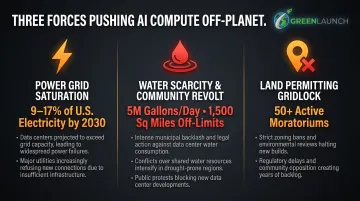
Three simultaneous constraints are forcing AI compute off-planet:
Power grid saturation — The Electric Power Research Institute revised its 2030 estimates upward by 60% in early 2026. Data centers could consume between 9-17% of total U.S. electricity generation by 2030. Virginia's share could reach 39-57%. Seven additional states will exceed 20%. Existing grids cannot absorb this level of demand, and no near-term buildout changes that math.
Water scarcity and community revolt — Large hyperscale facilities consume up to 5 million gallons of water per day for cooling. Over 50 U.S. communities have enacted data center moratoriums, placing 1,500 square miles in Michigan alone off-limits. Indirect water consumption from electricity generation adds another 1.2 gallons per kWh. The social license to expand terrestrial data centers is eroding rapidly.
Land permitting gridlock — Communities are pushing back on noise, energy use, and environmental impact. Permitting delays and outright bans are spreading across North Carolina, Michigan, and other states. The infrastructure required to cool and power massive AI training clusters can't be sited quickly or quietly.
What LEO Solves
Orbital data centers address all three constraints simultaneously:
Near-continuous solar exposure — Google's Project Suncatcher research confirms that solar panels in dawn-dusk sun-synchronous LEO at 650 km altitude are up to 8x more productive than ground-based panels and produce power nearly continuously. This eliminates the need for massive battery storage and grid interconnections.
Passive radiative cooling — Satellites reject waste heat via radiation into the cosmic microwave background at approximately 3 Kelvin. This provides a vastly superior thermal sink compared to terrestrial ambient cooling at 290-310K, with no water consumption.
Zero land footprint — Orbital infrastructure requires no permitting, no community buy-in, and no environmental impact studies. Satellites operate above all terrestrial constraints.
Who's Already Moving
The orbital compute sector has already crossed from concept to capitalized industry. Funding is committed, hardware is in orbit, and regulatory filings are active:
- Starcloud launched the first data-center-class GPU (Nvidia H100) to orbit in November 2025, reached $1.1 billion valuation in March 2026 (the fastest YC unicorn ever), and filed with the FCC for up to 88,000 orbital data center satellites
- Google's Project Suncatcher plans two prototype satellites by early 2027, testing Trillium TPUs with free-space optical links achieving 800 Gbps bench-scale performance, with a vision extending to gigawatt-scale constellations
- SpaceX has filed for orbital compute constellations using 100 kW satellites (versus current 20 kW Starlink units)
What each of these programs has in common is an unsolved logistics problem: getting hardware to orbit at the scale and cadence this industry will require. That's where the supply chain question — and the role of the moon — begins.
The Real Bottleneck: It's Not the Rockets
Most coverage focuses on launch cost as the gating factor, but launch economics are only one variable. The deeper problem is the supply chain for space-grade components.
The Bespoke Hardware Trap
Orbital hardware relies on mission-specific components with no interoperability standards. Space-qualified passive components cost $10-$200 per unit versus $0.10-$5.00 for automotive equivalents, with procurement lead times of 12-52 weeks versus 1-8 weeks for commercial parts. That cost gap is significant — but the lead time gap is what kills scale.
The Aerospace Industries Association and PwC warned in March 2026 that the space supply network "originally structured around low-volume, high-cost government programs with long development timelines" is "struggling to keep pace." The most constrained areas: space-grade microelectronics, radiation-hardened chips, sensors, and propulsion systems. Critical components are "produced by only a handful of qualified manufacturers."
What Constellations Actually Require
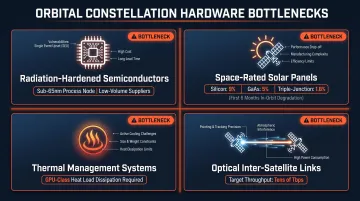
Starcloud's proposed 88,000-satellite constellation isn't just a launch logistics problem — it demands continuous industrial production of:
Radiation-hardened semiconductors: A handful of suppliers produce sub-65nm rad-hard chips at volumes built for hundreds of satellites per year — not tens of thousands.
Space-rated solar panels: Solar cells degrade fast in LEO. Monocrystalline silicon panels lose 9% power in the first six months at 500 km; GaAs panels lose 5%; triple-junction cells lose 1.8%. Atomic oxygen exposure adds another 5-15% efficiency loss in year one — capping satellite lifespan around five years and creating a permanent replacement cycle.
Thermal management systems: GPU-class heat loads in vacuum require specialized radiative rejection hardware. Nothing in the current supply chain produces this at constellation scale.
Optical inter-satellite links: High-bandwidth free-space optical systems remain largely developmental. Google's Suncatcher is targeting tens of Tbps — but production-ready, constellation-scale hardware doesn't yet exist.
The Bottleneck Moves, Not Disappears
Even if Starship hits its target cost-per-kg, the constraint shifts upstream to hardware availability and qualification cycles. That's the core problem: the parts pipeline, not the rocket, determines how fast a mega-constellation can actually be built.
Why the Supply Chain Has to Start on the Moon
The physics of moving mass from Earth to LEO is structurally unfavorable at industrial scale. The Moon changes the equation.
The Gravity Well Advantage
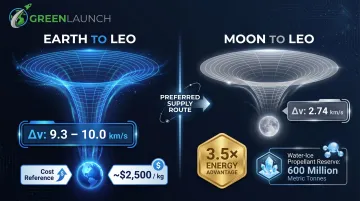
Launching raw materials or components from Earth to LEO means fighting Earth's full gravitational pull — a delta-v of 9.3-10.0 km/s. The Moon's escape velocity is approximately 2.4 km/s. With aerobraking, the delta-v from the lunar surface to LEO is roughly 2.74 km/s — approximately 3.5x lower than from Earth's surface.
At industrial supply chain scale, moving 1,000 tonnes of material from the lunar surface to LEO requires roughly one-third the energy of moving the same mass from Earth. That energy difference translates directly into cost, infrastructure, and feasibility.
The Lunar Vacuum as a Manufacturing Asset
The Moon's lack of atmosphere eliminates oxidation, contamination, and aerodynamic drag — conditions that are difficult and expensive to replicate in Earth-based cleanrooms. NASA confirms lunar crust contains oxygen, silicon, aluminum, iron, calcium, and magnesium — precisely the elements required for solar cell fabrication and structural materials.
Vacuum deposition processes for solar panels and optical components operate in their native environment on the Moon. No vacuum chambers, controlled atmospheres, or contamination risk required. The lunar surface is a natural cleanroom for manufacturing components destined for the vacuum of space.
Lunar In-Situ Resource Utilization (ISRU)
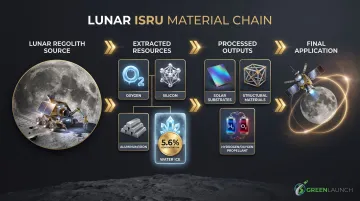
The Moon contains the raw materials for satellite production:
- Oxygen — Locked in regolith, extractable via molten regolith electrolysis
- Silicon — Suitable for solar panel production
- Metals — Aluminum and iron for structural materials
- Water ice — Detected at 5.6 ± 2.9% by mass in Cabeus crater, splittable into hydrogen and oxygen for propellant
Lunar Resources, Inc. designed a Lunar Vacuum Deposition Paver — a mobile crawler under 200 kg that fabricates solar cells directly on lunar regolith using thin-film vacuum deposition. Projected output: 17.44 MW of solar capacity over 7 years using indigenous materials.
Producing these materials on the Moon rather than launching them from Earth transforms the economics of orbital supply.
The Moon as a Logistics Hub
Those manufactured components don't stay on the Moon. Launched into cislunar space and routed to LEO, they arrive with far less delta-v expenditure than anything shipped from Earth. Lunar-derived propellant extends that advantage further — fueling in-space propulsion systems, topping off satellite station-keeping tanks, and ultimately sustaining the entire logistics network from a single upstream node.
Timeline Alignment
Lunar surface operations are nascent, but the timeline for scaling LEO AI infrastructure (realistically 2030s for meaningful constellations) aligns with the window in which lunar ISRU and manufacturing capabilities are expected to reach initial operational capacity. NASA's Artemis program and commercial lunar landers like Intuitive Machines' $180.4 million NASA contract for South Pole payloads are establishing the infrastructure foundation now.
What a Lunar-Origin Supply Chain Looks Like
The material flow transforms orbital economics:
Lunar regolith → processed into structural aluminum and silicon → solar array substrates and basic satellite structures fabricated on the lunar surface or in lunar orbit → launched to LEO staging depots → assembled and deployed as constellation nodes.
Even partial sourcing of bulk materials from the Moon reduces the Earth-launch mass fraction — estimates from cislunar logistics studies suggest meaningful reductions in the tonnage that must climb out of Earth's gravity well entirely.
In-Space Manufacturing and Assembly
Orbital data center satellites require solar arrays far larger than any rocket fairing can carry. Google's Project Suncatcher envisions gigawatt-scale constellations. These platforms demand in-space assembly — not incremental improvements to existing rockets.
A lunar-origin supply of structural materials allows construction of platforms no single Earth-launched payload could match. NASA's Archinaut project demonstrated 3D printing of a 37-meter beam structure and planned to manufacture two 10-meter solar arrays on an ESPA (Evolved Secondary Payload Adapter) satellite in orbit. Though NASA cancelled the program in 2024, engineers proved the core concept works.
Servicing and Lifecycle Extension
Unlike terrestrial data centers where failed components are hot-swapped, orbital nodes must either be deorbited or serviced in place. A lunar-anchored supply chain that includes in-orbit servicing depots changes the lifecycle economics — modules can be replaced or upgraded without full replacement.
Solar panels degrade 5-12% in the first six months in LEO. Servicing capability improves ROI by extending satellite lifespan and allowing incremental hardware upgrades as radiation-tolerant chip technology advances.
The Propellant Economy
Lunar-derived hydrogen and oxygen can fuel the in-space propulsion systems that move cargo from cislunar space to LEO, top off satellite station-keeping propellant, and reduce dependence on Earth-launched propellant mass for routine orbital operations. NASA investigated water extraction approaches targeting production of up to 30 metric tonnes of propellant on planetary surfaces.
Permanently shadowed regions at the lunar poles contain an estimated 600 million metric tonnes of water-ice. That volume is sufficient to sustain propellant depots serving dozens of LEO data center constellations simultaneously — making the Moon not just a materials source, but the logistics hub the entire architecture depends on.
The Launch Technology the Moon Actually Needs
Conventional chemical rockets are a poor fit for high-cadence lunar-to-orbit logistics. The Moon's environment eliminates two of the biggest challenges for alternative launch systems — aerodynamic heating and high-drag ascent profiles.
Why Rockets Don't Scale on the Moon
Rockets require complex propellant management, significant infrastructure, and per-launch costs that don't scale well for continuous material throughput. Each launch consumes propellant that must either be produced locally or imported from Earth. The economics remain marginal even with lunar in-situ resource utilization (ISRU).
Light-Gas Gun Systems: Purpose-Fit for Lunar Launch
Without an atmosphere, there is no aerodynamic drag penalty on high-velocity projectiles launched from a gun-type system. The Moon's ~2.4 km/s escape velocity is within the operational range of advanced light-gas propulsion platforms.
NASA technical papers confirm light-gas guns are capable of accelerating 10-tonne payloads to lunar escape velocity (2,370 m/s) and beyond, with demonstrated velocities up to 11,000 m/s — well above the 2.4 km/s threshold required.
Green Launch's hydrogen-oxygen light-gas technology traces its lineage to Dr. John Hunter's leadership of the SHARP project at Lawrence Livermore National Laboratory. That 130-meter system reached approximately 3 km/s. Green Launch's one-stage combustion system has since achieved 2.97 km/s (Mach 9), exceeding lunar escape velocity outright.
The conceptual Jules Verne Launcher scales this to 1.1 km in length, targeting 7 km/s with a cost goal of $500/kg — less than one-tenth the cost of chemical rockets.
On the lunar surface, this approach could enable continuous, low-cost material and component launches to orbit without the overhead of chemical rocket infrastructure.
What High-Cadence, Low-Cost Lunar Launch Unlocks
That cost and cadence profile changes what orbital logistics can look like at scale. The NASA-documented lunar light-gas gun concept targets a 30-minute launch cadence with 10-tonne payloads, giving a single launcher a theoretical throughput of approximately 480 tonnes per day.
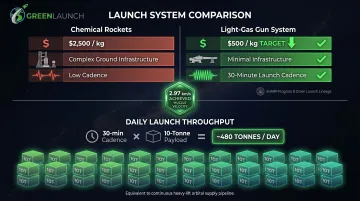
This transforms what is currently a project-based, one-off procurement model into an industrial supply chain that operates on cadence, feeding LEO assembly depots with structural materials, solar substrates, and bulk components — at the pace orbital AI constellations actually require.
Frequently Asked Questions
Why is LEO considered a good location for AI data centers?
LEO satellites in sun-synchronous orbit receive near-continuous solar exposure — up to 8x more productive than ground-based panels. They also benefit from passive radiative cooling into deep space and no terrestrial constraints around power grids, water supply, or permitting, making them well-suited for AI inference workloads.
What makes the supply chain for orbital data centers so difficult to build?
Space hardware lacks the interoperability standards, broad supplier bases, and short lead times of terrestrial components. Space-qualified parts cost 20–2,000x more than automotive equivalents and require qualification processes of 12–52 weeks, compared to 1–8 weeks for ground-based hardware.
What resources on the Moon are relevant to building space infrastructure?
Lunar regolith contains oxygen, silicon, and aluminum for solar panels and structural materials. Water ice in polar craters (detected at 5.6% concentration) can be electrolyzed into hydrogen and oxygen propellant. The vacuum environment itself serves as a natural manufacturing asset for semiconductor and optical fabrication.
How does the Moon's gravity well compare to Earth's for launch economics?
The Moon's escape velocity (~2.4 km/s) is roughly one-fifth of Earth's (~11.2 km/s). With aerobraking, delivering mass from the lunar surface to LEO requires approximately 2.74 km/s delta-v versus 9.3–10.0 km/s from Earth's surface. That translates to a 3.5x energy cost advantage at industrial scale.
What is ISRU and why does it matter for orbital AI infrastructure?
In-Situ Resource Utilization (ISRU) is the practice of producing materials and propellant from local planetary resources rather than launching them from Earth. Lunar ISRU could significantly reduce the Earth-launch mass required to sustain an orbital data center supply chain — cutting costs at the source rather than at the launchpad.
When could lunar manufacturing realistically support LEO satellite production?
The 2030s are the most realistic window, given current Artemis timelines, commercial lunar lander progress (including Intuitive Machines' recent NASA contracts), and the scaling requirements of LEO AI constellations. Initial ISRU propellant production will likely precede full manufacturing capability, with incremental buildout across the decade.