

Introduction
Small satellite operators face mounting pressure to compress deployment timelines. Over 90% of CubeSat missions incorporate deployable structures that introduce failure risk, yet constellation economics demand satellites reach operational status within months — not years — of mission approval. The numbers reflect the urgency: annual small satellite launches surged from fewer than 200 in 2015 to over 1,700 by 2023. Defense responsiveness requirements, constellation coverage economics, and expanding LEO access are all accelerating that pace.
That pressure is exactly what small satellite rapid deployment is built to address — the end-to-end process of designing, launching, and commissioning CubeSats, nanosatellites, and microsatellites on compressed schedules. The operators driving this demand span a wide range of sectors:
- Aerospace and defense primes managing responsiveness requirements
- Commercial constellation operators closing coverage gaps
- Government research agencies accelerating science return
- Satellite manufacturers responding to orbital asset degradation
Given how many variables — launch vehicle selection, licensing timelines, integration constraints — can quietly erode a "rapid" schedule, the gap between planned and actual deployment is often wider than teams expect. This guide breaks down how rapid deployment works, what determines success, and where the timeline typically slips.
Key Takeaways
- Rapid deployment compresses the satellite lifecycle—from mission definition to on-orbit commissioning—into months via standardized bus designs and modular payloads
- Primarily used in aerospace, defense, Earth observation, and IoT constellations where speed-to-orbit and scalability outweigh bespoke performance
- Success hinges on launch vehicle lead time, bus standardization, regulatory clearance, and deployment mechanism reliability
- Teams that confuse "rapid" with "rushed" typically fail; the discipline demands deliberate planning at every stage
What Is Small Satellite Rapid Deployment?
Small satellite rapid deployment is the end-to-end process of taking a spacecraft — typically under 500 kg, including CubeSats and nanosatellites — from design through launch and on-orbit commissioning in weeks to months rather than multi-year cycles. The measure of success is a fully operational satellite or constellation, not just a fast liftoff.
Traditional satellite programs rely on custom-built buses, bespoke launch contracts, and years of qualification testing. Rapid deployment trades some of that customization for speed through:
- Standardized satellite platforms (3U, 6U, 12U CubeSats, ESPA-class microsatellites — payloads that fit secondary slots on larger launch vehicles)
- Pre-negotiated rideshare manifests
- Commercial-off-the-shelf (COTS) components
- Pre-qualified deployment mechanisms
For defense, science, and commercial operators, this approach closes the gap between mission decision and operational capability — on a timeline that traditional programs simply can't match.
Why Rapid Deployment Is Critical in Aerospace and Defense
Speed isn't a luxury in the satellite industry — it's a structural requirement. Whether driven by commercial revenue timelines, defense resilience mandates, or accelerating hardware cycles, the pressure to deploy faster is reshaping how operators and agencies think about launch.
Constellation Economics Drive Speed Requirements
LEO constellation operators building communications, Earth observation, or IoT networks cannot afford multi-year launch cycles when revenue generation depends on early service availability and iterative hardware improvement. Consistency of coverage demands no constellation gaps — rapid deployment prevents service interruptions.
Defense Demands Responsive Space Capabilities
Military and government customers now require the ability to replace degraded or destroyed on-orbit assets within days or weeks, not years. Programs like DARPA Blackjack and the Space Development Agency (SDA) Tranche initiatives explicitly cite rapid replacement timelines as core resilience strategies.
Technology Refresh Cycles Accelerate
Rapid deployment enables operators to:
- Retire and replace satellites within their operational window
- Deploy updated technology on shorter cycles
- Respond to orbital debris events or satellite failures
- Reduce revenue delay periods for commercial operators
When those capabilities aren't available, the costs compound quickly:
- Slow launch cadence creates constellation coverage gaps
- Unaddressed satellite failures degrade service quality over time
- Extended revenue delays threaten commercial viability
- Defense customers lose operational relevance without timely on-orbit presence
How the Small Satellite Rapid Deployment Process Works
Rapid deployment breaks down into three phases: satellite preparation, launch and orbit insertion, and on-orbit commissioning. Each phase carries distinct timeline pressures—understanding them upfront is what separates missions that deploy on schedule from those that don't.
Phase 1: Mission Definition and Satellite Preparation
Mission planners define payload requirements and select a standardized satellite bus that can support them. Standardized platforms (3U, 6U, 12U CubeSats, ESPA-class microsatellites) dramatically shorten design-to-ready timelines by providing pre-qualified structures, avionics, and power systems.
Critical consideration: Over 90% of CubeSat missions incorporate deployable structures—solar panels, antennas, and booms—that must be validated during this phase. Deployment mechanism failures represent one of the most common causes of on-orbit mission loss, even after successful launch.
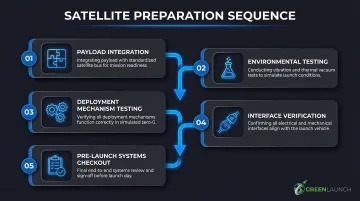
Preparation activities:
- Payload integration with standardized bus
- Environmental testing (vibration, thermal vacuum)
- Deployment mechanism functional testing
- Interface verification with launch vehicle
- Pre-launch systems checkout
Phase 2: Launch Vehicle Selection and Integration
Teams select a launch vehicle and manifest. Options include:
- Dedicated small satellite launchers for maximum schedule control
- Rideshare services on larger vehicles for cost efficiency
- Impulse-based launch systems for on-demand, rapid-turnaround deployment
Lead time, orbit altitude, inclination compatibility, and launch provider requirements must align with mission parameters. Rideshare manifests often book 6–18 months in advance, directly contradicting rapid deployment goals.
That 6–18 month rideshare window is where impulse-based systems offer a genuine contrast. Green Launch's light-gas propulsion technology uses hydrogen and oxygen propellant to deliver high-velocity, on-demand launch capability—achieving readiness in as little as 60–90 minutes between shots. At approximately $100 per pound to orbit, the system produces only water vapor as exhaust. For acceleration-tolerant payloads, it's a cost-effective and environmentally cleaner alternative to conventional rocket-based deployment.
Phase 3: On-Orbit Deployment and Commissioning
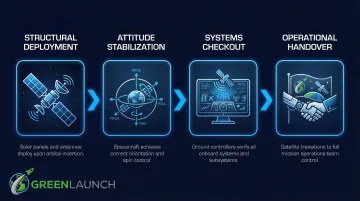
Upon separation from the launch vehicle, satellites execute pre-programmed deployment sequences:
- Structural deployment - Solar panels and antennas deploy using mechanical systems (springs, burn wires, shape memory alloys)
- Attitude stabilization - Control systems orient the spacecraft
- Systems checkout - Ground controllers verify system health
- Operational handover - Transition to mission operations
Critical risk factor: Deployment mechanism reliability is paramount. A failed solar panel or antenna deployment results in mission loss despite a successful launch. Robust design practices, pre-launch functional testing, and proven deployment approaches (burn wire restraints, torsion spring actuation) directly determine mission success.
Key Factors That Affect the Rapid Deployment Process
Launch Vehicle Lead Time and Availability
- Rideshare manifests book 6–18 months in advance
- Teams must secure flexible launch agreements or work with dedicated small launch providers offering shorter booking windows
- Some operators maintain launch-ready satellites on standby
Satellite Bus Standardization and Component Availability
- Fully standardized platforms with commercially available components compress integration timelines by weeks or months
- Custom designs introduce procurement delays, unique qualification requirements, and interface complexity that push out launch dates
Regulatory and Spectrum Clearance Timelines
- ITU frequency coordination, FCC or national regulatory approvals, and conjunction assessments won't move faster just because your schedule is aggressive
- Teams beginning regulatory processes late consistently miss target launch windows
Deployment Mechanism Reliability
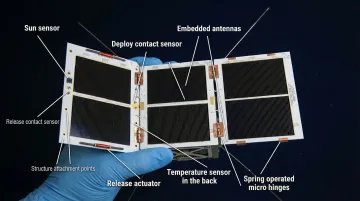
- Deployable structure failures (solar arrays, antennas, booms) rank among the most common causes of small satellite mission failures
- Robust design practices and selection of proven deployment approaches directly determine whether rapid deployment delivers a functioning asset
Cost and Sustainability Constraints
- Standardized platforms and rideshare services reduce per-satellite costs
- Hydrogen light-gas systems eliminate toxic propellants while cutting infrastructure costs — a practical advantage for programs requiring frequent launch cadence
Common Issues and Misconceptions About Small Satellite Rapid Deployment
Misconception: "Small Satellite" Equals "Simple Deployment"
Over 90% of CubeSat missions require deployable mechanical systems — and miniaturization creates its own set of failure risks that careful engineering must address regardless of schedule pressure:
- Mechanism jamming from thermal cycling or launch vibration
- Burn wire workmanship errors that prevent separation
- Insufficient torque margin leaving appendages partially deployed
Rushed testing is one of the most cited contributors to on-orbit deployment failures. Small does not mean forgiving.
Oversimplification: "Rapid Deployment" Always Means "Rideshare"
Rideshare is the default assumption when teams think "rapid deployment" — but it's not always the fastest path. Rideshare manifests lock in well in advance, offer limited orbit selection, and fill up quickly. A team needing a precise inclination or an urgent launch window may find a dedicated vehicle is the faster option. The right choice depends on orbit requirements and timeline, not on which mode sounds more agile.
Confusion Between Speed and Readiness
Speed-to-launch and readiness-to-launch are not the same thing. True rapid deployment compresses time to readiness through standardized designs, pre-qualified components, and parallel workstreams — not by skipping steps. Missions that skip environmental testing or deployment mechanism validation to hit a schedule tend to trade a few weeks of time savings for substantially higher mission risk on orbit.
Conclusion
Small satellite rapid deployment is a structured, multi-phase process that compresses satellite lifecycle timelines through standardization, proven deployment mechanisms, and flexible launch options—so organizations can reach on-orbit capability in months rather than years.
For aerospace and defense professionals, satellite manufacturers, and research organizations, rapid deployment is a discipline with real technical depth. Compressing a satellite program's timeline without sacrificing mission success means coordinating across several distinct planning areas:
- Mission design optimized for standardized form factors
- Regulatory coordination completed in parallel with hardware development
- Launch vehicle selection matched to orbit, cadence, and payload tolerance
- On-orbit deployment reliability validated before flight
Companies like Green Launch are expanding the launch options available at this scale, offering ground-based hydrogen light-gas propulsion as a cost-effective alternative for acceleration-tolerant small payloads. The more launch pathways that exist, the more realistic rapid deployment becomes for organizations working under constrained timelines and budgets.
Frequently Asked Questions
What is the difference between small satellite rapid deployment and standard satellite deployment?
Rapid deployment relies on standardized platforms, pre-qualified components, and flexible launch agreements to compress timelines from multi-year cycles to months. Standard deployment typically involves custom designs, bespoke launch contracts, and longer qualification programs.
How long does it typically take to rapidly deploy a small satellite?
Timelines vary by mission complexity. Missions using standardized CubeSat buses with COTS components and pre-booked rideshare can achieve launch readiness in 6-12 months from mission go-ahead. More complex microsatellite programs may take 18-24 months even under an accelerated model.
What launch vehicle options exist for small satellite rapid deployment?
Three main categories exist: dedicated small satellite launchers (such as Rocket Lab) offering schedule control, rideshare services on larger vehicles for cost efficiency, and emerging alternative launch technologies including light-gas propulsion systems (such as Green Launch's hydrogen impulse systems). Each offers different tradeoffs in cost, schedule flexibility, and orbit selection.
What are the most common causes of rapid deployment failure?
The most frequently cited causes include:
- On-orbit deployment mechanism failures (stuck solar panels, antenna non-deployment)
- Insufficient pre-launch testing driven by schedule pressure
- Regulatory delays that cause missions to miss their launch windows
Which satellite form factors are best suited for rapid deployment?
CubeSat standards (1U–16U) and standardized microsatellite buses in the 10–150 kg class are best suited because their modular, pre-qualified structures reduce design-to-launch timelines. Larger custom spacecraft require longer development cycles that undermine rapid deployment objectives.
What regulations govern small satellite rapid deployment?
Requirements vary by country but typically cover:
- Radio frequency coordination with the ITU
- National licensing (such as the FCC in the U.S.)
- Orbital debris mitigation compliance, including post-mission deorbit within 25 years for LEO
- Export control clearances for satellite components and ground systems in some cases