Introduction
The commercial space launch industry is growing fast. fast. The FAA recorded 148 licensed commercial operations in FY 2024 — a 900% increase from just 14 operations in FY 2015. By 2034, the FAA projects that annual launch activity could reach between 259 and 566 operations, averaging more than one launch every day. Yet as launch frequency accelerates globally, the environmental cost of this activity is coming under intense scrutiny. Each heavy kerosene-fueled launcher injects approximately 10 tons of black carbon into the stratosphere — particles that persist for years, absorb solar radiation, and contribute to ozone depletion.
For aerospace organizations, defense contractors, satellite manufacturers, and research institutions, choosing a launch provider is no longer purely a technical and cost decision. Sustainability credentials now directly affect regulatory approvals, stakeholder trust, and long-term mission viability. Launching a climate research satellite on a high-emissions vehicle creates a credibility problem that funders and the public increasingly notice.
Regulatory frameworks are tightening in parallel. The FAA requires Environmental Impact Statements before granting launch licenses, and future international agreements may impose hard emissions caps on stratospheric pollutants. Providers that can't demonstrate environmental accountability face growing compliance exposure.
That pressure puts decision-makers in a difficult position: sustainability claims from launch providers are proliferating, but the criteria for evaluating them are not always clear. This guide breaks down what actually separates credible green providers from those using environmental language as a marketing veneer.
Key Takeaways
- Sustainable space launch minimizes atmospheric emissions, propellant toxicity, orbital debris, and local environmental impact across the mission lifecycle
- Propellant chemistry drives the biggest environmental difference: hydrogen-oxygen combustion produces only water vapor, while kerosene releases black carbon that heats the stratosphere
- Evaluate providers on measurable criteria: propellant emissions profile, hardware reusability, regulatory documentation, and lifecycle transparency
- Require documented environmental assessments and emissions data, not just marketing claims
- Green Launch uses hydrogen-oxygen propulsion that produces only water vapor, with over 91% propellant capture and reuse
What is Sustainable Space Launch?
Sustainable space launch refers to launch systems that minimize environmental harm across the full mission lifecycle — from propellant production and storage through the ascent phase, payload delivery, hardware disposal, and ground operations — while remaining technically viable and commercially scalable. Reusing hardware is one piece of that picture. Stratospheric emissions, propellant chemistry, and ground operations are equally consequential.
Traditional launches carry an environmental cost that most organizations underestimate. Conventional vehicles burn kerosene-based fuels like RP-1 or solid propellants that produce black carbon (soot), chlorine compounds, aluminum oxide, and CO₂. Unlike surface or aviation emissions, these pollutants are injected directly into the stratosphere during ascent, where their atmospheric lifetime extends to years rather than months.
Black carbon deposited at 15–50 km altitude forms an "umbrella" layer that absorbs solar radiation and alters atmospheric dynamics. Its radiative forcing efficiency runs approximately 500 times greater per unit mass than surface emissions — a scale of impact that surface-level carbon accounting doesn't capture.
Types of Green Launch Approaches
Sustainable launch systems currently fall into three main categories, each with distinct environmental trade-offs:
Reusable liquid-fueled rockets using methane or hydrogen-oxygen propellants reduce hardware waste by recovering and reusing stages, but still produce emissions during combustion. Methane burns cleaner than kerosene but releases CO₂ and trace black carbon. These systems lower manufacturing energy per flight but don't eliminate atmospheric impact.
Hydrogen-oxygen propulsion systems combust to produce only water vapor, representing the current gold standard for atmospheric cleanliness. Water vapor injected into the stratosphere may contribute to polar stratospheric cloud formation, but causes less than 0.001% increase in optical depth — negligible compared to black carbon and reactive chlorine impacts from hydrocarbon and solid fuels.
Non-combustion launch methods such as light-gas gun technology eliminate in-flight combustion entirely during the ascent segment. These systems use ground-based impulse launchers to accelerate payloads to hypersonic velocities, then rely on small upper stages for orbital insertion. This approach minimizes propellant consumption and enables propellant capture and reuse.
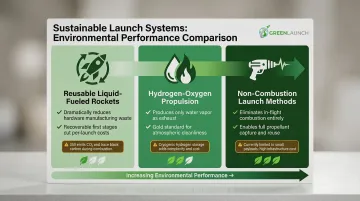
Visibility in the market doesn't track with environmental performance. Highly publicized reusable rocket programs frequently burn kerosene or methane. Hydrogen-based and impulse launch systems — less marketed, lower profile — often deliver a fraction of the atmospheric impact per mission.
Why Sustainability Matters in Launch Selection
Regulatory scrutiny is increasing, and the requirements are specific. The FAA's Office of Commercial Space Transportation already mandates Environmental Assessments or Environmental Impact Statements under NEPA before issuing launch licenses. The FAA analyzes 14 environmental categories — including noise, climate, and biological resources — for every commercial launch application. Organizations locked into high-emission providers today are taking on compliance risk as international frameworks follow suit.
For scientific missions studying climate, atmosphere, or ecology, the contradiction is direct: launching a climate-monitoring satellite on a vehicle that deposits tons of black carbon into the stratosphere undermines the research itself. Peer reviewers, funders, and the public are paying closer attention to how data is collected, not just what it shows. That scrutiny extends to the launch vehicle — and a credibility gap there is difficult to recover from.
What to Look for in a Green Launch Provider
Evaluating sustainability in a launch provider means examining specific, measurable criteria — not accepting branding at face value. The factors below connect technical specifications to real environmental outcomes, giving decision-makers a framework to separate genuine sustainability from marketing claims.
Propellant Type and Emissions Profile
Propellant chemistry is the single most consequential sustainability variable. The combustion byproducts determine the atmospheric impact of every launch:
| Propellant Type | Primary Combustion Byproducts | Stratospheric Impacts |
|---|---|---|
| RP-1/Kerosene | CO₂, H₂O, Black Carbon, NOx | BC heats stratosphere and alters circulation; NOx depletes ozone |
| Solid (APCP) | HCl, Al₂O₃, CO₂, H₂O, NOx, BC | Alumina catalyzes chlorine-activated ozone loss; HCl provides reactive chlorine |
| Liquid Methane | CO₂, H₂O, CO, NOx, BC | Emits BC (less than RP-1); contributes to radiative forcing |
| Hydrogen-Oxygen | H₂O, H₂, NOx | Water vapor contributes to high-altitude clouds; minimal ozone impact |
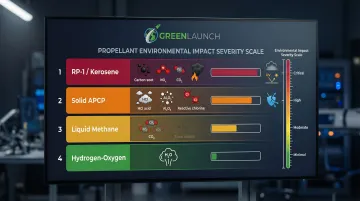
Kerosene combustion is particularly harmful. A heavy launcher using RP-1 can emit approximately 10 tons of black carbon per launch, with an emission index of 30-50 grams per kilogram of propellant burned during stratospheric flight. This soot persists for 4-5 years in the stratosphere and produces warming effects far exceeding those of CO₂ alone.
Solid propellants release hydrogen chloride and aluminum oxide particles that provide catalytic surfaces for chlorine activation, accelerating ozone-depleting reactions. Chlorine-induced ozone loss from solid rocket motors causes the bulk of gas-phase ozone depletion from rocket activity.
Hydrogen-oxygen combustion produces only water vapor, representing the cleanest atmospheric profile currently available at commercial scale. Green Launch uses this approach, combusting hydrogen and oxygen gas to produce water vapor as the sole byproduct — with no black carbon, no reactive chlorine, and zero CO₂ output.
KPI to track: Stratospheric black carbon deposition per launch, CO₂-equivalent emissions per kilogram of payload delivered, and whether the provider publicly discloses propellant formulation and combustion byproduct data.
Hardware Reusability and Debris Management
A truly green provider addresses what happens to launch hardware after the mission. Single-use expendable rockets create orbital debris and stage recovery footprints, while fully reusable systems reduce material waste and manufacturing energy per flight.
As of 2025, approximately 40,000 objects are tracked by space surveillance networks, of which only 11,000 are active payloads. There have been 656 confirmed on-orbit fragmentation events since the beginning of the space age, with inactive rocket bodies representing the largest share of environmental risk.
The Inter-Agency Space Debris Coordination Committee (IADC) guidelines require that spacecraft and orbital stages in Low Earth Orbit be removed or left in orbits that decay within 25 years, and that all on-board energy sources be passivated to minimize post-mission break-ups.
Light-gas gun and mass-driver approaches may eliminate expendable upper stages entirely for certain payload classes by imparting initial velocity from ground-based infrastructure, reducing the propellant and hardware needed for orbital insertion.
Questions to ask: Number of flights per hardware unit, stated reuse targets, debris mitigation compliance with IADC guidelines, and any active deorbit or stage recovery capability.
Launch Frequency and Cumulative Environmental Impact
A provider's per-launch emissions must be multiplied by their launch cadence. A provider with "clean" propellant but very high launch rates from a sensitive site may still produce outsized cumulative local and atmospheric impact.
Evaluate the provider's planned annual launch frequency and the cumulative footprint this creates at their designated launch site. High-cadence operations from coastal sites face particularly intense scrutiny due to impacts on marine ecosystems and protected habitats.
What to verify: Annual launch cadence, projected growth trajectory, and evidence of multi-mission environmental impact assessments — not just single-launch EIS filings.
Regulatory Compliance and Environmental Documentation
Legitimate green providers operate within a documented regulatory framework. In the United States, this means FAA launch licensing with completed Environmental Impact Statements or Environmental Assessments under NEPA. Under 14 CFR § 450.47, the FAA must comply with NEPA prior to issuing a commercial space license.
Request copies of:
- Current FAA launch licenses
- NEPA documentation (EA or EIS)
- State-level environmental permits associated with the launch site
- Any formal consultations with the National Marine Fisheries Service for coastal operations
Providers who resist sharing this documentation or who have unresolved FAA compliance issues represent both environmental and mission risk — a failed or delayed license renewal can strand your payload indefinitely.
Noise, Land Use, and Local Ecological Footprint
Launch operations produce intense acoustic events, vibration, exhaust plume deposition, and land use changes affecting local ecosystems, wildlife, and communities.
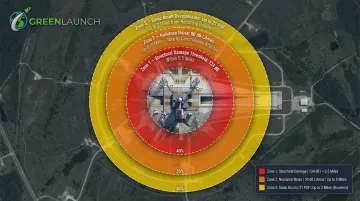
Acoustic impact thresholds vary significantly by vehicle size:
- Structural damage threshold: 134 dB Lmax (typically contained within 0.5 miles of the launch pad for heavy vehicles)
- Nuisance noise: 90 dB LAmax contours can extend up to 8 miles from the launch facility, potentially affecting nearby communities
- Sonic booms: Returning reusable boosters generate overpressures up to 21 pounds per square foot at 2 miles, risking window breakage
Coastal launch sites require formal consultation with the National Marine Fisheries Service to assess impacts on ESA-listed marine species and critical habitats. Launch noise greater than 80 dBA can cause temporary startle reactions in birds and mammals.
Due diligence checklist: Proximity of launch site to protected land or marine areas, decibel levels at specified distances, evidence of ongoing ecological monitoring programs, and any documented remediation of launch site contamination.
Transparency and Lifecycle Emissions Reporting
In the space industry, "clean" and "sustainable" appear frequently in marketing with no data behind them. Genuine lifecycle emissions accounting covers propellant production, transportation, storage, combustion, and hardware manufacturing — the full chain, not just the launch event.
A 2024 lifecycle assessment of reusable launch vehicles found that liquid hydrogen fleets have a 2-8 times lower carbon footprint than liquid methane fleets, driven by lower propellant consumption and the absence of black carbon emissions. An LCA of the Ariane 6 launcher revealed that the production and assembly phase accounts for almost 50% of all environmental impacts.
Academic critiques note that voluntary sustainability pledges in the space industry are often inconsistent, lack measurable ties to operational performance, and risk being greenwashing if not backed by standardized ESG reporting or regulatory baselines.
What to request: Lifecycle assessment (LCA) document or equivalent, a stated emissions disclosure policy, and whether the provider participates in any third-party verification program or industry sustainability working group.
How Green Launch Can Help
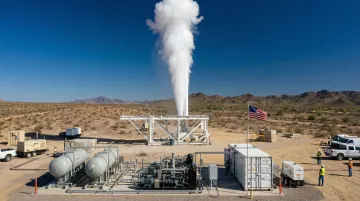
Green Launch is a provider built from the ground up around environmentally sound propulsion. The company's proprietary light-gas launch technology uses hydrogen and oxygen gas as the propellant, producing only water vapor upon combustion — one of the cleanest propellant profiles available in the commercial launch market.
Founded in 2017, Green Launch has validated this technology through multiple successful test campaigns at Yuma Proving Ground, including its first vertical light-gas launch for space access in 2022.
The technical foundation comes from Dr. John W. Hunter, who led the SHARP (Super High Altitude Research Project) at Lawrence Livermore National Laboratory from 1992–1998. That program set the world record for hydrogen impulse launcher performance, launching nine hypersonic scramjets at velocities up to Mach 9.
Those credentials translate into concrete sustainability differentiators:
- Water-only emissions: The hydrogen-oxygen system produces water vapor as the sole combustion byproduct, eliminating black carbon, CO₂, and reactive chlorine during ascent.
- 91%+ propellant capture efficiency: Demonstrated in testing, this enables hydrogen and oxygen recycling between launches — reducing both environmental impact and operational costs.
- Minimal upper-stage propellant: Ground-based impulse acceleration handles initial velocity, so only a small upper stage is needed for orbital insertion. First-stage rocket combustion is eliminated entirely.
- $100/lb to LEO target: High launch frequency (every 60–90 minutes at full capacity) is achievable without the cumulative emissions burden of traditional rocket systems.
- Board-level environmental oversight: Chairman Don Whitney is a licensed Professional Engineer and environmental consultant with 24+ years in air quality management, EPA compliance, and environmental permitting — institutional accountability built into the leadership structure.
To discuss payload requirements, mission profiles, and how these capabilities align with your organization's environmental and operational goals, contact Green Launch at eric.robinson@greenlaunch.space or visit greenlaunch.space.
Conclusion
Choosing a green launch provider requires scrutinizing propellant chemistry, hardware reuse, regulatory documentation, and lifecycle transparency — rather than accepting provider claims without verification. The right provider is the one whose environmental credentials hold up to the same due diligence applied to technical performance and price.
As launch frequency increases and regulatory scrutiny of space emissions intensifies, organizations that align with genuinely low-impact providers now will be better positioned for compliance and uninterrupted mission execution. The FAA forecasts launch activity may reach 566 operations annually by 2034 — nearly double the 2024 level — making cumulative atmospheric impact a critical concern for the industry.
Treat provider selection as an ongoing evaluation, not a fixed decision. Technology advances, regulations tighten, and provider capabilities shift — the organization that reassesses regularly is the one that stays ahead of both compliance requirements and mission risk.
Frequently Asked Questions
What makes a space launch provider genuinely "green" versus one that is just using green marketing language?
A genuinely green provider can document propellant chemistry and combustion byproducts, show completed Environmental Impact Assessments under FAA/NEPA requirements, and disclose lifecycle emissions data. Greenwashing relies on vague claims like "sustainable" or "eco-friendly" without supporting technical documentation, regulatory filings, or third-party verification.
How does hydrogen-oxygen propulsion compare to kerosene-based rocket fuel in terms of environmental impact?
Hydrogen-oxygen combustion produces only water vapor, while kerosene (RP-1) combustion produces CO₂, black carbon, and other particulates deposited directly into the stratosphere. Black carbon carries a radiative forcing effect roughly 500 times greater per unit mass than surface emissions, persists for 4-5 years in the stratosphere, and contributes to both ozone depletion and atmospheric heating.
What role does black carbon from rocket launches play in atmospheric damage?
Black carbon particles from hydrocarbon-burning rockets are injected into the stratosphere during ascent, where they absorb solar radiation, heat the atmosphere, and alter global circulation patterns. Unlike surface-level emissions, stratospheric black carbon cannot be captured or filtered after release — making prevention through propellant selection the only viable mitigation strategy.
Are there regulatory requirements for environmental compliance in commercial space launches?
Yes. In the United States, all commercial launch operators must obtain a launch license from the FAA's Office of Commercial Space Transportation, which requires an Environmental Assessment or Environmental Impact Statement under the National Environmental Policy Act (NEPA) before approval is granted. The FAA reviews 14 environmental impact categories for every license application.
Does launch site location affect the environmental impact of a mission?
Yes. Proximity to protected ecosystems, coastal or marine areas, populated zones, and sensitive wildlife habitats all affect the ecological footprint of launch operations. Acoustic impact, exhaust plume deposition, and land disturbance vary significantly by site and must be assessed during provider evaluation. Coastal sites require formal consultation with the National Marine Fisheries Service.
Can small satellite manufacturers or research organizations access sustainable launch options, or are they limited to high-emission rideshare services?
Sustainable options for smaller payloads are expanding — in 2024, 199 smallsats launched on micro or small launch vehicles. Hydrogen-fueled dedicated platforms and light-gas propulsion systems designed for cube-sat class payloads offer lower-emission alternatives to conventional rideshare. Organizations should evaluate total mission environmental impact, not just provider name recognition.