Green Launch offers a fundamentally different approach. Since 2017, the company has been developing a hydrogen impulse launcher—a large-scale light-gas cannon that accelerates ruggedized payloads to hypersonic velocities from the ground. The technology traces directly to the SHARP program at Lawrence Livermore National Laboratory, where Green Launch CTO Dr. John W. Hunter built the world's largest hydrogen gas gun and achieved Mach 9 velocities with multi-kilogram projectiles. After 12 successful horizontal test firings at Yuma Proving Ground in 2018 and a landmark vertical launch in December 2021, Green Launch has proven the system can deliver payloads to the stratosphere and beyond—with a reload cycle measured in minutes, not months.
Key Takeaways
- Green Launch accelerates payloads to hypersonic speeds using hydrogen gas expansion, reaching velocities up to Mach 9 with a ground-based cannon
- Reloading takes 60–90 minutes, enabling launch cadences that traditional rockets cannot match
- Hydrogen-oxygen propellant produces only water vapor, eliminating the 19+ tons of CO2 per launch typical of kerosene rockets
- 12 horizontal test firings in 2018 validated propulsion performance across a range of conditions
- The first vertical launch in 2021 reached 30 km altitude at Mach 3+
- Payloads experience extreme G-forces but commercial electronics survive with ruggedization techniques proven at 3,200 G
The Problem With Conventional Launch: A Bottleneck in Space Access
The Ideal Rocket Equation imposes structural limits on conventional launch economics. Achieving orbit requires approximately 9.4 km/s of delta-V, and the rocket's mass ratio—full mass divided by empty mass—must be high enough that the natural log of that ratio delivers sufficient velocity. The result: payload fractions of 1–4% for traditional rockets, with the remaining 96–99% devoted to propellant and structure.
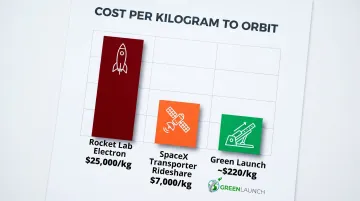
This mass penalty translates directly to cost. Rocket Lab's Electron charges approximately $25,000 per kilogram for dedicated launches; SpaceX Transporter rideshare missions cost $7,000/kg above a 50 kg base. Even at these prices, launch frequency remains the bottleneck—175 of 176 U.S. orbital launches in 2023 occurred at just three federally owned spaceports, and FAA Part 450 licensing adds months of regulatory delay to each mission.
The demand side has shifted dramatically. Satellite constellations, atmospheric researchers, and defense customers all need launch cadences that traditional rockets simply can't deliver—pad preparation, fueling, and range clearance alone span weeks or months per mission. Specific use cases where conventional systems fall short:
- Satellite constellation replenishment: Batch launches concentrate hundreds of satellites on a single vehicle, creating catastrophic single-point-of-failure risk
- Atmospheric research: Sequential sampling shots at different altitudes require multiple launches in tight succession
- Defense payloads: Same-day insertion windows don't accommodate month-long processing timelines
Other non-rocket approaches exist, but none solve the full problem. SpinLaunch relies on a centrifuge; railguns hit a practical ceiling around 3 km/s with heavy projectiles. Light-gas propulsion is the exception—muzzle velocities exceeding 6 km/s, scalability to orbital payloads, and decades of experimental data from programs like SHARP make it the only ground-based method with a credible path to orbit.
Inside the Hydrogen Impulse Launcher: How Green Launch's Technology Works
The Physics of Light-Gas Propulsion
Green Launch's hydrogen impulse launcher exploits a fundamental principle: the speed of sound in a gas is inversely proportional to the square root of its molecular weight. Hydrogen, with a molecular weight of 2, produces the highest speed of sound of any gas—and therefore the highest achievable muzzle velocity for projectiles accelerated by gas expansion. At a given temperature and pressure, hydrogen enables velocities roughly twice what helium can deliver and three times what gunpowder achieves.
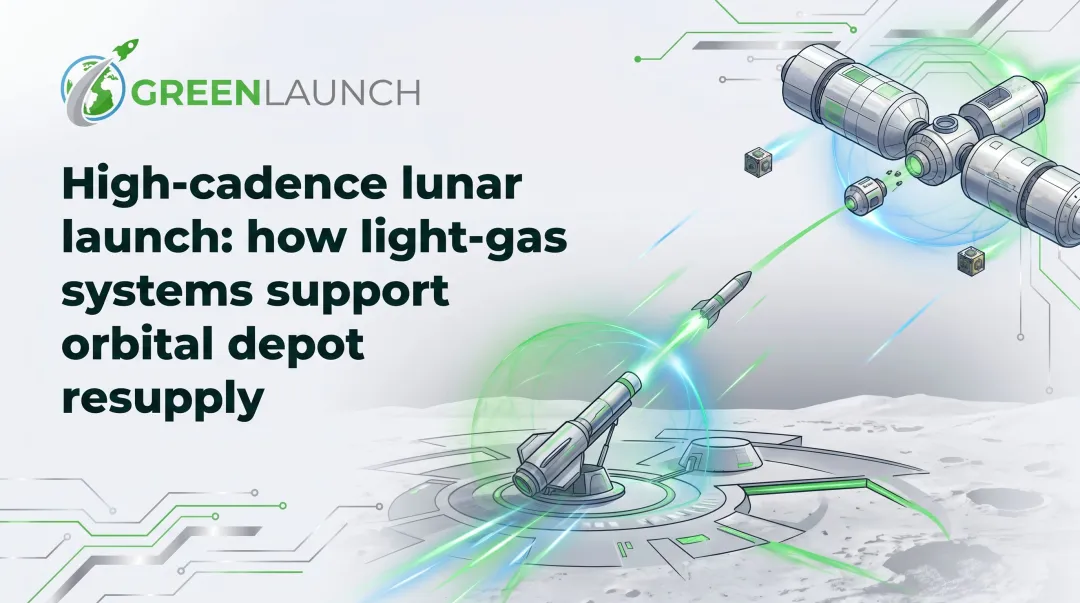
The system uses a long sealed tube in which rapid hydrogen-oxygen combustion generates extreme pressure that accelerates a projectile package down the barrel. Unlike chemical rockets that carry propellant aloft, the launcher remains on the ground, eliminating the mass penalty of lifting fuel tanks and engines.
SHARP Heritage: Proven at Lawrence Livermore
The technology draws directly from the SHARP program (Super High Altitude Research Project) developed by Dr. John W. Hunter at Lawrence Livermore National Laboratory from 1985 to 1995. Key system specifications:
- 82-meter pump tube and 47-meter, 10-cm caliber barrel
- Verified muzzle velocity of 3.1 km/s with 4.4 kg projectiles, surpassing electric railgun records
- First fully functioning hydrogen-burning scramjet launched at Mach 8
An earlier 3-meter prototype achieved 8 km/s. A small NASA gas gun reached 11 km/s in 1966 with sub-kilogram projectiles. Hunter's proposed Jules Verne Launcher, a scaled-up SHARP, projected payload delivery at 5% of typical U.S. rocket costs. The target: 1,000 metric tons to LEO annually, at one launch per day.
Two-Stage Launch Sequence
Green Launch's operational system uses a two-stage sequence:
- Hydrogen compression: A conventional propellant charge fires a piston down a pump tube, compressing hydrogen gas to extreme pressure.
- Payload acceleration: The piston halts at a high-pressure coupling, and the compressed hydrogen burst drives the payload package down the barrel into a ballistic trajectory.
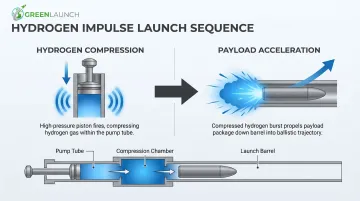
The muzzle velocity depends on the hydrogen temperature and pressure. Green Launch has demonstrated velocities up to 2.97 km/s (Mach 9) with their current system, with operational targets of up to 6 km/s (Mach 17.5) for orbital missions.
Surviving Extreme G-Forces
Peak acceleration forces reach approximately 30,000 G, requiring payload ruggedization. U.S. Army data puts this in context:
- Artillery-launched electronics routinely survive 15,000–20,000 G
- Tank cannon munitions endure up to 100,000 G
- Commercial off-the-shelf components can be hardened with potting compounds, aluminum wire bonds, and underfill on chip-scale packages
Green Launch demonstrated this capability in 1998 when the team built a test vehicle from consumer electronics—radio, GPS, TV camera, battery, and flexible solar cells—and repeatedly test-fired it at 3,200 G. All systems functioned properly after launch, proving that ruggedized COTS electronics can survive impulse launch environments.
Small Second-Stage Booster
After the ground-based launcher imparts its velocity, a small onboard rocket provides the final delta-V needed for orbital insertion. Because the launcher delivers roughly half the total delta-V required for orbit, this booster is dramatically smaller and lighter than a conventional rocket upper stage. Green Launch's payload fraction can reach 10–20%, compared to 1–4% for traditional rockets, a structural cost advantage that compounds across high-cadence operations.
The Yuma Proving Ground: Building a Track Record Shot by Shot
Securing Federal Testing Access
In April 2017, Green Launch signed a testing contract with Yuma Proving Ground (YPG), a U.S. Army facility north of Yuma, Arizona. The agreement provided access to a federally controlled, safety-monitored environment with existing infrastructure—bomb-proof shelters, range clearance protocols, ballistics expertise, and experienced test personnel. For a startup with limited resources, this partnership was transformative: YPG's facilities compressed timelines and reduced costs that would have been prohibitive at a commercial launch site.
The contract authorized Green Launch to use YPG's 7-inch by 55-foot gun tube and conduct a series of horizontal test firings designed to validate propulsion performance, barrel integrity, and payload survivability under hypersonic conditions.
12 Horizontal Test Firings: December 2017 – March 2018
Between December 2017 and March 2018, Green Launch completed 12 successful horizontal shots. Each test varied gas charge pressures, release peak pressures, vehicle weight, and resulting velocities to build a comprehensive dataset of system behavior. The team fired high-density plastic slugs through velocity traps into specially constructed catch boxes positioned in front of thick earthen berms.
In April 2018, Green Launch conducted four additional shots (designated 13–16) that achieved velocities up to 2 km/s—validating that the hydrogen propulsion system could reliably accelerate multi-kilogram projectiles to hypersonic speeds. These horizontal tests proved muzzle velocity capability, system repeatability, and the structural integrity of the launch tube under repeated firing cycles.
First Vertical Launch: December 21, 2021
The transition from horizontal to vertical firing is significant. Atmospheric penetration, trajectory stability, and projectile aerodynamics change fundamentally when firing upward. On December 21, 2021, Green Launch conducted its first vertical launch for space access using a 54-foot proof-of-concept launch tube aimed skyward.
The projectile—a 28-pound steel and tungsten vehicle—achieved a muzzle velocity exceeding Mach 3 and reached an estimated altitude of 30 kilometers (approximately 98,400 feet), well into the stratosphere. Radar did not capture the projectile, but the altitude result demonstrated the system's ability to penetrate the lower atmosphere and approach the boundary of space.
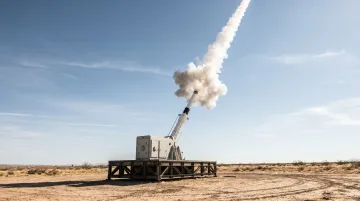
Green Launch described the shot as a "proof of concept impulse launch"—a result that validated trajectory stability, atmospheric penetration, and the system's readiness for higher-velocity attempts aimed at crossing the 100 km Kármán Line, the internationally recognized edge of space.
Why Yuma Matters
Those 16 horizontal shots and one vertical launch represent something no simulation can produce: real system behavior under real conditions. Yuma Proving Ground accelerated that development in ways a private test site could not. Established proving grounds offer:
- Existing safety infrastructure and regulatory familiarity
- Access to ballistic experts and range safety personnel
- Proximity to defense and research stakeholders
- Reduced timeline and cost for iterative testing
Each successful shot added to a dataset of propulsion performance, payload survivability, and system reusability that gives Green Launch a verifiable foundation for scaling toward orbital velocities. For a launch technology that departs so radically from rocket norms, that empirical record is what separates a working system from an engineering concept.
High-Cadence Launch: What a 60-to-90-Minute Turnaround Unlocks
Redefining Launch Frequency
High-cadence means the hydrogen impulse launcher can be recharged and fired approximately every 60–90 minutes. Traditional rocket timelines span weeks or months of pad preparation, fueling, and range clearance. Green Launch can deliver payloads to orbit in 5–10 minutes, reload, and fire again the same day—a capability the company describes as "the FedEx of space."
This frequency fundamentally changes what missions are possible:
- Rapid constellation replenishment: Replace a failed satellite node the same day, not the same quarter
- Sequential atmospheric sampling: Multiple shots at different altitudes within hours for climate or communications research
- Time-sensitive defense payloads: Same-day insertion for reconnaissance or emergency response
- Just-in-time logistics: Deliver supplies or components to orbit on demand, eliminating long lead times
Risk Distribution for Constellation Operators
Batch launches concentrate risk. When 200 satellites ride a single rocket, a launch failure is catastrophic. Three satellites were presumed lost in a SpaceX Transporter rideshare deployment malfunction in November 2023, illustrating the single-point-of-failure risk inherent in consolidated missions.
High-cadence launch inverts this risk model. Constellation operators can spread launches across dozens of Green Launch shots—each one a small, independent risk event. A single failure affects 1–2 satellites, not 200. This risk distribution becomes more attractive as constellation sizes grow and operators prioritize operational resilience over batch economics.
Environmental Advantage at Scale
Hydrogen-oxygen combustion produces water vapor, not carbon-based exhaust. Traditional RP1 and methane rockets release approximately 200–300 tonnes of CO2 per launch, with kerosene rockets producing roughly 19 tons of CO2 per ton of payload delivered to orbit. Solid-fuel boosters add chlorine gas and alumina particles to the exhaust stream.
NOAA estimates rockets emit approximately 1,000 tonnes of black carbon into the atmosphere annually. Black carbon particles from rockets are 500 times more efficient at warming the atmosphere than all other sources of soot combined — a figure that makes launch frequency an environmental variable, not just an operational one.
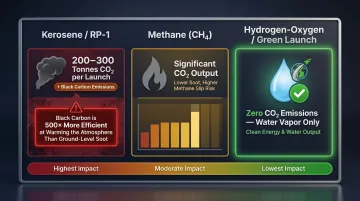
Green Launch removes the first-stage rocket entirely, replacing it with a ground-based system. Propellant capture technology runs at over 91% efficiency, meaning virtually nothing is released during suborbital launches. As regulators tighten sustainability requirements — ESA's Zero Debris Charter and the FCC's 5-year deorbit rule are already reshaping procurement decisions — high-cadence hydrogen launch becomes a compliance advantage, not just a technical one.
From Sub-Orbital to the Lunar Surface: Green Launch's Roadmap
Staged Development Path
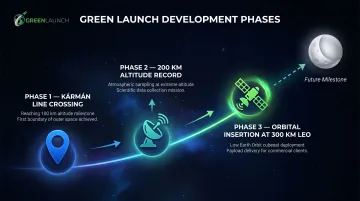
Green Launch has structured its development in three phases:
Phase 1: Karman Line Crossing (100 km) Demonstrate space access by launching payloads past the 100 km boundary. The December 2021 vertical launch reached 30 km; higher-velocity shots are planned to surpass the Kármán Line and validate atmospheric penetration dynamics.
Phase 2: 200 km Altitude Record Deliver sensor packages and atmospheric samplers to diagnose climate change and support communications research. This phase provides affordable, quick-turnaround access to the mesosphere and ionosphere—regions with extremely limited research access today.
Phase 3: Orbital Insertion (300 km LEO) Deliver cubesats and small payloads to low Earth orbit. The vehicle launches at 6 km/s, with an aeroshell nose ablating during ascent. At 100 km altitude, the aeroshell is discarded and a small onboard rocket motor burns for orbital insertion. This phase pioneers affordable payload delivery at scale, with plans to expand from 1-pound demonstrations to 100–1,000-pound payloads.
Why the Lunar Surface Makes Sense
The Moon has no atmosphere. Aerodynamic heating and drag—major constraints for Earth launch—disappear for lunar arrivals. The same high-velocity, low-recurring-cost profile that makes the system attractive for LEO becomes even more compelling for cislunar logistics (Earth-Moon supply chains).
The cost problem is stark. NASA targets monthly landing cadence by 2027–2028, requiring 2,000–6,000 kg of cargo per mission. Commercial CLPS providers currently quote approximately $1M–$1.5M per kilogram for lunar surface delivery — economics that cannot scale to the sustained presence Artemis demands.
Green Launch's approach addresses this directly:
- High launch cadence drives per-kilogram costs down as fixed infrastructure costs amortize across more missions
- Propellant capture technology enables reuse in a two-stage hydrogen system, with no expendable propellant hardware per shot
- On the Moon or Mars, where resupply is costly and slow, reusable propellant systems cut operational dependency significantly and support in-situ resource utilization (ISRU)
Institutional Partnerships: NSF Atmospheric Sampling
Green Launch references National Science Foundation engagement for mesospheric atmospheric sampling, validating the system for science-driven payloads. The company has designed lightweight fiberglass vehicles that are RF-transparent, allowing antennas to remain protected inside the vehicle body during hypersonic flight. This capability supports communication, navigation, and surveillance research—and NSF engagement gives the system a credible science validation record before it reaches orbital qualification.
Frequently Asked Questions
How does Green Launch work?
Green Launch uses a hydrogen impulse launcher—a large tube in which rapidly expanding hydrogen-oxygen gas accelerates a ruggedized payload to hypersonic speeds. A small onboard rocket provides the final orbital insertion burn after the ground-based launcher delivers most of the required velocity.
Is Green Launch safe?
Green Launch conducts testing at federally managed facilities like Yuma Proving Ground, which provide established safety protocols, range clearance, and monitoring infrastructure. The hydrogen-oxygen propellant burns cleanly, producing only water vapor without the explosive residue risks associated with solid-fuel rockets.
Can you use CO2 in green gas guns?
No. Green Launch's system relies on hydrogen because its extremely low molecular weight enables much higher achievable muzzle velocities than heavier gases like CO2. The speed of sound in a gas is inversely related to molecular weight: hydrogen delivers velocities roughly three times what CO2 can achieve.
What payloads can Green Launch deliver?
Green Launch delivers ruggedized small satellites, scientific instruments, and atmospheric sampling probes engineered to withstand high-G acceleration. Commercial off-the-shelf electronics have already survived test launches at 3,200 G, demonstrating that good mechanical design is sufficient for many components.
How does Green Launch's cost compare to traditional rocket launches?
Green Launch targets roughly $100 per pound (~$220/kg) for orbital delivery — compared to $7,000–$25,000/kg for conventional small satellite launches. Those savings come from eliminating expendable first-stage hardware and using hydrogen as a low-cost, recoverable propellant.
What is the maximum velocity Green Launch's system can achieve?
The SHARP heritage program demonstrated muzzle velocities up to Mach 9 (3.1 km/s) with multi-kilogram projectiles. Green Launch targets up to Mach 17.5 (6 km/s) for orbital missions, managing system reusability through propellant capture and tube inspection protocols refined across dozens of test shots.