The default assumption flowing through current planning documents is that chemical rockets should handle everything—Earth-to-moon cargo, surface-to-orbit transport, even inter-base movement. This isn't an engineering conclusion. It's institutional inertia.
The moon's physics—1/6 Earth's gravity, zero atmosphere, escape velocity 22 times less energy-intensive—make it one of the best environments in the solar system for non-rocket launch alternatives. Yet today's architectures treat the lunar surface as if it were just another launchpad in Florida, importing the same propellant-intensive logistics that make Earth access expensive and slow.
This letter challenges that default. Not because rockets are bad engineering, but because applying them to every segment of the lunar supply chain ignores better-suited alternatives that already exist, have been tested, and are waiting for institutional commitment.
Key Takeaways
- Chemical rocket dependence for all lunar logistics is a design choice, not a physics requirement
- Earth's rocket economics—high cost, low cadence, and the rocket equation's compounding mass-ratio penalties—worsen dramatically when transplanted to lunar supply chains
- The moon's low gravity and vacuum environment favor non-rocket launchers in ways impossible on Earth
- Decisions made between 2025 and 2027 will lock in lunar supply chain architectures for 30+ years
- Light-gas and electromagnetic launch systems have already demonstrated velocities exceeding the 2.4 km/s lunar escape threshold in ground-based testing
Earth's Rocket Problem: What We're Warning Against
Earth's rocket problem is the tyranny of the rocket equation: every kilogram of propellant you want to burn requires additional propellant to lift it, creating exponential mass penalties. This makes chemical rockets inherently expensive, infrequent, and ecologically costly at the scales a permanent base requires.
The numbers tell the story. NASA's Space Launch System costs $4.2 billion per Artemis launch, a figure senior officials told the Government Accountability Office makes the program "unaffordable" at current levels. Even next-generation systems face severe constraints: SpaceX's Starship HLS requires more than 10 tanker flights to refuel in low Earth orbit for a single lunar landing mission, with industry estimates ranging from 8 to 15 refuelings per sortie.
This problem compounds in lunar logistics. Every kilogram of propellant delivered to the moon first had to be lifted from Earth, meaning the rocket equation's penalties stack across multiple mission legs. Launch propellant from the lunar surface to orbit, and you're burning fuel that itself required fuel to deliver from Earth, each leg multiplying the cost of the last.
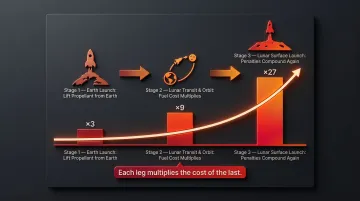
That mass penalty problem is inseparable from a cadence problem. NASA's $20 billion, seven-year lunar base plan targets two crewed landings per year plus up to 30 robotic missions starting in 2027. A self-sustaining base demands far more: dozens of reliable resupply missions annually.
Yet the entire planet managed just 259 orbital launch attempts in 2024. Lunar operations alone would consume a significant share of global launch capacity.
The institutional momentum is the hardest part. The same contractor ecosystems, political constituencies, and engineering cultures that produced SLS are designing lunar logistics. Those organizations default to familiar solutions. Chemical rockets are what they know how to build, how to certify, and how to write into a budget line.
The Moon Is a Clean Slate — Don't Waste It
When railroads were built, engineers didn't optimize horse-drawn cart axles—they designed for the new medium. Lunar infrastructure planners face the same choice: lock in chemical-propulsion assumptions now, and the budget for tomorrow pays for yesterday's constraints.
Importing the rocket problem looks like this in practice:
- Surface-to-orbit transport relying entirely on chemical landers
- Inter-base cargo movement using thruster-equipped hoppers
- Propellant production facilities optimized exclusively to feed rocket engines
- Landing pads, fuel depots, and logistics nodes designed around chemical propulsion
These choices compound over time. Infrastructure optimized for rockets makes switching to alternatives prohibitively expensive, exactly as fossil fuel infrastructure locked Earth into carbon dependency for over a century. Build propellant production to serve only chemical rockets, and you've eliminated the flexibility to feed electromagnetic launchers or gas-propulsion systems later.
The moon's environment enables what Earth cannot. No atmospheric drag means projectiles launched at escape velocity actually escape: no thermal protection, no ablative shielding, no staging required. Surface gravity of 1.62 m/s² means the energy to reach orbit is a fraction of Earth's requirement. Kinetic energy needed for lunar escape is approximately 2.83 MJ/kg versus Earth's 62.72 MJ/kg: a 22:1 ratio that makes ground-based launch systems far more competitive on the moon than they'll ever be here.
The geopolitical stakes are real. China's International Lunar Research Station program is advancing with 12+ partner nations targeting a basic south pole station by 2035. Both NASA and China are racing to establish infrastructure near permanently shadowed craters containing water ice.
The architecture locked in first will shape the economics and access patterns for cislunar space for decades. Building that foundation on the most propellant-intensive launch method available isn't a technical necessity — it's a choice, and one worth examining before the concrete is poured.
Why the Moon's Physics Favor Alternative Launch Systems
The physics case for electromagnetic or gas-driven mass launchers on the lunar surface is straightforward: with no atmosphere, a projectile accelerated along a track or through a barrel can reach orbital or escape velocity without drag losses, thermal protection, or onboard propellant.
Lunar escape velocity is 2.38 km/s compared to Earth's 11.2 km/s. Because kinetic energy scales with velocity squared, this means the moon requires roughly 22 times less energy per kilogram to launch material to escape velocity. Combined with zero atmospheric resistance, mechanical launchers become practical in ways impossible on Earth.
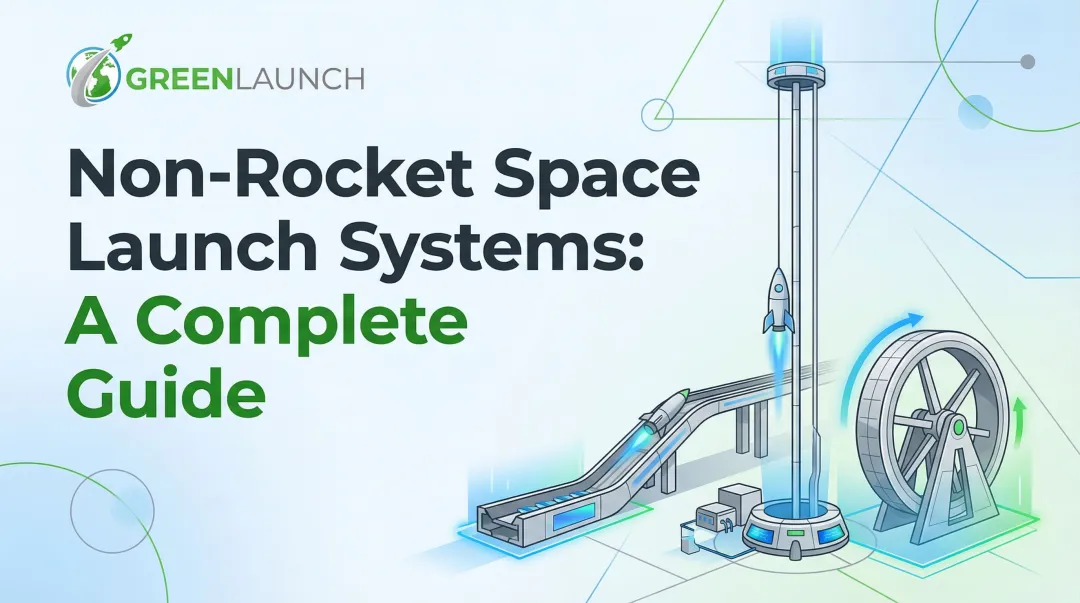
Three categories of non-rocket launch systems are technically credible for lunar applications:
- Electromagnetic rail/coil launchers (mass drivers): Use electromagnetic force to accelerate payloads along a track
- Light-gas guns: Use expanding low-molecular-weight gas (typically hydrogen) to accelerate projectiles through a barrel
- Pneumatic launcher concepts: Use compressed gas or mechanical energy storage
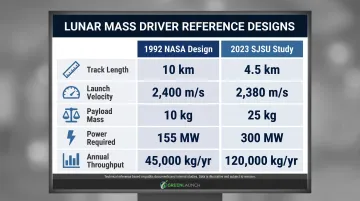
NASA has studied electromagnetic mass drivers since Gerard O'Neill's foundational work in 1974. The two most detailed reference designs show how far the concept has matured:
| Parameter | 1992 NASA Design | 2023 SJSU Study |
|---|---|---|
| Track length | 150 m | 495 m |
| Launch velocity | 1,700 m/s | 2,400 m/s |
| Payload mass | 1,000 kg (liquid oxygen) | 25.4 kg |
| Power required | 350 kW | 8.7 MW solar |
| Annual throughput | 4,400 tons | 100,000 metric tons (80% uptime) |
Payload suitability is frequently raised as a concern — and it's worth addressing directly. Non-rocket launchers excel at rugged cargo: processed regolith, raw materials, manufactured goods, water ice, liquid oxygen. Artillery shell electronics routinely survive 15,500g; bulk materials tolerate far more. The high-volume items in any realistic lunar export manifest are exactly these bulk materials, not fragile instruments. That alignment isn't incidental — it's the strongest argument for building this infrastructure from the start.
What Lunar Infrastructure Planners Should Do Differently
Three concrete requests for planners finalizing surface logistics architectures:
Require comparative analysis before committing. Demand side-by-side assessments of electromagnetic and gas-propulsion launchers alongside rockets for surface-to-orbit and inter-base cargo. Rockets should have to earn their place, not inherit it by default.
Fund demonstrator programs now, not later. Test lunar-appropriate launch technologies while costs are low and infrastructure commitments are still reversible. Once a base is operational, switching costs become insurmountable.
Build propellant infrastructure for optionality. Lunar water ice electrolysis produces hydrogen and oxygen — gases that can feed chemical rockets or light-gas launchers equally. Design production systems that preserve this flexibility rather than locking into one propulsion path from day one.
None of this requires betting on unproven architectures. NASA has decades of research documenting the feasibility of these systems. The barrier is institutional — specifically, the unwillingness to allocate planning resources before path dependencies calcify.
The Technology to Break the Cycle Already Exists
Ground-based high-velocity launch isn't theoretical. Light-gas gun and gas-propulsion systems have been developed and tested for hypersonic research and space access applications, achieving velocities that exceed lunar escape requirements—on Earth, where gravity and atmosphere make the problem far harder.
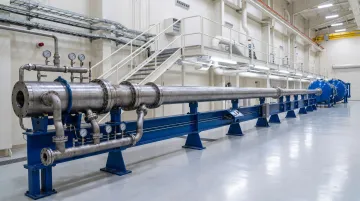
NASA's White Sands Test Facility operates two-stage light-gas guns achieving 27,500 feet per second (8.38 km/s)—more than triple lunar escape velocity—in just 24 feet of barrel. Lawrence Livermore National Laboratory's SHARP program, led by Dr. John Hunter, achieved 3 km/s with 5 kg projectiles using hydrogen gas, demonstrating Mach 8.8 velocities with a propellant producible from lunar water ice via electrolysis.
Green Launch's light-gas propulsion system—using hydrogen and oxygen—has achieved Mach 9-class velocities and completed vertical launch testing in 2022. It runs on the same physics that make NASA's White Sands guns work: hydrogen's low molecular weight enables extreme velocities that heavier gases simply cannot reach.
The moon's environment makes all of this easier, not harder. Earth-based systems must achieve 8+ km/s against atmospheric drag and thermal loading. On the moon, 2.4 km/s is sufficient, vacuum eliminates drag entirely, and no heat shielding is required on launch.
The question facing planners isn't whether the technology exists to build a non-rocket surface launcher on the moon—it does. The question is whether institutions will allocate even a fraction of planning budgets to evaluate it before baseline architectures get locked in.
The lunar resource base to support this infrastructure is already mapped. Three data points make the case:
- Chandrayaan-1 radar identified at least 600 million metric tons of water ice in polar craters
- LCROSS confirmed 5.6% ice concentration in Cabeus crater regolith
- Electrolysis systems to extract hydrogen and oxygen from that ice are at TRL 5 — NASA's IHOP-BAA project demonstrated 1.34 kg/hr water processing with 0.14 kg/hr hydrogen output
The infrastructure to support gas-propulsion launchers can be built from what's already on the moon. The technology has been proven on Earth. The physics favor lunar application at every step. What's missing is a line item — even a small one — in early planning budgets to formally evaluate surface launch as an alternative before rocket-only architectures become the default by inertia rather than by analysis.
Frequently Asked Questions
What are the alternatives to rockets?
The main categories of non-rocket launch include electromagnetic launchers (rail guns, coil guns, mass drivers), light-gas guns, and pneumatic systems. For near-term lunar applications, gas-propulsion and electromagnetic systems are the most mature technologies.
What does NASA use now instead of space shuttles?
NASA uses SpaceX's Falcon 9 and Crew Dragon for ISS crew transport, commercial cargo providers for resupply, and the Space Launch System for deep-space Artemis missions. None of these architectures translate well to routine lunar surface operations, which is precisely why infrastructure planners need different tools for the moon.
Why is the moon's environment better suited for non-rocket launch systems than Earth?
The moon's vacuum eliminates aerodynamic drag and heating entirely, while 1/6 gravity reduces the energy needed to reach escape velocity by a factor of 22. That means a surface launcher can achieve lunar escape velocity at around 2.4 km/s—achievable with today's light-gas and electromagnetic technology.
Can a lunar base be supplied without chemical rockets?
Earth-to-moon delivery will rely on rockets for the foreseeable future. However, surface-to-orbit and inter-base cargo transport on the moon are strong candidates for non-rocket alternatives, cutting the propellant and cost burden on the overall supply chain.
What is a light-gas launcher and how does it apply to the moon?
A light-gas launcher uses low-molecular-weight gas—typically hydrogen—to accelerate projectiles to hypersonic speeds. On Earth, atmospheric drag limits practical range; on the moon, that constraint disappears entirely. Low gravity and vacuum conditions make the approach more efficient than any Earth-based equivalent, and hydrogen can be extracted directly from lunar water ice, enabling a locally sustained launch system.