Introduction
Every kilogram of payload delivered to orbit today requires more than 20 kilograms of rocket fuel. That ratio drives launch costs into the millions and deposits tons of carbon emissions directly into the stratosphere. Chemical rockets, constrained by the Tsiolkovsky rocket equation, devote 95-99% of their mass to propellant rather than payload.
As satellite constellations expand and demand for frequent small-payload launches grows, this economic and environmental bottleneck has pushed engineers toward entirely different approaches: getting payloads to orbit without traditional rocket propulsion.
What follows covers the major non-rocket launch technologies currently in development, how they stack up on cost and capability, and which programs — including Green Launch's hydrogen-powered impulse launcher — are moving from concept to working systems.
Key Takeaways
- Non-rocket systems accelerate payloads using electromagnetic force, compressed gas, mechanical energy, or structural tethers, cutting fuel requirements and emissions significantly
- Leading approaches include light-gas guns, centrifugal accelerators (SpinLaunch), electromagnetic mass drivers, and mega-infrastructure concepts like launch loops
- Most systems subject payloads to extreme G-forces (10,000–60,000 Gs), restricting use to ruggedized cargo rather than crewed missions
- Green Launch achieved vertical space-access demonstrations in 2022 using hydrogen propulsion, producing only water vapor as exhaust
- Most near-term systems pair with a small upper-stage rocket for final orbit insertion — ground-based launch handles the heavy lift, the rocket handles the fine-tuning
Why Chemical Rockets Are No Longer the Only Option
The 4% Payload Problem
The ideal rocket equation sets a hard ceiling: a high-performance single-stage vehicle with a 95% propellant fraction and 400-second specific impulse reaches roughly 12,000 m/s terminal velocity with no payload at all. Factor in gravity losses, drag, and maneuvering, and that ceiling drops fast.
Real-world payload fractions collapse to just 0.2%–1.4% of gross takeoff mass for single-stage designs. Even multi-stage vehicles like Falcon 9 deliver only 1%–4.5% payload fraction — meaning 95–99% of launch mass is structure and propellant, not cargo.
The physics aren't the only constraint pushing the industry to look elsewhere.
Stratospheric Pollution at Scale
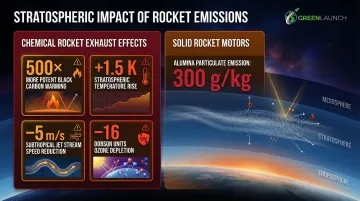
Unlike ground-based emissions, rocket exhaust injects pollutants directly into the stratosphere where they persist for years. A 2022 NOAA study found that black carbon (soot) from kerosene-fueled rockets produces radiative forcing 500 times more potent per unit mass than surface or aviation emissions. Modeling an annual emission rate of 10 Gg/year showed stratospheric temperatures rising by 1.5 K, subtropical jet speeds slowing 5 m/s, and northern hemisphere ozone depletion of 16 Dobson Units in some months. Solid rocket motors add alumina particulate at rates up to 300 g/kg of propellant.
The environmental toll compounds as launch frequency scales — and frequency is scaling fast.
Economic Pressure from Smallsat Growth
Launch costs have dropped sharply — from the Space Shuttle's $54,500/kg to Falcon 9's $2,720/kg and Falcon Heavy's $1,520/kg. Yet in 2024, nearly 2,800 smallsats (≤1,200 kg) were launched: 97% of all spacecraft and 81% of total upmass.
That volume exposes a mismatch. The smallsat market needs:
- Sub-$500/kg launch costs to make missions economically viable
- Daily or on-demand launch cadences for time-sensitive deployments
- Dedicated rideshare options that don't subordinate small payloads to larger manifest schedules
Non-rocket systems are being developed specifically to meet these constraints — not as supplements to chemical rockets, but as purpose-built alternatives for this segment.
The Major Categories of Non-Rocket Space Launch Systems
Non-rocket launch architectures fall into four operating principles: kinetic/mechanical launchers, electromagnetic systems, structural/tethered designs, and directed-energy concepts. Most near-term programs focus on the first two categories due to lower technical barriers and clearer paths to demonstration.
Kinetic and Ballistic Launchers
Light-Gas Guns
Light-gas guns replace gunpowder with low-molecular-weight gases—typically hydrogen or helium—because lighter molecules expand faster and reach higher exhaust velocities. Projectile velocity scales with the speed of sound in the propellant gas, making hydrogen the preferred choice.
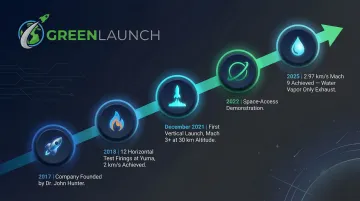
Lawrence Livermore National Laboratory's SHARP (Super High Altitude Research Project) demonstrated this at scale: a 155-foot, 4-inch diameter barrel launched scramjet test vehicles weighing 4.4–5.9 kg to velocities of 2.8–3.1 km/s. Green Launch, founded in 2017 by SHARP's former director Dr. John Hunter, builds directly on this heritage.
The company conducted 12 successful horizontal firings at Yuma Proving Ground in 2018, then achieved its first vertical launch on December 21, 2021—accelerating a 28-pound steel and tungsten projectile to Mach 3+ at an estimated 30 km altitude. By 2025, Green Launch demonstrated velocities of 2.97 km/s (Mach 9) using hydrogen-oxygen combustion, which produces only water vapor as exhaust.
Slingatron
HyperV Technologies' Slingatron gyrates its entire launch structure in a circular motion, building velocity through centripetal force as a projectile spirals outward through a curved track. The Mark II prototype accelerated a 227-gram steel block to 100 m/s. Scaling to orbital velocities would subject payloads to up to 60,000 Gs—requiring extraordinary ruggedization and limiting use to solid-state electronics or bulk materials like water and fuel.
SpinLaunch
SpinLaunch operates a 33-meter vacuum-sealed centrifuge at Spaceport America, New Mexico. A carbon-fiber tether spins payloads to approximately 5,000 mph (2.2 km/s) before releasing them through a launch tube. By September 2022, the company completed 10 suborbital test flights carrying NASA, Airbus, Cornell, and Outpost payloads.
SpinLaunch claims its system eliminates "over 70% of fuel and structures" compared to traditional rockets—though this figure comes from company marketing materials without independent verification. Peak acceleration exceeds 10,000 Gs, restricting payloads to ruggedized cargo. SpinLaunch targets orbital launches by 2026, requiring a small upper-stage rocket for final orbit circularization.
Electromagnetic Launchers
Railguns and Coilguns
Electromagnetic launchers use Lorentz force—the interaction between electric current and magnetic fields—to accelerate conducting projectiles along a track. Railguns pass high current through parallel rails and a sliding armature, generating force proportional to ½L'I² (where L' is inductance gradient and I is current). The U.S. Navy's 2010 demonstration achieved 33 megajoules, but sliding plasma contacts cause severe rail erosion—a persistent barrier for sustained launch operations.
Coilguns (induction launchers) avoid physical contact by using sequential electromagnetic coils to accelerate a magnetic projectile. They offer higher efficiency and better launch control but require massive pulse-power systems and high-voltage commutation at the speeds needed for orbital launch.
Launch Loop
Keith Lofstrom's Launch Loop concept stores energy in a continuously moving iron rotor belt at 80 km altitude, magnetically levitating above the atmosphere. Payloads are magnetically accelerated along the loop structure. Lofstrom's model estimates launch costs around $3/kg, assuming electricity at $0.12/kWh and massive throughput. Like StarTram, the $20+ billion infrastructure investment and unproven stability of an 80 km suspended structure place this firmly in the theoretical category.
Space Elevator
An Earth-based space elevator requires a tether extending from the surface to geostationary orbit (35,786 km) with specific strength of 30–80 megaYuri (roughly 50 GPa/(g/cm³)). Carbon nanotube theory supports this in principle, but current macroscopic CNT fibers reach only 4.2–14 GPa tensile strength—far below the defect-free performance required. That materials gap remains the fundamental barrier. Lunar and Martian elevators are more tractable, as lower gravity allows use of existing materials like Kevlar.
Directed Energy Systems
Of all the categories covered here, directed-energy systems remain the furthest from operational viability—though they clearly demonstrate the underlying physics. NASA's Lightcraft Technology Demonstrator tested laser propulsion at small scale, using a ground-based 10 kW CO₂ laser to heat air beneath a reflective vehicle. Spin-stabilized flights reached 4.3 m initially, later achieving 68 m. Microwave thermal propulsion operates on similar principles, with comparable development maturity.
Comparing Non-Rocket Systems: Payload, Cost, G-Forces, and Human Viability
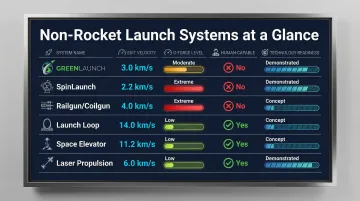
| System Type | Representative Example | Exit Velocity | G-Force on Payload | Human-Capable | Technology Readiness | Key Limitation |
|---|---|---|---|---|---|---|
| Light-gas gun | Green Launch, SHARP | 2.5-3.1 km/s | 30,000 G | No | Suborbital demonstrated | Atmospheric drag; requires upper stage |
| Centrifugal accelerator | SpinLaunch | ~2.2 km/s | 10,000 G | No | Suborbital flights completed | G-force limits payloads; needs upper stage |
| Railgun/coilgun | Military demos, proposed mass drivers | Variable | High (thousands) | No | Component-level only | Power delivery; rail erosion |
| Launch loop | Lofstrom concept | 8+ km/s | Low (~3 G) | Yes (theoretical) | Concept study | $20B+ infrastructure; stability unproven |
| Space elevator | Edwards/CNT design | Gradual climb | <1 G | Yes (theoretical) | Materials R&D | Material strength gap; decades from viability |
| Laser propulsion | NASA Lightcraft | <100 m/s (demos) | Variable | No | Lab-scale only | Power requirements; thermal management |
Three factors from this table drive most of the real-world trade-offs between systems: how many Gs the payload must survive, how much infrastructure the launch site requires, and how far short each system falls from orbital velocity. The following sections break down each.
G-Forces: The Payload Gatekeeper
Kinetic and electromagnetic launchers impose accelerations far beyond human tolerance. NASA standards limit sustained crew acceleration to approximately 2-5 Gs standing or 7-9 Gs seated for healthy subjects. In contrast:
- Green Launch: 30,000 Gs (commercial electronics survive with minor modifications)
- SpinLaunch: 10,000 Gs
- Slingatron (orbital scaling): 60,000 Gs
These forces restrict kinetic launchers to ruggedized solid-state satellites, bulk materials (propellant, water, shielding), and hardened scientific instruments. Only gradual-acceleration concepts like launch loops and space elevators remain viable for human passengers — and both exist only on paper.
Infrastructure vs. Per-Launch Cost Trade-Off
Systems divide sharply by capital requirements:
Launch loops and StarTram sit at one extreme — $20+ billion upfront, but projected marginal costs of $3/kg and $43/kg respectively at scale. The economics only work with massive, sustained throughput, making them best suited for bulk cargo resupply, propellant delivery, and high-volume constellation builds. Neither has been built, so those numbers remain theoretical.
Light-gas guns and SpinLaunch require tens to hundreds of millions in infrastructure — still substantial, but within the range of venture-backed aerospace programs. Green Launch targets ~$220/kg ($100/lb); SpinLaunch has not disclosed detailed pricing. Both systems suit small satellite launch, hypersonic testing, and rapid-cadence missions where G-force-tolerant payloads are the norm.
The Orbital Velocity Gap
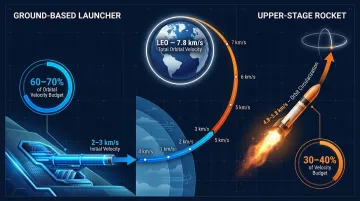
Most non-rocket systems provide only a fraction of the 7.8 km/s horizontal velocity needed for low Earth orbit. Even systems reaching 3 km/s exit velocity deliver payloads on suborbital trajectories. The "last mile" problem requires a small upper-stage rocket or electric thruster to:
- Circularize the orbit after atmospheric exit
- Provide final velocity increment
- Perform orbital maneuvering
That upper stage is still a fraction of a conventional rocket's size. By handling 60-70% of the velocity budget on the ground, these systems eliminate the first-stage booster that consumes 80-90% of a traditional rocket's propellant — which is where most of the cost lives.
Advantages and Limitations of Non-Rocket Launch
Advantages
Cost Reduction Potential
Eliminating the need to lift and combust massive propellant loads promises cost reductions of 10-100×.
Falcon Heavy's $1,520/kg represents the current commercial benchmark. Green Launch targets $220/kg ($100/lb) for orbital delivery using a hydrogen-gas first stage, while theoretical systems like the launch loop model $3/kg at scale. Even accounting for upper-stage rocket costs, non-rocket systems targeting the smallsat market could enable launches at costs previously impossible.
Environmental Benefits
Electrically powered systems (electromagnetic launchers, launch loops) can draw from renewable grids, producing zero exhaust at altitude. Green Launch's hydrogen-oxygen combustion produces only water vapor — traditional rockets emit 19+ tons of CO₂ per ton of payload by comparison. As constellations scale to thousands of satellites, avoiding stratospheric carbon and alumina deposition (aluminum oxide particles) becomes critical for atmospheric protection.
Operational Cadence
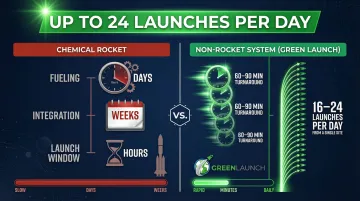
Unlike rockets requiring extensive processing, fueling, and integration between launches, non-rocket systems can fire repeatedly from the same installation. Green Launch has demonstrated launch cadence of every 60-90 minutes — 16-24 launches per day from a single site. That throughput supports rapid constellation deployment, time-sensitive cargo delivery, and on-demand ISS resupply at scales chemical rockets cannot match economically.
Limitations
These advantages come with real engineering constraints. Most are solvable — but they define which payloads and architectures are viable today versus longer-term.
Atmospheric Drag and Heating
Projectiles launched at 2-3 km/s through sea-level atmosphere experience enormous aerodynamic heating and drag losses.
Solutions under development include:
- Evacuated launch tubes (SpinLaunch's vacuum chamber)
- High-altitude launch sites (reducing atmospheric density)
- Ablative aerodynamic shrouds
- Vertical launch profiles to minimize time in dense atmosphere
The drag problem limits direct-to-orbit viability for most ground-based systems without upper-stage rockets.
Payload Survivability
Ruggedizing electronics and structures to survive 10,000-60,000 Gs adds mass and cost. Green Launch has demonstrated that commercial smartphone-grade electronics can withstand 30,000 Gs with minor modifications. Optical systems, large antennas, and delicate instruments remain unsuitable for kinetic launch.
Early applications will focus on:
- Solid-state cubesats
- Bulk propellant and water for orbital depots
- Radiation shielding materials
- Ruggedized scientific instruments
Real-World Projects and Current Developments
Green Launch's Hydrogen Impulse Launcher
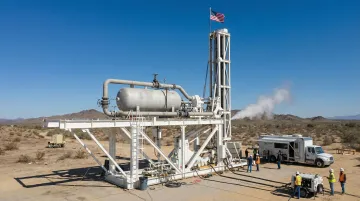
Founded in 2017 and led by Dr. John Hunter—former director of Lawrence Livermore's SHARP light-gas gun program—Green Launch has advanced hydrogen propulsion from laboratory concept to operational demonstrations. The company conducted 12 horizontal test firings at Yuma Proving Ground in 2018, achieving speeds up to 2 km/s using a 54-foot launch tube.
On December 21, 2021, Green Launch achieved its first vertical launch for space access, accelerating a 28-pound projectile to Mach 3+ and an estimated 30 km altitude. By 2025, the system reached 2.97 km/s (Mach 9) using a one-stage hydrogen-oxygen combustion system.
The hydrogen-oxygen reaction produces only water vapor as exhaust, and Green Launch's propellant capture technology recovers over 91% of the hydrogen for reuse—making suborbital launches virtually emission-free.
Key commercial and operational facts:
- Targets cubesat delivery to low Earth orbit at $100/lb
- Multiple customer contracts signed for suborbital atmospheric sampling missions
- Testing agreement in place with the U.S. Army at Yuma Proving Ground
- Launch cadence of 60-90 minutes between shots supports rapid-turnaround missions impractical for traditional rockets
SpinLaunch's Suborbital Accelerator
SpinLaunch operates a 33-meter centrifuge at Spaceport America, New Mexico, and has completed 10 suborbital test flights as of September 2022, carrying payloads from NASA, Airbus, Cornell University, and Outpost. The vacuum-sealed chamber spins payloads to approximately 5,000 mph before release through a launch tube. NASA signed a test-flight agreement to evaluate the system for smallsat launch applications.
G-force limitations (10,000+ Gs) restrict SpinLaunch to cargo-only missions. The company states it is on target for orbital launches by 2026, which will require a small upper-stage rocket for final orbit circularization. Cost projections and detailed performance data remain proprietary.
Other Programs and Lunar Applications
Where SpinLaunch and Green Launch have hardware flying, other concepts are still on paper. StarTram and Launch Loop remain in the study phase, with no funded construction programs. DARPA, ESA, and other agencies conduct periodic feasibility research into electromagnetic launch, but no large-scale demonstrators have been built.
Lunar and asteroid surface launch applications offer a more tractable starting point. Without atmosphere, electromagnetic mass drivers can accelerate payloads directly to escape velocity without aerodynamic heating. NASA and other space agencies have studied lunar mass drivers for delivering raw materials from the Moon to orbital construction sites—an application that could reach operational status well before any Earth-based equivalent.
Frequently Asked Questions
How can you launch into space without rockets?
Non-rocket systems use alternative acceleration mechanisms: electromagnetic force (railguns, mass drivers), compressed light gases (hydrogen guns), mechanical kinetic energy (centrifuges), or structural tethers (space elevators). These mechanisms push payloads to the velocities needed for space access. Most systems still require a small upper-stage thruster to circularize orbits after atmospheric exit.
Has an SSTO ever been built?
No fully operational Single Stage to Orbit vehicle has reached orbit. Experimental programs like the DC-X demonstrated key technologies, but the rocket equation's mass-fraction challenge has blocked production SSTO vehicles. Non-rocket systems could change that by pre-accelerating vehicles to 2-3 km/s before onboard propulsion ignites.
What are the main types of non-rocket space launch systems?
The four major categories are: kinetic/ballistic (light-gas guns, Slingatron, SpinLaunch), electromagnetic (railguns, coilguns, StarTram), structural/tethered (space elevators, launch loops), and directed energy (laser and microwave propulsion). Kinetic and electromagnetic systems are nearest to operational deployment.
Can non-rocket launch systems carry humans into space?
Current non-rocket systems generate G-forces far beyond human tolerance, ranging from 10,000 to 60,000 Gs versus the 7-9 G maximum humans can withstand. Launch loops and space elevators are designed with gradual acceleration suitable for passengers, but neither has been built or funded at scale.
What is a light-gas gun and how does it work for space launch?
A light-gas gun propels projectiles using rapidly expanding hydrogen gas instead of chemical combustion. Because light molecules expand faster than combustion products, the system achieves higher velocities — Green Launch reached 2.97 km/s (Mach 9) using hydrogen-oxygen propulsion, with water vapor as the only exhaust.
Are non-rocket space launch systems more environmentally friendly than rockets?
Yes. Electrically powered systems produce no direct exhaust, and hydrogen-propellant systems like Green Launch's emit only water vapor instead of CO₂ or alumina. By comparison, traditional rockets emit 19+ tons of CO₂ per ton of payload, with stratospheric soot generating 500× the warming effect of surface-level emissions.