Introduction
Launch frequency is rising fast. In 2024, 259 orbital launches occurred — roughly one every 34 hours — with commercial providers accounting for 70% of missions and small satellites making up 97% of all spacecraft launched.
Regulatory scrutiny is keeping pace. Environmental compliance now applies at every major licensing authority:
- UK Civil Aviation Authority requires environmental assessments for all launch applications
- ESA released updated Life Cycle Assessment guidelines in 2026 addressing atmospheric emissions
- FAA mandates environmental impact statements covering air quality and hazardous materials for every U.S. launch license
That pressure lands squarely on satellite manufacturers and defense customers. Most "sustainable" launch solutions focus on reusable hardware or greener fuels — but they overlook the single largest source of waste in a launch cycle: propellant that is consumed and gone forever. Conventional rockets, even reusable ones, expend 100% of their propellant per flight. Every mission starts the cost and emissions calculation from scratch.
Propellant recycling is the structural difference that sets Green Launch's Impulse Launch apart. By capturing approximately 91% of hydrogen after each launch and producing only water vapor as a byproduct, Impulse Launch breaks the link between launch frequency and environmental cost. No combustion rocket does that.
Key Takeaways
- Impulse Launch recovers 91% of hydrogen propellant after each launch—treating fuel as reusable infrastructure, not expendable cost
- Water vapor is the only byproduct, eliminating black carbon, ozone-depleting chlorine, and nitrogen oxides
- Per-launch propellant costs shrink as launch cadence increases, bending the cost curve downward over time
- Hydrogen is producible from water via electrolysis, eliminating supply chain risks tied to exotic or toxic propellants
- For G-force-tolerant payloads like CubeSats, fuel depots, and raw materials, Impulse Launch is where sustainability and cost efficiency reinforce each other
What Is Impulse Launch?
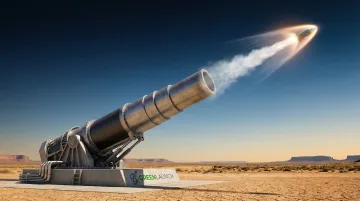
Impulse Launch is a light-gas gun system that uses hydrogen as a working gas—not a combusted and discarded fuel—to accelerate payloads to hypersonic velocities. It replaces the first and second stages of conventional rockets, eliminating the hardware that accounts for the majority of traditional launch vehicle mass and expense.
Unlike conventional rockets, this system does not rely on combustion. Hydrogen acts as the propellant medium, expanding to generate thrust. The payload is inserted into orbit via a solid rocket motor after the gun provides the bulk of velocity—approximately 6 km/s—minimizing atmospheric drag and enabling efficient orbital circularization.
Impulse Launch is optimized for high G-force-tolerant cargo. Modern electronics can withstand 30,000 Gs with minor modifications, making the following payload types ideal candidates:
- CubeSats and compact satellites
- Propellant loads and raw materials
- Ruggedized instrumentation and supply modules
The system does not support crewed vehicles or fragile electronics requiring gentle acceleration profiles.
Propellant recycling is what makes this architecture genuinely sustainable. Green Launch has demonstrated the capture of over 91% of hydrogen per launch. The gas is recaptured, purified, and reintroduced into the system—making propellant a reusable resource rather than an expendable one. This architecture was developed under the technical leadership of Dr. John Hunter, who directed the SHARP program at Lawrence Livermore National Laboratory, where he built the world's largest hydrogen impulse launcher and set velocity records that remain unmatched.
Key Advantages of Propellant Recycling in Impulse Launch
The three advantages below map directly to operational and financial outcomes that aerospace procurement teams, satellite operators, and mission planners track. Each is grounded in demonstrated performance, not theoretical environmental claims.
Advantage 1: Compounding Cost Reduction Per Launch
In traditional rocket systems, propellant cost is a negligible driver of total launch expense. Fuel and oxidizer combined cost approximately $10/kg, representing just 0.2-0.5% of total launch costs. The real costs come from expendable hardware manufacturing and launch operations. Rocket Lab's Electron, for example, reported a $7.8 million revenue value per launch in 2024.
When propellant is consumed and lost on every mission, the cost structure is fixed per flight. Impulse Launch's 91% hydrogen recovery shifts the model from consumables-per-flight to reusable infrastructure.
How the recycling loop works in practice:
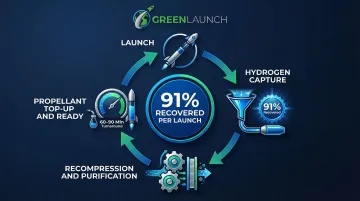
After each launch, hydrogen is captured before it can escape into the atmosphere. Water vapor—the combustion byproduct of the small fraction that does escape—is the only loss. The recovered gas is recompressed and reintroduced, meaning propellant replenishment per launch is a marginal top-up, not a full reload. Green Launch's eventual design targets 95% recapture using a solar-heated steam piston, reducing operational costs per mission further as the system matures.
Cost structure implications:
- For constellation operators launching tens or hundreds of CubeSats per year, propellant recycling bends the cost curve downward with volume rather than scaling linearly. Each launch builds on the last.
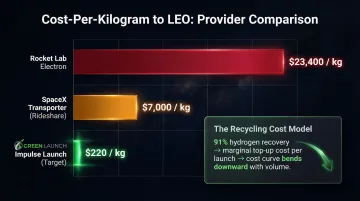
- Impulse Launch removes first- and second-stage mass, construction, and fuel costs entirely. Rocket Lab Electron charges approximately $23,400/kg; dedicated smallsat launches run 3-4x more per kilogram than rideshare. Green Launch targets $220/kg ($100/lb) by combining hardware elimination with propellant recycling.
- SpaceX's Transporter rideshare charges $7,000/kg but locks operators into fixed manifest schedules. The recycling model enables dedicated launch at comparable cost with on-demand timing.
KPIs impacted:
- Cost per kilogram to LEO
- Total mission cost
- Launch frequency economics
- Break-even payload volume
When this advantage matters most:
High-cadence small satellite operators, government programs with recurring payload delivery requirements, and constellation deployments where per-launch cost must decrease as the program scales.
Advantage 2: Near-Zero Atmospheric Emissions Profile
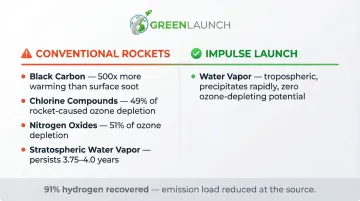
The environmental cost of traditional rocket launches extends far beyond CO₂. Black carbon deposited directly into the stratosphere, chlorine compounds from solid rocket motors, and nitrogen oxide byproducts all carry disproportionate atmospheric impact relative to ground-level emissions.
Stratospheric black carbon from rockets is approximately 500 times more effective at warming the atmosphere than surface soot, generating 8 mW/m² of radiative forcing. Current stratospheric emissions sit at roughly 1,000 metric tonnes annually. If launch rates hold their current trajectory, linear growth projections suggest this could reach 10,000 metric tonnes within two decades.
Solid rocket motors emit alumina particles and gaseous chlorine. Chlorine from solid fuel rockets accounts for approximately 49% of stratospheric ozone decline caused by contemporary rockets, with alumina particles enhancing chlorine-activated ozone loss through heterogeneous chemistry.
Nitrogen oxides from re-entry heating account for 51% of ozone decline associated with contemporary spaceflight.
Impulse Launch produces water vapor as its only direct exhaust—a byproduct with no ozone-depleting potential and negligible radiative forcing at the altitudes involved. Unlike rockets that inject water vapor directly into the stratosphere (where it can remain for 3.75 to 4.0 years, as demonstrated by the Hunga Tonga volcanic injection), Impulse Launch releases vapor in the troposphere, where it precipitates out rapidly without impacting stratospheric ozone.
How propellant recycling reduces total emission load:
Because 91% of hydrogen never combusts or escapes, the total atmospheric discharge per mission is a fraction of what systems burning full propellant loads produce. The recycling loop reduces emission load at the source, not just at the exhaust chemistry level.
Why emissions matter to procurement decisions:
- A 2022 study in Earth's Future modeled sustained 5.6% annual growth in rocket launches and found it would produce 0.15% upper stratospheric ozone depletion in Arctic springtime. Space tourism could push that to 0.24%, eroding the recovery the Montreal Protocol achieved. Impulse Launch's near-zero black carbon, chlorine, and NOx output removes this risk from the equation.
- NASA, ESA, and multiple national governments now require environmental impact assessments as part of launch licensing. A system whose sole emission is water vapor carries materially lower compliance burden than one emitting NOx, soot, or chlorine compounds.
- Commercial satellite operators and government procurement offices increasingly apply ESG frameworks. A verifiable near-zero emissions profile is a procurement differentiator with measurable regulatory and reputational value.
KPIs impacted:
- Regulatory compliance cost
- Environmental impact score
- ESG rating for mission operators
- Atmospheric emission load per kilogram delivered to orbit
When this advantage matters most:
High-frequency launch programs where cumulative emissions would otherwise be significant; missions serving ESG-sensitive investors or government sustainability mandates; customers operating near environmentally sensitive launch regions.
Advantage 3: Operational Simplicity and On-Demand Launch Access
Traditional propellants—particularly hypergolic fuels like hydrazine—require Self-Contained Atmospheric Protective Ensemble (SCAPE) suits, strict exclusion zones, specialized storage, and lengthy ground processing times.
The regulatory burden reflects the hazard. The EPA Risk Management Program sets the threshold quantity for hydrazine at 15,000 lbs with a 50 ppm IDLH concentration. NASA-STD-8719.24 mandates Category I SCAPE suits for propellant flow and pressurization, with a maximum 110-minute operating window and a mandatory 60-minute rest period between consecutive operations.
Hydrogen used in Impulse Launch requires no such toxic handling protocols. It is a well-understood industrial gas with established commercial supply infrastructure. The system can launch every 60 to 90 minutes, enabling rapid successive missions with minimal turnaround time.
How propellant recycling reinforces operational simplicity:
Because the same hydrogen is reused across missions, the resupply chain is minimal and predictable. Launch preparation shrinks when propellant loading is a top-up rather than a full hazardous material operation. Green Launch has successfully completed multiple shots per day during test series at Yuma Proving Ground, validating the 60-90 minute turnaround interval.
Operational advantages for mission planners:
- Hydrogen is producible from water via electrolysis using renewable power. Supply chain disruptions from geopolitical or regulatory factors affecting exotic propellant sources are not a factor — a meaningful reduction in launch schedule risk.
- The U.S. Space Force's Victus Nox mission demonstrated a 27-hour satellite-to-launch timeline. Impulse Launch's 60-90 minute turnaround enables tactically responsive space access that conventional rockets cannot match.
- Traditional small satellite launch timelines are heavily consumed by propellant fueling, safety protocols, and ground processing. Non-toxic working gas and a simplified resupply chain enable just-in-time scheduling that constellation operators increasingly require.
KPIs impacted:
- Launch lead time
- Ground processing hours
- Turnaround time between launches
- Propellant supply chain risk exposure
When this advantage matters most:
Defense and national security payloads requiring rapid reconstitution, constellation operators with tight deployment windows, and scientific missions where launch timing is driven by orbital mechanics rather than provider availability.
What Happens When Propellant Recycling Is Missing or Ignored
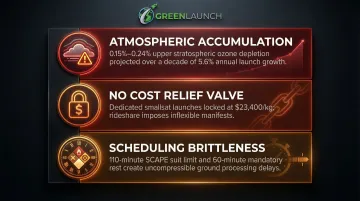
The baseline consequence of not recycling propellant is clear: every launch requires a full reload of consumable propellant, meaning cost scales linearly with frequency. There is no operational learning curve or volume discount built into the physics of the system. That cost pressure compounds in three specific ways as launch frequency grows:
- Atmospheric load accumulates with every launch. A decade of sustained 5.6% annual growth without emissions mitigation could reduce upper stratospheric ozone by 0.15% — rising to 0.24% with high-frequency commercial launch activity. That reverses ozone recovery achieved under the Montreal Protocol and increases regulatory exposure for operators.
- Cost pressure has no structural release valve. Without a recycling architecture, operators can negotiate payload integration or insurance terms, but they cannot reduce the fundamental per-launch propellant expenditure. Dedicated smallsat launches remain locked at $23,400/kg; rideshare options impose inflexible manifest schedules.
- Toxic propellant dependencies create scheduling brittleness. Delays in hydrazine delivery or shifts in hazardous materials regulations translate into launch delays and mission cost overruns. The 110-minute SCAPE suit operating limit and mandatory 60-minute rest periods between operations create hard scheduling constraints operators cannot compress.
How to Get the Most Value from Impulse Launch
Impulse Launch's propellant recycling advantages matter most when payload and mission profile are matched to the system's strengths: high G-force-tolerant cargo, recurring launch cadence, and operators who benefit from predictable, low per-unit costs.
The most immediate value goes to operators whose payloads—CubeSats, fuel canisters, structural components, raw materials destined for orbital assembly—can tolerate high acceleration profiles. Modern electronics can withstand 30,000 Gs with minor modifications, making compact satellites and supply modules natural candidates. The propellant recycling cost benefit grows directly with launch frequency.
Engaging Green Launch early in mission architecture ensures that G-force tolerances, scheduling cadence, and orbital insertion needs are defined before hardware is committed elsewhere. That early alignment avoids costly redesign downstream.
The National Science Foundation is a near-term customer for mesosphere atmospheric sampling — a concrete example of how diverse mission types integrate with the system without modification to the core launch infrastructure.
Different operator types capture the value differently:
- Constellation operators see per-launch costs decrease with volume, rather than scaling linearly as contracts grow
- Defense customers gain tactically responsive capabilities through the 60-90 minute turnaround and non-toxic propellant handling
- Scientific missions with tight orbital windows benefit from just-in-time scheduling that removes the manifest constraints typical of rideshare providers
Conclusion
Propellant recycling fundamentally changes the economics of launch operations. By capturing 91% of hydrogen per launch and producing only water vapor as a byproduct, Impulse Launch decouples launch cost and environmental impact from launch frequency — something no combustion-based system can replicate.
Each launch that recovers and reuses propellant builds an operational baseline that makes the next launch cheaper, faster, and cleaner. Every expendable launch resets the cost and emissions clock to zero. For high-cadence operators, this compounding advantage has a measurable cumulative effect: the cost curve bends downward with every mission, emissions stay consistently low, and supply chain risks disappear.
For satellite constellation operators, defense customers, and scientific missions where launch frequency drives total program cost, propellant recycling is the sustainable choice.
Frequently Asked Questions
How do reusable rockets help the environment?
Reusable rockets reduce hardware waste and manufacturing emissions by recovering and refurbishing the vehicle structure, but they still consume and discard all their propellant on each flight. The Falcon 9 reusable first stage reserves approximately 6% of its total fuel mass for re-entry and landing burns, but 100% of loaded propellant is combusted—meaning atmospheric emissions from black carbon, NOx, and water vapor remain constant per launch.
What percentage of propellant does Impulse Launch recover per launch?
Impulse Launch has demonstrated the capture of over 91% of hydrogen used as working gas per launch, with water vapor as the only byproduct of the small fraction not recovered. The eventual design targets 95% recapture using a solar-heated steam piston, further reducing operational costs and environmental impact.
What types of payloads are best suited for Impulse Launch?
Impulse Launch is optimized for high G-force-tolerant payloads such as CubeSats, fuel loads, raw materials, and ruggedized instrumentation. Modern electronics can withstand 30,000 Gs with minor modifications, making compact satellites and supply modules ideal candidates. The system does not support crewed vehicles or fragile electronics requiring gentle acceleration profiles.
How does Impulse Launch differ from reusable rockets in terms of sustainability?
Reusable rockets recover the vehicle structure but expend all their propellant per flight, combusting 100% of loaded fuel and oxidizer. Impulse Launch recovers the propellant itself—capturing 91% of hydrogen for reuse, turning propellant into a reusable resource rather than a per-flight expense—while producing no combustion byproducts beyond water vapor.
Does water vapor exhaust from Impulse Launch contribute to climate change or ozone depletion?
Water vapor released in the troposphere by Impulse Launch precipitates out rapidly without impacting stratospheric ozone. Unlike rockets that inject water vapor directly into the stratosphere (where it can remain for 3.75 to 4.0 years), Impulse Launch releases vapor at lower altitudes with negligible radiative forcing and no ozone-depleting potential.
How does propellant recycling reduce the per-launch cost of Impulse Launch over time?
Because 91% of hydrogen is recovered and reused, propellant replenishment per mission is a marginal top-up rather than a full reload. As launch frequency increases, the per-launch propellant cost decreases rather than compounding linearly as it does in expendable systems. This enables cost curves that bend downward with volume, delivering structural savings that traditional rockets cannot replicate.