What is a suborbital rocket launch?
A suborbital rocket launch propels a payload to high altitudes—typically reaching the stratosphere or mesosphere—without achieving the velocity needed for orbital insertion. The vehicle follows a ballistic trajectory, ascending to altitudes between 50-100+ km before returning to Earth. Green Launch's light-gas propulsion system accelerates payloads to velocities exceeding Mach 3 in vertical configuration, enabling atmospheric research, hypersonic testing, and scientific data collection in regions previously difficult to access. Unlike traditional orbital rockets, suborbital launches are more cost-effective and provide rapid turnaround for repeated missions.
What time will Artemis 2 launch?
Artemis 2 is NASA's crewed lunar mission scheduled for 2025, separate from Green Launch's suborbital operations. For information about NASA Artemis program schedules, visit NASA's official website. Green Launch specializes in suborbital launches for atmospheric research and hypersonic testing rather than crewed lunar missions. However, our hydrogen-oxygen propulsion technology and rapid launch cadence capabilities align with NASA's vision for sustainable, cost-effective space access. We work with research organizations requiring high-altitude payload delivery, atmospheric sampling, and hypersonic vehicle testing on flexible schedules with turnaround times measured in hours rather than months.
How much does a suborbital launch cost with Green Launch?
Green Launch is developing suborbital launch services with a target cost of $100 per pound for payload delivery to space. Our light-gas propulsion system uses hydrogen and oxygen—producing only water vapor—which dramatically reduces propellant costs compared to traditional rocket fuel. Current testing at Yuma Proving Ground demonstrates the viability of this cost structure. Specific pricing depends on mission parameters including target altitude, payload mass, and trajectory requirements. For atmospheric sampling, hypersonic testing, or scientific research missions, contact our team for a detailed quote based on your specific objectives and payload specifications.
What altitudes can Green Launch's suborbital system reach?
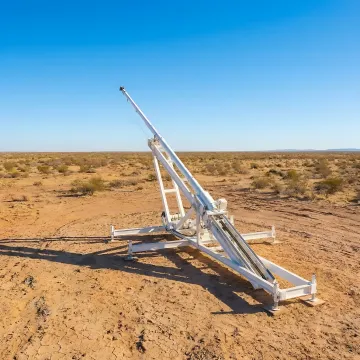
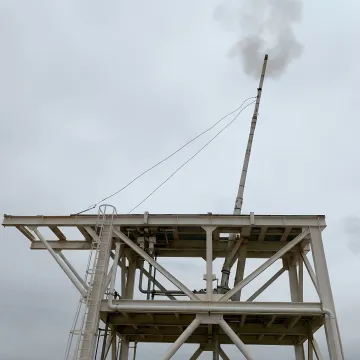
Green Launch's light-gas propulsion system has successfully delivered payloads to the stratosphere, with demonstrated capabilities reaching the mesosphere and ionosphere regions (50-100+ km altitude). Our 54-foot vertical launch tube achieves velocities exceeding Mach 3, with horizontal test configurations reaching Mach 9 for hypersonic vehicle testing. The specific altitude achieved depends on payload mass, launch angle, and propulsion configuration. We've conducted atmospheric sampling missions for the National Science Foundation and can tailor launch profiles to reach specific atmospheric layers required for your climatology, communications, or scientific research objectives.
What makes light-gas propulsion different from traditional rockets?
Light-gas propulsion uses hydrogen and oxygen gases in a combustion chamber to accelerate payloads through a launch tube, rather than continuously burning fuel like traditional rockets. Our system achieves over 91% propellant capture, dramatically reducing acoustic signature and environmental impact. The only byproduct is water vapor, making it a zero-carbon emission launch technology. This approach delivers several advantages: lower cost per launch ($100/lb target), faster turnaround times (60-90 minutes between launches), reduced noise and environmental footprint, and ability to achieve extreme velocities (up to Mach 9). The precision gas injection prevents errant detonation, ensuring safe and repeatable launch operations.
How long does it take to prepare for a launch?
Green Launch's light-gas propulsion system enables rapid turnaround compared to traditional rocket launches. Our testing at Yuma Proving Ground has demonstrated the ability to conduct two launches per day with optimized gas manifold controls and proper personnel coordination. Pre-launch preparation includes mission planning, payload integration, system validation, and propellant loading. Once your payload specifications and mission parameters are defined, we can typically execute a launch within days rather than the weeks or months required for conventional rocket systems. This rapid cadence makes us ideal for research programs requiring multiple atmospheric samples, iterative hypersonic testing, or time-sensitive scientific data collection.
Can Green Launch support hypersonic vehicle testing?
Yes, hypersonic vehicle testing is one of our core capabilities. Green Launch holds the world record for high Mach number engine operation in a free-flying scramjet at Mach 8, surpassing the previous record of Mach 5.5. We've successfully launched nine hypersonic combustion ramjets with proven performance at velocities up to Mach 9. Our light-gas propulsion provides the extreme acceleration needed to test scramjet engines, thermal protection systems, and hypersonic guidance technologies in realistic flight conditions. The 7-inch x 55-foot horizontal test tube at Yuma Proving Ground allows precise control of vehicle weight, gas pressures, and resulting velocities, giving you the flexibility to test various hypersonic vehicle configurations.
What types of atmospheric research can your system support?
Green Launch specializes in atmospheric sampling of the mesosphere and ionosphere—regions critical for climatology, communications, and navigation research. Our specialized fiberglass vehicles feature RF-transparent bodies, allowing antennas to remain protected inside during launch while maintaining signal transmission capabilities. We work with organizations like the National Science Foundation to collect data from atmospheric layers that are difficult to access with balloons (too high) or satellites (too low). This includes studying ionospheric conditions affecting communications systems, collecting mesospheric samples for climate modeling, and conducting surveillance R&D. Our zero-carbon hydrogen propulsion ensures sample integrity without contamination from traditional rocket exhaust.