Introduction
Electromagnetic launch from the Moon sounds compelling on paper — no propellant, low gravity, clean solar power, payloads accelerated to orbital velocity for a fraction of rocket costs. But nearly every analysis of lunar mass drivers skips a foundational engineering question: how much mass does it take to build the launcher before it launches anything at all?
The central tension is brutal. Every kilogram of electromagnetic track, power conditioning hardware, control electronics, and support equipment must first be delivered to the Moon by the exact type of expensive rocket launch this technology is supposed to make obsolete. This creates a hidden cost that undermines the economic case before the first payload ever moves — turning an elegant concept into a logistics problem that scales against you.
The delta-v advantage of the Moon is real. But the infrastructure mass required to use it carries a price that most feasibility studies never fully account for — and that gap is where the economic case breaks down.
Key Takeaways
- Lunar mass drivers require 333 to 3,130 metric tons of hardware alone — before power systems, construction equipment, or spares
- At $100,000/kg delivery cost, even modest designs demand 4+ Starship missions and billions in upfront investment
- Surviving 14-day lunar nights requires either 3.2 million kg of batteries or thousands of tons of nuclear reactors for power alone
- Earth-based light-gas guns reach the same Mach 9 velocities with 100-ton ground systems: zero lunar delivery required
The Promise of Lunar Electromagnetic Launch
An electromagnetic mass driver uses magnetic force to accelerate a payload along a track until it reaches lunar escape velocity of 2.38 km/s, eliminating chemical propellants on the launch side. The Moon's one-sixth gravity and complete lack of atmosphere make this theoretically far more efficient than anything achievable on Earth. NASA confirms the Moon's exosphere is too thin to provide protection from radiation or meteoroid impacts — meaning electromagnetic launch faces no aerodynamic drag or heating.
The concept dates to Edward Fitch Northrup's 1937 theoretical work Zero to Eighty, which proposed a multistage electromagnetic coilgun for launching vehicles to the Moon. Physicist Gerard O'Neill formalized the mass driver concept in 1974 and built the first prototype in 1976 at MIT, achieving 33 g of acceleration. By 1980, O'Neill's collaboration with Professor Henry Kolm had improved performance to 1,800 g. The concept then went largely dormant for decades — until February 2026, when SpaceX and Elon Musk pushed it back into public view as part of Project TERAFAB's AI satellite manufacturing vision.
Musk posted on X: "Mass drivers on the Moon will be awesome" and presented the concept at Giga Texas, proposing electromagnetic coilgun launchers to fling AI satellites manufactured on the lunar surface into distributed orbital networks.
The physics advantages are real. The delta-v requirement from the Moon is roughly 5% of Earth's, solar energy availability in cislunar space runs 30–40% higher than at Earth's surface, and lunar launch windows are plentiful. Where the argument breaks down is not in the physics — it's in the engineering and logistics required to get there.
What "Infrastructure Mass" Actually Means
Infrastructure mass is the cumulative mass of all hardware, materials, and systems that must be transported to and deployed on the Moon before the mass driver can perform its first operational launch. It is a one-way cost paid entirely in conventional rocket launches — the most expensive form of mass transport that exists.
Track and Structural Mass
A useful electromagnetic launch track must span multiple kilometers to achieve escape velocity through controlled acceleration. Each meter requires coil windings, structural guideway sections, anchor systems, and thermal management hardware. Engineering estimates vary significantly:
| Design | Track Length | Acceleration | Total System Mass |
|---|---|---|---|
| O'Neill 1977 (1,000g) | 488 m | 1,000 g | 3,130 MT |
| O'Neill 1977 (100g) | ~5 km | 100 g | ~3,000 MT |
| Snow & Kolm 1992 | 150 m + 50 m decel | 983 g | 333 MT |
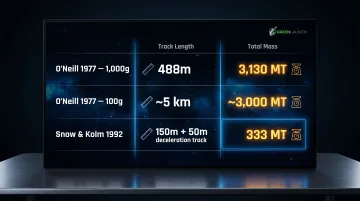
The O'Neill design breaks down to approximately 6,400 MT per kilometer of track, including 2.09 million kg of electrical systems and 1.04 million kg of structural mass.
Anchoring adds complexity. Unlike paved Earth terrain, the lunar surface is unconsolidated fine-grained regolith with poor load-bearing properties. While sintered basalt regolith can achieve 206 MPa in compression, unprocessed regolith requires specialized foundation engineering that ground-based analogues don't need.
Control, Electronics, and Guidance Systems
Precision launch control requires distributed sensor arrays, high-current switching systems, power conditioning equipment, and guidance electronics positioned along the full track length. The O'Neill 1977 design specified 50,300 kg of silicon-controlled rectifier switching mass alone.
These systems must be hardened against the extreme radiation environment. Chang'E 4 measurements recorded surface radiation doses of 1,369 microSv/day — the Moon lacks Earth's magnetospheric shielding, exposing electronics to unattenuated galactic cosmic rays and solar particle events. Radiation hardening adds significant mass penalties for shielding.
Maintenance, Redundancy, and Consumables
The lunar environment degrades hardware through multiple simultaneous mechanisms. Surface temperatures swing approximately 540°F between lunar day (260°F) and night (-280°F). Micrometeoroid flux modeling estimates a lunar base comparable to the ISS would experience 15,000 to 23,000 impacts per year from particles traveling up to 72 km/s.
Lunar dust compounds every threat. Apollo 17 commander Eugene Cernan called it "the greatest inhibitor to nominal operations." Regolith particles have Mohs hardness of 6+ — harder than aluminum, titanium, and stainless steel — and hold electrostatic charge indefinitely in vacuum. Apollo missions documented the consequences firsthand:
- Scratched helmet visors reducing crew visibility
- Jammed spacesuit joints restricting EVA mobility
- Degraded thermal surfaces on equipment and instruments
- Seized camera mechanisms and rover components
For a mass driver, every moving part along kilometers of track faces this same attrition. Dust mitigation hardware adds mass at every joint, seal, and actuator — and no long-duration solution has been demonstrated at operational scale.
Site Preparation Equipment
Track construction requires active site preparation: surface grading over several kilometers, anchor installation, cable routing, and assembly operations. That work demands bulldozers, excavators, and cranes. None of this equipment exists on the Moon. All of it must ship from Earth before a single track section can be placed.
The Bootstrap Paradox: Mass You Need Before You Can Launch Anything
The Delivery Problem
The paradox is explicit: the mass driver is proposed as the solution to expensive Earth-to-Moon transport, yet building it requires solving exactly that expensive transport problem many times over first.
Current estimates place lunar surface delivery at approximately $100,000 per kilogram using Starship. SpaceX's official specifications state Starship can deliver up to 100 tons directly to the lunar surface with on-orbit refilling.
| System | Total Mass | Starship Missions (at 100 MT) | Delivery Cost (at $100K/kg) |
|---|---|---|---|
| Snow & Kolm Quenchgun (modest) | 333 MT | 4 missions | ~$33.3 billion |
| O'Neill High-Throughput | 3,130 MT | 32 missions | ~$313 billion |
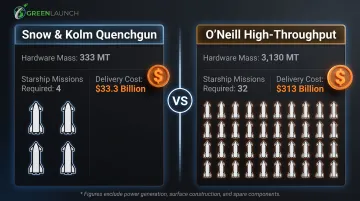
These figures cover launcher hardware only — they exclude power generation, energy storage, construction equipment, habitat modules, spares, and consumables.
The Compounding Effect
Those hardware figures are just the starting point. Deploying the infrastructure requires its own infrastructure — each of these must also be delivered to the lunar surface:
- Ground vehicles for lunar surface transport
- Robotic assembly systems
- Communication arrays for coordinating construction
- Human crew support systems, if people are involved
Every item on that list is additional mass, which means additional launches, which means additional cost.
The Register calculated that Musk's petawatt-scale TERAFAB vision requires 135 Starship launches per day (50,000 per year), each carrying 200 tons, to deliver 10 million tons annually. The author drew a pointed comparison: Musk promised one million robocabs by 2020; around 200 are currently in testing. At larger scale, the infrastructure mass problem doesn't shrink — the logistics requirements grow faster than the launch cadence needed to meet them.
Power Infrastructure: The Silent Mass Multiplier
Power Infrastructure: Where Mass Budgets Collapse
Electromagnetic launch is a burst-power application requiring megawatt-class energy delivery in seconds per launch cycle. The O'Neill 1977 high-throughput design required 125 MW total power. Even the modest Snow & Kolm quenchgun needs 350 kW operational power.
The lunar night problem is unforgiving. NASA's Fission Surface Power program confirms the Moon experiences 14.5 consecutive Earth-days of darkness. Any solar-powered mass driver must either store enough energy to continue operations through the night or shut down entirely.
Scaling ISS battery technology to survive a 2-week lunar night would require approximately 3,200,000 kg of batteries — roughly 32 Starship missions for energy storage alone.
Fission power is the only realistic alternative for continuous operations. NASA's Fission Surface Power program targets 40 kWe output at 174 kg/kWe specific mass. The resulting power infrastructure masses are staggering:
| Power Source | System | Power Required | Infrastructure Mass | Starship Missions |
|---|---|---|---|---|
| Fission reactors | O'Neill mass driver | 125 MW | ~21,750 MT | ~218 |
| Fission reactors | Snow quenchgun | 350 kW | ~61,000 kg | ~1 |
| ISS-class batteries | Solar + storage (night) | Any | ~3,200,000 kg | ~32 (storage only) |
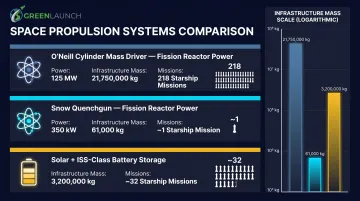
The "free energy from the Sun" assumption breaks down once you account for capture, conditioning, and burst-delivery hardware. For the O'Neill design, power infrastructure alone outweighs the launch track by a wide margin — and that mass still has to reach the Moon first.
Does the Math Ever Work Out?
The Amortization Horizon
The infrastructure mass cost is a fixed upfront investment. The economic advantage of electromagnetic launch only materializes after the system has launched enough payload to offset the cost of getting the infrastructure there in the first place. No published model has demonstrated break-even in fewer than 20 years under realistic cadence assumptions.
In-situ resource utilization (ISRU) — where track materials are manufactured from lunar regolith rather than delivered from Earth — is the most significant potential modifier. But NASA Langley's 2020 analysis found ISRU only trades favorably when plants achieve greater than 5 years of unattended operation and require a sustained 10-15 year lunar campaign first.
ISRU also demands yet another category of delivered infrastructure — mining equipment, manufacturing systems, materials processing hardware — compounding the mass equation before it improves it.
Earth-Based Launch: The Infrastructure Advantage
Green Launch's light-gas gun technology sidesteps the bootstrap problem. Earth-based high-velocity launch systems operate where infrastructure already exists — roads, power grids, supply chains, engineering teams.
The table below compares two proven Earth-based systems against O'Neill's baseline lunar mass driver — on the metrics that the bootstrap problem makes most consequential: system mass, site delivery, and maintenance burden.
| Parameter | SHARP (LLNL) | Green Launch | Lunar Mass Driver (O'Neill) |
|---|---|---|---|
| System Mass | ~100 tons | Compact (ground-based) | 3,130 MT minimum |
| Velocity | 3 km/s (Mach 8.8) | Up to Mach 9 | 2.4 km/s |
| Delivery to Site | Truck/rail | Truck/rail | 32+ Starship missions |
| Maintenance | Standard industrial | Standard industrial | EVA/robotic in vacuum |
| Power Source | Chemical (methane) | Chemical (H₂-O₂) | 125 MW nuclear/solar |
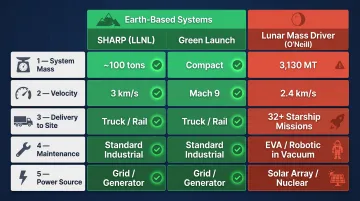
A ground-based system at comparable velocity can be operational within months of a deployment decision. The lunar equivalent requires a decade of precursor missions before the first payload launches.
Frequently Asked Questions
What is lunar mass?
Lunar mass refers to the total mass of the Moon, approximately 7.34 × 10²² kg. In this blog, "infrastructure mass" describes the mass of hardware and systems that must be delivered to the Moon to build operational facilities like a mass driver.
How much mass does it actually take to build a lunar mass driver?
No precise public figure exists for a full-scale system. Engineering studies estimate track structure, power systems, construction equipment, and support hardware together represent hundreds to potentially thousands of metric tons — with the O'Neill design totaling 3,130 MT and even modest designs requiring 333+ MT.
Has a lunar electromagnetic mass driver ever been built or tested?
As of 2026, no lunar mass driver has been built or tested. The concept remains at the proposal stage. SpaceX's 2026 announcement is a declared intent, not a funded construction program.
Why is the lunar night a problem for mass driver power systems?
The Moon experiences roughly 14 consecutive Earth-days of darkness, during which solar panels generate no power. Operating a mass driver through the lunar night requires either massive energy storage systems (3.2 million kg of batteries) or nuclear power sources — both adding to infrastructure mass.
What are the main alternatives to electromagnetic launch for getting mass off the Moon?
Three main options exist:
- Chemical rocket ascent: High propellant cost, but no upfront infrastructure mass required
- In-situ propellant production: Uses lunar resources to cut transport costs, but needs 5+ years of autonomous operation to break even
- Earth-based launch systems: Light-gas guns deliver payloads to orbit with zero lunar infrastructure investment
How does a light-gas gun differ from an electromagnetic mass driver?
A light-gas gun uses rapid expansion of low-molecular-weight gas (typically hydrogen) to accelerate a projectile to high velocity, while an electromagnetic mass driver uses magnetic force along a powered track. Both avoid chemical rocket propellant, but light-gas guns can be built and operated on Earth using existing infrastructure — no lunar delivery required.