Introduction
Selecting the right commercial launch provider for an NSF-funded research payload is rarely straightforward. Most researchers are experts in atmospheric physics, materials science, or microgravity biology—not in commercial space procurement. Yet choosing the wrong provider can stall a funded project, blow through budget allowances, or misalign with NSF's strict cost-allowability standards under 2 CFR Part 200.
NSF funds a broad range of space-related research: atmospheric sampling, suborbital astronomy, microgravity experiments, CubeSat deployment, and Earth observation. The commercial launch industry now offers more options than ever, along with far more complexity. Rideshare schedules, payload interface standards, and pricing models vary widely — and not all providers are equally accessible to university research teams.
This guide covers the leading NSF-eligible launch providers, what makes each one suitable for federally funded work, and how to match your mission type to the right option.
Key Takeaways
- NSF-funded researchers can contract commercial launch services as allowable direct costs, provided providers meet federal procurement and cost standards (2 CFR Part 200)
- Provider selection depends on mission type: suborbital vs. orbital, payload mass, microgravity duration, and budget
- This guide covers providers across sounding rockets, suborbital vehicles, orbital rideshare, and dedicated smallsat launch — from UP Aerospace to Rocket Lab
- Engage providers early—before submitting your NSF proposal—to include accurate cost estimates and confirm schedule availability
- Green Launch offers an alternative to traditional rockets using hydrogen light-gas propulsion, with lower per-launch costs suited to acceleration-tolerant payloads
What Makes a Launch Provider "NSF-Eligible" for Research Payloads
"NSF-eligible" doesn't mean the provider appears on an approved vendor list—NSF doesn't maintain one. Instead, providers must be contractable under standard federal procurement rules, and their costs must be allowable, allocable, and reasonable per 2 CFR Part 200 (Uniform Guidance). Research institutions typically execute procurement contracts or subawards with providers using grant funds.
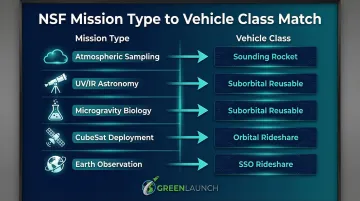
Mission types NSF commonly funds include:
- Atmospheric sampling via sounding rockets or suborbital vehicles
- UV/IR suborbital astronomy using high-altitude platforms with payload return
- Microgravity biology and materials research on suborbital reusable vehicles (3–4 minutes of microgravity)
- CubeSat/NanoSat deployment through orbital rideshare or dedicated smallsat launch
- Earth science observations requiring sun-synchronous orbit access
Each mission type maps to a different vehicle class — and choosing the wrong one early can affect both budget and schedule. Suborbital sounding rockets suit altitude-dependent experiments with parachute recovery, while orbital rideshare cuts cost for CubeSat deployments by sharing a rocket across multiple customers.
The providers covered here are actively contracting with research institutions and span the full range of suborbital and orbital mission profiles relevant to NSF-funded work.
Top Payload Launch Providers for NSF-Funded Research
These providers were evaluated based on demonstrated research payload heritage, flight frequency, payload interface documentation, pricing transparency, and relevance to NSF-funded science disciplines.
Blue Origin (New Shepard)
Blue Origin's New Shepard is a fully reusable suborbital launch system designed to carry payloads and crew above the Kármán line. The company operates a dedicated Payload Flight program that has flown more than 200 research experiments for NASA, universities, and independent researchers.
What sets it apart: New Shepard offers approximately 3 minutes of high-quality microgravity per flight, payload return (critical for biological and materials samples), and a pressurized crew capsule environment for tended experiments. Standardized payload locker interfaces—Single Locker (11.34 kg), Double Locker (22.68 kg), and Full Stack (68 kg)—reduce hardware development costs for researchers.
| Feature | Specification |
|---|---|
| Payload Capacity | Up to 68 kg; standard locker formats (1/6U, 1/2U, full-U) |
| Mission Profile | Suborbital, ~100-105 km apogee, ~3 minutes microgravity; payload return included |
| Relevant NSF Disciplines | Microgravity biology/materials, human physiology, suborbital atmospheric science |
Rocket Lab (Electron)
Rocket Lab operates the Electron launch vehicle from New Zealand and Virginia, targeting small satellite and research payload missions to low Earth orbit. The company offers dedicated and rideshare missions and has a growing manifest of university and government research payloads, including NASA's ELaNa-19 and the PREFIRE climate mission.
What sets it apart: Electron provides orbital access for payloads from 1 kg to ~300 kg to LEO, with high launch cadence (21 Electron missions in 2025) and flexible orbit options (SSO, LEO, mid-inclination). Rocket Lab's Kick Stage enables precise orbital insertion for payloads requiring specific altitudes—ideal for Earth observation and space science NSF grants.
| Feature | Specification |
|---|---|
| Payload Capacity | Up to ~300 kg to LEO (dedicated); 1–50 kg rideshare |
| Mission Profile | Orbital (LEO, SSO, mid-inclination 38°-120°); no payload return |
| Relevant NSF Disciplines | Small satellite deployment, space science, Earth observation, atmospheric science |
UP Aerospace (SpaceLoft XL)
UP Aerospace is one of the longest-operating commercial sounding rocket providers in the U.S., flying the SpaceLoft XL from Spaceport America in New Mexico. The company has a strong track record with NASA and university research payloads since the mid-2000s, having completed 23 suborbital space flights.
What sets it apart: SpaceLoft XL offers a low-cost, well-documented interface for small payloads (up to ~36 kg to 115 km altitude), relatively fast integration timelines, and an established flight history with research customers. The vehicle provides approximately 4 minutes of microgravity with parachute recovery—a practical entry point for first-time research launchers or smaller budgets.
| Feature | Specification |
|---|---|
| Payload Capacity | Up to ~36 kg; cylindrical payload bay (10-inch diameter) |
| Mission Profile | Suborbital (~115 km apogee); payload return via parachute recovery |
| Relevant NSF Disciplines | Atmospheric sampling, space environment measurements, student/educational payloads |
SpaceX (Transporter Rideshare Program)
SpaceX's Transporter rideshare program, flown on the Falcon 9, provides low-cost orbital access for small satellites and research payloads on a recurring (approximately quarterly) schedule to sun-synchronous orbit. It has become a primary access point for CubeSat and NanoSat researchers, with over 1,600 payloads deployed to date.
What sets it apart: Transporter offers among the lowest per-kilogram costs to orbit currently available commercially—starting at $7,000/kg over a 50 kg base. Standardized payload interfaces (8", 15", and 24" circular bolt patterns, ESPA rings, CubeSat deployers) are widely understood by the research community. The high cadence (missions every 4 months to SSO at ~525 km altitude) reduces schedule risk for time-sensitive grants.
| Feature | Specification |
|---|---|
| Payload Capacity | 50 kg base ($350,000) to 831 kg per port; additional mass at $7,000/kg |
| Mission Profile | Orbital (SSO ~525 km); no payload return |
| Relevant NSF Disciplines | CubeSat/NanoSat deployment, space science, Earth observation, technology demonstration |
Green Launch
Green Launch, founded in 2017 by physicist Dr. John W. Hunter, develops hydrogen light-gas propulsion systems for suborbital and space access missions. The company has conducted successful test campaigns at Yuma Proving Ground, including a December 2021 vertical launch that reached approximately 30 km altitude at velocities exceeding Mach 3.
What sets it apart: Green Launch's hydrogen-oxygen light-gas system produces only water vapor as a byproduct and has demonstrated high propellant capture efficiency in testing. Rapid turnaround capability (launches every 60–90 minutes) supports NSF programs requiring repeated atmospheric or suborbital measurements. The National Science Foundation has engaged Green Launch for mesospheric atmospheric sampling—validating the system for science-driven suborbital applications.
| Feature | Specification |
|---|---|
| Payload Capacity | Research payloads for suborbital and high-altitude delivery; contact for current specs |
| Mission Profile | Suborbital; high-velocity delivery; sustainable H₂/O₂ propellant; zero-carbon emissions |
| Relevant NSF Disciplines | Atmospheric science, suborbital physics experiments, cost-sensitive research programs |
How We Chose These Providers
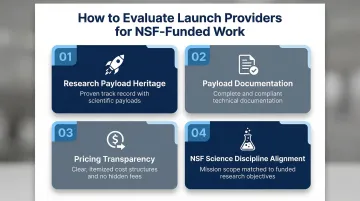
These providers were selected based on four core criteria:
1. Demonstrated research payload heritage – Flight history with scientific payloads from NASA, universities, or government research agencies
2. Publicly available payload documentation – User guides, Interface Control Documents (ICDs), or payload accommodation specs required for hardware integration planning
3. Pricing transparency – Publicly known cost ranges or willingness to provide firm quotes for NSF budget justification
4. Alignment with NSF-funded science disciplines – Relevance to atmospheric science, microgravity research, space science, Earth observation, and CubeSat programs
Check whether the provider holds Space Act Agreements, Educational Partnership Agreements, or prior contracts with U.S. universities — these arrangements can simplify procurement on your end. Determining whether pricing qualifies as "fair and reasonable" under federal cost principles falls to the PI and grants administrator, not the provider.
Conclusion
Selecting the right launch provider for an NSF-funded payload involves both scientific and programmatic judgment. The right partner should:
- Align with your mission profile and altitude or velocity requirements
- Fit within your grant timeline and post-award execution schedule
- Meet federal procurement standards for NSF-funded work
- Offer payload interfaces your team can integrate within budget
Contact providers early—ideally before submitting your NSF proposal—to obtain firm cost estimates, understand integration requirements, and confirm schedule availability. These details directly affect proposal competitiveness and post-award execution. With NSF's overall funding rate at 19% in FY 2025—down 7 percentage points from FY 2024—ensuring accurate, defensible launch costs in your budget is more critical than ever.
For research programs requiring cost-effective, high-cadence suborbital access, Green Launch is one provider worth including in your evaluation. The company uses hydrogen-powered impulse launch technology designed for acceleration-tolerant payloads, with a focus on reduced per-launch costs and a lower environmental footprint than conventional rocket systems. Reach out to discuss whether your payload requirements and mission profile are a fit.
Frequently Asked Questions
What is the 2-month rule for NSF?
NSF's 2-month salary rule limits the total salary charged to NSF grants to no more than two months of an individual's regular academic-year salary in any one year, regardless of how many NSF grants you hold. This rule governs PI compensation, not launch service procurement costs.
Who is eligible for the NSF grant?
NSF accepts proposals from institutions of higher education, non-profit non-academic organizations, and tribal nations — submitted by the institution on the researcher's behalf. For-profit entities or state/local governments may be eligible for specific solicitations. Always verify eligibility in the program solicitation.
How hard is it to get an NSF grant?
NSF's overall funding rate in FY 2025 was 19%, down from 26% in FY 2024. Competitiveness varies significantly by directorate and program, with some programs funding under 10% of proposals while others fund higher proportions. Engaging a program officer early improves your chances significantly.
What are the four types of grants?
NSF funding opportunities fall into four types: program descriptions/announcements, solicitations (with fixed deadlines), Dear Colleague Letters, and broad agency announcements. For launch-related research, solicitations under GEO, MPS, and ENG are most relevant.
Can NSF grant funds be used to pay for commercial launch services?
Yes. Launch services can generally be treated as allowable direct costs on NSF grants when they are necessary and directly tied to the funded research objectives, subject to the institution's procurement policies under 2 CFR Part 200. Work with your sponsored research office to structure the engagement (subcontract vs. procurement) correctly.
What payload classes are most commonly flown on NSF-funded research launches?
NSF-funded research payloads most commonly fall into small sounding rocket payloads (a few kg to ~36 kg), CubeSat/NanoSat form factors (1U to 6U), suborbital microgravity experiment packages, and atmospheric sensor suites. The payload class determines which provider class is appropriate and what integration standards must be met.