

Introduction
Few scientific terms pull double duty as effectively as "stratosphere." The same word that describes a precise atmospheric layer — 10–50 km above Earth's surface, home to the ozone layer and commercial flight paths — also signals extreme, rapid ascent in headlines, pitch decks, and aerospace briefings. Knowing which synonym fits which context keeps your writing accurate and purposeful.
This article maps three interconnected threads: the literal scientific term and its alternatives, the vocabulary of atmospheric layers and phenomena, and the figurative phrase "soaring to the stratosphere" with its many expressive synonyms.
Quick Reference:
- The stratosphere spans 10–50 km altitude — Earth's second atmospheric layer, housing the ozone layer
- Nearest synonyms: "upper atmosphere," "high atmosphere," "ozone layer" (each with different precision levels)
- "Soaring to the stratosphere" signals rapid, dramatic rise — top alternatives: "skyrocketing," "catapulting," "shooting through the roof"
- Boundary terms (tropopause, stratopause) and adjacent layers (troposphere, mesosphere) anchor precise usage
- Figurative applications dominate finance, marketing, and aerospace writing
What Is the Stratosphere?
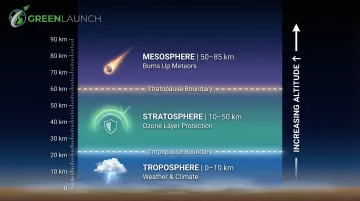
The stratosphere is Earth's second atmospheric layer, extending from approximately 10 to 50 km above the surface. It sits directly above the troposphere (where weather occurs) and below the mesosphere. What sets it apart physically:
- A temperature inversion where air warms with altitude rather than cooling
- The ozone layer, concentrated between 15–35 km
- Exceptionally dry, stable air with none of the turbulence or convection found below
The word derives from Ancient Greek "strōtós" (layer or stratum) combined with "-sphere," reflecting its layered structure. French meteorologist Léon Teisserenc de Bort and German scientist Richard Assmann independently discovered this region in 1902 through high-altitude balloon measurements.
They identified what they initially called an "isothermal layer," where temperature stopped decreasing with altitude, a finding that challenged prevailing assumptions about atmospheric structure. Teisserenc de Bort formally coined "stratosphere" in 1908, giving the term over a century of scientific use.
That temperature inversion has a direct cause: ozone molecules absorb incoming ultraviolet radiation from the Sun and convert that energy to heat. This absorption protects life at Earth's surface while creating the unusual warming effect that defines the layer.
Synonyms for "Stratosphere": What Else Can You Call It?
Upper Atmosphere
The most common plain-language substitute is "upper atmosphere." This works well in casual writing, crossword puzzles, and general-audience content where scientific precision isn't critical. However, technically "upper atmosphere" encompasses multiple layers—the mesosphere and thermosphere extending from 50 km up to 600 km—making it broader than the stratosphere alone. Use "upper atmosphere" when you need accessible language; choose "stratosphere" when altitude specificity matters.
Ozone Layer
"Ozone layer" frequently substitutes for "stratosphere" in popular press and crossword clues. While convenient shorthand, this creates technical imprecision: the ozone layer is a concentration zone within the stratosphere (roughly 15–35 km), not a synonym for the entire 10–50 km band. For atmospheric research, mission planning, and instrument payload design, treating them as interchangeable introduces altitude errors that matter.
Lower vs. Upper Stratosphere
When precision matters, writers subdivide the layer:
- Lower stratosphere: 10–25 km altitude, extending from the tropopause to about 30 hPa pressure
- Upper stratosphere: 25–50 km altitude, reaching maximum temperatures near the stratopause boundary
Commercial aircraft cruise in the lower stratosphere (9–12.5 km) to avoid tropospheric weather, while the upper stratosphere hosts phenomena like polar stratospheric clouds and peak ozone concentrations.
Additional Alternatives
Scientific and journalistic writing uses these near-synonyms:
- High atmosphere — informal but clear
- Stratospheric layer — emphasizes the stratum concept
- Second atmospheric layer — descriptive and precise
- Isothermal zone — historical usage from early 20th-century meteorology
- Stratum atmosphere — Latin-derived alternative
Popular culture follows its own conventions here. The New York Times crossword has clued "It's in the stratosphere" with THIN AIR, and "Layer of the upper atmosphere" typically yields OZONE — a reminder that public vocabulary doesn't map cleanly onto atmospheric science.
Related Atmospheric Terms and Concepts
Adjacent Layers and Boundaries
Understanding neighboring layers helps writers use "stratosphere" accurately:
- Troposphere (below): Earth's lowest layer (0–10 km), where weather occurs and temperature decreases with altitude
- Tropopause: The boundary between troposphere and stratosphere, marking where temperature behavior reverses
- Mesosphere (above): Extends from 50–85 km, where temperatures again decrease with altitude and meteors burn up
- Stratopause: The upper boundary of the stratosphere at approximately 50 km altitude
Atmospheric Phenomena
These terms frequently appear alongside "stratosphere" in scientific and general writing:
- Polar vortex: Large area of swirling cold air surrounding Earth's poles that strengthens in winter
- Brewer-Dobson circulation: Global mass circulation where tropospheric air enters the stratosphere in the tropics, then moves upward and poleward
- Quasi-biennial oscillation (QBO): Tropical stratospheric wind variation with an average 28-month cycle
- Nacreous clouds: Wave clouds forming at 15–25 km under extremely cold temperatures, creating iridescent displays
- Blue jets: Narrow cone-shaped flares of upper-atmospheric lightning rising from thunderclouds to 40–50 km
Aerospace Distinctions
Writers covering aerospace topics often mix up these related terms:
- High-altitude: Regions above 60,000 feet (18 km), where traditional aircraft engines lose efficiency and pressure suits become necessary
- Near-space: The 20–100 km zone between conventional airspace and outer space—above most aircraft but below orbital velocity
- Suborbital: Reaching high altitude without achieving orbital velocity, often describing flights to "the edge of space"
These aerospace terms define operational capabilities and regulatory boundaries rather than specific atmospheric layers. A commercial airliner cruising at 30,000–41,000 feet operates in the lower stratosphere, while a suborbital rocket may transit the entire stratospheric band during ascent.
"Soaring to the Stratosphere" — What the Phrase Really Means
"Soaring to the stratosphere" is an idiomatic expression meaning reaching extremely high levels—most commonly applied to prices, valuations, performance metrics, or popularity. The phrase carries connotations of both extreme height and rapid upward movement, distinguishing it from slower, steadier growth metaphors.
Launch Into the Stratosphere
This variant implies sudden, propulsive, often unexpected rise. Financial journalism particularly favors this phrasing. For example, Reuters noted that "$1.75 trillion valuation would send SpaceX's EBITDA multiple into the stratosphere," while The Economist has warned about "stratospheric valuations of America's tech companies." The "launch" variation emphasizes the moment of dramatic acceleration—such as a startup's valuation launching into the stratosphere after a funding round—distinguishing this from gradual appreciation.
Slang Usage: "In the Stratosphere"
In casual and pop-culture contexts, being "in the stratosphere" means occupying a level so elevated it's almost unreachable or incomprehensible to ordinary people. This usage often carries ironic or critical undertones: "His ego is in the stratosphere" suggests detachment from reality, while "Prices are in the stratosphere" implies unsustainable excess. The slang dimension emphasizes the distance between normal experience and the extreme level being described.
Why Writers Love This Metaphor
Unlike softer alternatives like "rising" or "increasing," "stratosphere" anchors the claim in a specific, measurable altitude (6–31 miles above Earth's surface). That scientific grounding is exactly why marketers, journalists, and speechwriters reach for it — the extreme sounds credible, not just dramatic.
The phrase works on multiple levels at once:
- Signals genuine scale without relying on vague superlatives
- Carries emotional weight through a real-world, recognizable reference point
- Applies equally to financial, cultural, and technical contexts
The Adjective Advantage
Stratospheric — the adjective form — often does more work than the noun in headlines and professional writing. Phrases like "stratospheric growth," "stratospheric prices," and "stratospheric ambitions" function as standalone intensifiers without requiring additional verbs. This form simplifies sentence structure while keeping the term's dramatic punch, which is why it turns up so consistently in business and technology reporting.
Synonyms for "Soaring to the Stratosphere"
Speed-Focused Synonyms
These alternatives emphasize rapid, dramatic upward movement:
- Skyrocketing — best for sudden price spikes or popularity surges
- Shooting through the roof — casual but vivid; suits informal or consumer-facing writing
- Surging — data-focused, often applied to markets or traffic metrics
- Spiking — emphasizes short-term movement; common in technical and analytics writing
- Catapulting — forceful, propulsive connotation; works well in engineering or sports contexts
- Blasting off — space launch imagery; better suited to casual or inspirational writing than technical copy
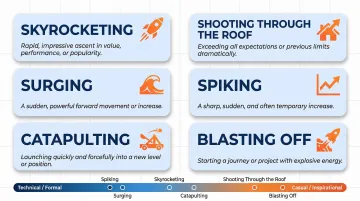
Tonal differences matter: "spiking" suits technical or data-driven writing, while "blasting off" works better for casual or inspirational contexts.
Height-Focused Synonyms
Use these when the magnitude matters more than how quickly it was achieved:
- Off the charts — exceeding normal measurement scales; casual and emphatic
- At an all-time high — works for any metric where historical comparison matters
- At stratospheric levels — uses "stratospheric" as modifier rather than destination; slightly more formal
- In the upper echelons — suited to social status, hierarchy, or competitive rankings
- Reaching new heights — achievement-focused, less dramatic; good for milestone announcements
- At the apex — formal and precise; strong in conclusions or summary statements
For example: "The company's market share reached new heights" emphasizes the accomplishment without implying urgency or alarm.
Formal and Literary Alternatives
These options suit professional writing, speeches, and editorial contexts where elevated register is appropriate:
- Ascending to unprecedented heights — emphasizes both novelty and achievement; works in policy or academic writing
- Reaching the zenith — implies a culminating moment; suits academic or executive writing
- Scaling new summits — mountaineering metaphor that implies sustained effort, not just a lucky leap
- Attaining the pinnacle — formal; works well in conclusions or achievement summaries
- Transcending conventional limits — philosophical in tone; use when the emphasis is on boundary-breaking rather than scale
Cautionary Alternatives
When writing about inflated prices or unsustainable growth, these synonyms redirect altitude metaphors as warnings:
- Ballooning — expanding rapidly, often beyond control
- Inflating — artificial expansion with bubble connotations
- Overheating — economic term suggesting unsustainable acceleration
- Going parabolic — mathematical curve implying the trajectory can't hold
- Entering bubble territory — explicitly warns of a potential crash
For example: "Valuations are going parabolic" signals concern to a financial audience without abandoning the upward-movement framing.
From Language to Launch: Reaching the Stratosphere in the Real World
While writers use "stratosphere" as a metaphor for extreme achievement, physically accessing this atmospheric layer requires extraordinary engineering. Commercial aircraft reach only the lower stratosphere at 9–12.5 km, avoiding tropospheric turbulence while staying well below the stratosphere's upper boundary. Suborbital and orbital launches must transit the entire 10–50 km stratospheric band to reach space—a challenge that has traditionally required expensive chemical rockets.
Green Launch has developed proprietary light-gas propulsion technology built to accelerate payloads through the stratosphere and beyond. The system uses hydrogen and oxygen as propellant, combusting to produce water vapor rather than the 19+ tons of CO2 per ton of payload that traditional hydrocarbon rockets emit.
That environmental advantage pairs with a significant cost reduction. Green Launch targets $100 per pound delivery to orbit, compared to thousands of dollars per pound for conventional small rocket launches.
Dr. John Hunter's work leading the Super High Altitude Research Project (SHARP) at Lawrence Livermore National Laboratory underpins this approach. His team built the world's largest light-gas gun and achieved velocities of 3 km/s. Green Launch's system has since demonstrated Mach 9 velocities (2.97 km/sec) and completed its first vertical launch in December 2021, sending a 28-pound payload to approximately 30 km altitude—well into the stratosphere.
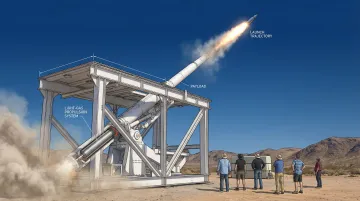
The system is designed for acceleration-tolerant payloads, with launch windows opening every 60–90 minutes. Candidate missions include:
- Cubesat and small satellite deployment
- Atmospheric research and sampling
- Hypersonic vehicle testing
- Rapid-turnaround sub-orbital research flights
That combination of low cost, clean propellant, and high cadence makes stratospheric and orbital access viable for organizations that conventional rocket pricing has historically priced out.
Frequently Asked Questions
Frequently Asked Questions
What does launch into the stratosphere mean?
Figuratively, "launch into the stratosphere" describes a sudden, dramatic rise to an extremely high level — used for prices, fame, or success metrics experiencing rapid growth. Literally, it means propelling an object through Earth's stratospheric layer (10–50 km altitude), which requires velocities exceeding Mach 3.
What is another word for stratosphere?
Common alternatives include "upper atmosphere," "ozone layer" (in popular usage), and "high atmosphere." These are approximate synonyms; the stratosphere is technically the specific layer between 10–50 km altitude, distinct from the troposphere below and mesosphere above.
What does stratosphere mean in slang?
In slang, "the stratosphere" refers to an extremely elevated level that feels out of reach to most people. It commonly describes prices, salaries, fame, or ego that have become disconnected from normal experience. "His salary is in the stratosphere," for instance, implies compensation far beyond typical ranges, often with undertones of excess.
What are the best synonyms for "soaring to the stratosphere"?
The most versatile alternatives are "skyrocketing" (sudden speed), "shooting through the roof" (dramatic height), "reaching new heights" (achievement), "catapulting" (forceful acceleration), and "going off the charts" (exceeding measurement scales). Choose based on whether you want to emphasize speed, surprise, or final elevation.
What is the difference between the stratosphere and the upper atmosphere?
"Upper atmosphere" is a broad term covering several layers (stratosphere, mesosphere, thermosphere) up to roughly 600 km altitude. "Stratosphere" refers specifically to the 10–50 km band, characterized by its ozone layer and temperature inversion, making it the more precise term for scientific or technical writing.
How high is the stratosphere?
The stratosphere begins at approximately 10 km (33,000 feet or 6.2 miles) above Earth's surface at mid-latitudes and extends to about 50 km (164,000 feet or 31 miles). Its lower boundary (the tropopause) varies by latitude and season, sitting higher at the equator (up to 18 km) and lower at the poles (as low as 8 km).