
Researchers at Harvard and UC San Diego set out to tackle this problem with a novel rocket-based sampling program targeting the mesosphere and upper stratosphere. Their goal: use isotope ratios to trace photochemical processes that concentration measurements alone can't explain.
This article walks through what's documented about the project, why isotope sampling at these altitudes is so difficult, how similar systems work, and what it means for scientific missions going forward. We'll also flag where public records stop and where verification is still needed.
Key Takeaways
- Isotope ratios show sources, mixing, and chemical history that concentration data alone cannot.
- Mesosphere sampling’s core problem is contamination control at low pressure, low density, and high velocity.
- The Harvard–UCSD project (NSF Award 2204475) is a documented research grant, not a completed mission with published results.
- High-altitude systems, including Green Launch’s hydrogen platforms, can support this research; Green Launch’s role here is not documented.
The Harvard–UCSD Case Study: Research Question and Mission Context
The verified source for this project is a National Science Foundation award record, not a published mission report. The NSF award record identifies David T. Johnston at Harvard as principal investigator, with the President and Fellows of Harvard College as the awardee institution. Samples were designated for analysis at both UC San Diego and Harvard.
The Scientific Question
The NSF project title is "Collaborative Research: EAGER — Novel Sampling and Isotopic Characterization of Upper Strato- to Mesospheric Photochemistry."
The team was investigating an anomalous isotope fingerprint and possible gas exchange between the troposphere, stratosphere, and mesosphere.
Planned Mission Architecture
According to the award record, the campaign was designed around:
- Two rocket launches, collecting four total atmospheric samples
- Two samples at 37 km (upper stratosphere) and two at 70 km (mesosphere)
- Target gases: O2, CO2, and N2
- Planned isotope analyses: 17O abundance and isotopic clumping in O2 and CO2
The award period ran from April 1, 2022, through March 31, 2024.
An Important Evidence Note
This NSF record describes planned sampling and laboratory work. It does not confirm a completed flight, a launch or recovery location, final isotope values, or a peer-reviewed publication of results.
Treat this as a documented research program, not a finished case study with measured outcomes. No launch provider, including Green Launch, is named anywhere in the record.
Why Mesosphere Sampling Is Scientifically Difficult
The mesosphere sits roughly between 50 and 85 km, above the stratosphere and below the thermosphere, according to NOAA. NASA gives a similar 50-80 km range. These boundaries shift with season and scientific convention, so treat them as approximate.
Composition Challenges
O2 and N2 dominate the bulk gas composition in the mesosphere and lower thermosphere. But reactive trace species, including ozone, atomic oxygen, and hydrogen-bearing radicals, drive much of the interesting chemistry, per an Atmospheric Chemistry and Physics review.
That mixture creates a sampling puzzle:
- Ozone forms when atomic oxygen reacts with O2, then gets destroyed by hydrogen- and nitrogen-bearing radicals
- OH radicals form from hydrogen and ozone reactions, feeding back into mesospheric heating
- Ozone abundance swings dramatically between day and night; it is far more abundant after dark
The Access Problem
Balloons and aircraft can't reach the mesosphere. Satellites fly above it. Rockets are the only platform offering direct, in-situ access, according to a 2024 PNAS review of sounding rocket science. That same review notes flight windows above 100 km typically last just 5 to 20 minutes for suborbital parabolic missions.

This is the crux of the problem: a sample collected during a brief ascent or dwell period captures a narrow slice of time and altitude, not the mesosphere's full behavior.
Photochemical variability compounds that limit. Model-observation gaps for ozone and OH have run 50 to 70% near 60 km, so these measurements are highly sensitive to timing, season, and local conditions.
The Sampling and Analysis Workflow
Getting isotope data from a mesosphere sample means solving two separate problems: collecting gas without contaminating it, then measuring isotope ratios precisely enough to mean something.
Collection Hardware
The Harvard-UCSD award record doesn't specify the sampler design used. But documented rocketborne analogues give a useful picture of what's possible.
One NASA technical record describes a system using a shock-diffuser inlet paired with a cryogenic sampler to collect air during supersonic ascent.
A separate 1973 flight used a cryogenic air sampler launched on an Aerobee rocket from White Sands, collecting a large air sample between 40 and 50 km. That flight targeted the stratosphere, not the mesosphere, but the hardware approach still maps to high-altitude collection constraints.
Contamination control matters enormously here. Documented risks for high-altitude sampling include:
- Surface outgassing from payload materials
- Particles from launch-vehicle exhaust
- Attitude-control thruster residue
- Handling and sealant contamination during payload prep
From Recovery to the Instrument
Once gas is collected, it typically moves through cryogenic trapping, gas chromatography for separation, and finally isotope-ratio mass spectrometry (IRMS). A peer-reviewed atmospheric CO2 isotope method describes a workflow using 12 mL whole-air samples, an autosampler, cryogenic trapping, and a sector-field IRMS — achieving precision better than 0.1 per mil for carbon and 0.2 per mil for oxygen.

Isotope ratios, in plain terms, compare the abundance of a rare isotope (like 18O) to a common one (like 16O) within a gas sample. That difference is then expressed relative to an internationally accepted reference scale, such as VPDB for carbon dioxide.
Quality control typically requires:
- Run known reference gases before and after each sample (bracketing)
- Subtract background contamination signals (blank correction)
- Measure each sample multiple times to establish repeatability
- Combine reference-material uncertainty with measurement repeatability in the reported error
None of these controls appear in the public Harvard-UCSD award record. Any finished dataset from the campaign would still need this level of QC before isotope ratios could support firm atmospheric conclusions.
What the Isotope Results Reveal
No measured isotope ratio, gas concentration, or model comparison from the Harvard–UCSD campaign appears in any verified public source located for this review. The award record states the research objective (investigating an anomalous isotope fingerprint and potential mesosphere-stratosphere-troposphere exchange) but stops short of reporting outcomes.
What Isotope Data Can Show, Generally
Even without campaign-specific results, the rationale for these measurements is clear. Isotope signatures can distinguish:
- Source attribution: whether a gas came from surface emissions, in-situ photochemistry, or transport from another layer
- Chemical processing history: reactions leave measurable isotope fractionation signatures
- Mixing between layers: ratios that diverge from expected background can signal stratosphere–mesosphere exchange
The Closest Verified Analogue
A separate 2023 study detected the atomic oxygen isotope 18O in the mesosphere and lower thermosphere. It used remote far-infrared absorption against the Moon, not gas sampling, so the method differs entirely and is not part of the Harvard–UCSD rocket campaign.
That work still confirms isotope signals of interest exist at these altitudes and remain worth pursuing.
Honest bottom line: this is still an open research question with a funded, methodologically sound approach, not yet a published finding.
Limitations, Validation, and Lessons for Future Missions
Every mesosphere sampling effort, completed or planned, faces a similar set of uncertainty sources.
Principal uncertainty sources include:
- Terrestrial air contamination during ascent or recovery
- Exhaust interference from the launch vehicle itself
- Isotope fractionation during storage or transfer
- Low sample volume limiting analytical precision
- Instrument drift between calibration checks
Validation Methods That Matter
Robust studies typically validate results through several checks:
- Blank samples and duplicate collections
- Bracketed reference standards
- Comparison against chemical transport models or independent instruments
None of these validation steps are documented for the Harvard-UCSD campaign in the public record. That gap is why this remains research in progress rather than a completed case study.
What Future Missions Need
When evaluating similar programs, check for:
- Verified sampling altitude and duration
- Named target gas and isotope system
- Documented contamination controls
- Stated calibration method and reference scale
- Reported measurement uncertainty
- Independent validation against other instruments or models
Future missions would benefit from:
- Multi-altitude collection in a single flight
- Longer dwell time at target altitude
- Improved inlet sealing to cut terrestrial air intrusion during ascent and descent
Relevance to Future High-Altitude Scientific Payloads
Reliable, repeatable access to the mesosphere matters far beyond one grant. NASA's own Sounding Rocket Program reported 17 launches in fiscal year 2025 with a 94% success rate, and 28 university teams flying experiments through the RockOn program. Demand for low-cost, direct atmospheric access keeps growing among research institutions.
Where Alternative Launch Platforms Fit In
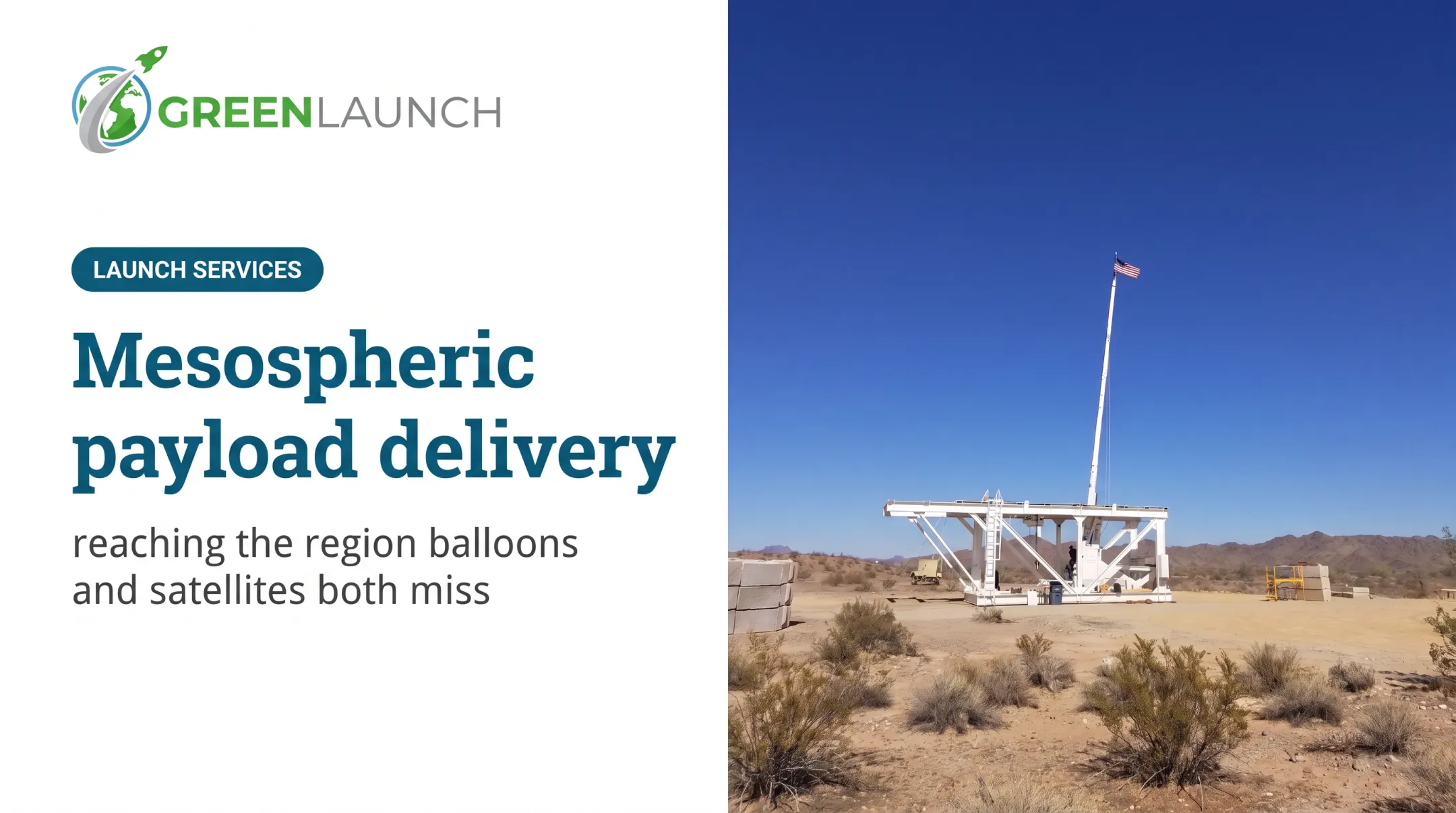
Green Launch's work centers on hydrogen light-gas propulsion for suborbital and high-altitude payload delivery, a different technical approach from the sounding rockets referenced in NSF and NASA program records. The company's Phase 2 development track targets a 200 km apogee. Plans call for delivering sensor packages and atmospheric samplers for climate research on roughly a one-month turnaround per sounding experiment.
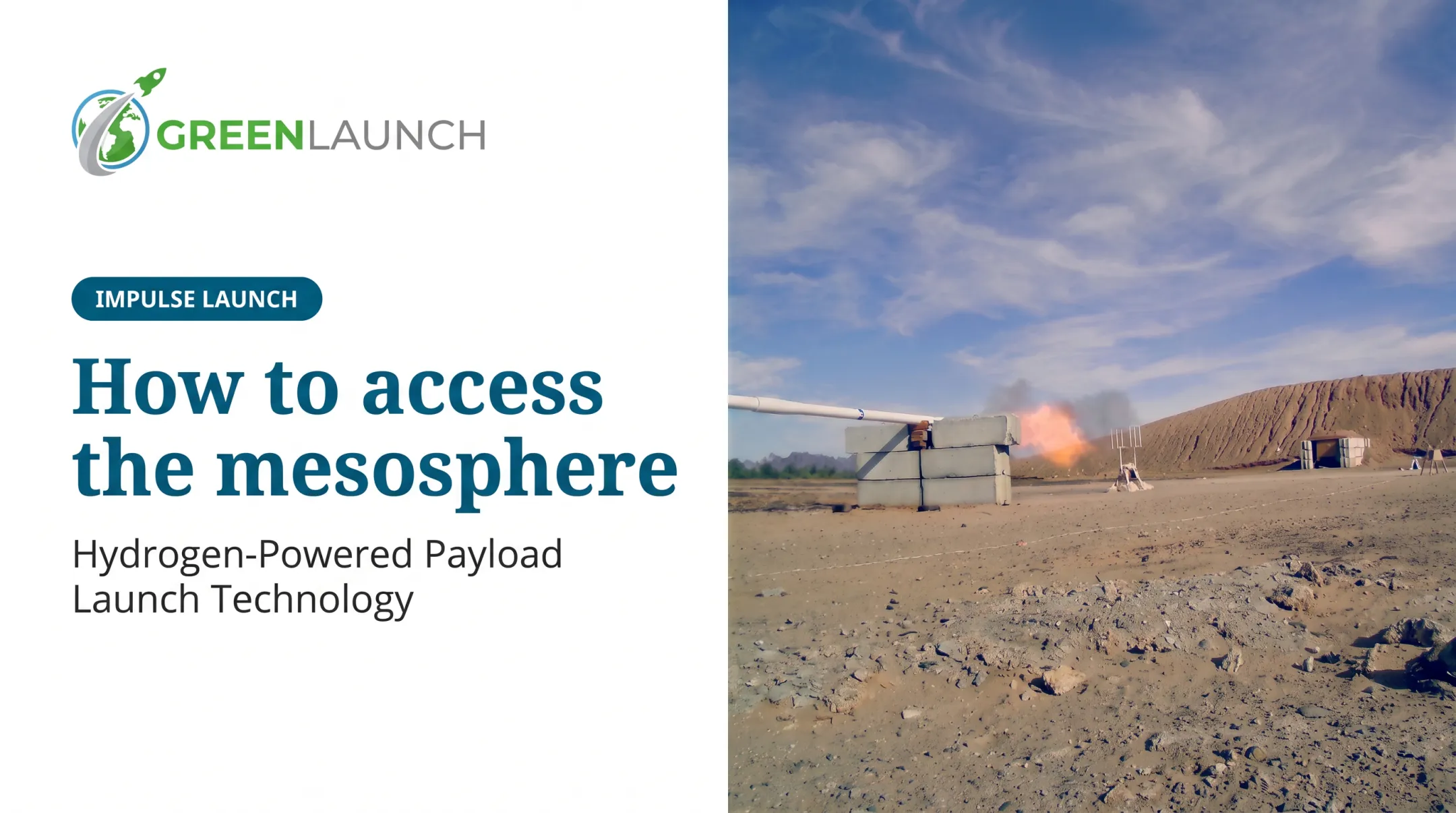
Green Launch's documented testing history includes a December 21, 2021 vertical launch from Yuma Proving Ground, using a 54-foot launch tube to send a payload past Mach 3 into the stratosphere. The company has also designed atmosphere-sampling payload vehicles with wound fiberglass bodies built for this work:

- Lightweight for altitude performance
- Strong in compression under launch loads
- RF-transparent for internal antennas
To be clear: none of this connects Green Launch to the Harvard–UCSD mesosphere project. The NSF award record names no launch provider, and no public source confirms Green Launch's involvement in that specific campaign. This section illustrates a general capability area, not a claimed partnership.
What connects the two threads is the same underlying requirement set:
- Controlled ascent to sampling altitude
- Low-contamination sampling hardware
- Repeatable recovery of collected samples
As more universities pursue mesosphere isotope research, closer collaboration between atmospheric scientists and launch-system developers can make each flight more scientifically productive, whichever platform gets used.
Frequently Asked Questions
How does isotope analysis work?
Researchers compare a rare isotope, such as 18O, with a common one in a gas sample. They measure that difference against a reference standard to trace where the gas came from and which chemical reactions it underwent.
What gases are found in the mesosphere?
Oxygen (O2) and nitrogen (N2) dominate the bulk composition. Ozone, atomic oxygen, and hydrogen-bearing radicals show up as reactive trace species, and the mix shifts with altitude, season, time of day, and transport patterns.
Is there ozone in the mesosphere?
Yes. Ozone exists in the mesosphere, with concentrations peaking near 90–95 km and shifting sharply between day and night. Its chemistry and abundance differ from the better-known stratospheric ozone layer.