This article examines two distinct engineering philosophies for stratospheric launch: air-launch platforms that use carrier aircraft to physically lift rockets to 35,000 feet before ignition, and kinetic systems that accelerate payloads to extreme velocities from the ground using technologies like light-gas guns. Each approach exploits the same altitude-dependent physics but uses fundamentally different mechanisms to get payloads there, creating complementary solutions for different payload classes and mission profiles.
TLDR:
- Launching from 35,000 feet reduces atmospheric drag and increases rocket efficiency by 10-15%
- Air-launch platforms like Stratolaunch's Roc excel at delivering sensitive, mission-specific payloads with precise orbital targeting
- Kinetic systems like Green Launch's light-gas launcher achieve Mach 9 velocities using hydrogen propulsion, ideal for rugged payloads
- Both approaches significantly undercut traditional rocket costs for their respective payload classes
- Hybrid architectures combining kinetic boost with secondary rocket stages may offer the best economics for small satellites
Why Altitude Matters: The Physics of Stratospheric Launch
The stratosphere spans roughly 12–50 km (39,000–164,000 feet) above Earth. At 35,000 feet, air pressure drops to about one-quarter of sea-level density — thin enough to cut aerodynamic drag substantially, yet dense enough for turbofan-powered carrier aircraft to operate reliably. That combination defines the operational window for stratospheric launch.
Efficiency Gains from Reduced Atmospheric Pressure
Rocket engines perform better in thin air. At stratospheric altitudes, reduced atmospheric pressure means:
- Less aerodynamic drag during the critical initial acceleration phase
- Higher specific impulse (Isp) because exhaust gases expand more efficiently against lower ambient pressure
- Smaller rocket requirements to deliver the same payload to orbit versus a ground-based equivalent
According to NASA and engineering analyses, launching from 35,000 feet can improve rocket efficiency by approximately 10-15%, allowing a noticeably smaller vehicle to carry the same payload.
Delta-V Budget Advantages
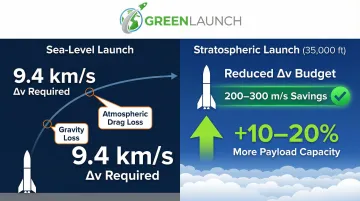
Delta-v—the total velocity change required to reach orbit—is the fundamental currency of spaceflight. Low Earth orbit (LEO) requires approximately 9.4 km/s of delta-v from sea level. Launching from 35,000 feet reduces this requirement by roughly 200-300 m/s, primarily by:
- Avoiding the densest atmospheric layers during initial acceleration
- Reducing gravity losses during the climb to altitude
- Enabling more efficient engine operation throughout the ascent
This 200-300 m/s savings translates directly to smaller propellant tanks, lighter vehicle structure, and either increased payload capacity or reduced launch costs. For a medium-lift rocket, this can mean 10-20% more payload to orbit.
Air-launch vehicles and ground-based kinetic systems each exploit these altitude-dependent physics — but they arrive at the same advantage through fundamentally different approaches, as the following sections examine.
Air-Launch Platforms: Carrier Aircraft and Their Capabilities
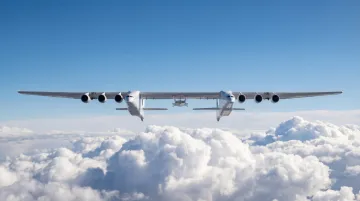
Air-launch-to-orbit (ALTO) relies on a simple premise: a massive carrier aircraft lifts a rocket to stratospheric altitude, releases it mid-flight, and the rocket's engines ignite in thin air. The most visible example is Stratolaunch's "Roc" — currently the largest aircraft in the world by wingspan, purpose-built for this mission.
Stratolaunch Roc: Engineering at Scale
Roc's specifications reveal the engineering challenge of air-launch:
- 385-foot wingspan (wider than a football field)
- Twin-fuselage design for structural efficiency and payload clearance
- Six Pratt & Whitney PW4056 turbofan engines (borrowed from Boeing 747-400s)
- 550,000-pound payload capacity at takeoff
- Design ceiling of 35,000 feet with payload attached
The carrier aircraft takes off from a conventional runway, climbs to altitude, flies to the optimal geographic release point, and drops the rocket. The rocket's engine ignites seconds later, beginning its ascent to orbit.
Operational Flexibility Advantage
Air-launch platforms offer three operational advantages ground-based systems can't easily match:
- Geographic flexibility — operators can fly to the optimal release point and choose orbital trajectory direction in real time, unconstrained by fixed pad locations
- Weather avoidance — the carrier repositions above cloud cover, cutting the delays that regularly ground surface-based launches
- Lower infrastructure overhead — no coastal launch facilities, flame trenches, or fixed propellant-loading systems required
Evolution Beyond Satellite Delivery
Air-launch payloads have evolved significantly. Early systems like Pegasus XL (launched from modified L-1011 carrier aircraft in the 1990s) focused purely on small satellite delivery. Stratolaunch has pivoted toward hypersonic vehicle testing with its Talon-A vehicle, reaching Mach 5–7.
Stratolaunch's TA-2 vehicle completed reusable hypersonic flights in December 2024 and March 2025. Air-launch has become a viable testbed for advanced aerodynamic research — well beyond its origins in small satellite delivery.
Other Notable Programs:
- Virgin Orbit's LauncherOne: Boeing 747-based, achieved first successful orbital launch in 2021, later acquired by Stratolaunch as "Spirit of Mojave"
- DARPA programs: Researching rapid-response launch capabilities for national security applications
- NASA's historical programs: B-52 carrier aircraft launched the X-15 and numerous other experimental vehicles, establishing the foundational technology
Payload Scale Constraints
Air-launch faces an inherent limitation: the carrier aircraft must lift both itself and the rocket to altitude. This constrains rocket mass relative to ground-launched systems.
Comparison of payload-to-LEO capacity:
- Pegasus XL: ~450 kg to LEO
- Falcon 9: ~22,800 kg to LEO
- New Glenn: ~45,000 kg to LEO
Air-launch occupies a distinct niche — payloads under 1,000 kg — where its geographic flexibility and infrastructure savings outweigh its mass limitations. For anything heavier, the physics of carrier-lift impose a ceiling that no operational design has yet overcome. This constraint is precisely why alternative approaches, including ground-based kinetic launch systems, have continued to attract development interest.
Operational Realities and Limitations of Air-Launch Systems
Air-launch systems carry real operational weight — and real costs. Building and maintaining a carrier aircraft at Roc's scale requires serious investment: development costs for Stratolaunch exceeded $400 million, with ongoing requirements including:
- Specialized hangars capable of housing a 385-foot wingspan
- FAA certification for experimental aircraft categories
- Maintenance programs for six turbofan engines
- Flight crew training and support infrastructure
Payload Mass Ceiling Problem
Air-launch systems occupy a well-defined niche, suited for:
- Small-satellite constellation deployment (100-500 kg payloads)
- Hypersonic test vehicle launches
- Rapid-response intelligence satellites
- Scientific payloads requiring precise orbital parameters
They cannot compete economically with Falcon 9 or New Glenn for:
- Large geostationary communications satellites (5,000+ kg)
- Deep-space missions requiring substantial delta-v
- Crewed spacecraft requiring robust abort systems
- Heavy cargo delivery to the International Space Station
Weather and Altitude Ceiling Trade-offs
While air-launch avoids some ground-level weather constraints, the carrier aircraft itself operates at 35,000–45,000 feet—within the lower stratosphere. At 35,000 feet, the temperature is approximately -54°C to -57°C, requiring specialized thermal management for both carrier and payload during the captive carry phase.
That ceiling is also a hard constraint on performance. Ground-based kinetic systems — the focus of the next section — sidestep this entirely, launching payloads directly into the upper stratosphere or beyond without the altitude limitations baked into any aircraft platform.
Kinetic Launch Systems: Light-Gas Guns, Railguns, and Beyond
Kinetic launch systems work on a different principle: they use stored energy on the ground to accelerate a payload to extreme velocities, potentially reaching orbital velocity or achieving stratospheric altitudes before any secondary propulsion activates.
Three main categories exist:
Light-gas guns: Use compressed low-molecular-weight gas (typically hydrogen) expanded rapidly to accelerate projectiles to several kilometers per second
Electromagnetic railguns/coilguns: Use Lorentz force to accelerate conductive projectiles along electromagnetic rails
Mass drivers: Use sequential electromagnetic coils to accelerate payloads progressively along a track
How Light-Gas Guns Work
Light-gas guns exploit fundamental thermodynamics. A heavy piston compresses a low-molecular-weight gas (typically hydrogen) to extremely high pressures. When released, the gas expands rapidly down a barrel, accelerating a projectile to velocities conventional gunpowder cannot achieve.
Hydrogen is the propellant of choice because its low molecular weight (2, compared to nitrogen's 28 or CO₂'s 44) produces much higher acoustic velocities in the gas. Since projectile velocity is tied directly to gas acoustic velocity, that light weight translates into muzzle velocities of 5-9 km/s — territory chemical propellants cannot reach.
The maximum theoretical velocity follows the relationship: Vpractical = C₀ / (Gamma - 1), where C₀ is the speed of sound in the gas and Gamma is the ratio of specific heats. For hydrogen at 2,000-2,500 K, this yields practical velocities of 8,000-9,000 m/s.
Green Launch: Leading Light-Gas Propulsion
Green Launch represents the current state-of-the-art in light-gas propulsion for space access. The company's CTO, Dr. John W. Hunter, previously led the SHARP (Super High Altitude Research Project) at Lawrence Livermore National Laboratory from 1992-1998, where he directed construction of the world's largest hydrogen impulse launcher and successfully launched nine hypersonic scramjets at velocities up to Mach 9.
Building on that research, Green Launch achieved its first vertical light-gas launch for space access in December 2021 — reaching Mach 3 and an estimated altitude of 30 km with a 28-pound steel and tungsten projectile. Recent testing in October 2025 pushed that further, achieving 2.97 km/sec (Mach 9) using a 54-foot launch tube.
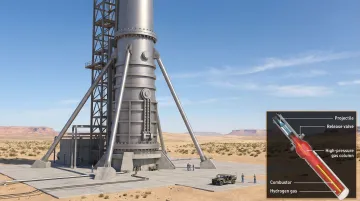
Green Launch's hydrogen and oxygen propellant system produces only water vapor as exhaust. With demonstrated propellant capture efficiency exceeding 91%, the system releases virtually nothing into the atmosphere — zero carbon emissions for suborbital launches.
Electromagnetic Kinetic Launch Concepts
Electromagnetic railguns and coilguns use Lorentz force rather than gas expansion to accelerate conductive projectiles. Current research and development includes:
- U.S. Navy railgun programs (though funding has been reduced)
- NASA electromagnetic launch initiatives exploring lunar surface launch
- Various university and private-sector research projects
These systems offer some compelling theoretical advantages over chemical or gas-based approaches:
- No combustion byproducts
- Electrically powered — compatible with renewable energy sources
- Potentially higher velocities than chemical propulsion
In practice, however, three engineering problems keep electromagnetic launch experimental: power storage requirements in the megawatt range delivered in milliseconds, severe barrel wear from arcing and mechanical stress, and payload G-forces reaching tens of thousands of Gs.
Railgun development for space access remains primarily experimental, with no operational systems demonstrated to date.
Payload Survivability Constraint
Whether gas-powered or electromagnetic, all kinetic systems share one hard constraint: payloads must survive extreme acceleration forces, potentially 10,000-30,000 Gs depending on barrel length and muzzle velocity.
This constraint defines which payload types are viable:
Good candidates include raw materials, propellant, fuel depot supplies, and small hardened satellites — payloads that are structurally dense with no sensitive components. Poor candidates include sensitive instruments, deployable optics, and humans (maximum survivable acceleration is roughly 50 Gs).
Standard commercial electronics fall somewhere in between. Green Launch has demonstrated that off-the-shelf electronics can survive 30,000 Gs with minor modifications, assembled into compact payload volumes approximately 1.25 inches diameter by 4 inches long — which meaningfully expands the viable payload set.
Modern packaging techniques are addressing this limitation.
Comparing the Two Approaches: Payload, Cost, and Mission Fit
Air-launch platforms and kinetic systems serve different market segments, each optimized for specific mission profiles.
Comparison Across Key Dimensions:
| Dimension | Air-Launch Platforms | Kinetic Systems |
|---|---|---|
| Payload Mass Capacity | 100-1,000 kg to LEO | Currently <10 kg; scaling to 100-1,000 kg |
| Payload Sensitivity Tolerance | Handles delicate electronics, optics, scientific instruments | Requires ruggedized payloads surviving 10,000-30,000 Gs |
| Infrastructure Cost | $400M+ development; specialized hangars; ongoing maintenance | $50-200M development; reusable ground facility; minimal per-launch cost |
| Environmental Footprint | Jet fuel combustion; standard aviation emissions | Zero carbon (hydrogen-oxygen); 91%+ propellant recapture |
Complementary, Not Competing
The two approaches address different market needs:
Kinetic systems are the stronger fit for:
- High-volume, low-cost delivery of rugged payloads
- Propellant and raw material delivery to orbit
- Small hardened CubeSats
- Rapid-response launch cadence (60-90 minute intervals)
- Missions where cost-per-kilogram is the primary decision driver
Air-launch platforms are the stronger fit for:
- Sensitive, mission-specific payloads (optics, scientific instruments)
- Precise orbital targeting and inclination control
- Hypersonic vehicle testing and research
- Missions requiring human oversight or last-minute intervention
Hybrid Architectures
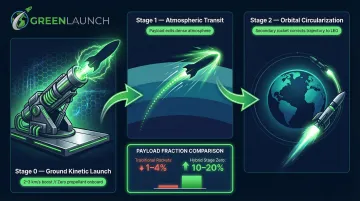
Recognizing that neither approach covers every mission alone, some architectures combine both: kinetic systems provide the initial velocity boost (potentially 2-3 km/s), then a small secondary rocket corrects trajectory and circularizes the orbit. Green Launch explicitly uses this architecture, describing their ground-based launcher as "Stage Zero" that accelerates payloads through the atmosphere, after which a small rocket engine supplies the remaining velocity to attain orbit.
The payload fraction gains are concrete: traditional rockets achieve 1-4% payload fractions, while Green Launch's Stage Zero concept reaches 10-20% by eliminating expendable first and second stages.
Cost Per Kilogram: The Economic Metric
Current market rates vary widely:
- Falcon 9 (rideshare): ~$3,000-$5,500/kg
- Electron (dedicated small-sat): ~$20,000-$30,000/kg
- Traditional small launchers: $15,000-$50,000/kg
Both air-launch and kinetic systems aim to undercut these figures:
- Green Launch target: $220/kg ($100/lb) for orbital delivery
- Air-launch systems: Competitive pricing for 100-500 kg payloads in the $5,000-$10,000/kg range
For their respective payload classes, both approaches offer meaningful cost advantages over traditional chemical rockets.
Frequently Asked Questions
How cold is it at 35,000 feet?
At 35,000 feet, temperatures reach roughly -65°F to -70°F (-54°C to -57°C) — well within the tropopause-stratosphere boundary. Carrier aircraft and launched vehicles require specialized thermal management to protect avionics, propellants, and structural components during captive carry.
What planes fly at 60,000 feet?
Very few aircraft reach 60,000 feet. The U-2S and ER-2 operate above 70,000 feet, and the SR-71 exceeded 85,000 feet; most air-launch platforms like Stratolaunch's Roc top out at 35,000–45,000 feet. At 60,000 feet, air is thin enough that only purpose-built aircraft with specialized engines can sustain flight.
What is the advantage of launching a rocket from high altitude?
Higher altitude means thinner air, which reduces atmospheric drag on the rocket, allows rocket engines to operate more efficiently (higher specific impulse), and reduces the total delta-v needed to reach orbit by approximately 200–300 m/s. The net result: smaller rockets or larger payloads, typically a 10–15% efficiency gain over sea-level launch.
How does a light-gas gun work for launching payloads to space?
A light-gas gun expands compressed hydrogen — driven by a piston or combustion — to accelerate a projectile to several kilometers per second. Hydrogen's low molecular weight produces muzzle velocities far beyond what gunpowder can achieve, making it viable for launching rugged payloads to orbital or near-orbital altitudes without onboard propellant.
What kinds of payloads are best suited for kinetic launch systems?
Dense, structurally robust payloads — raw materials, propellant, hardened CubeSats, and orbital supply cargo — handle kinetic launch's 10,000–30,000 G loads well. Sensitive optics, scientific instruments, and crewed missions require air-launch or conventional rockets instead.
Is kinetic launch more environmentally friendly than traditional rockets?
Yes. Kinetic systems like Green Launch's light-gas gun use hydrogen and oxygen propellants that produce only water vapor, with demonstrated 91% propellant recapture enabling virtually zero atmospheric emissions. Traditional rockets produce over 19 tons of CO₂ per ton of payload to orbit, while kinetic systems eliminate combustion exhaust entirely for the primary acceleration phase, though orbital circularization may still require a small rocket stage.