Introduction
NASA's Artemis program aims to establish a permanent Moon base by the early 2030s, targeting monthly robotic landings alongside regular crewed missions. This ambitious timeline demands a supply chain infrastructure unlike anything operated beyond Earth orbit. Yet a fundamental bottleneck has emerged: the same heavy-lift rockets designed for prestigious crewed flights—costing billions per launch—cannot economically serve as workhorses for routine depot resupply.
NASA Administrator Jared Isaacman stated bluntly in February 2026, "Launching a rocket as important and as complex as SLS every three years is not a path to success." The revised Artemis architecture now demands at least one lunar surface landing annually post-2028, with cadence scaling toward monthly robotic missions. This operational tempo requires a different class of launch system entirely—one optimized for high frequency and low cost rather than maximum payload mass.
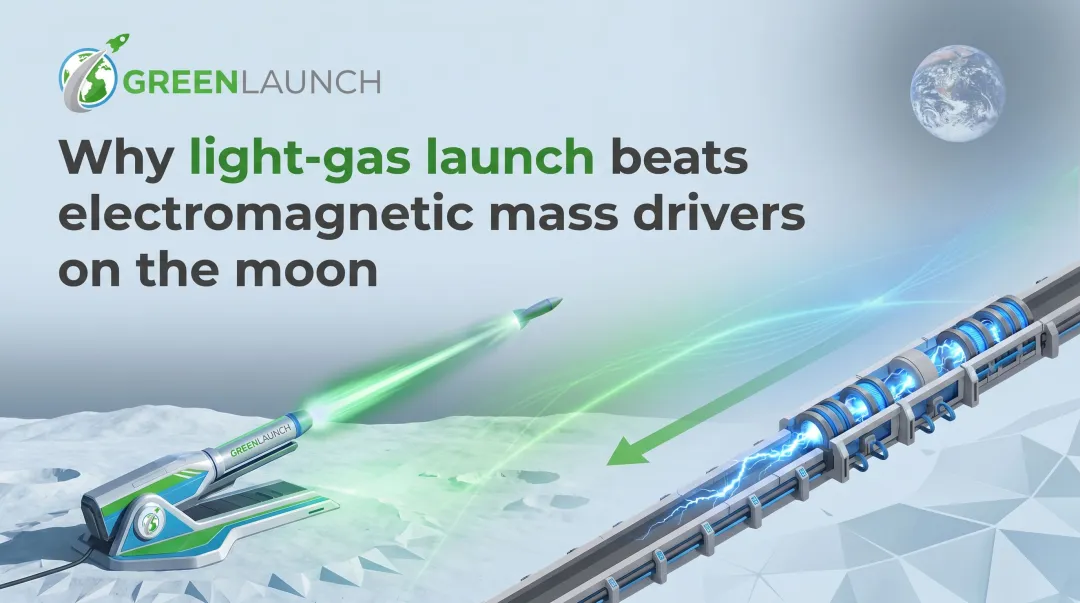
Light-gas launch systems are purpose-built for exactly this gap. Ground-based and reusable, they achieve Mach 9-class velocities with reset cycles measured in minutes rather than months. Propellant costs run a fraction of conventional rockets, making routine delivery of ruggedized bulk cargo—water, propellant, consumables—economically viable at the cadences orbital depots will need. Green Launch conducted its first vertical light-gas launch for space access in 2022, moving the concept from theory to demonstrated hardware.
Key Takeaways
- Artemis demands annual-or-faster lunar landings requiring continuous orbital depot resupply
- SLS costs $2.5 billion per launch and launches every three years—economically unsuitable for logistics
- Light-gas systems deliver propellant and supplies at $100/lb with 60–90 minute launch turnaround
- Green Launch has demonstrated Mach 9 exit velocity and 91% propellant recovery using hydrogen-oxygen combustion
Why High Cadence Is Now a Hard Requirement for Lunar Operations
The Artemis Cadence Crisis
NASA's February 2026 architectural overhaul fundamentally redefined what success looks like for lunar operations. Administrator Isaacman's statement that three-year launch intervals represent failure was not rhetoric—it was strategic diagnosis. When launches happen infrequently, contractor workforces lose skills, mission planners lose operational rhythm, and the entire lunar program loses credibility.
The revised Artemis plan now targets:
- Artemis IV (early 2028): First lunar surface landing under updated architecture
- Post-2028: Minimum one surface landing per year
- Late 2020s onward: Scaling toward monthly robotic logistics missions
This represents a shift from episodic exploration to sustained infrastructure operation. The economic and operational model must change accordingly.
Why Skills Atrophy Matters
Isaacman's observation that "when you're launching every three years, your skills atrophy" applies across the entire supply chain. Infrequent operations mean:
- Contractor workforce turnover between missions erodes institutional knowledge
- Ground infrastructure sits idle for years, requiring costly recommissioning
- Mission planning teams lose the operational rhythm that only repetition builds
- Supply chain vendors cannot sustain specialized capability without steady demand
High cadence solves this by creating operational continuity. Frequent missions keep teams sharp, infrastructure active, and vendors engaged.
Orbital Depots as the Linchpin
NASA Marshall Space Flight Center studies identify propellant depots at LEO and Earth-Moon L1 as central to sustainable cislunar architecture. Landers like SpaceX's Starship HLS and Blue Origin's Blue Moon require propellant staging in cislunar space to be economically viable at high cadence.
The bottleneck is upstream. If depot resupply depends on the same rockets used for crewed missions, resupply cost and cadence become the binding constraint on the entire program. A depot serving monthly lunar missions needs continuous, high-volume propellant delivery — a demand that conventional heavy-lift rockets cannot meet economically at that frequency.
This is where alternative launch architectures become relevant. Ground-based light-gas systems, designed for high-tempo delivery of acceleration-tolerant payloads, address precisely the resupply cadence gap that rocket-centric models leave open.
The Orbital Depot Resupply Problem: Volume, Frequency, and Cost
What Depots Do and Why They Matter
An orbital propellant depot acts as a fuel station in space, allowing landers and transfer vehicles to refuel before and after lunar missions. This dramatically reduces the propellant mass that must be launched from Earth on every crewed flight, making reusable lunar architectures economically feasible.
The Scale of Demand
NASA Marshall research estimates approximately 51.8 metric tonnes of propellant per lunar mission:
- Crew Transfer Vehicle: 21.8 mt (LEO to L1 round trip)
- Lunar Lander: 30 mt (L1 to surface round trip)
For sustained operations, ULA studies project 100-200 mt of liquid oxygen annually to support lunar missions.
To illustrate the logistical challenge: NASA OIG reports SpaceX plans more than 10 Starship tanker launches per HLS mission, targeting one tanker flight every 6 days. The OIG flagged this cadence as a "top risk," noting SpaceX has not demonstrated the required 12-24 day pad turnaround.
Why Conventional Rockets Are the Wrong Tool
Premium launch vehicles face fundamental mismatches with depot resupply:
Economic mismatch:
- SLS costs $2.5 billion per launch (NASA OIG projection)
- Small commercial launchers cost $14,500-37,500/kg
- Applying crew-rated launch economics to commodity propellant cargo inflates resupply costs by orders of magnitude
Operational mismatch:
- Long turnaround times (weeks to months)
- Complex range scheduling and logistics
- Cannot scale frequency without massive infrastructure investment
What Depot Resupply Actually Needs
Ideal characteristics for depot logistics:
- Low cost per kg — propellant is a commodity cargo
- Rapid turnaround — hours or days, not months
- High launch rate — without proportional infrastructure scaling
- Ruggedized payload tolerance — tanks, water, and packaged consumables don't need gentle handling
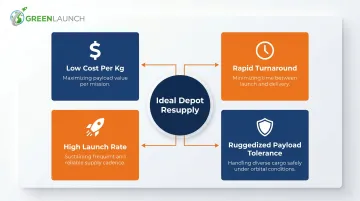
Light-gas systems address each of these constraints directly — through mechanical simplicity, ground-based infrastructure, and launch cycles measured in hours rather than weeks. The next section examines how that translates into practical resupply cadence.
How Light-Gas Systems Work and Why They're Built for This Role
Operating Principle
A two-stage light-gas gun uses a driver gas—typically hydrogen—to accelerate projectiles to hypersonic velocities through a long barrel. The process:
- First stage: Conventional propellant or compressed gas drives a piston down a pump tube containing hydrogen
- Compression: The piston compresses hydrogen to 40-100x initial volume, heating it to extreme temperatures
- Second stage: A diaphragm bursts at threshold pressure; expanding high-temperature hydrogen accelerates the projectile through the launch tube
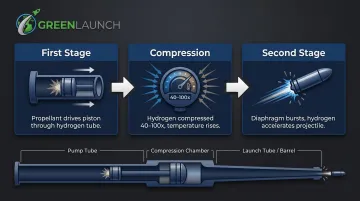
Hydrogen's low molecular weight (M ≈ 2) produces a higher sound speed than helium, translating to roughly 8.5% greater muzzle velocity — which matters significantly at hypersonic scales.
Performance Metrics
Demonstrated capabilities:
- Green Launch achieved 2.97 km/s (Mach 9) with a 54-foot launch tube
- SHARP project at Lawrence Livermore demonstrated 3 km/s (Mach 8.8) with 5 kg projectiles in 1992
- Reset cycles: 60-90 minutes between launches
These velocities enable sub-orbital trajectories and, with a secondary rocket stage, orbital insertion.
Environmental Advantage
Green Launch's hydrogen/oxygen propulsion produces water vapor as the primary exhaust byproduct—no hydrocarbons, no HCl, no alumina. The system captures over 91% of propellant gas post-launch, leaving minimal residual emissions for sub-orbital missions.
The contrast with solid rocket motors is significant:
| Light-Gas (H₂/O₂) | Solid Rocket Motor | |
|---|---|---|
| Primary exhaust | Water vapor | HCl, alumina, CO₂, black carbon |
| Propellant recovery | >91% captured | None |
| Stratospheric GWP | Negligible | Black carbon estimated at 23,000× CO₂ |
For sites targeting thousands of flights annually, that emissions gap becomes a regulatory differentiator — and a practical one for securing launch licenses.
Why Light-Gas Fits Depot Resupply
Light-gas systems offer three structural advantages for depot resupply:
- Fixed infrastructure model: one-time facility cost with low marginal cost per shot
- High-cadence operation: multiple launches per day from a single installation
- Bulk cargo optimization: designed for dense, ruggedized payloads — exactly the profile of propellant tanks
Green Launch has demonstrated Mach 9 performance and completed vertical launch testing — the two milestones that matter most for credibly bridging ground-based acceleration to actual depot resupply logistics.
Payload Compatibility: What Can a Light-Gas Gun Actually Deliver?
The High-G Constraint
Light-gas systems produce extreme acceleration—artillery projectiles routinely survive 20,000 G's, and laboratory guns have demonstrated over 149,000 G's. This means payloads must be structurally ruggedized. Electronics-heavy or mechanically delicate payloads are not suitable; dense, robust payloads are ideal.
Naturally Compatible Depot Payloads
Dense, structurally robust materials translate directly to the depot's most pressing needs:
- Liquid propellant in pressure-rated tanks — designed to withstand structural loads
- Water — for electrolysis into H2/O2 or life support use
- Solid consumables — packaged food, replacement hardware, bulk materials
- Standardized cargo containers — pre-integrated modular units sized to barrel diameter
Propellant resupply is the highest-volume, highest-frequency depot need, which is precisely what light-gas systems are optimized to address.
Ruggedization Is a Solved Problem
U.S. Army Research Laboratory reports document methods for hardening electronics to gun-launch environments, and modern commercial components can withstand 30,000 G's with minor modifications.
A "hardened payload bus" for light-gas delivery typically involves:
- High compression-strength materials (wound fiberglass, alloy steel)
- Compact cylindrical geometry to distribute loads evenly
- Sabot sleeve integration to protect the payload during barrel transit
- Minimal moving parts or fragile mechanisms
These approaches draw on decades of gun-launch hardening work from defense research programs — the engineering is well-documented and field-tested, not theoretical.
The Cost Calculus: Per-Launch Savings at Scale
The Economic Argument
Light-gas systems do not replace rockets for crewed missions—they take over the commodity cargo segment. The value proposition is in high-volume, repeating bulk runs that dominate depot resupply tonnage.
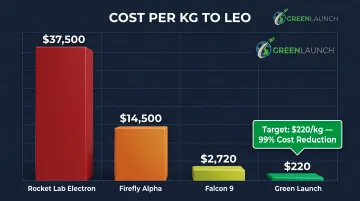
Comparative cost per kilogram:
| Launch System | Cost Per kg to LEO |
|---|---|
| Rocket Lab Electron | ~$37,500 |
| Firefly Alpha | ~$14,500 |
| Falcon 9 | ~$2,720 |
| Green Launch (target) | ~$220 |
Green Launch targets $100/lb (approximately $220/kg) based on a $200 million facility amortized over 5,000 launches annually.
Fixed-Cost Advantage
The economics invert conventional rocket models:
Rockets:
- Per-unit manufacturing costs for every flight
- Marginal cost stays high even at scale
- Reusable vehicles still require refurbishment
Light-gas systems:
- Dominant cost is the one-time facility build
- Marginal cost driven by propellant and consumables only
- Cost per launch falls as cadence increases — a dynamic rockets cannot replicate
- Higher shot volume spreads fixed infrastructure costs further
At 5,000 shots per year, facility amortization contributes $40,000 per shot over five years. The rest is hydrogen, oxygen, and projectile casings.
Operational Tempo Multiplier
Green Launch's 60-90 minute turnaround enables multiple launches per day from the same installation. A depot drawing down 500 kg of propellant daily could receive matched resupply within the same operational window, without waiting for the next scheduled launch slot. At that cadence, logistics stops being a bottleneck and starts behaving like a utility.
Frequently Asked Questions
Why is NASA using SLS?
The Space Launch System was developed as NASA's super-heavy lift vehicle for crewed Artemis missions requiring maximum payload mass to the Moon. However, its $2.5 billion cost per launch and three-year turnaround have prompted NASA to seek higher cadence through architectural changes and complementary commercial systems for logistics.
What is an orbital propellant depot and why does it need frequent resupply?
An orbital depot is a fuel storage facility in cislunar space that allows landers and transfer vehicles to refuel between Earth and the Moon. Sustaining monthly lunar missions requires regular, high-volume propellant deliveries—potentially hundreds of metric tonnes annually—to keep the depot stocked and operational.
What payloads are suitable for light-gas gun launch systems?
Light-gas systems are best suited for ruggedized, high-density payloads such as propellant tanks, water, packaged consumables, and hardened hardware. These payloads can withstand high-g acceleration loads and do not require fragile electronics or delicate mechanisms during launch.
How does launch cadence affect the economics of a cislunar supply chain?
Higher cadence amortizes fixed infrastructure costs across more missions, reduces per-unit delivery cost, and ensures depots are restocked at the rate they are consumed. Without sufficient cadence, depot logistics become the bottleneck constraining the entire lunar program—making launch frequency as important as launch capability.
Can light-gas systems launch payloads directly to lunar orbit, or only to Earth orbit?
Current light-gas systems target sub-orbital and low Earth orbit delivery. Orbital depot resupply requires a transfer stage or rendezvous maneuver for the final leg. This two-step architecture is compatible with how orbital depots are designed to operate, aggregating payloads in LEO before cislunar transfer.
What makes light-gas propulsion more environmentally sustainable than conventional rockets?
Light-gas systems using hydrogen and oxygen produce water vapor as their primary exhaust product. This avoids the carbon emissions, particulate matter, and toxic residues associated with solid rocket motors and hypergolic propellants. At high cadences, that clean profile becomes a meaningful operational and regulatory advantage.