As costs drop from tens of thousands of dollars per kilogram to potentially hundreds, the implications ripple across commercial, scientific, geopolitical, and environmental domains. The cheapest ways to access space now determine who can participate in the new space economy, from university researchers deploying atmospheric sensors to defense agencies rapidly reconstituting satellite constellations. The transition from expensive, infrequent launches to affordable, rapid-cadence access fundamentally reshapes what becomes possible beyond Earth's atmosphere.
This article explores what's driving costs down, what becomes possible as barriers fall, who stands to benefit, and what risks emerge alongside the opportunities.
Key Takeaways
- LEO launch costs once ran $10,000–$54,000/kg, putting space out of reach for most organizations
- Reusable rockets, commercial competition, and alternative propulsion are now cutting those costs sharply
- Cheaper access enables more satellites, affordable science missions, defense applications, and new commercial markets
- Orbital congestion, geopolitical friction, and environmental impact follow as space gets more crowded
- Aerospace, defense, and research professionals need to understand these dynamics now
Why Getting to Space Has Always Been So Expensive
The fundamental physics problem is unforgiving: to reach orbital velocity of roughly 7.8 km/s, a rocket must carry most of its own mass as propellant, leaving very little mass available for payload. This is the tyranny of the rocket equation — typically 90% of a chemical rocket's mass is propellant, meaning the vehicle must be enormous just to lift enough fuel to reach orbit.
That physics constraint translated directly into cost. For decades, launch prices reflected the reality that every kilogram to orbit required a massive, largely expendable vehicle built around propellant mass, not payload capacity.
Historical Cost Trajectory
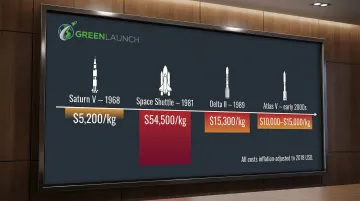
Launch costs remained stubbornly high for decades:
- Saturn V (1968): ~$5,200/kg to LEO (inflation-adjusted to 2018 dollars)
- Space Shuttle (1981): ~$54,500/kg to LEO
- Delta II (1989): ~$15,300/kg to LEO
- Atlas V (Early 2000s): $10,000–$15,000/kg
The status quo persisted because competition was limited (mostly government programs), and no economic incentive existed to innovate on reusability. That changed when the commercial satellite boom created real market demand — and with it, the pressure to finally drive costs down.
How the Space Industry Is Driving Down Launch Costs
Reusable Rockets: The First Breakthrough
SpaceX's Falcon 9 demonstrated that recovering and reflying first-stage boosters could slash per-launch costs. SpaceX advertises Falcon 9 launches at $67 million for 22,800 kg to LEO, equating to roughly $2,720/kg—a fraction of the Space Shuttle's $54,500/kg. The company has achieved up to 27 reflights per booster, with analysts estimating internal costs below $20–30 million per launch.
Commercial Competition and Rideshare Programs
The entry of multiple private launch providers has created market pressure governments alone never generated. In 2024, 27 distinct launch service providers completed orbital launches globally. SpaceX's Smallsat Rideshare Program offers launches for $5,500–$7,000/kg, opening access to smaller customers who previously had to piggyback on larger missions with restrictive scheduling constraints.
Alternative Launch Systems: Beyond the Rocket Equation
Non-rocket launch concepts bypass the propellant-mass problem entirely, targeting cost reductions that conventional rockets can't match:
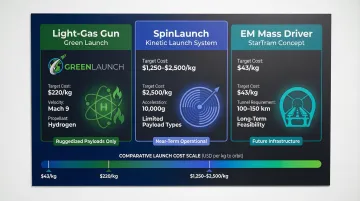
Light-Gas Propulsion Systems use compressed hydrogen as propellant to accelerate uncrewed payloads to hypersonic velocities. Pioneered through Dr. John Hunter's work at Lawrence Livermore National Laboratory's SHARP project, this approach is especially suited for ruggedized payloads such as small satellites and research instruments. Green Launch's hydrogen gun technology has achieved projectile velocities of 2.97 km/s (Mach 9) and targets launch costs of $220/kg—far below conventional rockets.
SpinLaunch's kinetic energy approach has tested payloads at 10,000g acceleration, targeting $1,250–$2,500/kg — though the severe g-forces limit payload types. At the far end of the spectrum, electromagnetic mass drivers like StarTram target costs as low as $43/kg, but require 100–150 km evacuated tunnels and infrastructure investment that remains well beyond current feasibility.
Miniaturization Enables New Economics
Lower launch costs matter most when payloads are small enough to take advantage of them. The rise of CubeSats has fundamentally changed what needs to be launched. In 2024, 2,790 smallsats (≤1,200 kg) were launched, representing 97% of all spacecraft deployed. Smaller payloads require less lift capacity, making cost-per-launch viable for many missions. The average smallsat mass reached a record 223 kg in 2024, driven primarily by heavier broadband constellation satellites.
Launch Frequency and Scheduling
Beyond per-kg cost, reliable access to frequent launch windows is critical for commercial viability. Prior to dedicated rideshare programs, small satellite operators faced three compounding barriers:
- Waiting months for available slots on larger missions with no guaranteed timeline
- Accepting whatever orbit the primary payload required, regardless of mission needs
- Paying integration fees that eroded the savings from sharing a ride
This scheduling bottleneck constrained small payload customers as much as cost itself.
Opportunities Unlocked by Affordable Space Access
Commercial Satellite Industry Expansion
Lower costs enable constellations of LEO satellites for broadband internet, Earth observation, precision agriculture, and climate monitoring. Euroconsult estimates approximately 18,500 satellites will be launched by 2031, averaging over 2,500 satellites per year. The global space economy generated $415 billion in 2024, with the commercial satellite industry accounting for 71% ($293 billion) of that total. Mega-constellations would not be economically viable without recent exponential reductions in launch costs.
Scientific Research and Heliophysics
NASA's Heliophysics Low Cost Access to Space (H-LCAS) program illustrates how affordable suborbital and orbital access is reshaping science. More frequent, smaller missions now compete with — and often complement — the traditional model of one large flagship observatory:
- Pioneers (SmallSat/Balloon): $20 million cost cap (excluding launch)
- Small Explorers (SMEX): $150 million cost cap (excluding launch)
- Nancy Grace Roman Telescope: $4.3 billion life-cycle cost
- James Webb Space Telescope: $9.7 billion total cost
That cost gap is significant: a university or small research organization can now run a real science mission for what a flagship program spends on a single instrument.
Defense and National Security
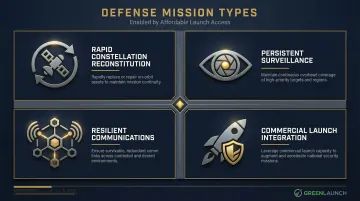
CSIS research highlights that ultra-low-cost access would unlock military missions currently considered cost-prohibitive. U.S. Space Command leadership testified in 2025 that "rapidly regenerating and reconstituting space capabilities" is central to deterrence. Key mission types that depend on lower launch costs include:
- Rapid reconstitution of satellite constellations after conflict or failure
- Persistent surveillance with redundant, replaceable assets
- Resilient space-based communications that can't be neutralized by destroying a single satellite
- Seamless integration with commercial launch capacity to surge capability on demand
Economic Democratization
Cost barriers that once reserved orbital access for superpowers are falling. Thirteen countries and one inter-governmental organization (ESA) now have proven independent orbital launch capability. India's PSLV, for example, competes at $25–$35 million per launch ($7,000–$15,000/kg), bringing viable options to emerging markets, academic institutions, and small commercial startups that previously had no seat at the table.
New Applications on the Horizon
Space-based solar power, in-space manufacturing, and asteroid resource extraction all become economically viable only if access costs drop to the hundreds-of-dollars-per-kg range rather than thousands. None of these industries can scale at current pricing — but analysts project that crossing the $500/kg threshold could trigger the same kind of market expansion that cheap bandwidth sparked for the internet economy.
Strategic and Geopolitical Implications
Democratization Cuts Both Ways
While affordable launch access empowers universities and startups, it also lowers barriers for actors with less benign intentions. The tension between openness and security includes the risk of adversarial use of commercial launch capacity. The DoD and RAND note that advantage accrues to the side that mitigates risks and takes advantage of accessible and affordable commercial launch services with greatest speed, agility, and consistency.
These security concerns don't exist in isolation — they compound as orbit itself becomes more crowded and contested.
Orbital Congestion and Kessler Syndrome
As launch frequency increases, so does the density of objects in orbit. ESA's Space Environment Report estimates 1.2 million objects between 1 cm and 10 cm, and 130 million objects between 1 mm and 1 cm, currently in orbit as of 2024. Kessler syndrome, first described by Donald J. Kessler and Burton G. Cour-Palais in 1978, postulates that collision frequency between artificial satellites could create a debris belt, triggering a runaway cascade of collisions.
ESA models show that within the most congested altitude bands (500–600 km), active payloads and debris are now approaching the same density. Without coordinated action, current trends point toward:
- Collision rates rising faster than debris removal can offset
- Key low-Earth orbit bands becoming operationally unsafe
- Loss of orbital slots that underpin GPS, weather, and communications infrastructure
The ITU's 5-year deorbit rule and active debris removal initiatives address part of this — but enforcement across sovereign operators remains an open problem.
The orbital congestion challenge has a direct geopolitical dimension: who controls access to the remaining safe orbits shapes economic and military power for decades.
Shifting Geopolitical Power
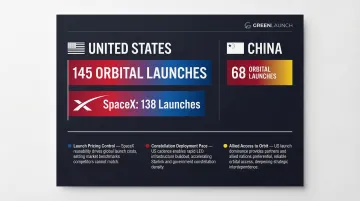
The United States' traditional dominance in space is being challenged. The U.S. conducted 145 orbital launches in 2024 (with SpaceX accounting for 138), while China conducted 68. Lowest-cost reliable launch is a strategic asset. The nation or company that achieves it controls pricing for allied and commercial customers, sets the pace for satellite constellation deployment, and determines who gets affordable access to orbit at all.
Environmental Considerations and the Push for Sustainable Launch
Traditional Rocket Propellants and Their Footprint
Many conventional launch vehicles burn RP-1 (kerosene) or solid propellants that produce black carbon (soot) at high altitudes. Rockets burning kerosene emit black carbon particles directly into the stratosphere, with BC emission indices two orders of magnitude larger than jet engines. Maloney et al. (2022) modeled that a 10 Gg/yr rocket BC emission increases stratospheric temperatures by up to 1.5 K, causing a reduction in the total ozone column, mainly in northern high latitudes.
The Case for Cleaner Propellants
Hydrogen-oxygen systems produce water vapor as their primary exhaust product, making them significantly cleaner than hydrocarbon-based rockets. Traditional RP-1 and solid-propellant rockets produce over 19 tons of CO₂ per ton of payload delivered into orbit. Hydrogen-oxygen systems with propellant capture technology release virtually nothing by comparison.
That gap becomes consequential as launch rates scale from dozens to potentially thousands of flights per year. Green Launch was built around this premise — using hydrogen and oxygen as propellant specifically to avoid the atmospheric burden that hydrocarbon rockets carry at scale.
Space Debris as an Environmental Concern
Low-cost access that enables rapid deployment of large satellite constellations must be paired with end-of-life disposal planning and international coordination. In 2022, the FCC adopted a rule requiring non-geostationary LEO operators (below 2,000 km) to deorbit satellites within 5 years of mission end — cutting the legacy 25-year guideline by 80%. For operators deploying at high cadence, that timeline is now a design constraint, not an afterthought.
Frequently Asked Questions
How much does it currently cost to access space?
Current launch costs to LEO range from around $2,720/kg for reusable systems like SpaceX's Falcon 9 to $10,000–$15,000/kg for expendable rockets. Rideshare programs offer smallsat access at $5,500–$7,000/kg, while emerging alternative systems target $100–$1,000/kg for ruggedized uncrewed payloads.
What are the cheapest ways to access space?
The most cost-effective current options are rideshare on reusable rockets like SpaceX's Transporter program and CubeSat dispensers for small satellites. Emerging approaches — including light-gas guns and electromagnetic launchers — could further reduce costs for small, ruggedized uncrewed payloads built to withstand high-acceleration environments.
Why is lowering the cost of access to space important?
High launch costs are the primary bottleneck limiting scientific research, commercial satellite deployment, and national security capabilities. Lower costs directly expand what is possible for governments, companies, and researchers, enabling applications from climate monitoring to rapid satellite constellation reconstitution that were previously cost-prohibitive.
Can I legally launch a satellite?
Yes, but with regulatory requirements. In the U.S., the FCC oversees satellite frequency licensing and the FAA licenses commercial launches under 14 CFR Part 450. International operators must comply with ITU spectrum coordination and may need approval from their national space agency.
What types of payloads are best suited for low-cost launch systems?
Ruggedized, uncrewed payloads—such as small satellites, scientific instruments, and CubeSats—are the best fit for high-acceleration, non-rocket systems. Modern electronics can withstand up to 30,000 Gs with minor modifications, making them compatible with impulse launch technologies. Crewed and fragile payloads require traditional rocket launches.
How will affordable space access change the satellite industry?
Lower launch costs enable larger constellations, more frequent satellite replenishment, and entry by smaller players who previously couldn't afford dedicated launches. The economics shift from a few large missions to many smaller, agile ones — shortening replacement cycles and expanding services like global broadband and precision agriculture.