Introduction
Stratospheric access has become a serious budget line for aerospace teams, defense contractors, and research institutions—and the price spread is wide enough to cause real planning problems. NASA's Scientific Balloon Program alone supports 40–60 active stratospheric projects per year, and those missions span everything from atmospheric sampling to satellite component validation.
The appeal is straightforward: the stratosphere (roughly 12–50 km altitude) offers near-space conditions without the cost and regulatory complexity of a full orbital launch.
Costs range from a few hundred dollars for a basic weather balloon experiment to several hundred thousand for high-velocity propulsion-based launches. That gap isn't arbitrary — it reflects real differences in launch method, payload mass, mission requirements, and operational support.
This article breaks down real pricing ranges, the key cost drivers, what's typically included (and excluded) in launch quotes, and how to build an accurate mission budget.
Key Takeaways
- Stratospheric launch costs range from under $1,000 (DIY balloon) to $300,000+ (sounding rocket or advanced propulsion), with most professional missions falling between $10,000–$150,000
- Primary cost drivers: launch method, payload mass/volume, target altitude, mission duration, and support services (integration, tracking, recovery)
- Budget-conscious researchers typically use high-altitude balloons; defense and precision R&D missions opt for sounding rockets or alternative propulsion systems
- Low upfront quotes often mask costs in recovery risk, reliability, and repeatability — total mission cost is what matters
How Much Does It Cost to Launch a Payload to the Stratosphere?
There's no single fixed price for stratospheric access. The figure changes sharply based on your delivery mechanism, payload sophistication, and mission support requirements.
Two budgeting mistakes plague mission planners consistently. The first is assuming balloon launches will always suffice — without accounting for altitude limits, flight path control, or recovery uncertainty. The second is budgeting only for the launch vehicle and ignoring the support costs that follow.
Typical Cost Ranges by Launch Method
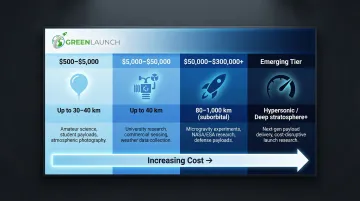
Entry-level / DIY high-altitude balloon: $500–$5,000
Complete vendor kits range from $399 to $829 for payloads under 2 kg. Total mission budgets typically run $430–$1,600 when factoring in balloon envelopes ($20–$400), helium ($120–$442), and aviation liability insurance. Best for universities, amateur scientists, and low-risk atmospheric data collection with payloads under 1–2 kg.
Professional high-altitude balloon (HAB) service: $5,000–$50,000
Full-service HAB operators handle launch, flight planning, FAA coordination, telemetry, and payload recovery. World View offers shared-payload pricing — where multiple experiments split a single flight — reducing entry costs to as low as $20,000 per experiment.
Suited to scientific institutions, government agencies, and companies needing reliable altitude profiles, longer float durations, or heavier payloads (up to ~30 kg).
Sounding rockets: $50,000–$300,000+
A typical Black Brant IX mission costs approximately $1.5 million, though NASA's 2011 sounding rocket program averaged $3.5 million per launch. These systems provide rapid ascent to the upper stratosphere or mesosphere, short payload exposure windows, and precise altitude targeting. Best for defense contractors, aerospace R&D firms, and experiments requiring microgravity or high-velocity deployment conditions.
Propulsion-based / light-gas launch systems: Emerging competitive tier
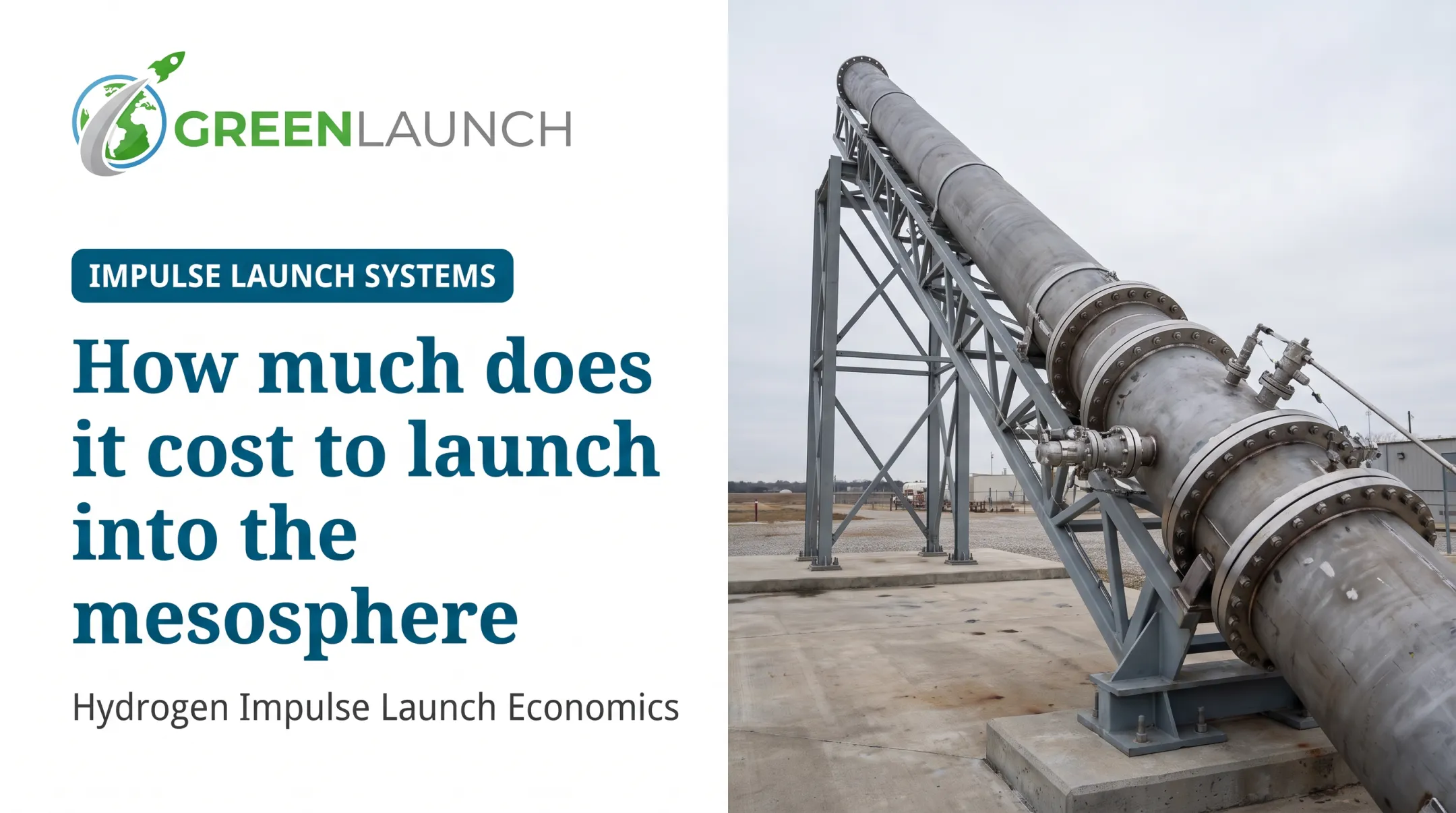
Green Launch's hydrogen-oxygen light-gas technology is targeting a cost tier well below conventional sounding rockets while achieving velocities suitable for stratospheric payload delivery. The company has reached vertical launch velocities exceeding Mach 3 with an estimated 30 km altitude capability using a 54-foot launch tube, and has demonstrated projectile velocities of 2.97 km/sec (Mach 9). Pricing has not been publicly listed, but the system is designed for repeatable, lower-cost access.
Ideal for organizations launching small, ruggedized payloads that require cost-effective cadence and environmentally cleaner propellants.
What's typically excluded from quotes:
Most base prices cover the vehicle, basic telemetry, and launch operations. Excluded costs can add 20–50% to your total budget:
- Payload engineering and integration
- Insurance and liability coverage
- Range fees and launch permits
- Data downlink systems
- Payload recovery operations
Key Factors That Affect the Cost of a Stratospheric Payload Launch
Two missions with similar payloads can vary in cost by an order of magnitude depending on technical, regulatory, and operational variables.
Launch Method and Propulsion Technology
Your choice between high-altitude balloon, sounding rocket, or propulsion-based system directly determines base price, altitude ceiling, payload survivability requirements, and overall mission profile. Propulsion-based systems like Green Launch's light-gas gun deliver lower per-launch costs than comparable rockets for organizations that need repeatable access to the upper atmosphere. The environmental difference is also measurable: the system produces only water vapor, while traditional rockets generate over 19 tons of CO₂ per ton of payload delivered to orbit.
Payload Mass, Volume, and Fragility
Heavier and larger payloads require larger balloon envelopes or more energetic propulsion systems, increasing cost non-linearly. Key reference points for balloon sizing:
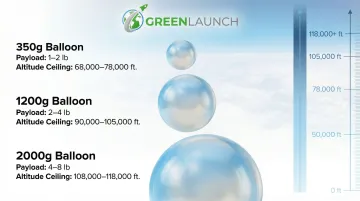
- A 350g balloon (~$39) lifts a 1–2 lb payload to 68,000–78,000 ft
- A 2000g balloon handles a 4–8 lb payload reaching 108,000–118,000 ft
- Fragile or sensitive instruments may require custom enclosures, vibration dampening, or active thermal management—each adding engineering and materials costs
Target Altitude and Mission Duration
Reaching 20 km costs significantly less than targeting 45–50 km. Professional scientific balloons can reach altitudes up to 42 kilometers, but the upper stratosphere requires either very large balloons or rocket propulsion. Longer float times (for atmospheric sampling) add complexity and cost compared to simple up-and-down profiles.
Regulatory Compliance and Range Fees
U.S. launches typically require:
- FAA Part 101 waivers for operations deviating from standard regulations
- FCC licenses for telemetry radios (Experimental Radio Service license: $125; Amateur license: $35)
- Range access fees at major U.S. test ranges including Wallops Flight Facility, White Sands Missile Range, and Poker Flat Research Range, which operate on a reimbursable basis charging for direct costs incurred
Requirements vary by launch method, altitude, and payload classification. Launches from dedicated ranges versus remote or commercial sites carry different fee structures and lead times.
Payload Integration, Tracking, and Recovery
Professional mission support—including payload interface design, pre-launch testing, real-time telemetry monitoring, and post-flight physical recovery—adds substantially to total mission cost. Missions requiring payload recovery (to reuse instruments or retrieve data) are substantially more expensive than expendable missions.
Full Cost Breakdown: What You're Actually Paying For
The total cost of a stratospheric launch goes well beyond the quoted vehicle price. Understanding each cost component is essential to building an accurate mission budget.
One-time / pre-mission costs (40–70% of total budget):
- Payload engineering and integration (designing the payload to survive launch conditions, mounting hardware, connectors)
- Launch vehicle or platform fee (the balloon, rocket, or propulsion system itself)
- Permitting and regulatory filings (FAA coordination, airspace waivers, range access)
- Pre-launch testing and qualification
Operational / launch-day costs:
- Launch crew and range operations
- Real-time telemetry and tracking infrastructure
- Weather monitoring and launch window optimization
- On-site safety and range compliance
For balloon launches these are often bundled into the service fee, but for rocket or propulsion-based launches, range operations fees can be substantial.
Recovery and post-flight costs:
- Physical payload recovery (ground chase teams, marine recovery for ocean splashdowns)
- Payload inspection and refurbishment
- Data retrieval and processing
Missions where payload recovery is critical (expensive instruments, classified sensors) may justify dedicated recovery operations budgets.
Recurring Costs for Multi-Launch Programs
Organizations running repeated stratospheric missions — regular atmospheric monitoring, iterative R&D campaigns — benefit from volume pricing and amortized permitting costs. The per-launch cost drops sharply with program scale.
That cadence advantage matters. Green Launch, for example, is built around high-frequency operations, capable of launching every 60 to 90 minutes. Its hydrogen light-gas propulsion system recovers 91% of propellant for reuse, which directly reduces the per-mission cost over a multi-launch program.
Budget vs. Premium Launch Options — What's the Difference?
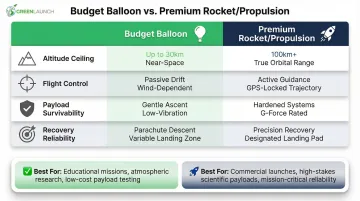
The gap between a $2,000 balloon launch and a $200,000 sounding rocket mission isn't just price—it reflects fundamental differences in mission capability, reliability, and risk profile. Here's how the core factors compare across launch types:
Capability comparison:
| Factor | Budget Balloon | Premium Rocket/Propulsion |
|---|---|---|
| Altitude ceiling | ~42 km maximum | 80–100+ km (rockets); 30+ km (light-gas systems) |
| Flight control | Subject to wind drift; no lateral control | Precise trajectory programming |
| Payload survivability | Gentle ascent (~400 ft/min) | High g-forces (32g for rockets; up to 30,000g for light-gas systems) |
| Recovery reliability | Weather-dependent; geographically unpredictable | Engineered for controlled return or impact zones |
When spending more makes sense:
Premium launch costs are justified when your mission requires:
- Precise altitude targeting or controlled trajectory
- High-velocity deployment conditions for payload testing
- Time-sensitive data collection windows
- Defense or national security applications
When balloon launches are the right choice:
Balloon launches are a practical fit for:
- Educational experiments and student payloads
- Long-duration atmospheric sampling at moderate altitudes
- Early-stage R&D where gentle ascent conditions are acceptable
- Budget-constrained missions that can tolerate geographic drift
How to Estimate the Right Budget for a Stratospheric Payload Launch
The right budget aligns with your mission's technical requirements, timeline, regulatory environment, and risk tolerance — not just the lowest quote you can find.
Key questions mission planners should answer before budgeting:
- What is the target altitude and required dwell time at that altitude?
- What are the payload's mass, volume, power, and environmental tolerance specs?
- Is payload recovery required, and what are the acceptable recovery zones?
- How many launches are planned (single vs. multi-mission program)?
- What are the compliance and reporting requirements (government-funded research, defense contracts, commercial applications)?
When soliciting bids, request fully-loaded mission cost estimates — not just the launch vehicle fee. Fully-loaded estimates should cover integration, range access, recovery operations, and regulatory compliance support.
Cost-reduction options worth exploring:
- Share launch vehicles with compatible co-payloads to split fixed costs
- Piggyback on scheduled flights when timeline flexibility allows
- Compare fixed-price contracts against cost-plus arrangements for multi-mission programs
Common Budgeting Mistakes When Planning a Stratospheric Launch
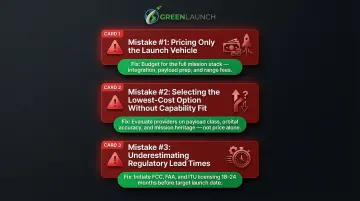
Most cost overruns in stratospheric programs aren't random — they trace back to a few consistent planning errors. Avoiding these early keeps your budget aligned with actual mission requirements:
- Pricing only the launch vehicle and ignoring integration, recovery, permitting, and data processing costs, which together often exceed the platform cost on professional missions
- Selecting the lowest-cost balloon option for missions that require altitude precision or payload recovery, then discovering mid-program that a higher-capability solution is needed — driving total costs above what a properly-scoped provider would have charged upfront
- Underestimating regulatory and range coordination lead times, which can add weeks of labor costs and delay mission windows
Getting the scope right before signing a contract is almost always cheaper than correcting it afterward.
Conclusion
The cost to launch a payload to the stratosphere ranges from under $1,000 to $300,000+ depending on launch method, payload specs, and mission support requirements. The right cost is the one that actually meets your mission's technical and regulatory needs—not simply the lowest quoted price.
That price range only makes sense when you account for every cost component — integration, range support, regulatory compliance, and recovery. Budgets that treat the launch fee as the total cost routinely run short. As propulsion technologies like light-gas systems and high-altitude balloons continue to expand the menu of viable options, research, defense, and commercial teams are better positioned to match the right method to the right mission — without overpaying for capability they don't need.
Frequently Asked Questions
How much does it cost to go to space?
"Space" (above the Kármán line at 100 km) costs significantly more than stratospheric access. Virgin Galactic charges $750,000 per seat for suborbital human spaceflight, while Blue Origin auctioned its first seat for $28 million. Unmanned stratospheric balloon missions costing in the low thousands provide far more accessible atmospheric testing environments.
How expensive is it to launch something into space?
Unmanned payload launch costs vary widely by destination. Stratospheric balloon missions start in the low thousands, while orbital small satellite launches run hundreds of thousands to millions—SpaceX's Transporter rideshare program charges $350,000 for up to 50 kg to Sun-Synchronous Orbit. The stratosphere is often used as a cost-effective precursor testing environment before committing to full orbital launch budgets.
What types of payloads can be launched to the stratosphere?
Common payload types include atmospheric sensors, scientific instruments, biological experiments, small satellite components under test, imaging systems, defense sensors, and technology demonstration packages. Modern commercial electronics can withstand forces of up to 30,000 Gs with minor modifications, making them viable candidates for high-acceleration launch profiles.
What permits or regulations are required for a stratospheric payload launch?
U.S. launches typically require:
- FAA airspace waivers under 14 CFR Part 101
- FCC licenses for radio telemetry (Experimental Radio Service or Amateur)
- Coordination with range safety authorities
Requirements vary by launch method, altitude, and payload classification. Operators must provide prelaunch notice to the nearest FAA ATC facility 6 to 24 hours before operations.
How long does it take to prepare and execute a stratospheric payload launch?
Timelines range from a few weeks for a simple balloon launch to 6–18 months for a sounding rocket or complex propulsion-based mission. NASA scientific balloon missions can be readied in roughly six months, while sounding rocket lifecycles average approximately two years from conception to launch.
What is the difference between a stratospheric launch and an orbital launch?
Stratospheric launches reach altitudes of roughly 12–50 km, remaining within Earth's atmosphere, while orbital launches must achieve sufficient velocity to sustain orbit above ~200 km. Stratospheric missions cost orders of magnitude less (thousands to hundreds of thousands vs. millions) and serve distinct purposes: atmospheric testing, sensor validation, and precursor experiments ahead of full orbital commitments.