

Introduction
Hypersonic missiles are outpacing the systems designed to stop them—and the U.S. is racing to close that gap. In January 2025, the Missile Defense Agency awarded Stratolaunch a competitive $24.7 million contract to expand America's capacity to test defenses against these weapons, which adversaries like China and Russia are deploying at an accelerating rate.
The contract addresses a specific bottleneck: U.S. testing infrastructure has struggled to keep pace with the threat. By modifying Stratolaunch's Spirit of Mojave 747 launch platform for globally deployable hypersonic test missions, the agreement enables more frequent, operationally realistic scenarios that fixed domestic ranges simply can't replicate. This article breaks down what the contract covers, what it changes for U.S. hypersonic defense testing, and why the approach matters.
Key Takeaways
- Stratolaunch received $24.7M from the Missile Defense Agency under a competitive agreement in January 2025
- Spirit of Mojave modifications will extend the Talon-A reusable hypersonic testbed's operational range
- Q4 2025 test campaign aims to demonstrate missile defense capabilities against hypersonic threats
- Hypersonic weapons challenge defenses with Mach 5+ speeds, low-altitude flight, and unpredictable maneuverability
- Contract signals a strategic shift toward commercial, reusable test infrastructure to close the testing capacity gap
The $24.7M MDA Contract: What It Covers
The Missile Defense Agency structured this award as a competitive firm-fixed-price Other Transaction (OT) agreement under solicitation HQ0860-23-S-0001—its Innovation, Science & Technology Broad Agency Announcement. Fully funded with FY2024 research, development, test, and evaluation dollars, the agreement ran from December 2024 through December 2025.
Unlike traditional Federal Acquisition Regulation (FAR)-based procurement contracts, OT agreements provide flexible acquisition authority for prototype and research efforts. This mechanism allows DoD to move faster, bypass standard procurement rules, and partner with commercial innovators who might not otherwise engage in defense contracting.
Two-Phase Project Scope
Phase 1 focuses on modifying the Spirit of Mojave 747 carrier aircraft to integrate Talon-A launch capability beyond the U.S. western coast. This modification work centers at Stratolaunch's Mojave, California headquarters and unlocks a critical operational advantage: the ability to launch Talon-A from any airport capable of accommodating a 747. This global test location flexibility was previously unavailable and enables operationally realistic test scenarios in diverse geographic environments.
Phase 2 involves an active flight test campaign, originally targeted for Q4 2025, demonstrating missile defense system performance against hypersonic targets. This campaign provides the data MDA needs to validate defensive architectures in realistic threat environments.
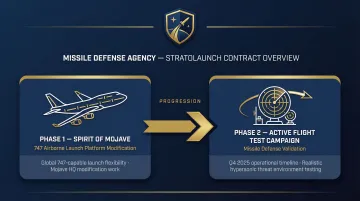
Together, these two phases represent something the DoD cannot easily replicate on its own timeline or budget.
Why This Partnership Matters
Dr. Zachary Krevor, President and CEO of Stratolaunch, emphasized the strategic value: "Stratolaunch is thrilled to provide the Missile Defense Agency with near-term, unparalleled hypersonic test capabilities using our reusable Talon-A and Spirit of Mojave platforms. This mission will enhance our national security posture, enabling rapid testing of new missile defense architectures designed to defend against hypersonic threats."
The DoD gains something it cannot easily build itself: a commercially operated, rapidly deployable, reusable hypersonic test infrastructure. Building dedicated government test systems would require years of development, billions in capital investment, and ongoing operational costs. Stratolaunch's approach builds on existing commercial aviation infrastructure and reusable testbeds, compressing timelines and reducing costs in ways a purpose-built government program could not match.
MDA Director of Systems, Targets and Countermeasures Michael Kryzak outlined the defensive challenge driving this partnership: "Hypersonic threats are difficult to detect and counter due to their speed, maneuverability, low-altitude flight paths, and unpredictable trajectories. We are pleased to partner with Stratolaunch to test our defensive architecture against these potential threats."
The Talon-A and Spirit of Mojave: Platforms Behind the Mission
Talon-A: Reusable Hypersonic Testbed
Talon-A is an autonomous, reusable hypersonic testbed designed to fly at high Mach speeds across various altitudes and flight profiles. Unlike expendable test vehicles that are destroyed after a single use, Talon-A is recovered after each flight, enabling rapid turnaround and significant cost savings. The vehicle carries customizable payload volumes and instrumentation, allowing customers to test sensors, propulsion systems, or defensive technologies in realistic hypersonic flight environments.
On March 9, 2024, Talon-A (TA-1) completed its first powered flight — demonstrating safe air-launch release from the Roc carrier aircraft, engine ignition, acceleration, sustained climb, and a controlled water landing. The vehicle reached speeds approaching Mach 5 (approximately 6,175 km/h).
Subsequent test flights advanced the reusability concept. In December 2024 and March 2025, Talon-A (TA-2) surpassed Mach 5 and completed full runway landings with prompt payload recovery—proving the system's reusability and rapid turnaround capability. According to George Rumford, Director of the DoD Test Resource Management Center, demonstrating fully recoverable vehicles helps "reduce vehicle turnaround time from months down to weeks."
Spirit of Mojave: Global Launch Flexibility
The Spirit of Mojave 747 has a unique history. Originally Virgin Atlantic's Boeing 747, it was modified by Virgin Orbit as "Cosmic Girl" to serve as a first-stage air-launch platform for orbital rockets. When Virgin Orbit ceased operations in 2023, Stratolaunch acquired the aircraft and renamed it in tribute to the Mojave aerospace community.
Stratolaunch's Roc aircraft — the world's largest plane by wingspan at 385 feet, capable of carrying payloads exceeding 500,000 lbs — offers unmatched payload capacity. The Spirit of Mojave adds a different advantage: global reach. The 747 brings:
- Operations from any airport with standard 747 infrastructure
- Geographically flexible missions that aren't tied to fixed test ranges
- Realistic test environments in regions that replicate actual threat scenarios
Why Reusability Matters for Defense Testing
Reusable test platforms reshape both the economics and pace of hypersonic development. Three advantages stand out:
- Data quality: Recovered instrumentation survives the flight, letting engineers examine hardware directly and understand what happened during the test
- Faster cycles: Weeks-long turnaround replaces months-long timelines, enabling iterative improvements that expendable vehicles can't support
- Lower costs per flight: The same testbed conducts multiple missions, spreading capital costs across many flights rather than building a new vehicle each time
Why Hypersonic Weapons Are So Hard to Counter
Hypersonic weapons travel at speeds of at least Mach 5 (approximately 3,800 mph or 6,175 km/h). They fall into two categories:
- Hypersonic Glide Vehicles (HGVs): Boosted to high altitudes by rockets before gliding unpowered to their targets
- Hypersonic Cruise Missiles (HCMs): Powered by air-breathing engines (like scramjets) throughout their flight
Both categories present fundamentally different interception challenges than ballistic missiles.
The Detection and Interception Problem
Unlike ballistic missiles that follow predictable parabolic arcs high above the atmosphere, hypersonic weapons fly at lower altitudes and can maneuver mid-flight. This low-altitude flight path keeps them below the radar horizon of many terrestrial-based sensors until late in their trajectory, severely compressing the reaction time available for point-defense systems to launch interceptors.
MDA Director Kryzak frames it plainly: hypersonic threats stack four interception problems at once.
- Speed — too fast for traditional point-defense systems to react
- Maneuverability — can evade interceptors mid-flight
- Low-altitude flight — operates inside the radar horizon
- Unpredictable trajectories — unlike the fixed arcs of ballistic missiles
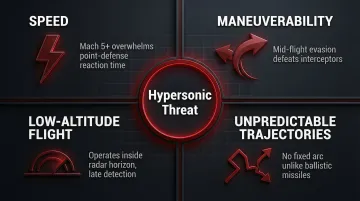
Each characteristic alone complicates interception. Combined, they create a defensive problem that existing architectures struggle to solve.
The Data Gap Problem
Without realistic, reusable test targets that replicate hypersonic threat characteristics, U.S. defensive architectures cannot be validated in operationally relevant environments. This is the gap the MDA-Stratolaunch contract addresses: providing a test capability that mimics the speed, maneuverability, and flight profiles of actual hypersonic threats.
Global Threat Context
Adversary programs have already reached operational status:
| Nation | System | Type | Status |
|---|---|---|---|
| China | DF-ZF (formerly WU-14) | HGV | Operational since 2020 (DF-17 MRBM) |
| Russia | Avangard | HGV | Operational since Dec. 2019 (SS-19 ICBM) |
Both systems were fielded before the U.S. had an operationally validated defensive response — which is exactly what the current MDA testing push aims to change.
What This Contract Means for US Hypersonic Defense Readiness
This contract's importance extends beyond a single test campaign. It establishes a commercially operated, reusable, globally mobile hypersonic test capability that can support multiple DoD customers—reducing dependence on scarce government-owned test ranges.
Addressing Systemic Capacity Shortfalls
A July 2024 Government Accountability Office (GAO) report (GAO-24-106792) identified test and evaluation capacity as a major risk to hypersonic development. The demand for ground and flight-test facilities far exceeds availability, leading to schedule conflicts and increased costs. The Congressional Research Service similarly noted that flight test schedules are continually challenged by the limited availability of flight corridors, target areas, and test support assets.
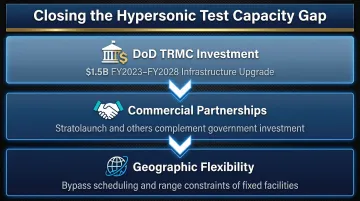
Three interconnected responses have emerged to close this gap:
- The DoD Test Resource Management Center committed $1.5 billion from FY2023 through FY2028 to upgrade and expand test infrastructure
- Commercial partnerships like Stratolaunch complement that investment rather than replace it
- Bringing in commercial providers allows DoD to work around the scheduling and geographic constraints of government-owned ranges
Alignment with DoD Priority Directives
That commercial-first approach fits directly within stated U.S. policy priorities: strengthening domestic defense manufacturing, removing barriers to deploying new technologies, and scaling hypersonic capabilities at the pace the threat environment demands. Dr. Krevor's capital raise announcement in January 2026 signals sustained institutional confidence in commercial hypersonic test infrastructure.
The Bigger Picture: America's Hypersonic Testing Ecosystem
The MDA contract is one component of a broader U.S. hypersonic investment wave. In September 2025, Stratolaunch secured a $90.8 million contract under the MACH-TB 2.0 Task 3 program to conduct multiple air-launched flight tests over two years using reusable/recoverable solutions. In January 2026, the company completed a significant capital raise with Elliott Investment Management—reportedly worth several hundred million dollars—explicitly intended to "increase production capacity of hypersonic vehicles, increase flight cadence, and pursue additional carrier aircraft."
How Air-Launch Fits the Wider Ecosystem
Air-launch hypersonic testing (Stratolaunch's model) complements a diverse ecosystem of testing modalities:
| Modality | Example Facilities | Role in Testing Ecosystem |
|---|---|---|
| Ground-Based Wind Tunnels | AEDC Hypervelocity Wind Tunnel 9 (Mach 7-14) | Validates computational fluid dynamics and aerodynamic stability |
| Arc-Heated Facilities | AEDC HEAT-H1/H2/H3 | Simulates extreme aeroheating environments to test thermal protection materials |
| Open-Air Ranges | White Sands Missile Range | Provides instrumented overland corridors for full-scale flight tests |
| Airborne Sensors | SkyRange (RQ-4 Global Hawks) | Replaces aging ship-based sensors with unmanned aircraft for persistent, global telemetry capture |
Diversifying testing modalities strengthens overall U.S. hypersonic R&D output. Wind tunnels offer controlled aerodynamic environments; open-air ranges handle full-scale flight validation. Air-launch platforms like Stratolaunch's add global deployment flexibility that neither of those can match.
Complementary Ground-Based Capabilities
Ground-based options fill gaps that air-launch platforms cannot easily address. Green Launch's hydrogen-powered light-gas systems reach velocities up to Mach 9, providing high-velocity testing for acceleration-tolerant payloads with a launch cadence of every 60-90 minutes—demonstrated at Yuma Proving Ground.
That rapid turnaround matters. Where air-launch operations require significant coordination and lead time, ground-based systems can cycle tests quickly, making them well-suited for iterative vehicle development at lower cost per test.
Frequently Asked Questions
What is the Missile Defense Agency and why is it investing in hypersonic flight testing?
The MDA is the DoD office responsible for developing and fielding missile defense systems for the U.S. and its allies. It needs realistic hypersonic targets and test environments to validate defensive systems against hypersonic threats from adversaries like China and Russia.
What is the Talon-A vehicle and how does it work?
Talon-A is Stratolaunch's autonomous, reusable hypersonic testbed that is air-launched from a carrier aircraft, flies at Mach 5+ speeds with customizable payloads, and is recovered after flight. Recovery after each flight enables rapid turnaround between test missions — a significant advantage over single-use expendable vehicles.
How does the Spirit of Mojave differ from Stratolaunch's Roc aircraft?
While Roc is the world's largest aircraft by wingspan (385 feet) with massive payload capacity (over 500,000 lbs), the Spirit of Mojave—a modified Boeing 747—offers global operational reach by launching from any 747-capable airport. This enables more geographically flexible and operationally realistic test missions.
Why are hypersonic weapons so difficult to intercept?
Hypersonic weapons combine Mach 5+ speeds with low-altitude flight, mid-flight maneuverability, and unpredictable trajectories — qualities that compress defender reaction times and defeat traditional point-defense systems. Ballistic missiles, by contrast, follow predictable high-altitude arcs that interceptors are designed to engage.
When is Stratolaunch's hypersonic test campaign under the MDA contract scheduled?
The test campaign was originally targeted for Q4 2025, following Spirit of Mojave modification work at Stratolaunch's Mojave, California facility.
What does this contract mean for the future of US hypersonic defense capability?
The contract establishes a commercially operated, reusable, mobile test infrastructure that can scale across multiple DoD programs — reducing reliance on scarce government-owned test ranges. For U.S. defense planners, that means more frequent, realistic testing against hypersonic threats without the bottlenecks of fixed facilities.