Introduction
CubeSats have put space within reach of universities, startups, and research organizations that once lacked the budget for orbital missions. As of January 2026, a total of 2,973 CubeSats have been launched globally, with 392 CubeSats launched in 2025 alone—the highest annual total to date. This rapid growth underscores how small satellite technology has opened the door for organizations that once could only dream of space missions.
Building a CubeSat can cost as little as a few thousand dollars, but the launch is consistently the largest and most misunderstood line item in any mission budget. Prices span a wide range: $0 through NASA educational grants, $50,000–$540,000 for rideshare slots, and upward of $7.5 million for a dedicated small launch vehicle.
Many first-time operators underbudget by 30–50%. They focus on the quoted launch price and miss what comes after: regulatory compliance, testing, insurance, and ground operations.
This guide covers current CubeSat launch pricing by size and method, the hidden costs beyond the quote, and how to build a realistic mission budget.
TL;DR
- CubeSat launch costs run from $0 (NASA CSLI) to $7.5M+ for dedicated vehicles; rideshare typically falls in the $50,000–$540,000 range
- Size (1U vs. 3U vs. 6U) and launch method (rideshare vs. dedicated) are the biggest cost drivers
- Hidden costs add $50,000–$200,000 beyond quoted prices: integration, compliance, testing, insurance, and ground operations
- Rideshare delivers the best value for most missions; dedicated launches only make sense for strict schedule or unique orbit requirements
- Green Launch's hydrogen-oxygen impulse systems provide a lower-cost option for acceleration-tolerant payloads, bypassing traditional rocket pricing entirely
How Much Does It Cost to Launch a CubeSat?
CubeSat launch pricing is not fixed. Costs vary significantly based on satellite size, target orbit, launch provider, and whether your mission uses rideshare or a dedicated vehicle. Teams that assume a single flat price often underbudget by 30–50%, creating funding gaps that can stall or derail projects mid-development.
The two most common budgeting mistakes are:
- Treating the quoted launch price as total mission cost — overlooking regulatory filings, pre-launch testing, insurance, and ground station access
- Choosing the cheapest slot without validating orbit compatibility — a low-priced rideshare to the wrong altitude or inclination can render your mission useless
Understanding the full picture starts with knowing how pricing breaks down by satellite size and launch method.
Pricing by CubeSat Size (Rideshare Benchmark)
Rideshare pricing scales directly with CubeSat form factor. The larger your satellite, the more you'll pay. Here are approximate rideshare launch cost ranges for standard CubeSat sizes to low Earth orbit (LEO) or sun-synchronous orbit (SSO):
- 1U (~1.3 kg): $60,000–$90,000
- 3U (~5.0 kg): $150,000–$270,000
- 6U (~10.0 kg): $300,000–$540,000
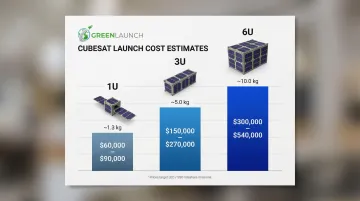
These figures are ballpark estimates. Provider-specific quotes will vary based on target orbit, launch schedule, and volume discounts. For reference, Spaceflight Inc. lists a 3U CubeSat launch at $145,000, while NanoRacks charges approximately $90,000 per 1U for ISS deployment.
Standard rideshare quotes cover dispenser integration, deployment, and basic mission coordination — but not regulatory licensing (FCC, FAA), launch insurance, pre-launch environmental testing, or ground station access.
Always confirm what's bundled before signing. Some providers offer integration and compliance support as add-ons; others leave it entirely to the customer.
Pricing by Launch Method
Once you know your satellite's size, launch method is the next variable that shapes your budget — and it goes beyond cost. Schedule control, orbit flexibility, and lead time all differ significantly across the three main tiers of the CubeSat launch market:
Budget Tier — NASA CubeSat Launch Initiative (CSLI)
Cost: $0 for qualifying entities
NASA's CSLI provides launch opportunities at no cost to U.S. educational institutions, non-profits, and NASA centers. The program covers integration and launch fees for CubeSats up to 6U, targeting specific orbital constraints such as ISS deployment or SSO orbits at or below 650 km.
Trade-offs:
- Launch windows are assigned by NASA and can be delayed 12–24+ months from selection
- Competitive application process (proposals typically due mid-November, selections announced in March)
- Two-year lead time from announcement to launch opportunity
Eligibility: U.S. accredited educational organizations, U.S. non-profits, and internal NASA projects. NASA anticipates providing updates on future CSLI opportunities in spring 2026.
Mid-Range Tier — Commercial Rideshare
Cost: $50,000–$540,000 depending on size and orbit
Commercial rideshare dominates the small satellite launch market. Providers aggregate multiple payloads onto a single launch vehicle, splitting costs across customers.
SpaceX Transporter Series
As of February 2026, SpaceX charges $350,000 for up to 50 kg to SSO, with additional mass priced at $7,000/kg — up from $5,000/kg in 2021. SpaceX runs Transporter missions every four months (3–4 launches per year), providing predictable scheduling for teams that can plan ahead.
NanoRacks ISS Deployment
For sensitive payloads, NanoRacks deploys CubeSats from the International Space Station at $90,000 per 1U. The pressurized, soft-stowed environment is gentler than direct launch integration — though you're locked into a 51.6-degree inclination at roughly 400 km altitude.
Aggregators (Spaceflight Inc., Exolaunch, Spaceflite)
Aggregators purchase bulk launch capacity and resell fixed-unit slots — often the most economical path for small CubeSats. Spaceflight Inc. pricing illustrates the scale:
- 3U: $145,000
- 6U: $295,000
- 12U: $595,000
Fixed per-unit pricing makes cost forecasting straightforward, and aggregators typically manage dispenser integration, manifesting, and launch coordination on your behalf.
Premium Tier — Dedicated Small Launch Vehicle
Cost: $7–$7.5 million per launch
Dedicated launches provide complete control over orbit, schedule, and deployment sequence. Rocket Lab's Electron starts at approximately $7.5 million per launch, with 300 kg payload capacity to LEO and 200 kg to SSO. This translates to roughly $25,000/kg to LEO.
Dedicated launches make sense only when:
- Deploying multiple CubeSats simultaneously (10+ units)
- Requiring precise, non-standard orbits
- Needing guaranteed launch dates for time-critical missions
For most small satellite operators, the cost premium is hard to justify unless the mission absolutely demands orbit or schedule flexibility that rideshare cannot provide.
Key Factors That Affect CubeSat Launch Costs
Launch pricing is shaped by a combination of physical, orbital, and mission-specific variables. Understanding each helps teams negotiate better and avoid budget surprises.
CubeSat Size and Mass
Rideshare pricing is calculated per kilogram or per unit. Larger form factors (3U, 6U, 12U) cost proportionally more. Even small mass overruns can trigger additional fees.
Example: If your 3U CubeSat exceeds its quoted mass by 500 grams, you may face a surcharge based on the provider's per-kg rate—potentially adding thousands of dollars to your invoice.
Target Orbit
Sun-synchronous orbit (SSO) and low Earth orbit (LEO) are the most common and most affordable rideshare destinations. Higher or more precise orbits carry steep cost premiums—often 200–350% above LEO rates.
Orbital cost premiums (Spaceflight Inc. published rates):
| Form Factor | LEO Price | GTO Price | Premium (LEO to GTO) |
|---|---|---|---|
| 3U | $145,000 | $650,000 | +348% |
| 6U | $295,000 | $995,000 | +237% |
| 12U | $595,000 | $1,950,000 | +227% |
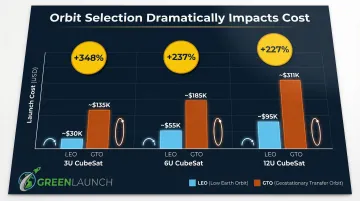
Moving a 3U CubeSat from LEO to geostationary transfer orbit (GTO) increases costs by nearly 350%. Unless your scientific use case strictly demands high-energy orbits, design for standard SSO rideshare to keep costs manageable.
Launch Provider and Vehicle Selection
Pricing varies considerably across providers:
- SpaceX Transporter: Cost-competitive for mass-efficient CubeSats; frequent launch cadence; limited orbit customization
- Rocket Lab Electron: Higher price point but offers more schedule and orbit flexibility
- Emerging alternatives: Providers like Green Launch are developing hydrogen-oxygen light-gas propulsion systems designed to offer rapid, low-cost access to orbit for acceleration-tolerant small payloads. Green Launch's system delivers payloads at approximately $220/kg ($100/lb) and can launch every 60–90 minutes, a cadence no traditional rideshare vehicle can match
Schedule flexibility and per-launch frequency matter as much as the base rate when total mission cost is on the line.
Scheduling and Slot Availability
Popular rideshare manifests (SpaceX Transporter, for example) fill quickly. Last-minute bookings or schedule changes typically carry surcharges. Dedicated launches offer more schedule control, but expect to pay a 3–5× premium over rideshare rates.
Pro tip: Book rideshare slots 6–9 months in advance to secure preferred launch windows and avoid late-booking fees.
Mission Complexity and Compliance Requirements
Missions requiring special orbits, hazardous propellants, active propulsion systems, or radio licenses must complete additional regulatory filings. Two major requirements add both time and cost:
FCC Part 5 Experimental Licensing
U.S. CubeSat operators must secure RF licensing to transmit data. The FCC Part 5 Experimental Radio Service is intended for non-federal entities conducting non-revenue generating experiments.
- Fee: $140 application fee (waived for educational and non-profit entities with IRS 501(c)(3) status)
- Timeline: File 3–6 months before launch integration, but no earlier than one year
Orbital Debris Assessment Report (ODAR)
An ODAR demonstrates your spacecraft will deorbit within the required timeframe (typically 5 years for LEO) and poses no unacceptable hazard to other orbiting assets.
- Required by: FCC (for RF licensing), FAA (for launch/reentry operations above 150 km), and NASA (for its own payloads)
- Tools: NASA's Debris Assessment Software (DAS)
- Cost: The FAA estimates approximately 10 hours of aerospace engineering time per launch. For commercial operators outsourcing this work, consulting fees range from $2,000 to $5,000 for simple CubeSat missions, scaling to $5,000–$15,000 for moderate smallsats
Some launch providers bundle compliance support as a fee-based add-on—worth factoring into provider comparisons alongside base launch rates.
Complete Cost Breakdown of a CubeSat Mission
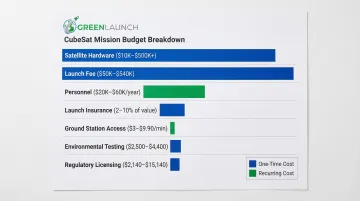
The quoted launch price is only one component of total mission cost. Budget for at least five distinct categories when planning a CubeSat program.
| Cost Category | Type | Typical Range |
|---|---|---|
| Satellite hardware & integration | One-time | $10,000–$500,000+ |
| Environmental testing | One-time | $2,500–$4,400 |
| Regulatory licensing | One-time | $2,140–$15,140 |
| Launch fee (rideshare) | One-time | $50,000–$540,000 |
| Launch insurance | One-time | 2–10% of mission value |
| Ground station access | Recurring | $3.00–$9.90/min or flat pass bundles |
| Personnel (operations) | Recurring | $20,000–$60,000/year |
Pre-Launch Costs (One-Time)
Satellite hardware and integration: $10,000–$500,000+ depending on mission complexity
Environmental testing: Vibration and thermal vacuum (TVAC) testing prove your CubeSat can survive launch forces and space temperatures. Commercial providers like Alba Orbital charge approximately $2,500–$4,400 (£2,000–£3,500 for UK-based providers like Alba Orbital) for standard testing. University facilities operate on fee-for-service models but are heavily oversubscribed—book slots 6–9 months in advance to avoid delays.
Regulatory licensing and compliance: FCC Part 5 filing ($140, waived for educational/non-profit entities) plus ODAR consulting ($2,000–$15,000)
Transportation to launch site: Shipping, insurance, and logistics for delivering your CubeSat to the integration facility. Domestic ground freight for a 1U–6U CubeSat typically runs $500–$2,000; international shipping with customs documentation can reach $5,000–$10,000.
Launch and Deployment Costs (One-Time)
Rideshare or dedicated launch fee: $50,000–$540,000 (rideshare) or $7.5M+ (dedicated)
Dispenser/deployment hardware charges: Some providers charge separately for deployment mechanisms
Launch insurance: Premiums typically run 2–5% of total mission value for rideshare missions. In high-density LEO regions, premiums can reach 5–10% due to collision risks. For low-cost, highly redundant CubeSats, universities and startups should weigh self-insurance against premium rates before committing.
Post-Launch Operating Costs (Recurring)
Ground station access: Ground Station as a Service (GSaaS) eliminates the need for dedicated antenna infrastructure. Pricing models include:
- AWS Ground Station: $9.90/min (narrowband, on-demand); $3.00/min (reserved capacity)
- Leaf Space: €2,500 (
$2,700 USD) for 150 passes (€16.67/pass)
Mission control software licensing: Tools for satellite commanding, telemetry processing, and orbit tracking. Open-source platforms (such as NASA's OpenMCT) are free but require engineering setup time; commercial options like Satsearch-listed SaaS tools typically run $5,000–$30,000/year depending on mission scope.
Personnel time: Operators, engineers, and analysts required for daily satellite operations. Small teams running a single LEO CubeSat for 12 months should budget for part-time personnel costs, which can range from $20,000–$60,000 annually depending on mission complexity.
Rideshare vs. Dedicated Launch: What's the Cost Difference?
Rideshare and dedicated launches are fundamentally different products. Rideshare offers lower cost but limited orbit control and fixed schedules. Dedicated launches offer flexibility at a much higher price. The right choice depends on mission requirements, not just budget.
Rideshare Advantages and Limitations
Advantages:
- Lower cost per kilogram
- Frequent launch cadence (SpaceX Transporter runs 3–4 times per year)
- Standardized deployment to LEO/SSO
Limitations:
- Limited orbit customization
- Shared manifest delays if another payload encounters issues
- Strict interface requirements (mass, size, outgassing, propellant restrictions)
- Fixed launch windows reserved months in advance
Dedicated Launch Case and Cost Reality
Dedicated launches make sense when:
- Deploying constellation clusters (10+ CubeSats simultaneously)
- Requiring unique orbit parameters rideshare cannot serve
- Needing guaranteed launch dates for time-critical missions
At $7M+ for Rocket Lab's Electron, a dedicated launch only approaches per-kg parity with rideshare when launching 10+ CubeSats simultaneously. Some operators use dedicated launches from smaller vehicles as a middle-ground option, but the cost premium remains substantial.
A Third Option: Ground-Based Impulse Launch
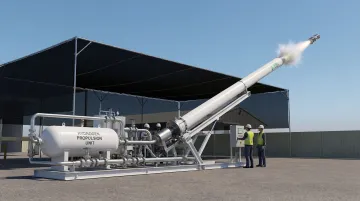
Green Launch takes a different approach entirely. Its hydrogen light-gas propulsion system uses ground-based acceleration rather than a traditional first-stage booster, delivering acceleration-tolerant CubeSats to orbit in approximately 10 minutes. The system targets a launch cadence of every 60–90 minutes at approximately $220/kg — a structure that sits outside the rideshare/dedicated binary and serves missions where turnaround speed matters more than orbit flexibility.
What Most Budget Plans Get Wrong About CubeSat Launch Costs
Focusing Only on the Launch Line Item
Many first-time CubeSat operators treat the rideshare price as the mission's total space access cost and fail to budget for regulatory compliance, pre-launch testing, insurance, and ground operations. This gap can cause projects to stall mid-development when unexpected costs arise.
Reality check: If your rideshare quote is $150,000, budget an additional $50,000–$100,000 minimum for testing, compliance, insurance, and integration support.
Underestimating Compliance and Documentation Costs
Regulatory paperwork can easily require hundreds of hours of engineering time. Even filings with no direct fee — FCC licensing, ODAR, launch provider payload safety documentation — carry real personnel costs.
For small teams without in-house regulatory expertise, common compliance expenses include:
- FCC and ODAR filings outsourced to consultants: $2,000–$15,000
- Launch provider payload safety documentation review: varies by provider
- Engineering hours for compliance coordination: often 50–200+ hours
Some launch providers offer compliance support as fee-based services — factor this into your budget planning from day one.
Choosing the Cheapest Launch Without Validating Orbit Compatibility
A lower-priced rideshare to the wrong orbital altitude or inclination can render your mission useless. Evaluate total mission value, not just launch price, when comparing providers.
Example: If your science payload requires SSO at 500 km but the cheapest rideshare delivers to 650 km, you may need additional propulsion capability to reach your target orbit. That gap can add tens of thousands in hardware and integration costs.
For acceleration-tolerant payloads, providers using non-rocket architectures — such as Green Launch's hydrogen light-gas propulsion system — can offer a cost-effective path to specific orbit profiles that traditional rideshare may not serve efficiently. The right provider isn't always the cheapest one on a price sheet; it's the one whose orbit delivery, payload tolerances, and timeline align with your mission's actual requirements.
Frequently Asked Questions
How much does it cost to launch a CubeSat?
Costs range from $0 via NASA's CSLI program (for qualifying educational institutions and non-profits) to $60,000–$540,000+ for commercial rideshare depending on satellite size, with dedicated small launch vehicles reaching $7M+. SpaceX Transporter currently charges $7,000/kg to SSO.
How much does it cost to launch a 3U CubeSat?
A 3U CubeSat launch via commercial rideshare typically costs $150,000–$270,000. The final price depends on target orbit, launch provider, and whether integration and compliance services are bundled. Spaceflight Inc. lists 3U CubeSat launches at $145,000 to LEO.
How much does CubeSat rideshare cost?
Rideshare pricing is calculated per kilogram or per unit. SpaceX's current published rate is $7,000/kg ($350,000 for up to 50 kg) to SSO; NanoRacks charges approximately $90,000 per 1U for ISS deployment. Integration, licensing, and insurance fees apply on top of the base price.
What is the cheapest way to launch a CubeSat?
NASA's CubeSat Launch Initiative offers no-cost launches to eligible educational institutions, non-profits, and NASA centers. For commercial operators, rideshare via SpaceX Transporter or aggregators like Spaceflight Inc. is the lowest-cost option, starting around $50,000 for a 1U and scaling up with satellite size.
Does NASA offer free CubeSat launches?
Yes. NASA's CSLI program provides no-cost launch opportunities to U.S. educational institutions, non-profits, and NASA centers. Slots are competitive—applications are typically due mid-November, selections announced in March, and timelines run 12–24+ months from selection to launch.
What factors make CubeSat launch costs go up?
The main cost drivers are:
- Larger satellite size or mass
- Higher or more complex target orbits (GTO, MEO, GEO)
- Dedicated rather than rideshare launch method
- Active propulsion systems requiring regulatory waivers
- Last-minute scheduling changes
Moving from LEO to GTO alone can increase costs by 200–350%.